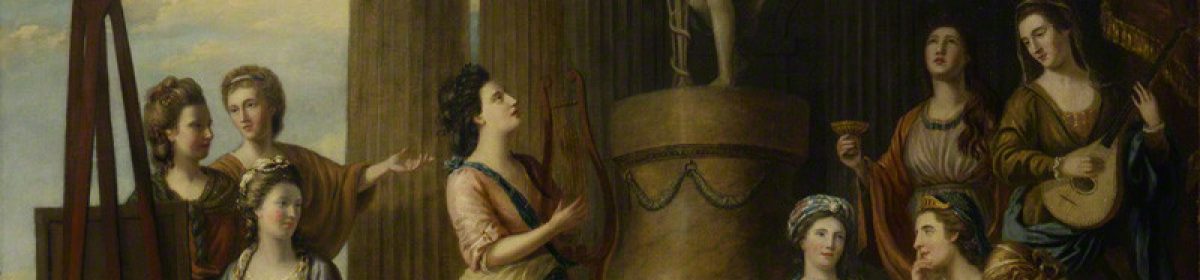
WSG’s next seminar takes place in just over a week, with papers on seventeenth-century sequestration, Mary Beale’s portraiture, and imagining the future in the (very long) eighteenth century.
Seminars take place at the Foundling Museum, 40 Brunswick Square, WC1N 1AZ, starting promptly at 1pm and finishing at 4pm. Doors open at 12.30. Directions for getting to the Museum can be found here. All seminars are free and open to the public, though refreshments will cost £2 to those who aren’t WSG members. Those attending the seminars are welcome to look round the museum before or after.
Saturday 21st January, 2017. Chair: Lois Chaber Charlotte Young: “Our Wives you find at Goldsmiths Hall”: Women and sequestration during the English Civil War. Helen Draper: Mary Beale and the Performance of Friendship. Mascha Hansen: Beyond Marriage: Envisioning the Future in Women’s Writings, 1660-1830.
The London & Southeast Romanticism Seminar, co-run by WSG member Susan Civale, is putting on a seminar series from January on “Romantic Novels 1817”. All seminars will be held at the University of Greenwich campus, starting at 6pm, and all will be free and open to the public. Please contact @reading1817 or reading1817@gmail.com for further details.
Friday 27 January 2017, Gillian Dow (Southampton/Chawton House Library) Jane Austen, Northanger Abbey
Friday 10 March, Freya Johnston (Oxford)
Thomas Love Peacock, Melincourt
Thursday 18 May, Jenny McAuley (QMUL)
William Godwin, Mandeville
Friday 21 July, Thomas McLean (Otago) Jane Porter, The Pastor’s Fire-Side
Friday 22 September, Anthony Mandal (Cardiff) Ann Hatton, Gonzalo De Baldivia
Friday 17 November, Andrw Lincoln (QMUL)
Sir Walter Scott, Rob Roy
The first WSG seminar of the academic year will shortly take place at the Foundling Museum. Directions for getting to the Museum can be found here. Doors open after 12.30pm with the session starting promptly at 1, and tea, coffee and biscuits at about 2.30pm. Seminars are free and non-members who wish to attend are very welcome but will be asked to make a donation of £2 for refreshments. Attendees are also welcome to visit the Foundling before or after the seminar and there is currently a very interesting exhibition on Handel’s singers.
For the September session organiser Carolyn Williams has put together a programme on song, play, and translation… we hope to see you there.
Saturday 17th September, 2016. Chair: TBC Brianna Elyse Robertson-Kirkland: Venanzio Rauzzini (1746 – 1810) and his female operatic students. Judith Page: Austen and Shakespeare: Mansfield Park, Shylock, and the ‘exquisite acting’ of Edmund Kean. Lucy Gent: What is becoming in Mansfield Park? Jane Austen and Cicero’s De Officiis.
In June at Mansfield College, Oxford, Ros Ballaster and Ruth Perry held the launch for their special issue of Women’s Writing, a festschrift in honour of Professor Janet Todd. WSG member Angela Escott was there to hear Janet reflect on a life in scholarship.
Front cover of Women’s Writing
WSG has had a close association with the journal Women’s Writing since its early days. The Editor, Marie Mulvey-Roberts, was a member of WSG, and she encouraged other members to contribute papers given at our Saturday sessions or annual one-day workshop. In 2010 some of us co-edited a special issue in honour of Mary Waldron, an active committee member. Now current and former WSG members are contributors to a special issue in honour of Professor Janet Todd, the pioneering scholar of Aphra Behn, Mary Wollstonecraft and Jane Austen, and a Founding (now Consultant) Editor of WW. The celebration took the form of an interview by Marie of her distinguished colleague in an imposing hall at Mansfield College, Oxford. Ros Ballaster, co-editor of the issue and fellow WSG member, hosted the event which included a reception and a banquet dinner.
Marie questioned Janet about her life and her extensive travelling both as a child and during her academic career. Janet spoke of the patronising attitudes towards women when she was a student at Cambridge University, and women were confined to three female undergraduate colleges. She told of the impossibility of choosing Mary Wollstonecraft as a PhD subject, so she wrote instead on John Clare. The only feminist theory being studied when she began her career was that of the French feminists, Irigaray, Kristeva and Cixous. Todd bravely defended Anglo-American “socio-historical” feminist criticism and also challenged the jargon of New Historicism. A pioneer in the study of women writers, Todd founded a journal Women and Literature which can be considered a forerunner to Women’s Writing.
She described the pressure under which she published her Dictionary of British and American Women Writers 1660-1800, the immense and significant project she conceived and researched extensively by herself, and she spoke self-effacingly of the number of times she had read ‘erroneously mentioned by Janet Todd’ in references to the women covered in her Dictionary. In a question about role-models she described sharing a platform with Germaine Greer who towered above her in height and whose confidence she admired. Although female networks were an important part of her own research, and Marilyn Butler was a close friend, no network of women academics existed to provide support for Janet early in her career, particularly as she was working in the USA, Ghana, Bermuda and Puerto Rica. Finally, she spoke of her recent first venture at writing fiction, and of the lack of pressure to publish at the beginning of her career. Marie ended by reminding us of the impressive publication list of this inspiring academic, including the multi-volume editions of the works of Behn, Wollstonecraft and Austen.
Want to read more? The special issue of Women’s Writing is available here, with a subscription. Ros Ballaster tweets as @BallasterRos.
Just a reminder that on 11 June at Senate House, University of London, the Women’s Studies Group annual workshop takes place and the theme this year is “Women and the Bible”.
Emma Major of the University of York is giving the keynote on Anna Letitia Barbauld, dissent and democracy during the age of revolution. To get an idea of Emma’s work, which is funded by the British Academy, you can watch this video:
WSG workshops always include a morning keynote followed by an afternoon of discussion in which all the attendees give 5-minute presentations on any research within the WSG time period relevant to the workshop theme. There is still time to register, and attendees are encouraged to bring material on any of the following topics: