Call for Papers: WSG 40th Anniversary ‘Afterlives’ Project
On 7 January 2027, it will be exactly 40 years since WSG’s first meeting. We intend to celebrate this milestone anniversary with two major collaborative events on the theme of ‘afterlives’: an online workshop, and a trade book compiled from the workshop contributions.
Our proposed theme, ‘Afterlives’, provides the potential for both expansive and reflective thinking. We could explore not only the representation of women throughout history but also WSG’s role in promoting the study of women over four decades. We’re open to a broad range of interpretations, but papers may wish to consider how women have been forgotten in posterity; the various ways in which they have been posthumously portrayed, vilified, or celebrated; and any progress (or lack thereof) in the exploration of women’s history in the past four decades.
We invite proposals for 10-minute papers. By submitting a proposal to the workshop, you confirm that you will subsequently submit your paper for publication. We will be requesting a 3,000-word mini chapter suitable for a general reader (submission date to be confirmed, probably mid-2027).
There will also be two bursary awards available for participants to conduct further research prior to their chapter submissions (applications open from October 2026 with awards announced January 2027).
Contributions should ideally be for one of the following six categories, which will form the basis of our workshop programme and book structure:
- Travelling Women
- Royal Women
- Women in Art
- Women Writers
- Scientific Women
- Religious Women
These were the most popular categories suggested in the informal expressions of interest we received from members. However, we’re open to receiving proposals on other themes, and may adjust this structure if exciting options materialise!
Please send a draft title and short proposal (maximum 350 words) by 14 August to louise@philipmarksav.co.uk and veschutte@gmail.com. The programme will be finalized by mid-September. Feel free to get in touch with any questions.
***
Previous publications by WSG include:
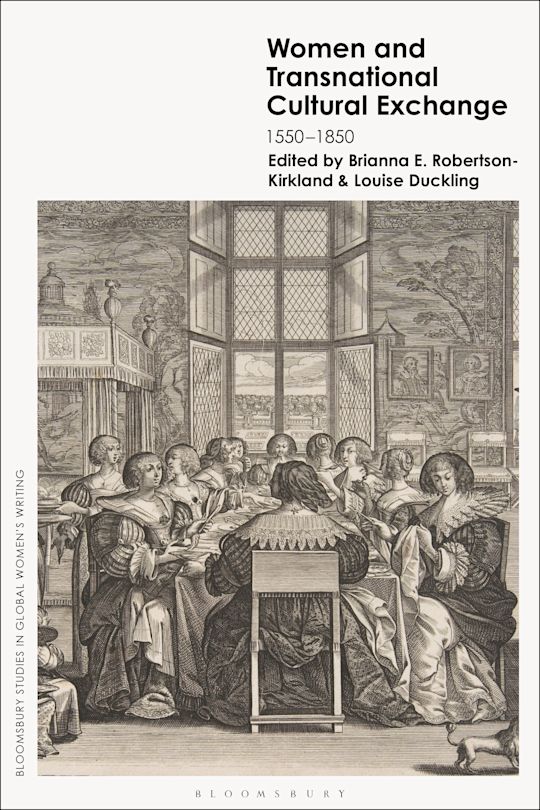
Women and Transnational Cultural Exchange 1550-1850 (Bloomsbury Academic, 2026) Hardback cover[/caption]
Women and Transnational Cultural Exchange 1550–1850
(Bloomsbury Academic, 2026)
Editors: Brianna E. Robertson-Kirkland and Louise Duckling
Hdbck: £85/Ebook: £76.50
This multidisciplinary collection has been five years in the making. It was inspired by the group’s own transnational exchanges during the Covid-19 pandemic, when the move to an online space allowed deeper engagement with an international community of scholars.
Table of contents:
Introduction. Brianna E. Robertson-Kirkland (Royal Conservatoire of Scotland, UK) and Louise Duckling (independent scholar, UK)
Prologue. Power
Postcard 1: Queen Mary I and La Peregrina, Valerie Schutte (independent scholar, US)
1. Maria Theresa and Catherine II: Women rulers transmitting unexpected gender notions far beyond their realms, Ruth Dawson (University of Hawaii at Manoa, US)
Part 1. Culture
Postcard 2: The 188-page letter-memoir: Mary Anne Canning’s life writing as a defense of her motherhood, Rachel Bynoth (Bath Spa University, UK)
2. Imagining England: Recovering Marie-Catherine d’Aulnoy’s Memoirs of the court of England (1707), Daisy Winter (Northumbria University, UK)
3. The racial politics of the Chilean family in Maria Graham’s Journal of a Residence in Chile (1824), Valentina Aparicio (Queen Mary University of London, UK)
4. “Today, two vent’rous females spread the sail”: The presence of female travelers in the works of Mariana Starke, Eva Lippold (University of Reading, UK)
Part 2. Knowledge
Postcard 3: “A new world of ideas”: Knowledge exchange in Helen Maria Williams’s translation of Alexander von Humboldt’s Personal Narrative (1814–29), Louise Duckling (independent scholar, UK)
5. Madeleine de Scudéry, Aphra Behn, and translation: Using the “Carte de Tendre” for cross-channel communication of women’s ideas, Amelia Mills (Nottingham Trent University, UK)
6. “Suns, wich to some other Worlds give Light”: Transnational philosophies of the universe in Margaret Cavendish’s poems and letters, Masuda Qureshi independent scholar, UK)
7. Science, art, and knowledge: Nancy Anne Kingsbury Wollstonecraft and the illustration of Cuban flora, Elisa Garrido Moreno (Universidad Autónoma de Madrid, Spain)
Part 3. Art
Postcard 4: Collecting travel memories: Charlotte Bonaparte’s family album, Arlene Leis (independent scholar, UK)
8. Aletheia Talbot and the art of Italy: England’s first female collector, Breeze Barrington (independent scholar, UK)
9. Back through time and beyond Britain: Revealing polytheistic imagination and British imperial resolve in Eleanor Coade’s Artificial Stone products, 1769–1821, Miriam al Jamil (independent scholar, UK)
Part 4. Music
Postcard 5: Mrs Macglashan of Jamaica, Andrew Bull (independent scholar, UK)
10. “quite different from what it is abroad”: Elizabeth Wynne’s musical exchanges, Penelope Cave (independent scholar, UK)
11. The Murrays of Warrawang: Scots in Australia, Brianna E. Robertson-Kirkland (Royal Conservatoire of Scotland, UK)
Epilogue
Postcard 6: Felicia Hemans, the Monument of Zalongo, and the “dance” of a moment in history, Trijit Acharyya (independent scholar, India)
***
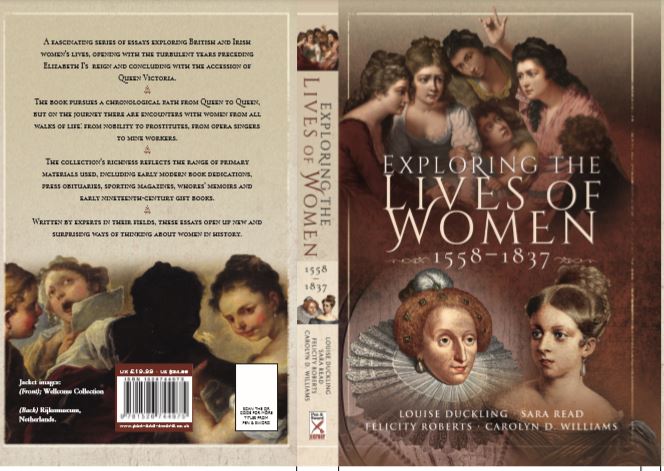
Exploring the Lives of Women, 1558-1837
(Pen & Sword books, 2018)
Principal Editors: Louise Duckling, Sara Read, Felicity Roberts, Carolyn D. Williams
Hbk £19.99; Pbk £12.99; ebook; illustrated
To celebrate its 30th Anniversary, the Women’s Studies Group 1558-1837 has gathered together contributions from its members to produce Exploring the Lives of Women, 1558-1837, a rich collection of peer-reviewed essays, providing original and thought-provoking accounts of British and Irish women in history. It also contains two original poems. The depth, range, and creativity of the essays in this book reflect the myriad interests of the group and its members.
Contributors:
- Carolyn D Williams surveys the book’s timeline, using queens to explore questions of gender, rank, and power
- Valerie Schutte examines a book dedication to Lady Jane Grey, England’s nine-day queen
- Sara Read investigates an intriguing address to readers of a breastfeeding advice tract published by a dowager Countess in 1622
- Jennifer Evans entertains with a survey of aphrodisiacs and how they connect to sexual pleasure and fertility
- Yvonne Noble reveals the challenges in researching women in history, using poet Anne Finch as a case study
- Gillian Williamson discusses obituarising women in the Gentleman’s Magazine
- Marie Mulvey Roberts explores female radicals in Bristol
- Sarah Oliver considers female sexual agency in the eighteenth-century romantic novel
- Tabitha Kenlon examines a pamphlet advising unmarried women on the dangers of ‘falling’
- Julie Peakman explores friendships between prostitutes in the eighteenth century
- Jacqueline Mulhallen celebrates an early nineteenth-century star of the stage in Eliza O’Neill and the art of acting
- Brianna E Robertson-Kirkland explores rivalry and camaraderie between two celebrated eighteenth-century opera singers
- Peter Radford reveals the physical strength and skill of female athletes and manual workers in the eighteenth century
- Marion Durnin investigates ideological control in the early nineteenth-century annual
- Louise Duckling concludes with an exploration of queens and learned ladies in nineteenth-century female biographies

Press
BBC Radio Leicester, 6 Jan 2019 (0:38:04)
BBC Radio Suffolk, 21 Jan 2019 (1:23:20)
BBC Radio Berkshire, 23 Jan 2019 (2:17:15)
Reviews
Counterfire
***
Carolyn Williams, Angela Escott and Louise Duckling (eds), Woman to Woman: Female Negotiations During the Long Eighteenth Century (University of Delaware Press, 2010)
Women Out Loud. Special issue of Women’s Writing 17:1 (2010)

