The Art of the Actress: Fashioning Identities. By Laura Engel. Review by Victoria Joule

The Art of the Actress: Fashioning Identities. By Laura Engel. Cambridge: Cambridge University Press. 2024. Pp 78. £17.00 paperback), ISBN 9781108977906.

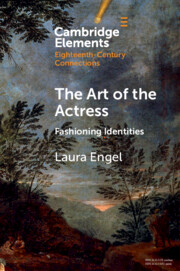
The cover image of Laura Engel’s The Art of the Actress is not of an eighteenth-century actress, but instead features the moody tones of Donato Creti’s Astronomical Observations: Comet (1711). Although not discussed within the book – indeed, Engel may not have chosen the image – the significance is clear. Set against darkening skies, the glowing comet shines out much like the actresses discussed in the text; their dazzling images and performances are moments in history that artists and actress-artists alike attempted to capture in solid form for posterity. In this book, Engel offers the reader a visually and intellectually stimulating insight into the literary, cultural and material legacy of the actress. The Art of the Actress is part of Cambridge Elements: an extensive collection of shorter academic works covering a wide range of disciplines. Engel’s work is published within the Eighteenth-Century Connections series that explores ‘connections between verbal and visual texts and the people, networks, cultures and places’ with attention to ‘oral, written and visual media’. Cambridge Elements can be purchased as affordable print or electronic editions, and some are also open access.

The paperback version of Engel’s book is about the size of a journal but lighter and softer to handle, and the cover image is beautifully reproduced. The text is divided into four parts: part one concentrates on the use of pearls in portraiture; part two is on the relationship between artist and actress; part three focuses on another material object – a muff; and part four cleverly reads the style of ‘unfinished’ art against the in/ability to capture the actress’s image. Engel effectively selects specific material objects and specific actresses to provide ‘a visual exhibition highlighting the representations, creative works, collaborations, and experiences of both well-established and lesser-known performers’ (3) in the eighteenth century. In Engel’s terms, ‘The “art” of the actress thus refers to the actress represented in art, as well as the actress’s labor and skill in making art ephemerally through performance and tangibly through objects’ (2). Throughout the study, Engel highlights the fascinating web of theatrical connections between artists and actresses, demonstrating how ‘women fashioned their identities on- and offstage, as well as how audiences perceived women in the public sphere through theatrical lenses’ (3–4).

Part one immediately establishes Engel’s aims using a piece of jewellery to observe the complex history it brings to different visual portrayals. A string of pearls can tell a story about the actress and her infiltration into the higher echelons of society, but it also conveys the pearls’ murky history in terms of slavery; furthermore, ideas about beauty and competing metaphors of virginity and sexuality show the actress’s ‘[occupation of a] precarious and significant place in the early modern world’ (18). The section concludes with a concise but fascinating examination of pearls as stage accessory in portraits of actresses, providing links between the parts they and others played.

Part two develops the concept of the actress as artist/artist as actress. With a focus on Anne Damer (amateur actress and sculptor) and Angelica Kauffman (artist), Engel demonstrates how involvement in acting had an impact on their representations of women. Engel provides an expansive backstory to a selection of portraits showing how Damer and Kauffman’s private and public lives, as well as public theatre and private theatricals – and even specific performances, costumes and contemporary fashions – fed into their artistic creations. Damer, present in the public eye as an actress, sculptor, and quite a character with her ‘dazzling, over-the-top costumes’ (38), was inevitably subject to satiric attacks. Engel provides an empowering reading of the ongoing presence of these women’s work in museums and galleries as testimony to their valuable contributions to the arts.

The penultimate section focusses on one figure and an emblematic object: Mary Anne Clarke and her strategically held muff. Clarke appeared with a huge white muff at the scandalous court case concerning her selling of army commissions to fund decoration of the house given to her by her lover, the Duke of York. Taking theory and knowledge of actresses’ self-fashioning and their contemporary reception and portrayal, Engel reads the subsequent images of Clarke in comparable ways: ‘Although Clarke was not an actress on the stage, her theatrical maneuvering and publicity stunts established her as a performer to be reckoned with’ (48). The validity of this approach is reinforced by the section on Thomas Rowlandson’s collection of prints featuring Clarke and actress Dorothy Jordan, in which Engel persuasively highlights connections between the satirical portrayals of the two women. Engel concludes with a more uplifting comment on Clarke’s later attempt to control her image through neo-classical sculpture.

To conclude, Engel effectively examines the transitory nature of performance by turning to ‘unfinished’ artwork. Engel uses a selection of Sir Thomas Lawrence’s unfinished portraits to show how they ‘are inextricably tied to the theater, an art form that is by definition fleeting, ephemeral, and open-ended’ (63). Again, Engel reveals the intricate web of theatrical connections behind and feeding into artistic works. The unfinished portraits are of the actress and playwright Elizabeth Inchbald, and of Lady Cahir who performed with Lawrence in one of Inchbald’s plays at a private theatrical. Engel extends the reading of theatrical influences on portraiture to a brief analysis of other portraits. One is ‘almost too finished’ (68) compared to the others: ‘these portraits are alive because they are not done yet’ (65).

One lasting impression this condensed book gives is just how theatrically infused culture was in the eighteenth century. Because of the impressive scope of Engel’s work in exploring the connections and conversations between artists and actresses, visual art, performances and more, there is less space at times to delve into detailed analysis and deepening of concepts, such as how the eighteenth-century actress ‘is central to understanding unfolding anxieties about nation, race, gender and heteronormativity’ (4). For example, the ‘unexpected analogy’ between an enslaved (female) child and duchess (in Duchess of Portsmouth with an Unknown Female Attendant) could be developed further using broader post-colonial studies, particularly in relation to the subsequent portrait of Nell Gwyn (with black male slave) which Engel presents as an echo (17). Sometimes the cruder, more explicit aspects of the material are left unsaid: for example, we can consider exactly how Gwyn is (erotically) ‘making’ (or stuffing or washing?) sausages and how Clarke’s muff (like Sophia Western’s in Tom Jones)is representative of female genitalia. These kinds of questions, however, also point to the effectiveness of Engel’s style, which encourages an interactive engagement. Engel often poses questions or makes references to online reproductions of portraits for readers to follow up in addition to the extensive range she discusses. I found myself setting up another device to look at these images while reading this book. I can imagine students and scholars alike being inspired to pursue new research projects. As a kind of condensed monograph, in an age when time seems to be as short as ever and new research is published rapidly, this easy-to-read book serves as a model and inspiration for future study.

Victoria Joule is an independent scholar based in Wales. Victoria has published on women’s writing of the long eighteenth century with particular attention to self-representation and literary forms. She co-edited and contributed to the essay collection with Emrys D. Jones, Intimacy and Celebrity in Eighteenth-Century Literary Culture: Public Interiors (Palgrave Macmillan, 2018).

WSG Bursary Applications now open for 2024-2025

WSG is offering a bursary of £750 to an early career researcher*, independent scholar or PhD student who is a member of the WSG. The bursary is intended to support research in any aspect of women’s studies in the period 1558-1837 for new or continuing interdisciplinary or single-discipline projects.

The deadline for bursary applications is 15 December 2024, and the successful applicant will be announced in January 2025. For further information, and to apply, please download the PDF application form here.

You can also download a Word application form.

Applications are considered by the WSG committee. The money will normally be paid on presentation of receipts. The successful applicant will be expected to give a paper at a future WSG meeting in person or via Zoom in the 2025-2026 seminar season. The contribution of the WSG bursary should be acknowledged in any resulting publications.

*Early career researcher is ‘an individual who is within eight years of the award of their PhD or within 6 years of their first academic appointment’ (AHRC).

***********

Previous Bursary Winners

  • 2024: Amy Solomons, ‘Eighteenth-century female reading experiences in historic house spaces’
  • 2023: Eleanor Bird, ‘Margaret Davy, sister-in-law of Humphrey Davy and collector of his works’ (Main Award); and Brianna Robertson-Kirkland, ‘Examining three Georgian opera singers: Elizabeth Billington, Anna Selina Storace and Gertrude Mara’ (Travel Award)
  • 2020: Anna Jamieson, ‘Spending and Shopping: Women’s Experience in the Eighteenth-Century Madhouse’ and Alexis Wolf, ‘Women Nurses and Inspectors of the Foundling Hospital, 1750-1830’ (Joint award with Foundling Museum)

The Women’s Studies Group 1558-1837 is pleased to announce the speakers for their seminar series 2024-25

The Women’s Studies Group 1558-1837 is pleased to announce the speakers for their seminar series 2024-25.

*RESCHEDULED* Our first seminar of the year will now take place on Zoom, starting at the earlier time of 5.45 for 6 pm and finishing 7.30 pm British Summer Time on Monday 14 October 2024. This first seminar features the following presentations:

Marion Wynne-Davies: Isabella Whitney and London.

Avantika Pokhriyal: The Sign of the Woman: Reading Spatial Negotiations in Betsy Thoughtless.

Emily C. Cotton: Elite Women’s Agency in Marriage Negotiations, 1742-1788.

*********

The group has two kinds of meeting for seminars.

In-person seminar meetings. These take place at the Foundling Museum, 40 Brunswick Square, WC1N 1AZ, UK, on Saturday afternoons. We will be allowed into the room at 1.00 pm, to give us time to sort out paperwork and technology, but sessions will run from 1.30 pm – 4.30 pm. Please arrive between 1.00 pm – 1.30 pm. The Foundling is a wheelchair accessible venue, and directions for getting to the Museum can be found here, including for those who are partially sighted. Seminars are free to WSG members. Non-members are welcome and are kindly requested to pay the Museum entrance fee and make a donation of £2 for refreshments. Those attending the seminars are welcome to look round the museum before or after.

ZOOM seminar meetings. These take place on Thursday evenings and will be hosted by a member of the WSG committee. They run from 7.00 pm – 8.30 pm, with the waiting room opening at 6.45 pm. Please be aware, you must be a member of the WSG to gain access to the Zoom sessions. The links are distributed through our WSG mailing list 24-hours before the event.

Download the full programme in PDF format: 

Women’s Studies Group 1558-1837, Seminar Schedule 2024-2025

Monday 14 October 2024

ZOOM STARTING AT THE EARLIER TIME OF 5.45 FOR 6 PM, FINISHING 7.30 PM, BRITISH SUMMER TIME

Marion Wynne-Davies: Isabella Whitney and London.

Avantika Pokhriyal: The Sign of the Woman: Reading Spatial Negotiations in Betsy Thoughtless.

Emily C. Cotton: Elite Women’s Agency in Marriage Negotiations, 1742-1788.

*********

Saturday 19 October 2024

FOUNDLING MUSEUM, LONDON, 1 FOR 1.30 PM, FINISHING 4.30 PM. BRITISH SUMMER TIME

Lindsey Bauer: The Women of Lucca and Costanza Bonarelli: Why Modern Scholars Cannot Place a Full-Stop after ‘Victim’.

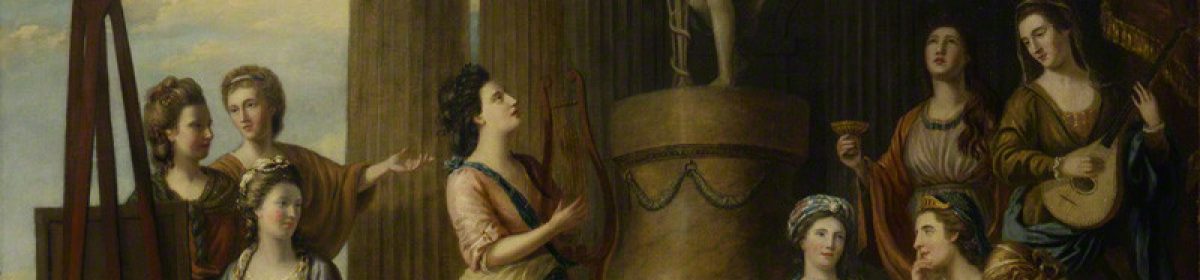
Holly Day: Recontextualising the Nine Living Muses of Great Britain.

*********

Saturday 9 November 2024

FOUNDLING MUSEUM, LONDON, 1 FOR 1.30 PM, FINISHING 4.30 PM. GREENWICH MEAN TIME.

Margarette Lincoln: Perfection: 400 Years of Women’s Quest for Beauty (Yale: Sept. 2024).

Luiza Tavares da Motta: Alchemy and Galvanism in legal theory: a look at nineteenth-century legitimation of common law through Frankenstein.

Megumi Ohsumi: Aphra Behn’s American Feathers.

Charlotte Vallis: An Empress’ Coronation: public display of gender identity for Elizabeth Petrovna, 1741-1761 and Catherine the Great, 1762-1796.

*********

Thursday January 16, 2025

ZOOM STARTING 6.45 FOR 7 PM, FINISHING 8.30 PM. GREENWICH MEAN TIME

Jasmin Bieber: Unprecedented Paths Beyond Europe: British Women’s Travel Writing 1680-1780.

Chandni (Anjali) Rampersad: Female Genius In Memoriam: Women Writers’ Afterlife in the Gentleman’s Magazine (1731-1806).

Rosalyn Sklar: Healing women: Early modern women as healers in their own texts, practices and representations.

*********

Thursday February 6, 2025

ZOOM STARTING 6.45 FOR 7 PM, FINISHING AT 8.30 PM, GREENWICH MEAN TIME

Dra. Pilar Botías Domínguez: ‘‘Masquerading! a lewd custom to debauch our youth’’: compliance and defiance in Aphra Behn’s The Rover (1677).

Amy Solomons and Elizabeth Ingham: Reconstructing Dispersed Collections: The Library of Lady Mary Wortley Montagu.

Charlotte MacKenzie: Women and knowledge making communities in Georgian Cornwall.

*********

Saturday March 15, 2025

FOUNDLING MUSEUM, LONDON, 1 FOR 1.30 PM, FINISHING 4.30 PM GREENWICH MEAN TIME

Susannah Lyon-Whaley: Small Enough to Hold: Stuart Consorts and Knowing Nature Through Cabinets, Miniatures, and Books.

Susan Bennett: ‘Fancy, Design and Taste’: Promoting female artistic talent in the 18th.century.

Valentina P Aparicio: Boundaries and Intimacy in Transatlantic Friendships: Maria Graham and Empress Maria Leopoldina.

Breeze Barrington: An introduction to the topic of her forthcoming book The Graces: The Untold Lives of the Women Who Transformed the Stuart Court.

*********

Thursday 10 April 2025

ZOOM STARTING 6.45 FOR 7 PM, FINISHING AT 8.30 PM, BRITISH SUMMER TIME

Claudia Cristell Maria Berttolini: Saint Gertrude as a female role model in 18th century Puebla de los Ángeles.

Jacqui Grainger: Mary Somerville, the United Service Museum and women of science.

Francesca Saggini: Jane Austen and the Golden Age of Crime Fiction.

For further information including abstracts, see our seminars page, or contact the organiser Carolyn D. Williams, cdwilliamslyle@aol.com. To join the WSG, see our membership page.

Summer Book Launch Event

Please join us for a special online Zoom event on Thursday 27 July, when we will be celebrating four new books by WSG members. Each author will be giving a short, informal talk about their work, followed by a Q&A session.

This event is free and open to everyone. Why not come along for some summer reading inspiration?

Reserve your place now on Eventbrite: Summer Book Launch Event – Online Tickets, Thu 27 Jul 2023 at 19:00 | Eventbrite

COME AND MEET OUR GUEST AUTHORS:

Charmian Kenner is a researcher and writer on women’s history, with a special interest in Latin America. She will discuss her free eBook Revolutionary Partners: Sarah Andrews and British campaigners for Latin American independence.

Revolutionary Partners asks: How did a young woman from Yorkshire meet a Venezuelan revolutionary in the year 1800? This is the story of Sarah Andrews and Francisco de Miranda, whose London home served as a British headquarters for the struggle to liberate Latin America from Spanish rule. Their sons Leander and Francisco took up the cause, joining many Britons who crossed the Atlantic to fight alongside Simón Bolívar or witness the dawn of a new society. All were partners in the revolution, but their contribution is little-known in Britain today, and Sarah Andrews has remained in the shadows.

Peter Radford is an Olympic medallist and world record holder, and Professor at the University of Glasgow and Brunel University. He will discuss his new monograph They Run with Surprising Swiftness: The Women Athletes of Early Modern Britain.

Sports have never been the sole preserve of men; women athletes have always been there. As this book shows, throughout the seventeenth and eighteenth centuries in Britain, women of all ages ran, fought, rode, played football, cricket, tennis, and other sports. They competed in tough, head-to-head events that required extraordinary endurance and skill. They Run with Surprising Swiftness recognizes these remarkable athletes and their achievements and aims to restore them to their rightful place in the long history of women in sport.

Sara Read is a Senior Lecturer in English at Loughborough University. Her research is in the cultural representations of women, bodies and health in the early modern era.

Her second novel The Midwife’s Truth is a sequel to The Gossips’ Choice and continues the story of midwife Lucie Smith. The birth stories, which form the backdrop to the novels, are inspired by the case notes of a Bristol midwife published in 1737. The books mix humour, compassion, and sorrow, and have been scrupulously researched.

Kim Sherwood is an award-winning author and creative writing lecturer at the University of Edinburgh. Her latest novel, A Wild and True Relation (2023), was described by Dame Hilary Mantel as “a rarity – a novel as remarkable for the vigour of the storytelling as for its literary ambition. Kim Sherwood is a writer of capacity, potency and sophistication.”

The novel opens during the Great Storm of 1703, as smuggler Tom West confronts his lover Grace for betraying him to the Revenue. Leaving Grace’s cottage in flames, he takes her orphaned daughter on board ship disguised as a boy to join his crew. But Molly, or Orlando as she must call herself, will grow up to outshine all the men of his company and seek revenge – and a legacy – all of her own.

WSG Mentoring Scheme: One week left to submit your applications in!

Scheme now open! Deadline 15th January 2021

Academia is becoming an increasingly competitive environment and some may feel at a loss when it comes to developing new research projects, producing publications, building networks and curating knowledge exchange events/resources. All of these activities are an important part of scholarly work and can help build a lucrative research portfolio (no matter the field). Yet, graduates may struggle to find specific support in these areas, especially if they do not belong to an institution.  

The WSG recognise that among its members is a diverse community with a wealth of expertise and experience, as well as those who would benefit from collegial support. With this in mind, we are implementing a mentoring scheme. The scheme hopes to pair mentees and mentors from similar fields to work together on one or more goals. A goal could be a mentee seeking advice on developing a fellowship application or a funding application, or perhaps developing a new research project, writing an article or book proposal or developing a knowledge exchange activity. We also strongly encourage mentees to work with their mentor to develop a WSG bursary application.

For further details, please see our mentoring scheme page.