Academia is becoming an increasingly competitive environment and some may feel at a loss when it comes to developing new research projects, producing publications, building networks and curating knowledge exchange events/resources. All of these activities are an important part of scholarly work and can help build a lucrative research portfolio (no matter the field). Yet, graduates may struggle to find specific support in these areas, especially if they do not belong to an institution.
The WSG recognise that among its members is a diverse community with a wealth of expertise and experience, as well as those who would benefit from collegial support. With this in mind, we are implementing a mentoring scheme. The scheme hopes to pair mentees and mentors from similar fields to work together on one or more goals. A goal could be a mentee seeking advice on developing a fellowship application or a funding application, or perhaps developing a new research project, writing an article or book proposal or developing a knowledge exchange activity. We also strongly encourage mentees to work with their mentor to develop a WSG bursary application.
Academia is becoming an increasingly competitive environment and some may feel at a loss when it comes to developing new research projects, producing publications, building networks and curating knowledge exchange events/resources. All of these activities are an important part of scholarly work and can help build a lucrative research portfolio (no matter the field). Yet, graduates may struggle to find specific support in these areas, especially if they do not belong to an institution.
The WSG recognise that among its members is a diverse community with a wealth of expertise and experience, as well as those who would benefit from collegial support. With this in mind, we are implementing a mentoring scheme. The scheme hopes to pair mentees and mentors from similar fields to work together on one or more goals. A goal could be a mentee seeking advice on developing a fellowship application or a funding application, or perhaps developing a new research project, writing an article or book proposal or developing a knowledge exchange activity. We also strongly encourage mentees to work with their mentor to develop a WSG bursary application.
Academia is becoming an increasingly competitive environment and some may feel at a loss when it comes to developing new research projects, producing publications, building networks and curating knowledge exchange events/resources. All of these activities are an important part of scholarly work and can help build a lucrative research portfolio (no matter the field). Yet, graduates may struggle to find specific support in these areas, especially if they do not belong to an institution.
The WSG recognise that among its members is a diverse community with a wealth of expertise and experience, as well as those who would benefit from collegial support. With this in mind, we are implementing a mentoring scheme. The scheme hopes to pair mentees and mentors from similar fields to work together on one or more goals. A goal could be a mentee seeking advice on developing a fellowship application or a funding application, or perhaps developing a new research project, writing an article or book proposal or developing a knowledge exchange activity. We also strongly encourage mentees to work with their mentor to develop a WSG bursary application.
In this post, Gillian Dow reflects on the life of Deirdre Le Faye (1933-2020).
The quarrels of popes and kings, with wars or pestilences, in every page; the men all so good for nothing, and hardly any women at all – it is very tiresome: and yet I often think it odd that it should be so dull, for a great deal of it must be invention.
Northanger Abbey, Volume 1, Chapter 14.
I can’t remember exactly when I talked about this passage with Deirdre Le Faye, who has died age 86. It must have been after the publication of the Cambridge University Press edition of Northanger Abbey, which she co-edited with Barbara Benedict, and which appeared in 2006, because we were talking about her work on that. It was certainly before her honorary doctorate, awarded at the University of Southampton in 2011. No matter: I remember our discussion vividly. We were sitting in the Great Hall at Chawton House, and I was quizzing Deirdre about her rejection of what she always called ‘lit crit’ (she could load the phrase with a great deal of disdain). Surely, I said, there’s a great deal of invention in biography, and perhaps even in editing? Leaving aside the destruction of Austen’s letters, and the necessary account that must be made of what’s missing, what’s there still needs to be interpreted. What of the gaps, the omissions, what of providing a reading of tone and style? “I deal in facts”, Deirdre said. And that was the end of that. The phrase ‘facts as crisp as lettuce leaves’ was one she herself used, on many occasions. It was cited in the conferment speech made at the graduation ceremony for her honorary Doctorate, which can be read here.
I knew not how to reconcile Deirdre’s very different account of what she did to what I felt was the work of biography. But on this, as on many, many other things, she and I agreed to differ.
I first met Deirdre in 2005, when I took up my position as postdoctoral research fellow at Chawton House and the University of Southampton. I got to know her well because of her constant devotion to the Chawton House Library project, and support of me, personally, in a variety of my roles there. She was thrilled that the house had been saved for the benefit of the public, and that it was a centre for the study of women’s writing, and she was delighted to be a Patron. She gave many talks at conferences and study days at Chawton House over the years, frequently causing some anxiety to the Chair of her panel because of her relaxed approach to keeping to her allotted time. When she launched her book Jane Austen’s Country Life at Chawton House in 2014, she spoke entirely without notes, and insisted on taking her watch off for the evening: I managed to coax her into finishing, but only so that we had time for questions.
Deirdre’s theme, in her talks, never really changed, and could be summed up by the keynote that she gave at the New Directions in Austen Studies conference hosted at Chawton House in 2009, the bicentenary of Jane Austen’s move to the village. Although she was saddened that new Austen letters would almost certainly never come to light, she felt convinced that new evidence about the lives of the Austen family could be found via the papers of neighbours and relations in Steventon, Chawton, Godmersham, Southampton and Bath. The conclusion to that paper – a version can be found online – was in effect a call to arms for other researchers to pick up in the archives where she had left off.
I’m certain that one of the reasons that Deirdre made this call to arms was because she had thoroughly enjoyed her own research trips over the years, and wanted others to have that same thrill of the chase. She was a committed archival researcher, hunting down information about the extended Austen family and their acquaintances in local record offices, and in the homes of Austen-family descendants, many of whom she befriended. One of her descriptions of a research trip to a family archive in the 1980s that she sent me gave a hilariously Gothic account of the visit: encountering green mould on the flag stones, and ‘lavatory paper so damp it might almost have been previously used’. She certainly relished locating her visit in the steps of Catherine Morland, as well as Austen herself.
Even after her travelling days were over, and Deirdre called on the next generation to take up the reins, one of the things that always impressed me about her was her enormous appetite for work and research from her own home. She was always working on some new article, or note, or helping another scholar with their own endeavours. Indeed, her generosity to other scholars could be remarkable – she was a great one for sending little cards and relevant anecdotes, unprompted, and she was always quick to reply to direct pleas for her assistance. But one disagreed with her at ones peril. She was extremely stern, if, for example, one raised any questions about a certain Austen portrait. That, for Deirdre, was an unmentionable topic, and it shall go unmentioned here. In my years editing the Chawton House Library newsletter The Female Spectator, I was on the receiving end of many emails which began ‘Gillian! No! It is quite incorrect to…’ Nor did I ever manage to convince her that the French women writers I was interested in myself were worth reading, although she had – in the interests of completeness, and with a grim sense of duty – read a great many that the Austen women themselves would have read.
Deirdre’s industry put most of us to shame. She was a true independent scholar, in the best sense of the words. She amused me with her accounts of her idleness too. In April 2015 – when she was, it must be remembered, already in her eighties – she wrote that it was so sunny that
I have lolled in the back garden doing nothing except read and think, instead of sitting at my desk and working! This morning so far is rather overcast, hence dolce far niente must be put aside and stern Puritan work ethic return.
We had very different ideas about what leisure was! I valued Deirdre’s friendship, and especially her correspondence, which could be full of gossip, scandal, and not-to-be-repeated comments about Austenian scholarship and Janeite devotees. She frequently had me laughing out loud at her descriptions of mutual acquaintances, and indeed her doctors in her final years. She rejoiced in being a ‘Puzzling Case’ for her medical team, turning accounts of what must have been extremely wearing and worrying appointments into amusing and carefully-crafted emails. She took being a correspondent seriously, and never forgot what my own family had been, or were due to be, doing. She never met my son, but she never failed to ask after him, or to send advice for books he might enjoy.
Deirdre’s exhaustive approach to Jane Austen’s life and work, and her devotion to those she met through her scholarship, meant that she was industrious to the very end. Although frustrated that motor neurone disease had robbed her of the power of speech, and what she called ‘the ability to appear in polite society’, she was typing until the last days of her life. Her last email to me expressed frustration with her computer system, and she turned it off to ‘let the wretched thing regain some degree of normality’. Her ‘more anon’, and ‘Love and Freindship’ are left hanging in my inbox. Cassandra-like, I censor Deirdre’s missives, whilst knowing that the Le Faye correspondence – scattered around her friends and colleagues across the world, in drawers and computers – must be prolific and contain a great many gems. It is, however, something of a comfort that her own books and papers – with their extensive marginalia, notes and ‘corrections’ – are to be held at Chawton House for the scholars of the future to deduce their own ‘facts’. Deirdre made this donation with a strong sense of her own legacy, and an even stronger wish to further the Austenian scholarship of the future. I hope that many will travel to Chawton House in her steps, and, in doing so remember a scholar whose ‘Love and Freindship’ for the library were generous to the end.
_______________________________________________
With many thanks to Dr Gillian Dow for writing this very personal obituary for the Women’s Studies Group. Gillian was also featured on a BBC Radio 4 episode of ‘Last Word’ where she spoke about Deirdre Le Faye. A link to the episode can be found here. Deirdre was very dedicated to Chawton House and donations made to them in her memory would be much appreciated.
Louise Ducklingreflects on the collegial traditions of WSG and, in particular, its history of collaborative publication, which cumulated in the launch of the group’s latest book last year.
My first encounter with the Women’s Studies Group was in 1996. I had just begun (rather ambitiously) a part-time PhD at the University of Essex while working full-time as a media analyst. My PhD supervisor was Elaine Jordan, a passionate proponent of feminism and gender studies in literature. She was also a great believer in the importance of creativity, scholarly networks and the simple pleasure of loving what you do. Unsurprisingly—given their common values—Elaine introduced me to WSG by sharing the 1996–97 seminar programme (featuring Marilyn Butler and Jacqueline Labbe as speakers) and subsequently keeping me up to date with group events. I was finally able to become an active WSG member, following a career change, in January 2001.
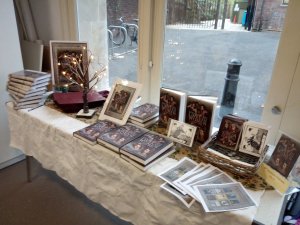
Exploring the Lives of Women on display at the book launch in Dec 2018
One of the earliest seminars that I attended was in June 2001 and the speaker was WSG committee member Mary Waldron. The paper was auspiciously entitled “A Very Different Kind of Patronage: Ann Yearsley’s New Friends”; within a year, Mary had become a new friend and a special kind of patron to me. As a Visiting Fellow at the University of Essex, Mary wanted to be of practical use in the department and so, in 2002, I acquired an additional informal supervisor. I gained enormously—as did so many of us at WSG—from her incisive comments and breadth of knowledge.
Mary’s support encapsulated the generosity of the group and its community spirit. By May 2003, when I was invited to join the organising committee, I naturally welcomed the opportunity to give back something in return. During my time on the committee (2003–2017) there were some exciting changes within the group. In 2003, WSG hosted the first of its popular workshops (with keynote speaker Helen King talking on “The Reproductive Cycle: Menstruation, Pregnancy, Childbirth and Lactation”) and the seminar programme was relaunched (with fewer sessions featuring multiple speakers). For my own part, I really enjoyed sharing some of the skills gleaned from my professional life in marketing, working on publicity for the group and establishing an online presence.
Over its thirty year history, the WSG has continually evolved; however, its core commitment has always been to support and promote the work of its members and this fact is evident in the group’s history of collaborative publication. Our edited essay collections, in book and journal form, provide a permanent record of the group’s activities and showcase our members’ research. In each volume, the majority of articles were first given as papers at WSG events, augmented with contributions by other group members responding to our internal calls for papers.
The first publication was a special issue of Women’s Writing (Volume 8, 2001 – Issue 2, introduced by Carol Banks and Anne Kelley). This project evolved from WSG’s 1998 Day School on “The Body and Women” and featured a wide range of topics, ranging from Elaine Hobby on midwifery to Myra Cottingham on Felicia Hemans’s “dead and dying bodies”. When Mary Waldron died, in 2006, Carolyn D. Williams was the energetic catalyst for two further publications that were inspired by and dedicated to Mary. The first of these emerged from the 2008 workshop and was another special issue of Women’s Writing, this time celebrating “edgy” women (Volume 17, 2010 – Issue 1: Women Out Loud, with managing editors Vicki Joule, Daniel Grey and Sarah Oliver). It included some fabulous characters, including two articles (by Kerri Andrews and Claire Knowles) on the subject of Mary’s research, the labouring-class ‘milkmaid poet’ Ann Yearsley. The second festschrift for Mary was Woman to Woman: Female Negotiations During the Long Eighteenth Century (University of Delaware Press, 2010), which I had the great pleasure of co-editing with Carolyn D. Williams and Angela Escott. Fittingly, for a work by WSG dedicated to Mary Waldron, the book’s theme was female collaboration. The essays were grouped into three core themes—family alliances, friends and companions, adventurous women—and included contributions from Jennie Batchelor and Judith Hawley.
We enjoyed two memorable launch events for our 2010 publications, with Ron Waldron (Mary’s husband) attending as guest of honour. The Women’s Writing special issue was launched at a champagne reception in June 2010 at Lucy Cavendish College in Cambridge, hosted by the journal’s co-founders Janet Todd and Marie Mulvey Roberts to coincide with their “Celebrating Women’s Writing” conference. It was wonderful that so many WSG members were able to attend, given the long association between the group and the journal. In October 2010 Lois Chaber hosted another splendid gathering for WSG members at her London home to mark the publication of Woman to Woman.
By a fortunate stroke of serendipity, the ideas for these publishing ventures were conceived around the time of WSG’s tenth and twentieth birthdays. However, in 2016—with our thirtieth anniversary approaching—Sara Read proposed a deliberate strategy: to officially celebrate this important milestone in print. The result was our latest book, Exploring the Lives of Women, 1558–1837 (Pen & Sword History, 2018), a rich collection of essays sourced from WSG members and edited by myself, Sara Read, Felicity Roberts and Carolyn D. Williams.
As Carolyn notes, ‘the thirtieth year has a particularly organic appeal, because it measures a generation’ (Introduction, Exploring, p.xix). As a celebration of the group’s ability to survive and thrive over its thirty-year existence, the editorial objective of the book was to reflect the essential qualities of WSG and the many and varied interests of our members. Unlike our previous publications, which focused on a single theme, it therefore provides an expansive, wide-ranging view of women from all walks of life—featuring opera singers and mine workers, queens and prostitutes—within an accessible and affordable volume.
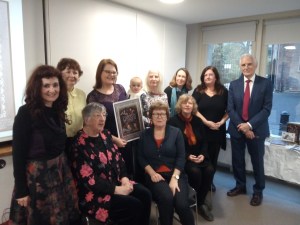
On December 8, 2018, Exploring the Lives of Womenwas formally launched at WSG’s thirtieth anniversary seminar at The Foundling Museum, London. This was a convivial and inclusive occasion, with attendees aged from 8 months to 80 years old and guests travelling from as far afield as the US. The one great sadness was that one of our authors, long-term member Marion Durnin, died very shortly before the event. The seminar was a timely opportunity to remember and celebrate Marion’s significant contribution to WSG and to the book (which includes her last published work) in the company of her husband Kevin and son Owen.
While the launch provided an opportunity to reflect upon and commemorate the group’s history and achievements over a generation, the key theme of the event was “Women’s and Gender Studies in 2018 and Beyond”. This focus reflects WSG’s forward-thinking philosophy, equally evident in the decision to use all proceeds from sales of the book to fund the group’s popular bursary scheme, thereby supporting future research in the field.
I was privileged to open the event with anillustrated talk,describing how the editorial team sourced the public domain images included in the book’s generous plate section, before using these images to describe and celebrate each author’s contribution. The next paper was delivered by our guest speaker Professor Bernadette Andrea(University of California, SantaBarbara). An expert on English women and Islam in early modern English literature, Bernadette introduced us to a unique narrative: Elizabeth Marsh’s The Female Captive(1769), the first full-length account of Maghrebian captivity written by an Englishwoman. Bernadette provided close readings from the text to illustrate Marsh’s “sartorial negotiations” which delicately balance her abjection as a female English captive with her apparent assimilation to Moroccan gender norms. The final speaker, Felicity Roberts, provided a stimulating and thought-provoking talk on the issue of precarity in academia, considering issues relating to gender and marginalisation, alongside a personal and polemical view on the practical ways in which WSG could provide enhanced support to its members in the future.
One of the emerging trends within the group has been its desire to embrace the creativity of our members, demonstrated perfectly by WSG’s very first creative seminar scheduled for August 2019. This tendency is also reflected in Exploring the Lives of Women, which features two poems: ‘Gretchen’s Answer’ by Tabitha Kenlon and ‘Stilts’ by author and performer Jacqueline Mulhallen. At our thirtieth anniversary event, Jacqueline entertained us all with a recital of ‘Stilts’: this was recorded by William Alderson and we are delighted to be able to share a video of the performance.
To conclude the event, it was fitting that the final words should be reserved for the personal reminiscences of long-term supporter Lois Chaber, who gave an honest and entertaining account of her life within the group and its evolution, and WSG founder member Yvonne Noble. Yvonne Noble wonderfully described how and why the WSG was founded as a support network, and urged us all to continue to work together to support the group and reach out to those who may benefit from its collegial spirit.
When I was urged to join WSG, almost twenty years ago, I expected to find friendship and community. Yet professionally and intellectually it has exceeded my expectations. As an independent scholar, WSG has given me an unrivalled opportunity to publish my own work, collaborate with others and benefit from the significant skills, knowledge and experience of my co-editors. WSG will continue to flourish in the coming decade and I am certain there will be plenty to celebrate in its fortieth year–and perhaps there will even be another book?
 On December 8, 2018, Exploring the Lives of Womenwas formally launched at WSG’s thirtieth anniversary seminar at
