Call for Papers: Adapting the Tudors: From Novels to Film to Public History

WSG member and historian Valerie Schutte is co-editing an exciting new two-volume collection with Jessica S. Hower and William B. Robison that explores how the Tudor period has been adapted across various media and forms. This timely collection comes as Tudor-themed adaptations continue to captivate audiences, from the National Portrait Gallery’s recent Six Lives exhibition to new screen productions like Firebrand and Shardlake.

The editors welcome submissions examining any aspect of Tudor adaptation, from historical novels and screen adaptations to museum exhibits and heritage sites. The collection aims to investigate how history is adapted for public audiences and what these adaptations reveal about both the Tudor period and the times in which they were created.

Potential topics include, but are not limited to:

  • Historical novelists and their works, focused on the Tudor period
  • Screen adaptations of Tudor-themed novels
  • Theatrical adaptations
  • Historians who have ventured into historical fiction
  • Museum exhibitions and heritage sites
  • Digital adaptations, including virtual exhibitions and video games

Submission Guidelines:

  • Abstract length: 250-300 words
  • Chapter length: approximately 7,500 words
  • Deadline: Friday, 31 January 2025
  • Full contributions due: early 2026
  • Please include a brief academic CV (max 3 pages)

Submit abstracts to all three co-editors:

This collection promises to be an essential resource for academics, students, and enthusiasts of Tudor history and its contemporary interpretations.

For the complete CFP and further details, please see the full CFP: Adapting the Tudors

Do not miss this opportunity to contribute to this significant collection—remember to submit your abstract by Friday, 31 January 2025.

Great explorations: a fictional midwife and fictions of ideal women by Louise Duckling

Following on from the arrival of WSG’s anniversary volume in paperback format, Louise Duckling introduces new books launched by two of its contributors: Sara Read and Tabitha Kenlon.

_________________________________________________________ 

On an autumnal evening last September, a small crowd gathered at Harris & Harris Books in Clare, Suffolk, for one of its popular Author on the Stairs events. Gillian Williamson and I had been invited to talk about WSG’s anniversary book, Exploring the Lives of Women, 1558–1837, which had recently been released in paperback format.

As one of the book’s editors, I wanted to convey the scope and originality of our authors’ contributions in my talk. Therefore, I chose to address the question: why had so many of the women featured in the book been left out of the historical record? I considered how women’s history was constructed (and gendered) in Victorian biographical dictionaries, using our ‘bookend’ queens Elizabeth I and Victoria as opening case studies, before introducing some of the women whose lives are explored in our anniversary volume.

This approach led neatly into Gillian’s talk about her chapter on the Gentleman’s Magazine. Gillian eloquently described how the magazine constructed ideas of gender in the eighteenth century, specifically referencing the emergence of obituaries in its pages. The obituaries were used by Gillian (with some brilliant flashes of humour) to show how femininity was framed in the Gentleman’s Magazine, while also providing glimpses of a less-neatly gendered society.

There was an opportunity for the audience to ask questions and handle some of our original source material – an 1866 edition of a female biographical dictionary and an early volume of the Gentleman’s Magazine­. We enjoyed lively discussion and hospitality, in the perfect setting of an independent bookshop. Reflecting on this evening, in such an intimate and sociable environment, it is clear we were very fortunate. For anyone releasing a book right now, any ‘in-person’ events or celebrations will have to wait. This is exactly the case for two of our book’s contributors, whose latest work has been published during the lockdown.

The first of these new books is by Dr Sara Read, who specialises in cultural and literary representations of women, reproduction and medicine in the early modern period. Sara played a pivotal role in the WSG book, serving as both co-editor and contributor, with her chapter focusing on The Countesse of Lincolnes Nurserie (1622) by Elizabeth Clinton and highlighting views around childcare and breastfeeding. In her latest work, Sara continues to draw upon this rich subject knowledge, while venturing into new territory: the genre of historical fiction.

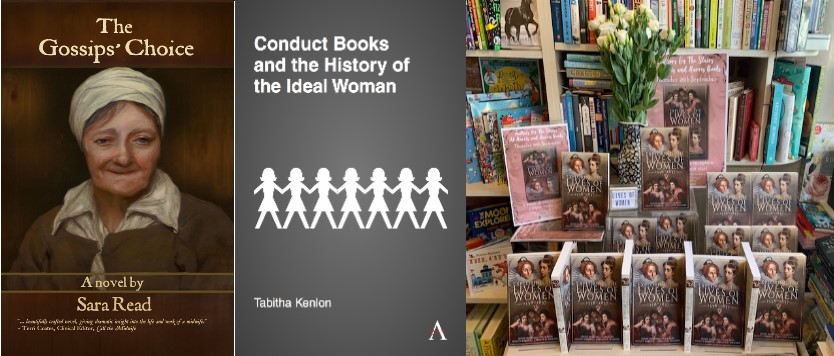
In her excellent debut novel, The Gossips’ Choice, Sara has created an atmospheric world for her protagonist, the midwife Lucie Smith. The book has been described as a seventeenth-century version of ‘Call the Midwife’, as we follow Lucie’s cases during the plague year of 1665. It is a beautifully crafted and impeccably researched novel, drawing upon a wide range of historical sources. For example, some of the events in the book are inspired by A Complete Practice of Midwifery (1737), the memoir of midwife Sarah Stone. This approach provides authentic detail to a vividly imagined and compelling story.

The second new book release is by Dr Tabitha Kenlon. Tabitha’s research concentrates on eighteenth-century British novels, theatre, and conduct manuals. In Exploring the Lives of Women, Tabitha’s chapter provides a close reading of a single text, exposing the confused rhetoric in the cautionary pamphlet Advice to Unmarried Women (1791) written by an anonymous clergyman. Tabitha also contributed one of the two poems in our book, ‘Gretchen’s Answer’, which follows similar themes by exploring the consequences of “when society tells women how to think, how to act, how to feel” (Exploring, p. 98).

Tabitha’s first monograph continues this investigation. In Conduct Books and the History of the Ideal Woman, Tabitha shows how the longest-running war is the battle over how women should behave. This is an exceptional study, being the first of its kind to provide a trans-historical approach: expanding upon previous period-specific studies, Tabitha considers the persistence (or alteration) of the female ideal over six centuries. Tabitha’s brilliant close readings of a wide range of texts are superbly executed and entertaining, making the book highly accessible to the specialist or general reader. It is a powerful book, written with compassion and flashes of anger, in an elegant and witty prose.

Until we can all meet to celebrate, congratulations to Sara and Tabitha for producing two great books. Full reviews of both publications will appear on this website in the coming months: watch this space!

____________________________________________

The Gossips’ Choice by Sara Read is published by Wild Pressed Books for £12.

Conduct Books and the History of the Ideal Woman by Tabitha Kenlon is published by Anthem Press for £80 (hardback) and £25 (ebook). Please ask your institutional library to buy a copy. A 20% discount is available to WSG members.

Exploring the Lives of Women, 1558–1837, the anniversary book by WSG, is published by Pen & Sword Books for £19.99 (hardback), £12.99 (paperback) and £5.20 (ebook).

Please support your local independent booksellers if you can. Harris & Harris Books is currently offering a delivery service.
Valerie Schutte: 500th anniversary of Mary I

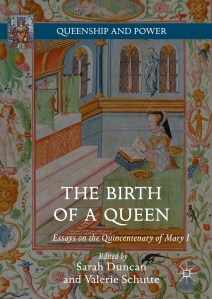
Sarah Duncan and Valerie Schutte (eds), front cover, Birth of a Queen (Palgrave Macmillan, 2016)

Independent historian and WSG member Valerie Schutte and her co-author Sarah Duncan have edited a new collection of essays on Queen Mary I for the 500th anniversary of her birth in 1516.  Entitled The Birth of a Queen, the collection reflects on Mary’s life, tumultuous reign, death and “cultural afterlife”.

Valerie has spoken at previous WSG seminars and her book Mary I and the Art of Book Dedications was also published by Palgrave in its Queenship and Power series earlier this year.  She’ll be talking about aspects of her work in the next WSG seminar, at the Foundling Museum on 19th November 2016, along with Emma Newport on Sarah Sophia Banks and Chrisy Dennis on Mary Robinson.

Helen Draper: Mary Beale’s self-portraits

During the WSG’s recent trip to the Geffrye Museum, member Helen Draper gave a talk about the seventeenth-century artist Mary Beale.  She writes more below.

As already described so beautifully by Miriam Al Jamil, members of the WSG met for this year’s annual outing at East London’s Geffrye Museum, an institution devoted mainly to the study and representation of England’s middle classes from 1600 the present day. A particularly interesting example of a middling family of the mid- to late-seventeenth century, that of artist Mary Beale, is represented in the collection by a very novel object. Beale’s Self-portrait with her husband and son (c.1660, oil on canvas, 63.5 x 76.2 cm) is the earliest of her firmly attributed works, and in it she put a daring new slant on a well established male genre – that of the artist’s self-portrait with his family. At first glance this slightly sombre yet affecting portrait appears too small and unassuming to be of revolutionary importance in the canon of British art history, yet in it Mary very purposefully placed herself, a virtuous Christian wife and mother, in the role of creator, the author of her own and her family’s painted biography.

Mary Cradock (1633-99), born the daughter of a clergyman in the hamlet of Barrow in Suffolk, married Charles Beale (1632-1705) in 1652 just days before her father’s untimely death left her an orphan. By 1654 the couple and their newborn son, Bartholomew ‘Batt’ Beale, were living in Covent Garden, the centre of metropolitan art production and patronage during the Interregnum. Mary’s near neighbours included fellow artists Peter Lely (d.1680), who prospered and went on to become Court Painter to Charles II, and the innovative Joan Carlile (d.1679) who was engaged in what proved to be an abortive strategy to earn a ‘fortune’ as a society portraitist. In 1658, when Charles Beale was appointed Deputy Patents Clerk, the family moved eastwards to occupy the Patents Office house in Hind Court, a narrow alley off Fleet St and just ‘Without’ the London Wall. It was in that house – full of family, lodgers and servants – that Mary made her way upstairs to her top floor studio to paint the triple, perhaps quadruple, portrait now at the Geffrye Museum. I have suggested elsewhere that it is entirely possible that the artist was pregnant with her son Charles at the time, and that the space in the portrait between her, her husband and young Batt alludes to the other member of the family who was at once absent and present.

When, in 1665, plague spread through the city the Beales swapped their cramped little street for five years on a smallholding in Allbrook, Hampshire. Although we know little of Mary’s painterly activities in the countryside, brief references confirm that she continued to work, while Charles prepared her canvases. During their sojourn Mary Beale painted her second surviving Self-portrait (c.1666, oil on canvas, 109.2 x 87.6 cm, NPG), this time openly in the guise of an artist with her palette hanging on the wall nearby, and as mother to two young children who appear as the subjects of a small double portrait held at her side. Here Beale is again gently subversive, playing with the concept of likeness and asserting her power to create progeny in paint as well as flesh – an undeniable advantage over her male colleagues, and one shared by many women artists through the centuries.

In 1670/1 the family left their rural idyll and returned to London, this time as householders in a newly built terrace of well-to-do middling homes on the north side of Pall Mall. It was there, a stone’s throw from the mansions of St James’s Square and Charles II’s palace, that Mary Beale established the fully professional portrait studio in which she created fashionable likenesses of patrons who were stalwarts of Court, County and the City. Mary also found time to paint several other self-portraits, and dozens of gradually ageing studies of her husband Charles. Her last known ‘selfie’ (c.1681, oil on bed ticking, 121.9 x 104.1 cm, private collection) painted when she was almost fifty, shows a self-possessed woman, well, but not opulently dressed, a pet spaniel by her side. Echoing the still, interrogative gaze of the earlier images, her expression in this portrait is again characteristic of the inner three-way visual conversation being conducted between Beale the creator, subject and viewer of her own likeness.

Helen is a conservator and is currently completing a PhD thesis on Mary Beale part-time at the Courtauld Institute and IHR. You can read more about her work on her very elegant website, www.draperconservation.com.

Women’s Writing special issue on Janet Todd launch

In June at Mansfield College, Oxford, Ros Ballaster and Ruth Perry held the launch for their special issue of Women’s Writing, a festschrift in honour of Professor Janet Todd.  WSG member Angela Escott was there to hear Janet reflect on a life in scholarship.

Front cover of Women's Writing
Front cover of Women’s Writing

WSG has had a close association with the journal Women’s Writing since its early days. The Editor, Marie Mulvey-Roberts, was a member of WSG, and she encouraged other members to contribute papers given at our Saturday sessions or annual one-day workshop. In 2010 some of us co-edited a special issue in honour of Mary Waldron, an active committee member. Now current and former WSG members are contributors to a special issue in honour of Professor Janet Todd, the pioneering scholar of Aphra Behn, Mary Wollstonecraft and Jane Austen, and a Founding (now Consultant) Editor of WW. The celebration took the form of an interview by Marie of her distinguished colleague in an imposing hall at Mansfield College, Oxford. Ros Ballaster, co-editor of the issue and fellow WSG member, hosted the event which included a reception and a banquet dinner.

Marie questioned Janet about her life and her extensive travelling both as a child and during her academic career. Janet spoke of the patronising attitudes towards women when she was a student at Cambridge University, and women were confined to three female undergraduate colleges. She told of the impossibility of choosing Mary Wollstonecraft as a PhD subject, so she wrote instead on John Clare. The only feminist theory being studied when she began her career was that of the French feminists, Irigaray, Kristeva and Cixous. Todd bravely defended Anglo-American “socio-historical” feminist criticism and also challenged the jargon of New Historicism. A pioneer in the study of women writers, Todd founded a journal Women and Literature which can be considered a forerunner to Women’s Writing.

She described the pressure under which she published her Dictionary of British and American Women Writers 1660-1800, the immense and significant project she conceived and researched extensively by herself, and she spoke self-effacingly of the number of times she had read ‘erroneously mentioned by Janet Todd’ in references to the women covered in her Dictionary. In a question about role-models she described sharing a platform with Germaine Greer who towered above her in height and whose confidence she admired. Although female networks were an important part of her own research, and Marilyn Butler was a close friend, no network of women academics existed to provide support for Janet early in her career, particularly as she was working in the USA, Ghana, Bermuda and Puerto Rica. Finally, she spoke of her recent first venture at writing fiction, and of the lack of pressure to publish at the beginning of her career. Marie ended by reminding us of the impressive publication list of this inspiring academic, including the multi-volume editions of the works of Behn, Wollstonecraft and Austen.

Want to read more? The special issue of Women’s Writing is available here, with a subscription.  Ros Ballaster tweets as @BallasterRos.