The title of this superbly illustrated book ostensibly indicates an overview of a specific group of royal portraits, produced over the course of three hundred years. An unusual focus on consorts who united the Danish and British royal families through marriage reveals the deep bonds between European dynasties, but also presents exemplary models for the author’s argument across otherwise broad and unmanageable periods of time. The book remains disciplined and centred, while at the same time offering a variety of evidence and new readings to make it a compelling and authoritative contribution to art history and visual culture. The chosen cover image, if unfamiliar to the reader, is assumed to represent one of these royal individuals in eighteenth-century military costume and with all the expected accoutrements of assertive might and power. However, it is soon revealed to encapsulate the far more complex narrative of the book. It subverts our expectations and challenges us to reassess what a portrait can tell us.
The 1770 portrait by Peder Als shows Caroline Matilda of Great Britain (1751–1775), the daughter of Frederick, Prince of Wales and Princess Augusta of Saxe-Gotha, who was married to King Christian VII of Denmark. She wears the uniform of the Life Guards, with red coat, sash and spurs, and sword at her side, about to take her tricorn hat from the table and to stride out through an arched doorway to inspect a line of soldiers drawn to attention in the courtyard. Her story forms chapter four of the book. By then, the reader has followed the writer’s close readings of three other consort portraits and traced the postures, settings and iconography which connect them to tell a history of transformation in the art of embodying the royal image (p. 10). The portrayal of rank shifted into one based exclusively on gender, a shift which affects our ability to understand and interpret a portrait even today. The argument is original and intriguing, underscored by research references drawn from a broad range of visual culture and historical sources, in particular Walter Benjamin’s writings on the work of art in an age of technological reproducibility. The argument relies on detailed observation to find new connections. Of the five Danish royal consort subjects of this study, only one, Prince George of Denmark (1653–1708), is male, but the book aims to explore how the royal image “rhetorically incorporated the most functional, symbolic qualities of maleness and femaleness” (p.22). It centres on uncovering the “complex palimpsest” of royal portraiture as embodiment, centring on the 1617 Paul van Somer portrait of Anne of Denmark (Royal Collection Trust) as its starting point.
Anne’s full-length portrait incorporates elements of the traditional male hunting portrait, the horse, dogs and distant view of a royal palace and park, as part of her self-fashioning. It was importantly designed to “instruct and nurture” (p.44) her son Charles in the noble and princely arts necessary for kingship. Charles I’s dismounted equestrian portrait by Anthony van Dyck, dated to c.1635, can be construed as a pendant. The crooked elbow which features in these and later royal portraits is an important sign derived from emblem book symbols of female perfection. When added to examples of extended elbows in male portraits suggesting greater male heat and virility, a feature of the ancient four humours medical theory, it is clear that there was more gender fluidity and layered meaning in the royal portrait than we might have realised.
The book explores the construction of royal embodiment and its image through the physical nature of the medium. The discussion on Prince George of Denmark centres on his youthful Grand Tour which included England on its itinerary, and the shaping of a cultured and refined royal figure. The wax medium used for the clothed and wigged waxwork of the young prince by Antoine Benoist (undated), now in Rosenborg Palace, Copenhagen, indicates the pliable mind of the prince as he was prepared for a role of power. The advances in scientific and Cartesian methodology, while essential elements of a modern royal education, changed the nature of royal embodiment. Louisa (1724–1751), daughter of George II, married Crown Prince Frederick V of Denmark-Norway. Her death during a late stage in pregnancy was followed by an autopsy which her doctors described in detail, changing the sacral body into a pathological case study. As the author notes,“The artisanal epistemology that had been the province of the consort and the artist as they together crafted the contours of the royal body as a work of art now became the property of the man of medical sciences” (p.80). The work of the anatomist reinforced the changing balance of power and the female body was laid open to a newly authorised male gaze.
The final two chapters consolidate the narrative of change. The author offers a new interpretation of a scurrilous woodcut lampoon of Caroline Matilda, printed in 1772, which “heralds the hygienic exclusion of the influence of women from political, public life, regardless of their rank, and their exile en masse to the seclusion of the domestic sphere” (p.88). The crude woodcut shows the queen on horseback, alongside a nurse holding her baby, and a male figure looking out of a window. The queen is construed as an “unnatural, sexually incontinent woman” (p.87) in the tradition of world turned upside down satire. The author suggests that the nurse represents the king, “left holding the baby” (p.89), the offspring of the queen’s affair with Johann Friedrich Struensee, the king’s doctor and prime minister. The threat to the royal bloodline at the centre of the print and the failure of masculine authority is embodied in the subversive and unruly woman. However, the king approved of Caroline’s wearing male attire, so contrary to a simple reading of the satire, the author suggests “the queen’s transvestism [is] a performative fall into masculinity responding to the king’s desire”, and a form of “sympathetic magic of mimesis” which constitutes the “body of the absolute king for him” (p.100–101). This reading questions and complicates the satire, based on traditional forms of unruly female representation and possible interpretations. However, the final example of consort portraiture is taken from an age of reproduction by means of photography. The narrative was reinvented for a new audience with irreconcilable binary gendered expectations determining its reception.
Alexandra of Denmark (1844–1925) married Albert Edward, Prince of Wales, later Edward VII, in 1863. Her elaborate reception in the capital “created a topological phantasmagoria within which ancient ceremony and industrial modernity comingled” (p.113). The rise of the carte de visite form popularised the image of the consort but also enabled comparisons and imitations in its mass availability and reproducibility. Following this, “fashion and the photographic image” defined the image of the consort and made her “a visual commodity”, a development that has ultimately made the represented female body “simultaneously object and abject” (p.128). Though beyond the scope of the book, clear contemporary examples can be found in the consorts of the current British royal family. The book does not falter in its structured and thorough exploration. Each chapter contributes new material and builds on its central premise of change over several centuries. However, while the title is precise, the breadth of the subject may not be anticipated by the browser in a library or book shop. But the book is a rewarding study as part of the Northern Lights book series, and the portraits examined cannot be seen in isolation again.
Miriam Al Jamil is on the WSG committee, chairs the Burney Society UK, and is Fine Arts editor for BSECS Criticks online reviews. She has published on women travel writers, Horace Mann and his circle in Florence and Rome, on Frances Burney, and on Eleanor Coade. There will be a chapter on Coade in the forthcoming WSG book.
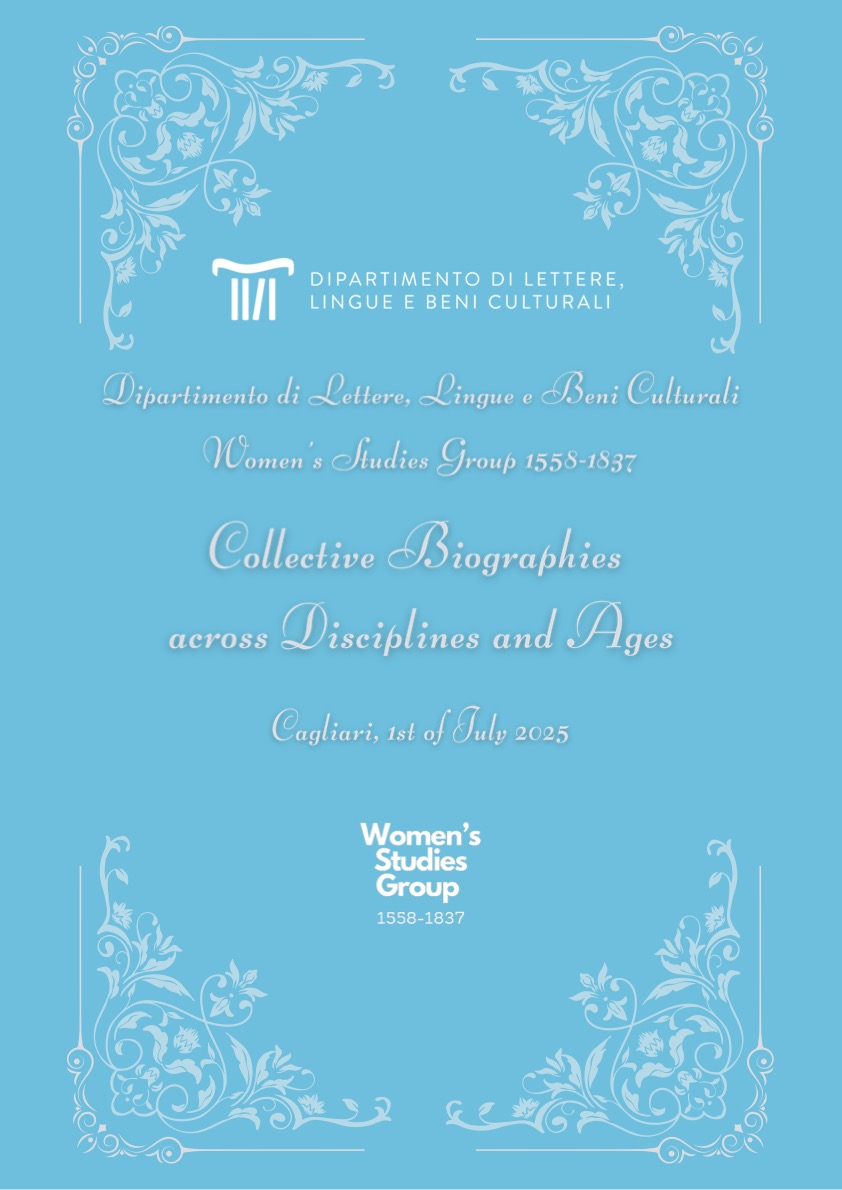
WSG Member Organizes July 1st, 2025 Hybrid Conference: “Collective Biographies Across Disciplines and Ages”
The Women’s Studies Group 1558–1837 is pleased to announce an upcoming one-day hybrid conference, “Collective Biographies Across Disciplines and Ages,” taking place on 1 July 2025, in person at the Università degli Studi di Cagliari (Faculty of Humanities, Via San Giorgio 12, Aula 6 and Aula Magna) and online via Microsoft Teams. This international event is organized by WSG member Dr. Maria Grazia Dongu, and it brings together an international group of scholars across disciplines.
About the Conference
This conference explores the literary, historical, and artistic dimensions of collective biography, narratives that center shared experience, social connection, and cultural memory. Presenters will consider how collective biographies function as both historical sources and narrative strategies, across genres as varied as Shakespearean drama, Quaker life writing, detective fiction, and eighteenth-century art. Drawing on approaches from literary studies, historiography, and biography theory, the conference reflects on how individual and group identities are shaped through storytelling.
The Women’s Studies Group 1558–1837 is proud to support this event, which features presentations by a number of our members and provides the opportunity to strengthen scholarly networks internationally and across disciplines.
Conference Schedule – 1 July 2025
9:30 am – Brief Introduction: On Collective Biographies by Maria Grazia Dongu (Università di Cagliari)
10:00 am – Competing to Tell Lives in Shakespeare’s Richard III by Maria Grazia Dongu (Università di Cagliari)
10:30 am – A Case Study of Early Quaker Biographies by Judith Roads (Independent Scholar)
11:00 am – Indizi tra le righe: l’Irlanda che cambia nelle detective story (Clues Between the Lines: Ireland’s Changing Face in Detective Stories) Luciano Cau (Università di Cagliari)
11:30 am – Break
12:00 pm – Anne of Cleves in Collective Biographies by Valerie Schutte (Independent Scholar)
12:30 pm – The Collective Biographies of 18th-Century Art: Harnessing the Power of Storytelling to Re-Read Martin’s “Lady Elizabeth Murray and Dido Belle” (1779) by Karen Lipsedge (Kingston University)
1:00 pm – Vita collettiva e autorialità: La famiglia Manzoni (Collective Life and Authorship: The Manzoni Family) by Fabio Vasarri (University of Florence)
13:30 pm – Catherine of Aragon, Cardinal Wolsey and Henry VIII through Chronicles and Shakespeare’s plays by Valeria Steri, Alessandra Carta, and Elena Melis (Università di Cagliari)
The day will conclude with a roundtable discussion among speakers and attendees.
Hybrid Attendance – All Are Welcome
This is a hybrid event, and attendees are warmly invited to join either in person or virtually. To receive the Microsoft Teams link for online attendance, please contact Dr. Maria Grazia Dongu at dongu@unica.it.
The Women’s Studies Group 1558–1837 is proud to support Dr. Maria Grazia Dongu in organizing this exciting interdisciplinary event. We celebrate her leadership and the vibrant international scholarly exchange this conference promises to foster across disciplinary boundaries.
Ellen Ledoux’s Laboring Mothers is dedicated to women as nurturers and caretakers and their multifarious professions. The monograph consists of six chapters – organised into three parts – featuring mothers who worked as actors, midwives, soldiers, slaves, street hawkers and prostitutes. This selection already points to Ledoux’s central ambition to seek out intersections of gender and class in a diverse array of case studies. The female elite of eighteenth-century Britain is accordingly not her main focus; instead, she concentrates primarily on the lower and working classes, the mothers without a ‘voice’ or those whose ambitions cast them into obscurity. Working mothers, Ledoux determines, existed and continue to exist on societal and spatial thresholds in which the principles and expectations of the public and private spheres merge and/or clash.
Ledoux not only productively renders visible those mothers at the margins, but she also argues that they enabled and were enabled by two cultural and social circumstances of the eighteenth century: the emergence of the public sphere and the cult of motherhood. These conditions, she observes, “created an Enlightenment concept of maternity that galvanized privileged women’s ability to earn income and, in some cases, to professionalize” (p. 3). As this statement demonstrates, her study draws attention to the strategies that allowed women to deliberately profit from their status as mothers and also highlights rhetorical representations or visual reflections of motherhood. Laboring Mothers employs an intersectional feminist reading that applies a broad understanding of ‘text’ as anything pertaining to a signifier, which results in a vast and impressively researched corpus of paintings, poems, letters, advertisements, plays, contracts, newspaper articles and further materials that facilitate Ledoux’s reading of “literal and symbolic forms of motherhood” (p. 9). Her acknowledgement of women’s resilience is paired with sober reflections on the tolls of maternal caretaking and, at times, working conditions that render mothering impractical or even impossible.
Part 1 of the book (‘Speaking for Herself’) is dedicated to women utilising the public sphere to their economic advantage, a pursuit which is impaired by their social, financial, and educational status. Ledoux presents, in her first chapter, the cases of actresses Sarah Siddons and Mary Robinson. For both, maternity and motherhood were not damaging circumstances. They deliberately staged their swollen pregnant bodies and mother–child relations to curate their virtuous public images, which were paradoxically based on a display of the private. While they garnered societal criticism for their practices – especially once their bodies showed their advanced age and illnesses – their longstanding professional successes speak to the eighteenth century’s fascination with maternity on display. Their stagings were only acceptable if their motherly duties were not superseded by their desire for fame and fortune. Chapter 2 offers a different perspective on such public self-fashioning by turning to midwifery and its shifting trends throughout the eighteenth century, notably from female to male practitioners. In response to these developments, manuals by female midwives argued for their expertise, pointing to their first-hand experience as mothers as topping male medical education. The chapter effectively demonstrates the paradoxical rhetoric governing debates that appear to hinge on existential gendered distinctions and the scrutiny of gender.
While Part 1 presents professionalism and motherhood as being far from exclusive states, Part 2 (‘Spoken For’) opens with another apparent contradiction. In Chapter 3, Ledoux introduces two mothers who served in the military, Christian Davis and Hannah Snell. Their autobiographies are testimonies of women’s patriotism and a desire for a lifestyle detached from normative societal female obligations. The absence of motherly affection and care for their children is considered a rejection of any aspirations to adhere to ‘good’ motherhood. Ledoux refrains from speculating on the lack of remarks on their time as mothers or their disinterest in their children’s future. Instead, these gaps in their narratives are used to highlight the stark limitations of female virtues in a militant and thus masculine-coded field of work. Chapter 4 likewise deals with a narrative’s failings in addressing maternity and its affective dimension, in light of physically taxing work. While reciprocal caretaking had been possible in all previous cases, The History of Mary Prince (1831) emphasises the insurmountably different expectations towards empathic caretaking and the labouring and living conditions of female slaves. Ledoux observes what she terms as ‘slow violence’ (pp. 116ff) in early instances of Prince’s narrative. Her reading results in bleak imageries of motherhood that either end in spiritual defeat or the death of mother and child. The chapter adds to its primary case an array of caricatures that showcase how the supposed ‘natural’ nurturing abilities of black women have been used and reproduced in public debates surrounding childcare at English-owned plantations.
Opening Part III (‘Spoken About’), Chapter 5 consists of six representations of female street hawkers, all artistic renditions by (male) painters such as William Hogarth and Thomas Rowlandson. As caricatures, parts of larger ensembles or allegorical representations, women are depicted carrying their children as well as tools of their professions. This balancing act already runs counter to idealised practices of the ‘cult of motherhood’ that sees women solely focused on nurturing, as expertly demonstrated by Ledoux with the example of Caroline Watson’s Maternal Tuition (1793). In such street hawker prints, lower-class mothers – literally and metaphorically – buckle the expectations of mindful mothering while pursuing honest or socially degrading occupations. Failing at one task entails failing at the other; a gin seller, for instance, is bound to bring forth the next generation of drunkards. The influence of the mother’s profession on their offspring is, however, shrouded in silence in Ledoux’s final chapter on prostitutes. Demonstrating the eighteenth century’s shifting attitude towards prostitutes as victims rather than active perpetrators by exploring manuscripts relating to the Magdalen House. The case study highlights sentimental rhetoric as an effective tool to stage a woman’s resort to prostitution as a parental obligation, allowing for her potential readmission into society.
Ledoux expresses throughout her work an awareness of the complex etymology of terms central to her cultural research. Her collection of cases highlights the effects and processes of the dissemination of stereotypes surrounding the feminine and female, as well as the enduring issues related to womanhood and motherhood. Her conclusive remarks reflect her findings on prevailing contemporary formations and cement the importance of Ledoux’s work in addressing mothering as a profession, one whose compatibility with women’s working aspirations can greatly vary. Laboring Mothers is an excellent read for students and researchers of British eighteenth-century society and presents its readership with a productive intersectional feminist perspective with far-reaching applicability.
***
Jasmin Bieber is a doctoral student at the University of Konstanz, Germany, where she is working on her PhD project dedicated to eighteenth-century British women travellers. Her research reflects her interests in gendered geography and literary spatiality, and she enjoys teaching undergraduate courses in early modern to contemporary literature.




 Women's Studies Group 1558 - 1837