Laboring Mothers. Reproducing Women and Work in the Eighteenth Century. By Ellen Malenas Ledoux. Charlottesville: University of Virginia Press. 2023. Pp. 274. $29.50 (paperback), ISBN 9780813950280. By Jasmin Bieber

Ellen Ledoux’s Laboring Mothers is dedicated to women as nurturers and caretakers and their multifarious professions. The monograph consists of six chapters – organised into three parts – featuring mothers who worked as actors, midwives, soldiers, slaves, street hawkers and prostitutes. This selection already points to Ledoux’s central ambition to seek out intersections of gender and class in a diverse array of case studies. The female elite of eighteenth-century Britain is accordingly not her main focus; instead, she concentrates primarily on the lower and working classes, the mothers without a ‘voice’ or those whose ambitions cast them into obscurity. Working mothers, Ledoux determines, existed and continue to exist on societal and spatial thresholds in which the principles and expectations of the public and private spheres merge and/or clash.

Ledoux not only productively renders visible those mothers at the margins, but she also argues that they enabled and were enabled by two cultural and social circumstances of the eighteenth century: the emergence of the public sphere and the cult of motherhood. These conditions, she observes, “created an Enlightenment concept of maternity that galvanized privileged women’s ability to earn income and, in some cases, to professionalize” (p. 3). As this statement demonstrates, her study draws attention to the strategies that allowed women to deliberately profit from their status as mothers and also highlights rhetorical representations or visual reflections of motherhood. Laboring Mothers employs an intersectional feminist reading that applies a broad understanding of ‘text’ as anything pertaining to a signifier, which results in a vast and impressively researched corpus of paintings, poems, letters, advertisements, plays, contracts, newspaper articles and further materials that facilitate Ledoux’s reading of “literal and symbolic forms of motherhood” (p. 9). Her acknowledgement of women’s resilience is paired with sober reflections on the tolls of maternal caretaking and, at times, working conditions that render mothering impractical or even impossible.

Part 1 of the book (‘Speaking for Herself’) is dedicated to women utilising the public sphere to their economic advantage, a pursuit which is impaired by their social, financial, and educational status. Ledoux presents, in her first chapter, the cases of actresses Sarah Siddons and Mary Robinson. For both, maternity and motherhood were not damaging circumstances. They deliberately staged their swollen pregnant bodies and mother–child relations to curate their virtuous public images, which were paradoxically based on a display of the private. While they garnered societal criticism for their practices – especially once their bodies showed their advanced age and illnesses – their longstanding professional successes speak to the eighteenth century’s fascination with maternity on display. Their stagings were only acceptable if their motherly duties were not superseded by their desire for fame and fortune. Chapter 2 offers a different perspective on such public self-fashioning by turning to midwifery and its shifting trends throughout the eighteenth century, notably from female to male practitioners. In response to these developments, manuals by female midwives argued for their expertise, pointing to their first-hand experience as mothers as topping male medical education. The chapter effectively demonstrates the paradoxical rhetoric governing debates that appear to hinge on existential gendered distinctions and the scrutiny of gender.

While Part 1 presents professionalism and motherhood as being far from exclusive states, Part 2 (‘Spoken For’) opens with another apparent contradiction. In Chapter 3, Ledoux introduces two mothers who served in the military, Christian Davis and Hannah Snell. Their autobiographies are testimonies of women’s patriotism and a desire for a lifestyle detached from normative societal female obligations. The absence of motherly affection and care for their children is considered a rejection of any aspirations to adhere to ‘good’ motherhood. Ledoux refrains from speculating on the lack of remarks on their time as mothers or their disinterest in their children’s future. Instead, these gaps in their narratives are used to highlight the stark limitations of female virtues in a militant and thus masculine-coded field of work. Chapter 4 likewise deals with a narrative’s failings in addressing maternity and its affective dimension, in light of physically taxing work. While reciprocal caretaking had been possible in all previous cases, The History of Mary Prince (1831) emphasises the insurmountably different expectations towards empathic caretaking and the labouring and living conditions of female slaves. Ledoux observes what she terms as ‘slow violence’ (pp. 116ff) in early instances of Prince’s narrative. Her reading results in bleak imageries of motherhood that either end in spiritual defeat or the death of mother and child. The chapter adds to its primary case an array of caricatures that showcase how the supposed ‘natural’ nurturing abilities of black women have been used and reproduced in public debates surrounding childcare at English-owned plantations.

Opening Part III (‘Spoken About’), Chapter 5 consists of six representations of female street hawkers, all artistic renditions by (male) painters such as William Hogarth and Thomas Rowlandson. As caricatures, parts of larger ensembles or allegorical representations, women are depicted carrying their children as well as tools of their professions. This balancing act already runs counter to idealised practices of the ‘cult of motherhood’ that sees women solely focused on nurturing, as expertly demonstrated by Ledoux with the example of Caroline Watson’s Maternal Tuition (1793). In such street hawker prints, lower-class mothers – literally and metaphorically – buckle the expectations of mindful mothering while pursuing honest or socially degrading occupations. Failing at one task entails failing at the other; a gin seller, for instance, is bound to bring forth the next generation of drunkards. The influence of the mother’s profession on their offspring is, however, shrouded in silence in Ledoux’s final chapter on prostitutes. Demonstrating the eighteenth century’s shifting attitude towards prostitutes as victims rather than active perpetrators by exploring manuscripts relating to the Magdalen House. The case study highlights sentimental rhetoric as an effective tool to stage a woman’s resort to prostitution as a parental obligation, allowing for her potential readmission into society.

Ledoux expresses throughout her work an awareness of the complex etymology of terms central to her cultural research. Her collection of cases highlights the effects and processes of the dissemination of stereotypes surrounding the feminine and female, as well as the enduring issues related to womanhood and motherhood. Her conclusive remarks reflect her findings on prevailing contemporary formations and cement the importance of Ledoux’s work in addressing mothering as a profession, one whose compatibility with women’s working aspirations can greatly vary. Laboring Mothers is an excellent read for students and researchers of British eighteenth-century society and presents its readership with a productive intersectional feminist perspective with far-reaching applicability.

***

Jasmin Bieber is a doctoral student at the University of Konstanz, Germany, where she is working on her PhD project dedicated to eighteenth-century British women travellers. Her research reflects her interests in gendered geography and literary spatiality, and she enjoys teaching undergraduate courses in early modern to contemporary literature.
Annual workshop

Details for our annual workshop have now been announced. They are as follows.

Women’s Studies Group Annual WorkshopSunday 18th May 2025, at the Foundling Museum, London, WC1N 1AZ Registration 11 a.m; event ends at 4.30 p.m.

Meeting and Greeting in (im)Polite Society Keynote by Professor Penelope Corfield: ‘Female Salutations in Britain in the Long Eighteenth Century: Deep Curtseying, Bobbing, Kissing … and Shaking Hands’.

Keynote Abstract: Greetings are dynamic. They can be given politely or rudely. They also change significantly over time. So women, when giving or receiving salutations, have to stay alert and make choices – as Penelope Corfield explains in her keynote lecture, focusing upon Britain in the long eighteenth century.

Further details, including the call for 5-minute presentations and registration details can be found here.

WSG Seminar Reminder: Thursday, April 10, 2025 via Zoom

WSG Seminar Reminder

Thursday 10 April 2025 – ZOOM

STARTING 6.45 FOR 7 PM, FINISHING AT 8.30 PM, BRITISH SUMMER TIME

Chair: Karen Griscom

Host: Louise Duckling

Claudia Cristell Maria Berttolini: Saint Gertrude as a female role model in 18th century Puebla de los Ángeles.

Jacqui Grainger: Mary Somerville, the United Service Museum and women of science.

Francesca Saggini: Jane Austen and the Golden Age of Crime Fiction.

Valentina P. Aparicio: Boundaries and Intimacy in Transatlantic Friendships: Maria Graham and Empress Maria Leopoldina.

The seminar will take place on Zoom. Please be aware, you must be a member of the WSG to gain access to the Zoom sessions. The links are distributed through our WSG mailing list 24-hours before the event.

For further information, please see our seminars page.  To join the WSG, please see our membership page.

WSG Member Organizes Italian Conference on Aphra Behn

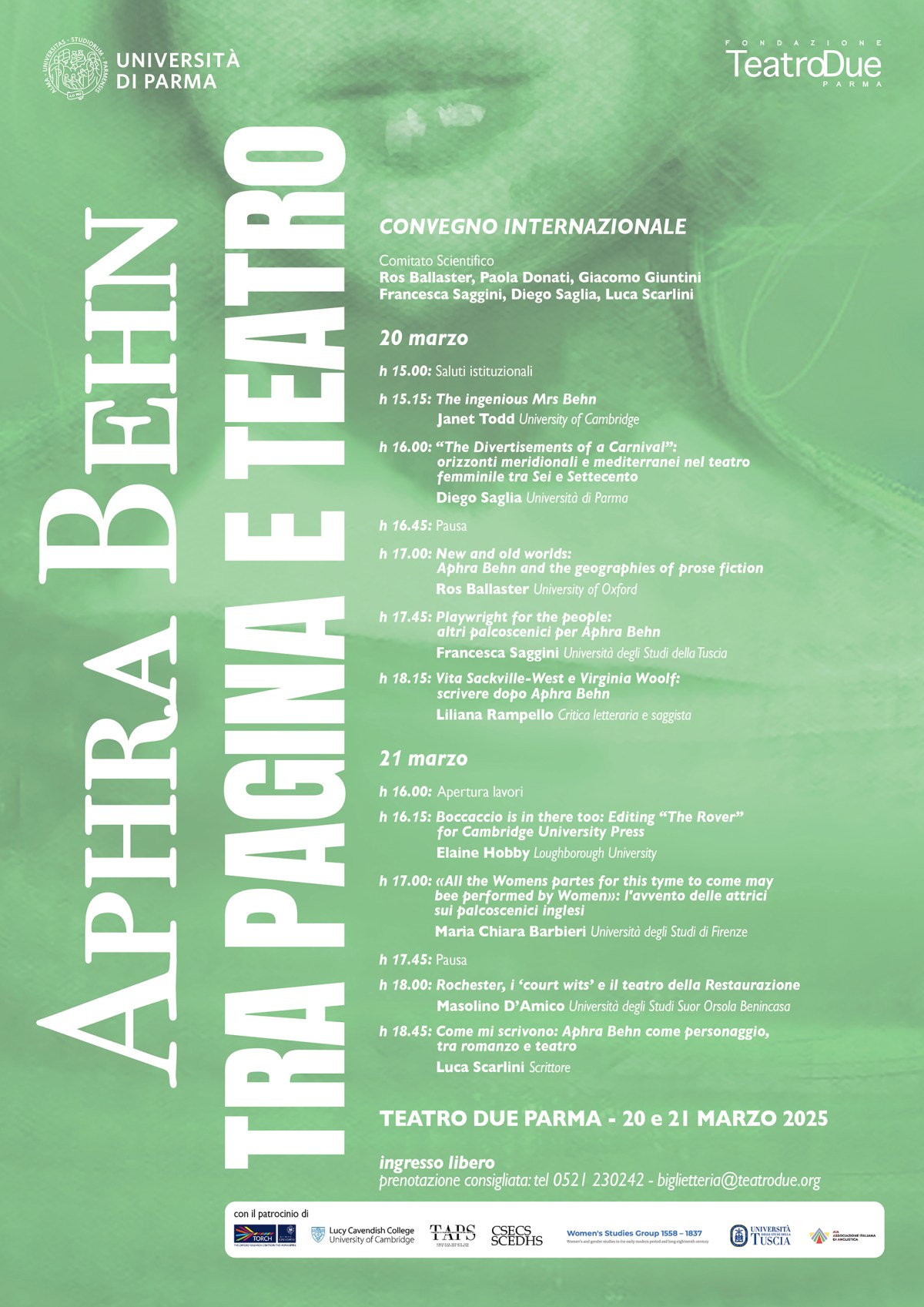
The Women’s Studies Group 1558-1837 is pleased to announce an exciting international conference, “APHRA BEHN TRA PAGINA E TEATRO” (Aphra Behn Between Page and Stage), taking place on 20-21 March 2025 at Teatro Due Parma, Italy. Our esteemed member, Francesca Saggini, is part of the organizing committee for this groundbreaking event, which represents the first event of its kind in Italy dedicated to the pioneering English author Aphra Behn.

About the Conference

This international conference, jointly organized by the Fondazione Teatro Due and the Università di Parma, will explore Behn’s remarkable contributions to literature and theatre, as well as the historical period in which she lived—a time combining “the charm of licentiousness with the violence of intrigue, marked by political and socio-cultural upheavals, scientific and artistic innovations.” The conference examines a crucial period spanning the English Civil War, the Stuart Restoration, and the Glorious Revolution through the lens of Behn’s work.

The event benefits from the support of institutions including the University of Oxford (The Oxford Research Centre in the Humanities), University of Cambridge (Lucy Cavendish College), Università degli Studi della Tuscia (Dipartimento di Studi Linguistico-Letterari, Storico-Filosofici e Giuridici), American Society for Eighteenth-Century Studies, Canadian Society for Eighteenth-Century Studies, and The Women’s Studies Group, 1558–1837.

Conference Schedule

20 March 2025

  • 15:00 – Institutional greetings
  • 15:15“The ingenious Mrs Behn”
    Janet Todd (University of Cambridge)
    The British author and scholar, a leading expert on Aphra Behn and largely responsible for her critical reappraisal in the late 20th century, will discuss her experiences of scholarship and life with this author.
  • 16:00“The Divertisements of a Carnival”: orizzonti meridionali e mediterranei nel teatro femminile tra Sei e Settecento
    Diego Saglia (Università di Parma)
    An exploration, starting with The Rover, of southern and Mediterranean settings and their meanings in female comic theatre in the late 17th and early 18th centuries.
  • 16:45 – Break
  • 17:00“New and old worlds: Aphra Behn and the geographies of prose fiction”
    Ros Ballaster (University of Oxford)
    Astrea’s prose production as a starting point to explore its geographical and cultural imagery.
  • 17:45“Playwright for the people: altri palcoscenici per Aphra Behn”
    Francesca Saggini (Università degli Studi della Tuscia)
    An overview of Behn’s reappearance in contemporary culture, not only on stage or in publishing, but also through commemorative events and digital remediations.
  • 18:15“Vita Sackville-West e Virginia Woolf: scrivere dopo Aphra Behn”
    Liliana Rampello (Critica letteraria e saggista)
    An evocative reading of reflections on Behn developed by Vita Sackville-West and Virginia Woolf in the early decades of the 20th century.

21 March 2025

  • 16:00 – Opening of proceedings
  • 16:15“Boccaccio is in there too: Editing ‘The Rover’ for Cambridge University Press”
    Elaine Hobby (Loughborough University)
    A discussion of philological and annotation strategies based on the experience of editing The Rover for Cambridge University Press.
  • 17:00“‘All the Womens partes for this tyme to come may bee performed by Women’: l’avvento delle attrici sui palcoscenici inglesi”
    Maria Chiara Barbieri (Università degli Studi di Firenze)
    A focus on Restoration theatre, particularly the revolutionary phenomenon of actresses appearing on stage following the reopening of London theatres in 1660.
  • 17:45 – Break
  • 18:00“Rochester, i ‘court wits’ e il teatro della Restaurazione”
    Masolino D’Amico (Università degli Studi Suor Orsola Benincasa)
    An in-depth analysis of the playwrights connected to the court of Charles II, including the controversial Earl of Rochester, and their innovative theatrical productions.
  • 18:45“Come mi scrivono: Aphra Behn come personaggio, tra romanzo e teatro”
    Luca Scarlini (Scrittore)
    A broad overview of Behn as playwright and novelist, offering a general picture of the complexity and richness of a figure always inhabiting the space between stage and page.

A Festival of Behn

This conference is the culminating event of a two-month celebration of Aphra Behn taking place in February and March 2025. The broader initiative includes:

  • A new Italian translation and performance of Behn’s play The Rover at Teatro Due
  • Public readings of her prose works including Oroonoko and The History of the Nun
  • The creation of a “docudrama” about the author

The conference welcomes university students and researchers, secondary school teachers and students, and the general public. This represents a significant milestone as the first event of its kind in Italy dedicated to Aphra Behn.

Program Committee

The conference is guided by an esteemed Program Committee comprising Ros Ballaster, Paola Donati, Giacomo Giuntini, Francesca Saggini, Diego Saglia, and Luca Scarlini.


Admission and Reservations

The conference offers free entry (ingresso libero). Reservations are recommended and can be made by calling tel. 0521 230242 or emailing biglietteria@teatrodue.org.

The Women’s Studies Group 1558-1837 is proud to support our member Francesca Saggini in this important endeavor to highlight the work and legacy of one of England’s first professional women writers.

Reminder: WSG Reading Group, Her Stories, March 10, 2025, 7–8pm (GMT) via Zoom

The next WSG Reading Group, Her Stories, is on 10th March, 7-8pm 2025 (GMT) 

The Women’s Studies Group (WSG) will host its next “Her Stories” Reading Group meeting on March 10th, 2025, from 7-8pm GMT. All members are welcome to participate in this upcoming session, organized and hosted by Karen Lipsedge.

The group will discuss Louise’s selected text: Jennie Batchelor’s The Lady’s Magazine (1770–1832) and the Making of Literary History (2022, Edinburgh University Press). For those unable to read the entire book, Louise recommends either the Conclusion or Chapter 6, “Achievements and Legacies: The Lady’s Magazine in Literary History.”

Members can access a virtual copy of the book through a provided link, though they should note it’s a large file and check their connection in advance. Thanks go to Louise for providing this link.

Each reading group follows a consistent format: the member who selected the text gives a brief introduction explaining their choice, followed by participants sharing one aspect of the text they wish to discuss—whether it relates to characters, style, readership, or even a single word or phrase.

Anyone interested in joining “Her Stories” can contact Karen Lipsedge directly.