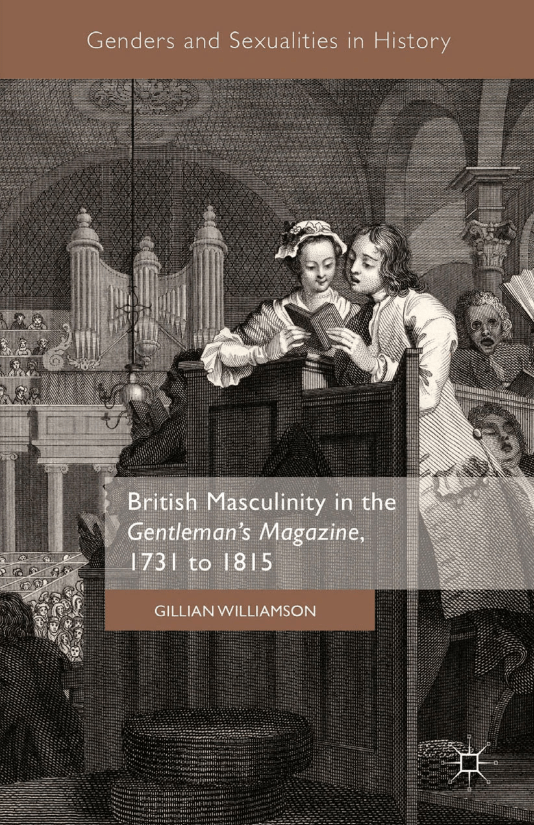
British Masculinity in the Gentleman’s Magazine 1731 to 1815. By Gillian Williamson.

Basingstoke: Palgrave Macmillan. 2016. Pp 283. £44.99 (hardback), £18.99 (eBook), ISBN 9781137542328. Review by Julie Peakman.

As part of our mission to promote women’s and gender studies, we are always happy to publish reviews of key texts in our field – especially those produced by our members. Here, Julie Peakman discusses Gillian Williamson’s important book on the Gentleman’s Magazine, an essential read for anyone interested in magazine culture and gender in the long eighteenth century.

***

The Gentleman’s Magazine ran from 1731 right up to 1907 and is one of the longest running gentleman’s magazines. In this neatly researched book, Gillian Williamson’s aim is to examine the Gentleman’s Magazine for ‘its construction of British gentlemanly masculinity’ (p. 2) between 1731 and 1815, a period which saw the emergence of a new public identity and ideology in ‘a new gentlemanly masculinity of merit achieved through industry and self-restraint’ (p. 3). In doing so, she sheds light on a particular area of literature which has not been explored before in any great depth.

Williamson sees the magazine as ‘a key medium through which middling-sort and ambitious artisan men first acquired politeness’ (p. 181) and as part of the creation of a new gentlemanly status. Readers were not simply passive participants, but took an active role in contributing in the form of letters, prose, poems and obituaries. The magazine covered all sorts of diverse topics including divinity, history, literature, geography, philosophy and scientific discovery. Debates between readers often stretched over months of the periodical.

The book is divided into four parts with six chapters. First is a general historiography providing an overview of eighteenth-century gentlemanly masculinity. Second is a history of the Gentleman’s Magazine, its owners, editors and writers. Third is an examination of the magazine’s readers and their contributions. The final three chapters provide an in-depth analysis of gentlemanly masculinity in the magazine divided into time periods: 1731–1756, 1757–1789 and 1790–1815.

In her examination of the magazine’s readers, Williamson attempts to assess the types of readers through their contributions. It is evident that those who wrote in with submissions often used pseudonyms or initials, so it is impossible to track all of them, and many contributed multiple times. Those that were traceable included the gentry and the middling sort, though as Williamson points out, these are difficult categories to define, but among them were clerics, academics, teachers and lawyers. If the content is anything to go by, there is also evidence that some contributors were ‘men of learning’ and ‘educated men’, sending in Latin poems, maths problems and debates on theological matters and domestic topics such as marriage and the education of children. At 6d an issue, the magazine was accessible to a broad span of readers.

Since self-improvement was the key to becoming a gentleman, this topic was also aimed at the lower-class artisans who would have found the publication of educational value. The reader numbers gleaned from the circulation figures were around 9,000 in 1734, rising to 12,000 by 1748, but Williamson estimates a readership of five times that much, of about 50,000 readers. One copy might go through the hands of many other readers, not just the subscribers, as they would have happened upon the Gentleman’s Magazine in inns, taverns, clubs and coffeehouses, as well as numerous people reading it at one household.

Women were both readers and contributors though the image of women was the conventional one of being subordinate to men. The Gentleman’s Magazine attacked those who behaved like men: for women, there should be no whistling, laddishness, striding around the room or making the first move in courtship. But women could be brave, as seen in the coverage of the female soldier Hannah Snell who was lauded for rescuing a girl from the unwanted attention of a sergeant. However, the magazine still managed to make a salacious story out of her, pointing to her close female friendships,

her cross-dressing, her enforced bed sharing with men and undergoing half-naked floggings as a punishment. An ideal woman was important as a wife to support her husband’s gentlemanly role, but anxieties over possible discord were voiced.

In the early Gentleman’s Magazine of the 1730s, the image of the ideal gentleman is seen as rooted firmly in the private sphere of industry and respectability. He was depicted initially as a temperate Christian Hero, a construct disrupted somewhat by the intervention of the odd unruly wife and the alternative masculinities of libertines, fiery soldiers and their like.

Masculine vices threatened this ideal of the polite gentleman which came in the form of the abusive husband or the fop, characters that were both criticised by the magazine’s authors. The drunk, the gambler, the seducer or spendthrift were gradually all overshadowed by the upstanding gentleman of family values and hard work, buttressed by his self-restraint and benevolence. Generally, in the obituary sections, the industrious man was being praised.

By 1760, benevolence to women, children, servants, the poor and dumb animals were part of the moral values necessary to fit the ideal image of the gentleman in the magazine. This was part of a refocus of gentlemanly traits within the home and family, turning inwards towards the private rather than outwards to his public persona. By now, the magazine was placing marriage above male friendship in importance and, according to its poems and obituaries, the ideal woman was designated to the positions of nurturing mother and dutiful daughter. The turning point of the Gentleman’s Magazine, argues Williamson, came in 1768, a time when it began to challenge the elite, with attacks on the ruling class calling for reforms of property law and taxation.

During the period from 1790 to 1815, the Gentleman’s Magazine was regularly covering the French Revolution and Britain’s war with France, right up to the Battle of Waterloo (1815). Another turning point was not so much the loss of America, but the monitoring of the French Revolution and fears that an uprising might erupt in Britain. Tom Paine’s Rights of Man (1791) had lit a fuse, igniting a challenge to the entire political and social system. A state of solidarity emerged between the gentleman and the elite in the face of this potential social upheaval.

Curiously the violence of masculine idols such as Captain James Cook and Horatio Nelson was blotted out, with accounts showing only the benevolent and moral aspects of their personas as middling-sort heroes. After the Battle of the Nile (1798), for example, Nelson was depicted as a man of sensibility, praised for his virtue of piety – rather a challenging view considering his long-term affair with Emma Hamilton, someone else’s wife.

During this period, the more militant readers of the magazine fell away, and circulation dropped, leaving two sorts of readers: those reminiscing about the landed squire versus those supporting self-advancement and punishment for the idle.

In the end, the overall mission of the Gentleman’s Magazine was to entertain with doses of humour, science and literature, as well as to provide information to broaden the horizons of its readers. The magazine was recognised for its educational value, and even used as a reference, as Edward Kimber compiled the first index in 1753 covering twenty volumes to 1750. Bound volumes would eventually become worth a lot of money – 50 guineas in one case. While luxury editions might appear to be targeted at the nobility and gentry, Williamson has found evidence that the magazine’s success was based on a readership from the middling sort of professionals and tradesmen, and even among men from lower down the social scale. The Gentleman’s Magazine was often read from adolescence to the grave.

Overall, Williamson’s study gives us an accessible yet scholarly overview of the development of the magazine and its depictions and image of the quintessentially British gentleman. Assessing the authors of the Gentleman’s Magazine and the contributions of its readers and their obituaries, she is able to paint a picture of what made up the Gentleman’s Magazine idea of the ideal gentleman. Her case studies provide thumbnail sketches and give added insight into her findings. In all, Williamson’s in-depth analysis of the Gentleman’s Magazine provides us with a valuable contribution to eighteenth-century magazine literature and adds another layer to our understanding of the history of masculinity.

***

Dr Julie Peakman is an historian, a Fellow of the Royal Historical Society and Honorary Fellow at the Department of History, Classics and Archaeology at Birkbeck College, University of London. She is a prolific author in the areas of eighteenth-century culture, history of sexuality and social history. Recent books include Libertine London and Licentious Worlds.
The Women’s Studies Group 1558–1837 is pleased to announce the speakers for their seminar series 2025–2026

The Women’s Studies Group 1558–1837 is pleased to announce the speakers for their seminar series 2025–26.

The group has two kinds of meeting for seminars.

In-person seminar meetings. These take place at the Foundling Museum, 40 Brunswick Square, WC1N 1AZ, UK, on Saturday afternoons. We will be allowed into the room at 1.00 pm, to give us time to sort out paperwork and technology, but sessions will run from 1.30 pm – 4.30 pm. Please arrive between 1.00 pm – 1.30 pm. The Foundling is a wheelchair accessible venue, and directions for getting to the Museum can be found here, including for those who are partially sighted. Seminars are free to WSG members. Non-members are welcome and are kindly requested to pay the Museum entrance fee and make a donation of £2 for refreshments. Those attending the seminars are welcome to look round the museum before or after.

ZOOM seminar meetings. These take place on Thursday evenings and will be hosted by a member of the WSG committee. They run from 7.00 pm – 8.30 pm, with the waiting room opening at 6.45 pm. Please be aware, you must be a member of the WSG to gain access to the Zoom sessions. The links are distributed through our WSG mailing list 24-hours before the event.

Women’s Studies Group 1558–1837, Seminar Schedule 2025–2026

Saturday 4 October 2025            

In-person, Foundling Museum London 13:00 for 13:30 – 16:30, British Summer Time (GMT +1)

Julia Hamilton:  Anna of Denmark and the origins of the Stuart sequence.

Pilar Botías Dominguez: Cathartic privacy: war, exile and melancholia in Margaret Cavendish’s Sociable Letters.

Gillian Williamson: Elizabeth Inchbald: a life in lodgings.

***

Thursday 6 November 2025           

ZOOM 19:00 – 20:30 (GMT) 

Valerie Schutte: Queen Mary I of England and portrait medals in print.

Conor Byrne: Representations of the executions of British Queens in early modern images.

Yihong Zhu: Women at night: readers, writers, pleasure-seekers, and night-walkers in eighteenth-century London.

***

Saturday 6 December 2025       

In-person, Foundling Museum London 13:00 for 13:30 – 16:30 (GMT)

Breeze Barrington: ‘Versifying Maid[s] of Honour’: Mary of Modena’s artistic legacy.

Diane Clements: ‘A very anxious and affectionate mother’: dealing with personal indebtedness in Georgian England.

Rhian Jones: ‘For what signifies an absent friend?’ Epistolary friendship between women and men in England, c. 1650-1750.

***

Thursday 15 January 2026         

ZOOM   19:00 – 20:30 (GMT)

Stephen Spiess: Trans Allegoresis: Margaret Cavendish’s ‘Assaulted and Pursued Chastity’.

Gillian Beattie-Smith: Creating women’s literary identities: the Tour of Scotland.

Vicki Joule: Travelling and performing the self: Delarivier Manley and the ‘Stage’ coach.

Brianna Robertson-Kirkland: The other Mrs Corri: Camilla Corri’s musical legacy in Edinburgh.

***

Saturday 7 February 2026     

In-person, Foundling Museum London 13:00 for 13:30 – 16:30 (GMT) 

Esther Villegas de la Torre: Seventeenth-century women scholars: an interdisciplinary, comparative approach.

Nora Rodriguez Loro: The rhetoric of royal panegyrics: Medbourne’s dedication of St Cecily (1666) to Catherine of Braganza.

Sarah Clarke: Catharine Pelzer’s years in Exeter in the 1840s: from child prodigy to adult musician. Clutching at straws.

 ***

Thursday 12 March 2026               

ZOOM   19:00 – 20:30 (GMT)  

Sarah Barthélemy: Spiritual retreats and women in early modern France.

Helena Queirós: Mediated bodies, devotional scripts: intermedial practices in early modern convents.

Laura Giuliano: Lady Anna Miller (1741-1781): a question of connoisseurship.

Teresa Rączka-Jeziorska: A Polish museum in an English garden. Romantic collection of multinational items of Princess Izabella Czartorska née Flemming.

 ***

Thursday March 19 2026       

ZOOM   19:00 – 20:30 (GMT) 

Elisabetta Marino: Mary Shelley and biography, between history and romance.

Ramit Samaddar: Sophia Goldborne in Colonial Bengal: Phebe Gibbes’s Hartly House, Calcutta.

Charlotte Vallis: The role of French Ambassadors at the courts of Elizabeth Petrovna and Catherine II.

Lisa VandenBerghe and Isabelle Lémonon-Waxin: Victorine de Chastenay: a scholar, an archive, a digital edition

For further information including abstracts, see our seminars page, or contact the organiser Carolyn D. Williams, cdwilliamslyle@aol.com. To join the WSG, see our membership page.

WSG Member Organizes Hybrid Conference: “Collective Biographies Across Disciplines and Ages”

WSG Member Organizes July 1st, 2025 Hybrid Conference: “Collective Biographies Across Disciplines and Ages”

The Women’s Studies Group 1558–1837 is pleased to announce an upcoming one-day hybrid conference, “Collective Biographies Across Disciplines and Ages,” taking place on 1 July 2025, in person at the Università degli Studi di Cagliari (Faculty of Humanities, Via San Giorgio 12, Aula 6 and Aula Magna) and online via Microsoft Teams. This international event is organized by WSG member Dr. Maria Grazia Dongu, and it brings together an international group of scholars across disciplines.

About the Conference

This conference explores the literary, historical, and artistic dimensions of collective biography, narratives that center shared experience, social connection, and cultural memory. Presenters will consider how collective biographies function as both historical sources and narrative strategies, across genres as varied as Shakespearean drama, Quaker life writing, detective fiction, and eighteenth-century art. Drawing on approaches from literary studies, historiography, and biography theory, the conference reflects on how individual and group identities are shaped through storytelling.

The Women’s Studies Group 1558–1837 is proud to support this event, which features presentations by a number of our members and provides the opportunity to strengthen scholarly networks internationally and across disciplines.

Conference Schedule – 1 July 2025

9:30 am – Brief Introduction: On Collective Biographies by Maria Grazia Dongu (Università di Cagliari)

10:00 am – Competing to Tell Lives in Shakespeare’s Richard III by Maria Grazia Dongu (Università di Cagliari)

10:30 am – A Case Study of Early Quaker Biographies by Judith Roads (Independent Scholar)

11:00 am – Indizi tra le righe: l’Irlanda che cambia nelle detective story (Clues Between the Lines: Ireland’s Changing Face in Detective Stories) Luciano Cau (Università di Cagliari)

11:30 amBreak

12:00 pm – Anne of Cleves in Collective Biographies by Valerie Schutte (Independent Scholar)

12:30 pm – The Collective Biographies of 18th-Century Art: Harnessing the Power of Storytelling to Re-Read Martin’s “Lady Elizabeth Murray and Dido Belle” (1779) by Karen Lipsedge (Kingston University)

1:00 pm – Vita collettiva e autorialità: La famiglia Manzoni (Collective Life and Authorship: The Manzoni Family) by Fabio Vasarri (University of Florence)

13:30 pm – Catherine of Aragon, Cardinal Wolsey and Henry VIII through Chronicles and Shakespeare’s plays by Valeria Steri, Alessandra Carta, and Elena Melis (Università di Cagliari)

The day will conclude with a roundtable discussion among speakers and attendees.

Hybrid Attendance – All Are Welcome

This is a hybrid event, and attendees are warmly invited to join either in person or virtually.
To receive the Microsoft Teams link for online attendance, please contact Dr. Maria Grazia Dongu at dongu@unica.it.

The Women’s Studies Group 1558–1837 is proud to support Dr. Maria Grazia Dongu in organizing this exciting interdisciplinary event. We celebrate her leadership and the vibrant international scholarly exchange this conference promises to foster across disciplinary boundaries.

WSG 2025 – 2026 Calendar of Events

Day/Date/Time EventDetails
Saturday 4 October 2025
13:30 – 16:30 (BST) GMT+ 1
In-person seminar 
Foundling Museum,40 Brunswick Square, London WC1N 1AZ
Julia Hamilton:  Anna of Denmark and the origins of the Stuart sequence.
Pilar Botías Dominguez: Cathartic privacy: war, exile and melancholia in Margaret Cavendish’s Sociable Letters.
Gillian Williamson: Elizabeth Inchbald: a life in lodgings.
28 October 2025
19:00 – 20:00 (GMT)
WSG Reading Group: Her StoriesFrances Brooks’ ‘History of Montague’
Thursday 6 November 2025
19:00 – 20:30 (GMT)
Online seminar via ZoomValerie Schutte: Queen Mary I of England and portrait medals in print.
Conor Byrne: Representations of the executions of British Queens in early modern images.
Yihong Zhu: Women at night: readers, writers, pleasure-seekers, and night-walkers in eighteenth-century London.
Saturday 6 December 2025
13:00 for 13:30 – 16:30 (GMT)
In-person seminar 
Foundling Museum, 40 Brunswick Square, London WC1N 1AZ
Breeze Barrington: 
‘Versifying Maid[s] of Honour’: Mary of Modena’s artistic legacy.
Diane Clements: ‘A very anxious and affectionate mother’: dealing with personal indebtedness in Georgian England.
Rhian Jones: ‘For what signifies an absent friend?’ Epistolary friendship between women and men in England, c. 1650-1750.
Thursday 15 January 2026
19:00 – 20:30 GMT
Online seminar via ZoomStephen Spiess: Trans Allegoresis: Margaret Cavendish’s ‘Assaulted and Pursued Chastity’.
Gillian Beattie-Smith: Creating women’s literary identities: the Tour of Scotland.
Vicki Joule: Travelling and performing the self: Delarivier Manley and the ‘Stage’ coach.
Brianna Robertson-Kirkland: The other Mrs Corri: Camilla Corri’s musical legacy in Edinburgh.
Saturday 7 February 2026
13:00 for 13:30 – 16:30 (GMT)
In-person seminar 
Foundling Museum, 40 Brunswick Square, London WC1N 1AZ
Esther Villegas de la Torre: Seventeenth-century women scholars: an interdisciplinary, comparative approach.
Nora Rodriguez Loro: The rhetoric of royal panegyrics: Medbourne’s dedication of St Cecily (1666) to Catherine of Braganza.
Sarah Clarke: Catharine Pelzer’s years in Exeter in the 1840s: from child prodigy to adult musician. Clutching at straws.
Sunday 8 March 2026International Women’s DayDetails to be confirmed. WSG in collaboration with the Foundling Museum.
Thursday 12 March 2026
19:00 – 20:30 (GMT)                
Online seminar via ZoomSarah Barthélemy: Spiritual retreats and women in early modern France.
Helena Queirós: Mediated bodies, devotional scripts: intermedial practices in early modern convents.
Laura Giuliano: Lady Anna Miller (1741-1781): a question of connoisseurship.
Teresa Rączka-Jeziorska: A Polish museum in an English garden. Romantic collection of multinational items of Princess Izabella Czartorska née Flemming.
Thursday 19 March 2026Online seminar via ZoomElisabetta Marino: Mary Shelley and biography, between history and romance.
Ramit Samaddar: Sophia Goldborne in colonial Calcutta: Phebe Gibbes’s Hartly House, Calcutta.
Charlotte Vallis: The role of French Ambassadors at the courts of Elizabeth Petrovna and Catherine II.
Lisa VandenBerghe and Isabelle Lémonon-Waxin: Victoria de Chastenay: a scholar, an archive, a digital edition.
Saturday 18 April 2026 (GMT)WorkshopAn opportunity to present and discuss your research interests.
Saturday 16 May 2026Summer VisitHam House visit. A NT property, former home of Catherine & Elizabeth Murray.

Women’s Studies Group Annual Workshop, 18 May 2025: Meeting and Greeting in (im)Polite Society

Keynote by Professor Penelope Corfield:

‘Out of the Shadows: Eighteenth-Century Women Greeting their Fellow Britons . . . and Shaking Hands’.

This year we were delighted to welcome Professor Corfield as our 2025 Workshop keynote speaker. Her recent work on the complex nature of shaking hands throughout history informed her talk which was amply illustrated with slides. As she noted, styles of greeting are evidence of the changing social status and roles of women, but they are difficult to research. They usually go unremarked as part of daily life and changes only take place over decades. There are few images of women shaking hands. Urban and commercial growth, the rise in literacy and the expansion of radical Protestantism were all involved in the development of different styles of salutation. There are passing references to greetings in different forms of literature, plays, diaries, letters, etc., and examples from many women writers of the eighteenth century were cited. Forms of greeting between working women prove harder to identify than the deep formal curtsey which remained current in elite and court circles. Eventually the egalitarian handshake of the Quakers spread throughout society to become the most acceptable and common mode of greeting.

Five-minute presentations by workshop attendees revealed, as usual, a fascinating variety of interpretations on the theme. We had two panels, Women in Society and Music and Manners, with many connections between them. We discussed the different forms of public and private residential access provided by bells and doorknockers, the forms of surveillance, control and punishment imposed on women who transgressed in public, and the visible signs of conformity provided by uniform dress, particularly for charity school children. The means of distinguishing social status through access to public spaces in London, the Spa towns and the sites of Parisian promenades, and the alarm caused when this delineation broke down was discussed as a feature of eighteenth-century urban living. The anxiety of arranging introductions, announcing arrivals and of adhering to correct precedence and customary greetings was covered by several presentations; the different meanings of the term ‘Gallantry’ in Austen and Burney novels was examined, and an array of calling cards from the Sophia Banks collection demonstrated their role in sociability and self-fashioning but also how they maintained exclusivity.

Among our papers on music, we learnt about dedications in books of music, both their polite and political significance, and about the precarious status of musicians who were often segregated in the homes where they performed, even if celebrated for their talent. Occasionally, however, music became a leveller and musicians became part of the household. Finally, we enjoyed a demonstration of ‘Making the Honours’ before dancing, the formal bows and curtsies, eye contact and body postures which became essential features of eighteenth-century dance.

We had a stimulating and convivial day with so much to think about as a result of our discussions. Thank you to all participants for putting so much thought into your contributions, and to Professor Corfield for providing the focus of our event!