Upcoming in-person seminar at Foundling Museum, Saturday 4th October, 2025. 

We have an upcoming seminar taking place on Saturday 4th October, 2025.  In-Person: Foundling Museum, 40 Brunswick Square, London, WC1N 1AZ, Saturday 13.00 for 13:30 – 16:30, British Summer Time (GMT + 1)

The papers to be presented include:

Julia Hamilton:  Anna of Denmark and the origins of the Stuart sequence.

Pilar Botías Dominguez: Cathartic privacy: war, exile and melancholia in Margaret Cavendish’s Sociable Letters.

Gillian Williamson: Elizabeth Inchbald: a life in lodgings.

All members are invited to attend.

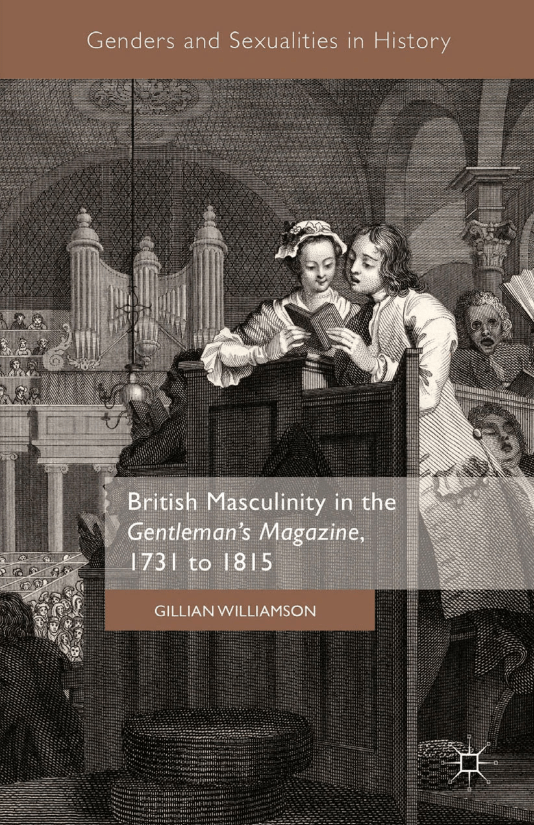
British Masculinity in the Gentleman’s Magazine 1731 to 1815. By Gillian Williamson.

Basingstoke: Palgrave Macmillan. 2016. Pp 283. £44.99 (hardback), £18.99 (eBook), ISBN 9781137542328. Review by Julie Peakman.

As part of our mission to promote women’s and gender studies, we are always happy to publish reviews of key texts in our field – especially those produced by our members. Here, Julie Peakman discusses Gillian Williamson’s important book on the Gentleman’s Magazine, an essential read for anyone interested in magazine culture and gender in the long eighteenth century.

***

The Gentleman’s Magazine ran from 1731 right up to 1907 and is one of the longest running gentleman’s magazines. In this neatly researched book, Gillian Williamson’s aim is to examine the Gentleman’s Magazine for ‘its construction of British gentlemanly masculinity’ (p. 2) between 1731 and 1815, a period which saw the emergence of a new public identity and ideology in ‘a new gentlemanly masculinity of merit achieved through industry and self-restraint’ (p. 3). In doing so, she sheds light on a particular area of literature which has not been explored before in any great depth.

Williamson sees the magazine as ‘a key medium through which middling-sort and ambitious artisan men first acquired politeness’ (p. 181) and as part of the creation of a new gentlemanly status. Readers were not simply passive participants, but took an active role in contributing in the form of letters, prose, poems and obituaries. The magazine covered all sorts of diverse topics including divinity, history, literature, geography, philosophy and scientific discovery. Debates between readers often stretched over months of the periodical.

The book is divided into four parts with six chapters. First is a general historiography providing an overview of eighteenth-century gentlemanly masculinity. Second is a history of the Gentleman’s Magazine, its owners, editors and writers. Third is an examination of the magazine’s readers and their contributions. The final three chapters provide an in-depth analysis of gentlemanly masculinity in the magazine divided into time periods: 1731–1756, 1757–1789 and 1790–1815.

In her examination of the magazine’s readers, Williamson attempts to assess the types of readers through their contributions. It is evident that those who wrote in with submissions often used pseudonyms or initials, so it is impossible to track all of them, and many contributed multiple times. Those that were traceable included the gentry and the middling sort, though as Williamson points out, these are difficult categories to define, but among them were clerics, academics, teachers and lawyers. If the content is anything to go by, there is also evidence that some contributors were ‘men of learning’ and ‘educated men’, sending in Latin poems, maths problems and debates on theological matters and domestic topics such as marriage and the education of children. At 6d an issue, the magazine was accessible to a broad span of readers.

Since self-improvement was the key to becoming a gentleman, this topic was also aimed at the lower-class artisans who would have found the publication of educational value. The reader numbers gleaned from the circulation figures were around 9,000 in 1734, rising to 12,000 by 1748, but Williamson estimates a readership of five times that much, of about 50,000 readers. One copy might go through the hands of many other readers, not just the subscribers, as they would have happened upon the Gentleman’s Magazine in inns, taverns, clubs and coffeehouses, as well as numerous people reading it at one household.

Women were both readers and contributors though the image of women was the conventional one of being subordinate to men. The Gentleman’s Magazine attacked those who behaved like men: for women, there should be no whistling, laddishness, striding around the room or making the first move in courtship. But women could be brave, as seen in the coverage of the female soldier Hannah Snell who was lauded for rescuing a girl from the unwanted attention of a sergeant. However, the magazine still managed to make a salacious story out of her, pointing to her close female friendships,

her cross-dressing, her enforced bed sharing with men and undergoing half-naked floggings as a punishment. An ideal woman was important as a wife to support her husband’s gentlemanly role, but anxieties over possible discord were voiced.

In the early Gentleman’s Magazine of the 1730s, the image of the ideal gentleman is seen as rooted firmly in the private sphere of industry and respectability. He was depicted initially as a temperate Christian Hero, a construct disrupted somewhat by the intervention of the odd unruly wife and the alternative masculinities of libertines, fiery soldiers and their like.

Masculine vices threatened this ideal of the polite gentleman which came in the form of the abusive husband or the fop, characters that were both criticised by the magazine’s authors. The drunk, the gambler, the seducer or spendthrift were gradually all overshadowed by the upstanding gentleman of family values and hard work, buttressed by his self-restraint and benevolence. Generally, in the obituary sections, the industrious man was being praised.

By 1760, benevolence to women, children, servants, the poor and dumb animals were part of the moral values necessary to fit the ideal image of the gentleman in the magazine. This was part of a refocus of gentlemanly traits within the home and family, turning inwards towards the private rather than outwards to his public persona. By now, the magazine was placing marriage above male friendship in importance and, according to its poems and obituaries, the ideal woman was designated to the positions of nurturing mother and dutiful daughter. The turning point of the Gentleman’s Magazine, argues Williamson, came in 1768, a time when it began to challenge the elite, with attacks on the ruling class calling for reforms of property law and taxation.

During the period from 1790 to 1815, the Gentleman’s Magazine was regularly covering the French Revolution and Britain’s war with France, right up to the Battle of Waterloo (1815). Another turning point was not so much the loss of America, but the monitoring of the French Revolution and fears that an uprising might erupt in Britain. Tom Paine’s Rights of Man (1791) had lit a fuse, igniting a challenge to the entire political and social system. A state of solidarity emerged between the gentleman and the elite in the face of this potential social upheaval.

Curiously the violence of masculine idols such as Captain James Cook and Horatio Nelson was blotted out, with accounts showing only the benevolent and moral aspects of their personas as middling-sort heroes. After the Battle of the Nile (1798), for example, Nelson was depicted as a man of sensibility, praised for his virtue of piety – rather a challenging view considering his long-term affair with Emma Hamilton, someone else’s wife.

During this period, the more militant readers of the magazine fell away, and circulation dropped, leaving two sorts of readers: those reminiscing about the landed squire versus those supporting self-advancement and punishment for the idle.

In the end, the overall mission of the Gentleman’s Magazine was to entertain with doses of humour, science and literature, as well as to provide information to broaden the horizons of its readers. The magazine was recognised for its educational value, and even used as a reference, as Edward Kimber compiled the first index in 1753 covering twenty volumes to 1750. Bound volumes would eventually become worth a lot of money – 50 guineas in one case. While luxury editions might appear to be targeted at the nobility and gentry, Williamson has found evidence that the magazine’s success was based on a readership from the middling sort of professionals and tradesmen, and even among men from lower down the social scale. The Gentleman’s Magazine was often read from adolescence to the grave.

Overall, Williamson’s study gives us an accessible yet scholarly overview of the development of the magazine and its depictions and image of the quintessentially British gentleman. Assessing the authors of the Gentleman’s Magazine and the contributions of its readers and their obituaries, she is able to paint a picture of what made up the Gentleman’s Magazine idea of the ideal gentleman. Her case studies provide thumbnail sketches and give added insight into her findings. In all, Williamson’s in-depth analysis of the Gentleman’s Magazine provides us with a valuable contribution to eighteenth-century magazine literature and adds another layer to our understanding of the history of masculinity.

***

Dr Julie Peakman is an historian, a Fellow of the Royal Historical Society and Honorary Fellow at the Department of History, Classics and Archaeology at Birkbeck College, University of London. She is a prolific author in the areas of eighteenth-century culture, history of sexuality and social history. Recent books include Libertine London and Licentious Worlds.
The Women’s Studies Group 1558–1837 is pleased to announce the speakers for their seminar series 2025–2026

The Women’s Studies Group 1558–1837 is pleased to announce the speakers for their seminar series 2025–26.

The group has two kinds of meeting for seminars.

In-person seminar meetings. These take place at the Foundling Museum, 40 Brunswick Square, WC1N 1AZ, UK, on Saturday afternoons. We will be allowed into the room at 1.00 pm, to give us time to sort out paperwork and technology, but sessions will run from 1.30 pm – 4.30 pm. Please arrive between 1.00 pm – 1.30 pm. The Foundling is a wheelchair accessible venue, and directions for getting to the Museum can be found here, including for those who are partially sighted. Seminars are free to WSG members. Non-members are welcome and are kindly requested to pay the Museum entrance fee and make a donation of £2 for refreshments. Those attending the seminars are welcome to look round the museum before or after.

ZOOM seminar meetings. These take place on Thursday evenings and will be hosted by a member of the WSG committee. They run from 7.00 pm – 8.30 pm, with the waiting room opening at 6.45 pm. Please be aware, you must be a member of the WSG to gain access to the Zoom sessions. The links are distributed through our WSG mailing list 24-hours before the event.

Women’s Studies Group 1558–1837, Seminar Schedule 2025–2026

Saturday 4 October 2025            

In-person, Foundling Museum London 13:00 for 13:30 – 16:30, British Summer Time (GMT +1)

Julia Hamilton:  Anna of Denmark and the origins of the Stuart sequence.

Pilar Botías Dominguez: Cathartic privacy: war, exile and melancholia in Margaret Cavendish’s Sociable Letters.

Gillian Williamson: Elizabeth Inchbald: a life in lodgings.

***

Thursday 6 November 2025           

ZOOM 19:00 – 20:30 (GMT) 

Valerie Schutte: Queen Mary I of England and portrait medals in print.

Conor Byrne: Representations of the executions of British Queens in early modern images.

Yihong Zhu: Women at night: readers, writers, pleasure-seekers, and night-walkers in eighteenth-century London.

***

Saturday 6 December 2025       

In-person, Foundling Museum London 13:00 for 13:30 – 16:30 (GMT)

Breeze Barrington: ‘Versifying Maid[s] of Honour’: Mary of Modena’s artistic legacy.

Diane Clements: ‘A very anxious and affectionate mother’: dealing with personal indebtedness in Georgian England.

Rhian Jones: ‘For what signifies an absent friend?’ Epistolary friendship between women and men in England, c. 1650-1750.

***

Thursday 15 January 2026         

ZOOM   19:00 – 20:30 (GMT)

Stephen Spiess: Trans Allegoresis: Margaret Cavendish’s ‘Assaulted and Pursued Chastity’.

Gillian Beattie-Smith: Creating women’s literary identities: the Tour of Scotland.

Vicki Joule: Travelling and performing the self: Delarivier Manley and the ‘Stage’ coach.

Brianna Robertson-Kirkland: The other Mrs Corri: Camilla Corri’s musical legacy in Edinburgh.

***

Saturday 7 February 2026     

In-person, Foundling Museum London 13:00 for 13:30 – 16:30 (GMT) 

Esther Villegas de la Torre: Seventeenth-century women scholars: an interdisciplinary, comparative approach.

Nora Rodriguez Loro: The rhetoric of royal panegyrics: Medbourne’s dedication of St Cecily (1666) to Catherine of Braganza.

Sarah Clarke: Catharine Pelzer’s years in Exeter in the 1840s: from child prodigy to adult musician. Clutching at straws.

 ***

Thursday 12 March 2026               

ZOOM   19:00 – 20:30 (GMT)  

Sarah Barthélemy: Spiritual retreats and women in early modern France.

Helena Queirós: Mediated bodies, devotional scripts: intermedial practices in early modern convents.

Laura Giuliano: Lady Anna Miller (1741-1781): a question of connoisseurship.

Teresa Rączka-Jeziorska: A Polish museum in an English garden. Romantic collection of multinational items of Princess Izabella Czartorska née Flemming.

 ***

Thursday March 19 2026       

ZOOM   19:00 – 20:30 (GMT) 

Elisabetta Marino: Mary Shelley and biography, between history and romance.

Ramit Samaddar: Sophia Goldborne in Colonial Bengal: Phebe Gibbes’s Hartly House, Calcutta.

Charlotte Vallis: The role of French Ambassadors at the courts of Elizabeth Petrovna and Catherine II.

Lisa VandenBerghe and Isabelle Lémonon-Waxin: Victorine de Chastenay: a scholar, an archive, a digital edition

For further information including abstracts, see our seminars page, or contact the organiser Carolyn D. Williams, cdwilliamslyle@aol.com. To join the WSG, see our membership page.


Abstracts: 2025 – 2026 programme

Saturday 4th October, 2025. In-Person: Foundling Museum, 40 Brunswick Square, London, WC1N 1AZ, Saturday 13.00 for 13:30 – 16:30, British Summer Time (GMT + 1)

Julia Hamilton: Anna of Denmark and the origins of the Stuart sequence

Anna of Denmark arrived in England in 1603 as James VI & I’s queen. It had been over half a century since England had a queen consort. Anna was given the Queen’s Side at Whitehall and a group of jointure properties for her use. A Tudor sequence comprising a Watching Chamber, a Presence Chamber, a Privy Chamber and a Bedchamber was awaiting her. Anna extended the Queen’s sequence by adding additional rooms to it. She also gave new meanings to Tudor spaces. These initiatives had a profound effect on royal spatial usage. Anna taught subsequent Stuart queen consorts to communicate decoratively the working relationships between rooms. A close study of material and visual culture draws connections between Anna of Denmark, Henrietta-Maria, Catherine of Braganza and Mary of Modena to reveal the origins of the Stuart sequence and a Stuart style of interior decoration. Stuart monarchs and courtiers adopted Anna’s patterns too. Thus, she influenced men as well as women.

Pila  Botías Domínguez: Cathartic privacy: war, exile and melancholia in the Sociable Letters of Margaret Cavendish

Margaret Cavendish, Duchess of Newcastle (1623-1673) was one of the most prolific female writers in seventeenth-century England. In 1664 she published CCXI Sociable Letters, a total of 211 letters in which the letter writer discusses various topics such as philosophy, politics, society, or literature. The writer addresses an imaginary female friend who acts as her confidante. These epistles, never answered, encapsulate Margaret Cavendish’s psyche. This private experience of writing epistles provides an intimate space which results in complex philosophical dilemmas. The author talks very often about her own retreat in the countryside where she finds peace of mind, yet she misses intellectual conversation. In these epistles, we encounter a private experience where she processes common traumatic episodes in England such as a civil war (1642-1649) and her own exile to the Netherlands. She and her imaginary friend are far from England, and through this cathartic experience, Cavendish proposes the concept of sociability. This, in turn, helps her undergo a process of therapeutic reasoning. Thus, this paper aims to explore how Cavendish uses the epistolary genre as an intimate and private space to talk openly about her inner fears and concerns. In doing so, she tests the possibilities of female wit.

Gillian Williamson: Elizabeth Inchbald: A Life in Lodgings

Despite her considerable professional success, actor and author Elizabeth Inchbald (1753-1821) did not have a permanent home of her own. Instead, she chose to live for some forty years in a series of lodging rooms across London. Her published diaries and Memoirs written shortly after her death by her near-contemporary James Boaden provide a rich insight into this manner of living.

This paper uses these sources together with new archival research to examine Inchbald’s agency in selecting her accommodation against the background of the widespread phenomenon of lodging in eighteenth-century London. It makes a contribution to the ‘new economic criticism’, which since the 1990s has sought to examine the ways in which material and financial conditions and systems, factors often overlooked in earlier literary biographies, shape literary production.

I conclude with some suggested motives for this deliberate choice by an independent ‘career woman’.

******

Thursday 6th November, 2025.  ZOOM 18:45 FOR 19.00 – 20.00 (GMT)

Valerie Schutte: Queen Mary I of England and portrait medals in print

In 2022 and 2023, two of Queen Mary I of England’s portrait medals featured in a touring exhibition entitled The Tudors: Art and Majesty in Renaissance England. One of the medals was of Queen Mary I with an Allegory of Peace, and the other was of Queen Mary I and Philip, Prince of Spain.

These stunning medals, as well as others featuring Mary, such as the 1555 papal reconciliation medal, have always proved a point of fascination, circulating in Mary’s own time and frequently displayed in museums and exhibitions in modern times. However remarkable the medals are, they are often left out of the historical record of Mary’s reign, and relegated to exhibition catalogues and studies of coins, medals, and emblems. In fact, no monographs on Mary even mention the medals.

Rather than provide a detailed history of Marian medals, as that has been completed by others, this presentation will briefly examine how medals featuring Mary have been understood and reproduced in print over the last 500 years. It is not exhaustive, but will highlight the types of works that showcased the medals, from Early Modern numismatic and emblem studies to modern exhibition and collection catalogues. Specifically, I will examine how Mary’s medals were represented and understood by later audiences who wanted images of famous figures.

I suggest that these medals are largely left out of histories of Mary because they highlight the co-monarchy of Mary and Philip; the medals depict the royal couple as equals, with Philip as King of England. This is an aspect of Marian history that until recently has been downplayed, with Philip traditionally being portrayed as an enemy of England. Portrait medals of Mary firmly tie her to the Habsburgs. Alongside more traditional sources, portrait medals can illuminate just how majestic, culturally relevant, and even international Mary’s reign truly was, as well as the incredibly positive outlook the regime had in 1554 and 1555.

Conor Byrne: Representations of the Executions of British Queens in Early Modern Images

The executions of British queens between 1536 and 1587 were sensational news events, both in the British Isles and on the Continent, and were visually represented in woodcuts, engravings and paintings well into the following century. While several of the sources that will be examined in this paper have been extensively studied by scholars, others remain understudied or ignored, which is surprising in view of the rich interdisciplinary potential of the subject: such visual representations appeared in a broad corpus of literary and historical sources that crossed national boundaries. Visual representations are a critical source for scholars not only on account of their insights into the ways in which artists creatively imagined the executions but because of the role they are likely to have played in disseminating knowledge of these shocking events to audiences both at home and abroad. Scholars have long appreciated the power of images in early modern culture, but, regarding the subject at hand, this scholarly attention should be more effectively integrated with the analysis of other, traditionally well-studied sources for the queens’ executions (including chronicles and ambassadors’ reports, among others). Indeed, while representations of early modern women’s executions more broadly have been the subject of scholarly enquiry, this has largely been confined to textual and written representations rather than visual forms, which this paper seeks to redress.

Yihong Zhu: Women at Night: Readers, Writers, Pleasure-Seekers, and Night-Walkers in Eighteenth-Century London

This paper examines the gendered experience of night in eighteenth-century London through the figures of women who occupied, navigated, or haunted its nocturnal spaces. Despite the long tradition of restricting women’s access to the nocturnal city and framing their solitary presence as morally dubious, eighteenth-century women nonetheless participated in London’s nocturnal spheres through reading, writing, pleasure seeking and street walking. Drawing on a variety of eighteenth-century texts, I trace different modes of women’s nocturnal experience: the coffee-woman who marked the limits of inclusion within male-dominated sociable spaces; the female club participant who made her voice heard in public discourse through conversation and editorial work; the pleasure-garden visitor and masquerade-goer who sampled the frisson of sexual freedom within recreational spaces charged with carnivalistic energy; the streetwalker and urban survivor who appropriated the city’s topography for her own ends. Just as London’s nocturnal culture in the eighteenth century displayed a productive tension between light and darkness, politeness and indecorum, control and anarchy, reason and unreason, the female figures who inhabited these spaces revealed a complex interplay between visibility and marginality, agency and surveillance, pleasure and precarity. Through close readings of urban periodicals, fiction, and other textual materials, this paper offers a literary reconstruction of women’s lived and imagined nights in the eighteenth century.

******

Saturday 6th December, 2025.  In-Person: Foundling Museum, 40 Brunswick Square, London, WC1N 1AZ, Saturday 13.00 for 13:30 – 16:30(GMT)

Breeze Barrington: ‘Versifying Maid[s] of Honour’: Mary of Modena’s artistic legacy

When Maria of Modena arrived at the English court in 1673, she established an environment of education and creative production among the women around her. The culture she created shaped female artistic production during this period and beyond. My paper will use two of Maria’s maids of honour as case studies: the poet Anne Finch and the poet and painter Anne Killigrew. In their works we can see the influence of their time at Maria’s court, both in terms of the literature they read and the culture of friendship and learning they inhabited.

Dr Diane Clements: ‘A very anxious and affectionate mother’: dealing with personal indebtedness in Georgian England

Recent studies have begun to question the idea that the economic expansion and commercialisation of the eighteenth century were to the advantage of the middling sort. Hannah Barker’s study, drawing on examples in the north-west of England, demonstrated how financial and business issues could also lead to concerns about downward social mobility. Tawny Paul has addressed this anxiety particularly with regard to financial activity. In a period when credit was ubiquitous but depended on maintaining reputation, character and status, the consequence of failing to do so could result in acute financial insecurity. Whilst both these approaches have suggested new areas to consider, Andrew Popp has pointed out that the particular role of women in maintaining family reputation and status amidst this insecurity has been overlooked.

This paper considers how one family encountered economic and social insecurity as a consequence of debt and personal life choices. It focuses on the role played by the matriarch, Elizabeth Legh (1728-1806) and the coping strategies she devised and implemented to maintain the family’s financial standing and rank. The paper draws on an exchange of letters with her youngest son, which demonstrate both her anxieties and her approach to the challenges that family actions had caused. It will consider how she sought to resolve these problems and the extent to which she was successful.

Rhian Jones: ‘For what signifies an absent friend?’ Epistolary friendships between women and men in England, c. 1650-1750

This paper will examine the dynamics of letter-writing and friendship between women and men in England between c.1650 and c.1750. It will offer a comparative analysis of mixed-sex pairs who engaged in sustained correspondences, including Anne Conway and Henry More, Elizabeth Elstob and George Ballard, and John Locke and several of his female correspondents. The paper will begin by examining the ways in which correspondents used letters to set out expectations for these epistolary relationships, thereby subverting entrenched notions of ideal friendship as a virtuous bond between men. It will then draw upon recent scholarship in the ‘history of emotions’ to highlight the role of the letter as a therapeutic tool, analysing the ways in which correspondents used letters to bridge distance, offer comfort, and care for the body and the mind. Finally, the paper will use the letters of Isabella Duke to John Locke as a case study to explore what happened when points of tension and difficult emotions disrupted these epistolary relationships, and letters became inadequate substitutes for the ‘absent friend’. By reconstructing the ways in which women and men communicated and related through letters, this paper seeks to contribute to the study of friendship and epistolary culture in the long eighteenth century.

******

Thursday 15th January, 2026.  ZOOM 18:45 for 19.00-20.30 (GMT)

Stephen Spiess: Allegory and Violence: The Epistemology of the Whore in the Early Modern Visual Arts

When Iago infers that Desdemona has been unfaithful, Othello famously does not reject the charge. Rather, he responds with a specific evidentiary request: Iago must validate the claim by providing “ocular proof.” In this paper, I argue that Othello’s visual mandate—and the sexual epistemology that underlies it—cannot be understood in isolation from the iconography of whoredom in the early modern visual arts, which likewise channels attention to the fraught correspondences between visual evidence, discursive meanings, and sexual knowing that so powerfully animate Shakespeare’s tragedy. Moving from the London stage to images of whores and courtesans in English broadside ballads, emblem books, miscellany drawings, and the interactive flap prints of Pietro Bertelli, I first examine how this visual tradition animates what I am calling the “ontological paradox” of early modern whoredom: a pervasive cultural logic which figures whores as at once (a) definitionally fixed and socially legible and (b) privileged emblems of artifice, changeability, counterfeit, dissimulation, falsehood, and inauthenticity. To be a whore, in other words, is to be able to appear otherwise: to seem chaste and prove indistinguishable from one’s licit counterparts. Detailing how this ontology assumes particular shape and form in the visual arts, with special attention paid to the reuse of popular woodcuts, the deployment of allegorical figures, and modes of viewer interpellation, I then examine how such works help to illuminate—even allegorize—a contemporary epistemology of the whore that, by arguing that the “truth” of whoredom can only be secured by stripping the woman in question and examining the “proof(s)” writ upon their body, conjoins sexual knowledge to gendered violence.

Gillian Beattie-Smith: Creating Women’s Literary Identities: The Tour of Scotland

The Grand Tour was essentially a masculine device which had the effect of locating men in classical history, and in public hierarchical place. However, by the beginning of the nineteenth century, following the publication of texts by, such as Johnson and Boswell, the tour of Scotland had come to be seen as a literary journey, one synonymous with the resulting text.

Eighteenth and nineteenth century travel journals about the Tour of Scotland offered opportunities for women to be seen as Romantic authors by means of writing about engagement with landscape, concern for social reform, and developing the tour as an organising framework for the text, but, moreover, offered women a place in the growing literary canon of the Tour of Scotland.

Writing which determines the woman as subject and the personal as context, and yet manifests that personal in journeys, in travel, and the self in changing locations, serves to foreground the relational performance of an authoritative identity in the subjectivities encountered of people, landscapes, and events of a creative journey.

This paper discusses the creation of women’s literary identities in their journals of their tours of Scotland, and draws on several examples.

Victoria Joule: Travelling and Performing the Self: Delarivier Manley and the ‘Stage’coach

As part of a larger project on Manley’s self-representation throughout her literary career, this paper will concentrate on her early work, Letters Writen[sic] by Mrs. Manley (1696) and the way in which the stagecoach is used to explore identity. The specific conditions of this vehicle; intimate, social, oppressive, for example, put pressure on individuals to assert or perform their character. Manley’s short epistolary work is one of the first ‘stagecoach novels’ and establishes pathways for later explorations of authorial self-consciousness. Despite being classified as fiction, this paper argues that her work is better understood in the context of travel writing and theatre history. Letters Writen points to the potential of travel to ‘shed, renegotiate, reinvent ourselves’ (Annabel Abbs, 2002) and in its physical and social set-up, the stagecoach can be read as a mobile theatre. Manley’s early work is one of the first of many diverse generic variants she used in her ongoing self-portrayals.

Brianna Robertson-Kirkland: The other Mrs Corri: Camilla Corri’s musical legacy in Edinburgh

Camilla Corri née Giolivetti (c.1767-fl.1822), alongside her sister, Frances, arrived in Britain in August 1792 to take up their positions as leading singers for the Edinburgh Musical Society (EMS). Hired by Natale Corri (1766-1822), whose family were influential musicians in Edinburgh, the two sisters had been performing in Paris, only narrowly missing the ‘September massacres’. Frances would only perform for the EMS for a season, but Camilla performed as one of their leading singers until the EMS’s demise in 1797. Her remaining in the city was, in part, due to her marriage to Natale in 1794 where she became part of the larger Corri family, who were already celebrated performers, publishers and teachers. Her sister-in-law, Francesca was the wife of Domenico, who had been the leading performer for the Edinburgh Musical Society from 1771 until the couple and their children moved to London in 1788. Her singing had left a lasting impression in the city that several critics, including William Tytler (1793) and George Thompson (1838) continued to remark upon long after her departure. Though Camilla attempted to style herself differently to Francesca, publicly calling herself ‘Madame Corri’ while Francesca was known as ‘Signora Corri’, the pair were regularly described in sources as ‘Mrs Corri’ leading later histories to tangle their musical contributions. This paper aims to untangle their confused biographies, demonstrating their individual contributions to Edinburgh’s Music History. In particular, I will focus on Camilla, whose involvement in Edinburgh’s music scene has received little scholarly attention.

******

Saturday 7th February, 2026.  In-person, Foundling Museum, London WC1N 1AZ, Saturday 13.00 for 13:30 – 16:30 (GMT)

Esther M. Villegas de la Torre: Seventeenth-Century Women Scholars: An Interdisciplinary, Comparative Approach

This paper argues that women’s endeavours with seventeenth-century commercially- and scholarly-driven authorship are of paramount importance. Print publications in the seventeenth century reflected a collective effort to trade in and systematise knowledge from an interdisciplinary, comparative perspective. Take, for instance, the transnational traction gained by the publications of Teresa de Ávila, María de Zayas, Madeleine de Scudéry, Aphra Behn, and Sor Juana Inés de la Cruz, both in original and in translation. Every one of these learned women had their intellectual labour repeatedly marketed and cited in bibliographical discourses across borders, whatever the degree. Nonetheless, there is still a strong reluctance to take seriously such early female achievements, at least in parallel to those of their male counterparts. This paper, therefore, focuses on elucidating how women’s publications factually resonated with their audiences and beyond —namely, by locating the collective efforts that supported learned women within the context of early modern knowledge systems through an interdisciplinary, comparative approach, rooted in book history. As we shall see, print scholarly authorship, particularly, affords us a most valuable insight into the processes that determined recognition and remembrance, within and beyond the early modern Republic of Letters.

Nora Rodriguez Loro: The Rhetoric of Royal Panegyrics: Medbourne’s Dedication of St Cecily (1666) to Catherine of Braganza

This paper provides a discussion of Matthew Medbourne’s dedication of St Cecily (1666) to Catherine of Braganza, which was the only literary text the queen consort was offered. Dedicatory writing was a widespread practice in 17th-century England, for it functioned in the same manner as other forms of propaganda, such as court masques and portraits, and this strategy benefitted both playwrights and patronesses.

The dedication of this ‘Christian Tragedy’—featuring the martyrdom of St Cecily—to a Catholic queen was used to derive additional profits (for the play was not staged) and legitimise the work of a Catholic actor, who was trying to make a name as a dramatist. The support of the powerful was all the more necessary in this case, for being an actor, Medbourne’s status was lower than his fellow authors, and because of increasing Catholic anxiety, he could be relegated to a secondary position. In fact, a decade later Medbourne was incriminated in the Popish Plot and charged with high treason; he was imprisoned in Newgate on November 26, 1678, where he died in 1680.

The rhetoric of this epistle deserves attention: Medbourne’s dedication to the queen consort is indicative of the ways in which playwrights divinised their dedicatees to pay tribute to them, and the very choice of Catherine as his dedicatee demonstrates her agency as a patroness of Catholics. For years, Queen Catherine’s political and cultural agency has been widely disregarded because of her inability to produce an heir, her lack of involvement in political factions (as opposed to the royal mistresses Barbara Palmer, Eleanor Gwyn, and Louise de Kéroualle), and the proposals made to Charles II to divorce and remarry.

However, recent scholarship has demonstrated the queen’s relevant role as a Catholic agent, for the support of her English household was paramount, particularly after 1673, when the Test Act placed restrictions on those who could serve her, and again in 1678, when she became the focus of conspiracy. The queen relied on her household to exercise political patronage and promote her interests, even establishing a network of illicit Catholic printing, by ordering Catholic books for her chapel. Medbourne’s dedication of St Cecily is indicative of the queen’s political agency, though less overt than that of Charles I’s queen consort, but in no way ineffective. In fact, Medbourne would later secure the patronage of another important Catholic patron, Henry Howard, to whom he dedicated his translation of Tartuffe (1670), which was staged by the Duke’s Company.

Sarah Clarke: Catharina Pelzer’s years in Exeter in the 1840s: from child prodigy to adult musician. Clutching at straws.

Catharina Pelzer (1824-1895), who styled herself Madame Sidney Pratten after her marriage of 1854, was a musician who became the most well-known guitarist in Victorian London.  In her early life she was a child prodigy taught by her father, Ferdinand Pelzer (1801-1864), who was German and had come to London with his family around 1829.  In 1843 they moved to Exeter probably because Ferdinand was teaching singing at that time in the West Country.  Ferdinand and most of the family moved back to London in 1847 but Catharina remained, it seems alone, until late 1848 at which time she also returned to the capital.  There is no evidence that she resided again with her parents at any time after this.  If a thorough biography is to be written about Catharina, then her Exeter years would need to be accounted for because it was then that she began developing her own style of working independently of her father.  This paper will explore how existing narratives about the family need to be challenged and how a careful analysis of scant primary sources needs to be done in order to achieve an understanding of this crucial time in her career.

******

Thursday 12th March 2026.  ZOOM 18.45 FOR 19.00 TO 20.30 (GMT)

Sarah Barthélemy: ‘Spiritual Retreats and Women in Early Modern France’

This session will bring new attention to spiritual retreats, a privileged observatory to understand the gender relations shaping the spirituality of women. It considers the case of the demoiselles of La Retraite, founded in 1675 by Catherine de Francheville (1620–89) in Brittany, then a land of mission in the wake of the French Wars of Religion. French interior Catholic missions were themselves part of a wider movement of encounter with otherness focussed on the social and religious integration of the populations, whether in France or abroad. As stated by their Rule from the beginning of the eighteenth century, the demoiselles had ‘the talent to speak in private and in public during the Retreats’. Little attention has been given to the work of retreats organised by both religious lay women and women religious. In the early modern period, the missionary framework (catechism, preaching, confession to save souls) allowed regular and secular clergy to rely on lay women—specifically trained by them even if illiterate—to instruct and catechise in the Breton countryside, with the help of images. The session will question the notion of spiritual direction, the influence of the ‘techniques of the self’, and build upon recent research showing a style of collective and horizontal direction.

Helena Queirós: Mediated bodies, devotional scripts: intermedial practices in early modern convents.

Recent scholarship has examined visual culture and text-image relations from a gendered perspective. Yet the very idea of “feminine visual culture” remains a critical challenge to Western hierarchies of the senses, where vision has traditionally been coded as masculine (Classen). This paper explores early modern Portuguese women’s religious visual culture through devout (auto)biographies.

It focuses on three interrelated practices: virtual pilgrimage as a gendered form of imaginative vision; the use of bodily measurement, particularly of Christ’s wounds, as an embodied Imitatio Christi shaped by text, image, and object; and baroque gestural culture (Sánchez Lora), linked to the evolution of discursive meditation and mental prayer.

Imposed by post-Tridentine constitutions, mental prayer acted as a sensory and disciplinary regime, reshaping devotional embodiment. These intermedial and embodied practices illuminate a distinct feminine visual culture, revealing how early modern religious women negotiated spiritual agency within and against normative structures.

Laura Giuliano: Lady Anna Miller (c. 1741–1781): A Question of Connoisseurship

My presentation focuses on Anna Riggs Miller’s Letters from Italy, published in 1776 (with a second edition appearing the following year) after her brief visit to Italy between 1770 and 1771. In particular, I intend to share the results of research I have conducted over the past year for the Oxford Conference, ‘The Travelling Self: Tourism’, and for my two forthcoming articles on this subject. Researchers have already highlighted Miller’s role in the development of art criticism and female travel literature, underlining that by expressing her personal views on the art she saw in Italy, Miller pioneered a group of leisured middle-class women—from Hester Lynch Piozzi to Mariana Starke—who were committed to dismantling social and gender prejudices against female art writers, particularly in the mid-eighteenth century. A close examination of Miller’s Letters sheds further light on her multifaceted personality. She was a witty reader of Jonathan Richardson’s works and learned from him how to achieve the objectivity of a connoisseur through a practical method of evaluating works of art. Moreover, she used to sketch what she saw on the spot and decided to stop in places outside the ordinary itinerary such as Foligno, Loreto, and Narni. Her determination to form her own opinions and verify the accuracy of earlier travel narratives echoes Hogarth’s maxim, ‘to see with their own eyes’, meaning to be able to judge independently. Through this cultural self-training, Miller was able to provide comprehensive descriptions and insightful commentary on Italian art from an alternative, personal perspective that challenged contemporary thinking. For example, she criticised Correggio and Guido Reni, who were praised by all her contemporaries. This presentation aims to demonstrate why her account of Italy can be regarded as a clear expression of her attitude and her ability to form and express judgements in a critical, intelligent and independent manner, as well as her desire to engage in contemporary art debate.

Teresa Rączka-Jeziorska: A Polish Museum in an English Garden. Romantic Collection of Multinational Items of Princess Izabela Czartoryska, née Flemming (1745–1835)

When discussing the origins of Kraków’s most admired exhibition, which includes such gems as the ‘Lady with an Ermine’ and ‘Shakespeare’s chair’, it is worth remembering that they are connected to the charming landscape garden in Puławy, which was designed at the end of the 18th century by Izabela Czartoryska (1745-1835), née Flemming. A Polish aristocrat and one of the most accomplished artists and writers at the court of King Stanisław August Poniatowski (1732-1798), she created the garden using the firmly held knowledge of the superiority of unfettered nature over ordered geometry. The experience of her several highly insightful peregrinations through the naturally enchanting corners of England and Scotland, carried out between 1768 and 1791, played a great part in this. The idea of independently creating a similar environment in the rural countryside on the banks of the Vistula was undoubtedly a challenge that no other lady would have taken up under the complicated political conditions for her homeland resulting from the partitions. Izabela Czartoryska, however, was not only interested in creating a fashionable garden. In the era of occupation and collapse of the Polish-Lithuanian Commonwealth, the first museum of romantic memory within Polish lands was to be created there, bringing together the most valuable multinational items ranging from antiquity to the times of Izabela Czartoryska.

******

Thursday, March 19, 2026. ZOOM, 18.45 for 19.00 – 20.30 (GMT)

Elisabetta Marino: Mary Shelley and Biography, Between History and Romance

In an 1843 letter to Edward Moxon, Mary Shelley emphasized her preference for “quieter work, to be gathered from other works,” such as the biographical profiles she wrote for the Cabinet Cyclopaedia, adding that, in her view, she was much better at that “than romancing.” By focusing on her two historical romances, Valperga (1823) and The Fortunes of Perkin Warbeck (1830), and briefly examining the project behind her profiles for the Cabinet Cyclopaedia—especially her contributions to Lives of the Most Eminent Literary and Scientific Men of Italy, Spain and Portugal—this paper seeks to highlight the paramount and revolutionary importance Mary Shelley attached to this genre. In the analysis, William Godwin’s 1797 essay “Of History and Romance” will serve as a critical framework to shed light on Shelley’s works.

Ramit Samaddar: Sophia Goldborne in Colonial Bengal: Phebe Gibbes’s Hartly House, Calcutta

In all likelihood, Phebe Gibbes, a now-forgotten eighteenth-century writer with a substantial body of work to her credit, never visited colonial Bengal herself. However, her son, Anthony Gibbes, who served the East India Company and was buried in the Calcutta Mission cemetery in 1786, may have sent her letters that formed the basis of the Anglo-Indian encounter depicted in her novel, Hartly House, Calcutta. Published in 1789 as a three-volume book by James Dodsley of Pall Mall in foolscap octavo and priced at seven shillings and sixpence, the novel records the experiences of its sixteen-year-old English protagonist, Sophia Goldborne, who travels to far-flung Bengal with her widowed father, the captain of an East Indianman. In recent years, Hartly House, Calcutta has gained relative prominence, thanks to the works of Felicity A. Nussbaum, Michael J. Franklin, Priya J. Shah, Kathryn S. Freeman, and Arnab Chatterjee, among others. Building on these scholarly reassessments of the novel, my paper will examine Gibbes’s heroine’s perceptions of late eighteenth-century Bengal, particularly Calcutta, by taking into account her interracial romance with a Brahmin pandit who instructs her in Hindu philosophy; her reflections on the 1756 tragedy of the Black Hole of Calcutta; her whitewashing of Warren Hastings’s image, the first governor-general of Bengal (notably, the novel came out in the second year of Hastings’s impeachment); her witnessing of an exotic dance performance by a group of nautch girls; and, finally, her condemnation of the sexual violence inflicted on a native girl by an East India Company army officer. By exploring these issues, I aim to bring to the fore a neglected novel that merits sustained critical attention owing to its complex representation of 1780s Bengal through the perspective of a young white woman.

Charlotte Vallis: The role of French Ambassadors at the courts of Elizabeth Petrovna and Catherine II

The mid-eighteenth century saw the Russian nobility develop a fascination with French culture. Fashion, language and intellectual trends permeated the Russian court and would continue to do so until the end of the century. This did not always equate to a positive relationship between the two countries and in fact, their relationship was, at times, quite tempestuous. This paper will consider the role played by French Ambassadors at the courts of Elizabeth Petrovna, 1741-1761, and Catherine II, 1762-1796. French perceptions of key moments in each woman’s reign will be explored, based on research undertaken at the diplomatic archives at La Courneuve. There were several French Ambassadors that played key roles at the Russian court and some who were not quite so well placed. The complexities of this diplomatic relationship will add an interesting dimension to the portrayal of Elizabeth and Catherine’s respective courts.

Lisa VandenBerghe and Isabelle Lémonon-Waxin: Victorine de Chastenay: a scholar, an archive, a digital edition

The departmental archives of the Côte-d’Or (France) holds over 4,000 manuscript sheets and notebooks that bear witness to the intellectual curiosity and encyclopedic culture of Victorine de Chastenay (1771-1855), a true paragon of the learned woman of the Enlightenment. Victorine de Chastenay, descendant of a Burgundian noble family established at Château d’Essarois (Burgundy) since the early 17th century, left us thousands of writings, written between 1788 and 1855, richly imbued with her scholarly practices: reading notes, pieces of correspondence, ego-documents, genealogical research, drafts of her publications, lecture notes and miscellaneous writings (theatre, poetry, lists, thoughts, quotations, songs). Through the diversity and completeness of her body of work, it bears witness to the investment—now largely forgotten—of a woman in the intellectual and scholarly world of the 18th and 19th centuries, and thus helps to redress the epistemic injustice to which these women of letters are subjected in the historical narrative. Her archives cover a wide variety of fields: mathematics, botany, history, law, economics, geography, poetry, literature, theatre, physics, chemistry, the languages and cultures of many countries and civilizations (China, Italy, England, Latin America, Russia, ancient Rome and Greece . . .), politics, astronomy, religion, philosophy, etc. They are currently the subject of a digital publishing project led by a multidisciplinary team of academics and independent scholars, which will be presented to you.


Paper submission information

Topics can be related to any aspect of women’s studies: not only women writers, but any activity of a woman or women in the period of our concern, or anything that affects or is affected by women in this period, such as the law, religion, etc. Male writers writing about women or male historical figures relevant to the condition of women in this period are also a potential topic. Papers tackling aspects of women’s studies within or alongside the wider histories of gender and sexuality are particularly welcome; so are topics from the early part of our period. We would also welcome how-to presentations for discussion: examples of suitable topics would include, but are not limited to, grant applications, setting up research networks, becoming a curator, co-authorship, using specialised data, and writing about images. Papers should be 20-25 minutes.

Seminar organiser: Carolyn D. Williams

WSG Member Organizes Hybrid Conference: “Collective Biographies Across Disciplines and Ages”

WSG Member Organizes July 1st, 2025 Hybrid Conference: “Collective Biographies Across Disciplines and Ages”

The Women’s Studies Group 1558–1837 is pleased to announce an upcoming one-day hybrid conference, “Collective Biographies Across Disciplines and Ages,” taking place on 1 July 2025, in person at the Università degli Studi di Cagliari (Faculty of Humanities, Via San Giorgio 12, Aula 6 and Aula Magna) and online via Microsoft Teams. This international event is organized by WSG member Dr. Maria Grazia Dongu, and it brings together an international group of scholars across disciplines.

About the Conference

This conference explores the literary, historical, and artistic dimensions of collective biography, narratives that center shared experience, social connection, and cultural memory. Presenters will consider how collective biographies function as both historical sources and narrative strategies, across genres as varied as Shakespearean drama, Quaker life writing, detective fiction, and eighteenth-century art. Drawing on approaches from literary studies, historiography, and biography theory, the conference reflects on how individual and group identities are shaped through storytelling.

The Women’s Studies Group 1558–1837 is proud to support this event, which features presentations by a number of our members and provides the opportunity to strengthen scholarly networks internationally and across disciplines.

Conference Schedule – 1 July 2025

9:30 am – Brief Introduction: On Collective Biographies by Maria Grazia Dongu (Università di Cagliari)

10:00 am – Competing to Tell Lives in Shakespeare’s Richard III by Maria Grazia Dongu (Università di Cagliari)

10:30 am – A Case Study of Early Quaker Biographies by Judith Roads (Independent Scholar)

11:00 am – Indizi tra le righe: l’Irlanda che cambia nelle detective story (Clues Between the Lines: Ireland’s Changing Face in Detective Stories) Luciano Cau (Università di Cagliari)

11:30 amBreak

12:00 pm – Anne of Cleves in Collective Biographies by Valerie Schutte (Independent Scholar)

12:30 pm – The Collective Biographies of 18th-Century Art: Harnessing the Power of Storytelling to Re-Read Martin’s “Lady Elizabeth Murray and Dido Belle” (1779) by Karen Lipsedge (Kingston University)

1:00 pm – Vita collettiva e autorialità: La famiglia Manzoni (Collective Life and Authorship: The Manzoni Family) by Fabio Vasarri (University of Florence)

13:30 pm – Catherine of Aragon, Cardinal Wolsey and Henry VIII through Chronicles and Shakespeare’s plays by Valeria Steri, Alessandra Carta, and Elena Melis (Università di Cagliari)

The day will conclude with a roundtable discussion among speakers and attendees.

Hybrid Attendance – All Are Welcome

This is a hybrid event, and attendees are warmly invited to join either in person or virtually.
To receive the Microsoft Teams link for online attendance, please contact Dr. Maria Grazia Dongu at dongu@unica.it.

The Women’s Studies Group 1558–1837 is proud to support Dr. Maria Grazia Dongu in organizing this exciting interdisciplinary event. We celebrate her leadership and the vibrant international scholarly exchange this conference promises to foster across disciplinary boundaries.

WSG 2025 – 2026 Calendar of Events

Day/Date/Time EventDetails
Saturday 4 October 2025
13:30 – 16:30 (BST) GMT+ 1
In-person seminar 
Foundling Museum,40 Brunswick Square, London WC1N 1AZ
Julia Hamilton:  Anna of Denmark and the origins of the Stuart sequence.
Pilar Botías Dominguez: Cathartic privacy: war, exile and melancholia in Margaret Cavendish’s Sociable Letters.
Gillian Williamson: Elizabeth Inchbald: a life in lodgings.
28 October 2025
19:00 – 20:00 (GMT)
WSG Reading Group: Her StoriesFrances Brooks’ ‘History of Montague’
Thursday 6 November 2025
19:00 – 20:30 (GMT)
Online seminar via ZoomValerie Schutte: Queen Mary I of England and portrait medals in print.
Conor Byrne: Representations of the executions of British Queens in early modern images.
Yihong Zhu: Women at night: readers, writers, pleasure-seekers, and night-walkers in eighteenth-century London.
Saturday 6 December 2025
13:00 for 13:30 – 16:30 (GMT)
In-person seminar 
Foundling Museum, 40 Brunswick Square, London WC1N 1AZ
Breeze Barrington: 
‘Versifying Maid[s] of Honour’: Mary of Modena’s artistic legacy.
Diane Clements: ‘A very anxious and affectionate mother’: dealing with personal indebtedness in Georgian England.
Rhian Jones: ‘For what signifies an absent friend?’ Epistolary friendship between women and men in England, c. 1650-1750.
Thursday 15 January 2026
19:00 – 20:30 GMT
Online seminar via ZoomStephen Spiess: Trans Allegoresis: Margaret Cavendish’s ‘Assaulted and Pursued Chastity’.
Gillian Beattie-Smith: Creating women’s literary identities: the Tour of Scotland.
Vicki Joule: Travelling and performing the self: Delarivier Manley and the ‘Stage’ coach.
Brianna Robertson-Kirkland: The other Mrs Corri: Camilla Corri’s musical legacy in Edinburgh.
Saturday 7 February 2026
13:00 for 13:30 – 16:30 (GMT)
In-person seminar 
Foundling Museum, 40 Brunswick Square, London WC1N 1AZ
Esther Villegas de la Torre: Seventeenth-century women scholars: an interdisciplinary, comparative approach.
Nora Rodriguez Loro: The rhetoric of royal panegyrics: Medbourne’s dedication of St Cecily (1666) to Catherine of Braganza.
Sarah Clarke: Catharine Pelzer’s years in Exeter in the 1840s: from child prodigy to adult musician. Clutching at straws.
Sunday 8 March 2026International Women’s DayDetails to be confirmed. WSG in collaboration with the Foundling Museum.
Thursday 12 March 2026
19:00 – 20:30 (GMT)                
Online seminar via ZoomSarah Barthélemy: Spiritual retreats and women in early modern France.
Helena Queirós: Mediated bodies, devotional scripts: intermedial practices in early modern convents.
Laura Giuliano: Lady Anna Miller (1741-1781): a question of connoisseurship.
Teresa Rączka-Jeziorska: A Polish museum in an English garden. Romantic collection of multinational items of Princess Izabella Czartorska née Flemming.
Thursday 19 March 2026Online seminar via ZoomElisabetta Marino: Mary Shelley and biography, between history and romance.
Ramit Samaddar: Sophia Goldborne in colonial Calcutta: Phebe Gibbes’s Hartly House, Calcutta.
Charlotte Vallis: The role of French Ambassadors at the courts of Elizabeth Petrovna and Catherine II.
Lisa VandenBerghe and Isabelle Lémonon-Waxin: Victoria de Chastenay: a scholar, an archive, a digital edition.
Saturday 18 April 2026 (GMT)WorkshopAn opportunity to present and discuss your research interests.
Saturday 16 May 2026Summer VisitHam House visit. A NT property, former home of Catherine & Elizabeth Murray.