Call for papers from the Women’s Studies Group: 1558-1837 (London)

The Women’s Studies Group 1558-1837 is a small, informal, multidisciplinary group formed to promote women’s studies in the early modern period and the long eighteenth century. Established in the 1980s, the group has enabled those interested in women’s and gender studies to keep in touch, hear about one another’s research, meetings and publications, and meet regularly to discuss relevant topics. We organize regular meetings and an annual workshop (see membership application form) where members can meet and discuss women’s studies topics. We can also offer advice and opportunities to engage in activities that increase opportunities for publication, or enhance professional profiles in other ways. The WSG is open to men, women, and non-binary people, students, faculty, and independent scholars, all of whom are invited to join the group and give papers.

The group now has two kinds of meeting.

In-person meetings. These will take place at the Foundling Museum, 40 Brunswick Square, WC1N 1AZ, UK, on Saturday afternoons. We will be allowed into the room at 13:00, to give us time to sort out paperwork and technology, but sessions will run from 13:30 – 16:30. Please arrive a little early if you can. Please note the 7 October 2023 seminar is BST (GMT +1), whilst all other seminar are Greenwich Mean Time.

ZOOM meetings. These will take place on Thursday evenings and will be hosted by a member of the WSG committee. They will run from 19:00 with the waiting room opening at 18:45 (Greenwich Mean Time for all meetings).

Topics can be related to any aspect of women’s studies: not only women writers, but any activity of a woman or women in the period of our concern, or anything that affects or is affected by women in this period, such as the law, religion, etc. Male writers writing about women or male historical figures relevant to the condition of women in this period are also a potential topic. Papers tackling aspects of women’s studies within or alongside the wider histories of gender and sexuality are particularly welcome; so are topics from the early part of our period. We would also welcome how-to presentations for discussion: examples of suitable topics would include, but are not limited to, grant applications, setting up research networks, becoming a curator, co-authorship, using specialised data, and writing about images. Papers should be 20-25 minutes.

Dates of meetings:

Saturday  7 October 2023  In-person Seminar starts 13:30 BST (GMT +1)

Thursday 2 November 2023 via ZOOM Seminar starts 19:00 (GMT)

Saturday 2 December 2023  In-person Seminar starts 13:30 (GMT)

Thursday  11 January 2024  via ZOOM Seminar starts 19:00 (GMT)

Saturday 3 February 2024    In-person Seminar starts 13:30 (GMT)

Thursday 7 March 2024 via ZOOM Seminar starts 19:00 (GMT)

Find out more about us on https://womensstudiesgroup.org

Please reply to Carolyn D. Williams on cdwilliamslyle@aol.com

Venanzio Rauzzini and the Birth of a New Style in English Singing: Scandalous Lessons. Brianna E. Robertson-Kirkland. Review by Cheryll Duncan.

Venanzio Rauzzini and the Birth of a New Style in English Singing: Scandalous Lessons. By Brianna E. Robertson-Kirkland. New York and Abingdon: Routledge, 2022. Pp 244. 11 B/W Illustrations. £130.00 (hardback) £29.24 (ebook), ISBN 9780367443375.

The Italian castrato Venanzio Rauzzini (1746–1810) spent some 36 years in Britain, where he made a significant contribution to the musical and cultural life of the nation. His multi-faceted career was chronicled in Paul F. Rice’s monograph Venanzio Rauzzini in Britain: Castrato, Composer, and Cultural Leader (2015), which concluded that Rauzzini’s most enduring legacy was ‘his teaching of a generation of leading soloists and his development of the Bath concerts’ (p. 285). While his activities as a concert director account for a generous proportion of the book, however, little attention is given to Rauzzini’s achievements as an educator. Robertson-Kirkland’s study fills this gap in the literature by examining the singer’s influence through the lens of his teaching, probing the pedagogical methods and socio-historic contexts that contributed to his producing some of the finest singers of the period. It unpacks the loyal network of relationships that Rauzzini built with his students, revealing how he cultivated a respectable public image in order to navigate the culture of suspicion that surrounded music masters generally, and castrati in particular.  

After an opening ‘Prelude’ that sets out the book’s novel agenda, chapter one provides an overview of British music education in the eighteenth century, pointing up the distinction between the rigorous training that Rauzzini received in Italy and the unregulated system of apprenticeships and private tuition that prevailed in Britain. Arriving in London in 1774 to take up the role of primo uomo at the King’s Theatre, Rauzzini brought with him a wealth of knowledge of Italian music pedagogy at a time when Italian opera and vocal methods were highly respected. Having already established himself as an operatic star and singing master on the continent, the timing was opportune for Rauzzini to hone his skills in Britain. He was also well placed to use his celebrity status to promote his own students on the London stage, and chapter two explores the mixed reception given to two such individuals. Caterina Schindlerin failed to make a lasting impression and prompted Charles Burney to grumble about ‘the number of Italian singers who insisted their inferior students perform with them in the opera’ (p. 43). Anna Selina (Nancy) Storace was only ten when Rauzzini assigned her a minor role in his opera Le ali d’Amore in 1776 (Storace’s performances 1773–1778 are listed in Appendix 1). After completing her training in Italy, she went on to enjoy considerable success, not least as Mozart’s first Susanna in Le nozze de Figaro.  

Rauzzini’s activity as a teacher was closely linked to the musical and cultural life of Bath, where from 1780 his own prestigious concert series provided a public platform for his growing network of associates. Chapter three compares the vocal techniques and careers of Gertrud Mara and Elizabeth Billington, both leading sopranos who regularly sang at these concerts. Claims that they were formally trained by Rauzzini are shown to be unlikely, however, although both women were certainly part of the musical circle that promoted his reputation. The next chapter unpacks why Rauzzini was dubbed ‘the father of a new style in English singing’, contrasting English and Italian vocal techniques and explaining how the two melded to create a ‘new style’. Although unable to father children of his own, Rauzzini spawned a generation of celebrity British-born singers through his teaching of Italian vocal technique. Chapter five explores this method through a detailed account of Rauzzini’s Twelve Solfeggi (1808), a treatise aimed at the advanced student and which sealed his pedagogical legacy. The concepts and history of the solfeggi tradition are lucidly explained and shown to be a versatile training tool that was fundamental to musical literacy and vocal flexibility. Rauzzini’s exemplary musicianship can be attributed to his own study of solfeggi, which was the standard method taught in the Italian conservatories and continues to inform vocal pedagogy today.

Chapters six and seven engage with the ‘scandalous lessons’ of the book’s subtitle, amusingly reflected in the caricature by Thomas Rowlandson chosen for its cover. During his early years in Bath, Rauzzini’s pupils included wealthy young women for whom musical skill was an expected accomplishment, and in which context his renowned good looks and geniality made him susceptible to slander. In 1779 he was publicly accused by William Gooch of a romantic involvement with his wife Elizabeth while she was Rauzzini’s pupil. The assumptions underlying this incident provide a platform for exploring fictional narratives that played into contemporary attitudes concerning music masters, particularly foreign ones. George Colman the elder’s comic afterpiece The Musical Lady (1762) satirised the British infatuation with Italian music and musicians through its portrayal of Sophy, a young woman whose moral judgement was swayed by ‘an unhealthy attachment to music and Italians’ (p. 132). 

Although Rauzzini emerged from the Gooch incident relatively unscathed, other singers in his circle were less fortunate, and those whose careers were harmed by their involvement in scandal are discussed in chapter seven. Gertrud Mara’s liaison with Charles Florio prompted Joseph Haydn to declare her behaviour to be ‘despicable to the whole nation’ (p. 155), while Nancy Storace’s affair with John Braham, another of Rauzzini’s students, elicited considerable opprobrium in the press. Framing these case studies is an anecdote concerning a romantic entanglement immediately prior to Rauzzini’s arrival in England, recounted years later by the tenor Michael Kelly in his Reminiscences (1826, I, p.10). The story was unsubstantiated and received scant notice at the time, but it has recently been appropriated by a media keen to exploit public curiosity around castrati, particularly their perceived gender and sexual function. Thus an article in The Guardian in 2010 headlined Rauzzini as ‘the bedhopping singing star of the 1700s’, describing him as ‘a ladies’ man, a kind of castrato Casanova, sleeping his way round Europe’.

Intriguingly entitled ‘The Eighteenth Century in the Twenty-First Century’, the Postlude opens with an admission that we know very little about what Rauzzini’s singing lessons actually entailed, because of the intrinsically private nature of the teaching space. The one-to-one lesson is still the primary model for vocal and instrumental instruction today, and Robertson-Kirkland does not shy away from drawing parallels between potential hazards of the teacher-pupil relationship 350 years ago and those in the present. Reference to recent abusive behaviour and sexual grooming at a specialist music school in the UK makes uncomfortable reading but is effective in highlighting the timeliness and relevance of this study.

Overall, this is a fascinating investigation of teaching in relation to the education of professional and amateur singers in Georgian Britain, set in its wider cultural and social context. The writing is clear and engaging, and the scholarship lightly worn while underpinned by meticulous archival work of an interdisciplinary nature. There is a useful appendix containing short biographies of 47 singers advertised as Rauzzini’s pupils, the majority of whom are women. Comprehensive end notes for each chapter are supplemented by a detailed bibliography of manuscripts and published sources, and the excellent index will ensure the book’s usefulness as a reference tool. As a study that places teaching at the centre of the socio-historical narrative, it is a welcome addition to Routledge’s Studies in Eighteenth-Century Cultures and Societies series and deserves a wide readership.  

Cheryll Duncan

Cheryll Duncan is Emeritus Professor of Musicology at the Royal Northern College of Music in Manchester, UK. She publishes on professional music culture in Britain during the late seventeenth and eighteenth centuries, with a particular focus on records of the equity and common-law courts. 

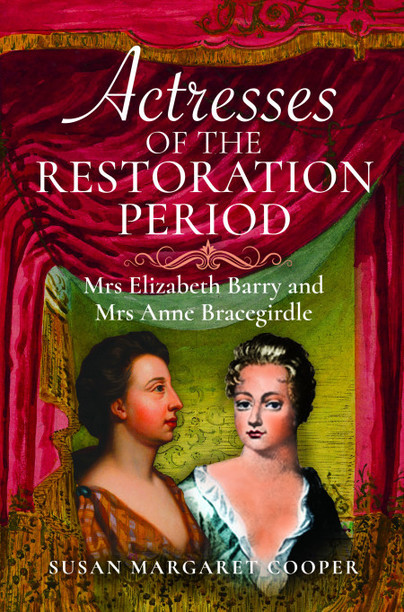
Actresses of the Restoration Period: Mrs Elizabeth Barry and Mrs Anne Bracegirdle. Susan Margaret Cooper. Review by Annette Rubery.

Actresses of the Restoration Period: Mrs Elizabeth Barry and Mrs Anne Bracegirdle. By Susan Margaret Cooper. Yorkshire: Pen & Sword History. 2023. Pp 224. £22.00 (hardback), ISBN 9781399064804.

Susan Margaret Cooper is in the somewhat rare position amongst theatre historians. She is herself descended from a stalwart of the 18th-century stage, Roger Bridgwater, who trod the boards in London for 31 years, and whose biography she published in 2020. This new work is a double biography of two actresses, who, although forgotten today, were hugely influential figures of the Restoration stage. Aside from various biographical dictionary appearances, Cooper’s book is the first mainstream publication to tackle the lives of Elizabeth Barry and Anne Bracegirdle, and to put them into context.

Actresses of the Restoration Period opens with an overview of Restoration London’s cultural scene, before turning to Mrs Barry (‘Mrs’ was the proper form of address for professional actresses, being an abbreviation of ‘mistress’, i.e., one who is skilled at something). Despite the indignity of being considered plain and ‘indifferent plump’, Barry nonetheless made a vital contribution to the British stage, especially in the tragic repertoire. According to Cooper, she inspired passion in the playwright Thomas Otway, and was the lover of John Wilmot, 2nd Earl of Rochester, with whom she had a daughter (Elizabeth or ‘Little Barry’).

Cooper has sifted the sources, giving us excerpts of scandalous poetry and material spoken by Barry in the form of prologues and epilogues. One difficulty, given the lack of primary source material, is capturing Barry’s personality, but Cooper draws on some rare sources including a transcription of a letter by the actress, held at the Horace Howard Furness Memorial Library at the University of Pennsylvania.

She also provides interesting reflections on Barry’s sudden illness at Drury Lane in 1688 while acting in John Crowne’s Darius, King of Persia. George Granville wrote that Barry ‘was forced to be carried off, and instead of dying in jest was in danger of doing it in earnest’ (p. 52). Cooper notes that the actress did not return to the stage for 18 months. Putting the incident in the context of her daughter’s illness (who died the following year), she speculates that Barry may have been suffering from a nervous breakdown.

In the case of Mrs Bracegirdle (or ‘Bracey’ as she was affectionately known) Cooper presents some excellent research on the actress’s Northampton relatives and childhood. She also covers her friendship with the playwright William Congreve: ‘It was rumoured by contemporaries that her friendship with Congreve might have been more than just platonic, he regularly visited her until his death in 1729’ (p. 113). In fact, Congreve lodged with Bracey’s sister (Mrs Frances Porter), and his involvement with the Kit-Cat Club helped to establish Thomas Betterton’s new theatre company at Lincoln’s Inn Fields, where both Barry and Bracegirdle performed.

Bracey (who was famed for her chastity) remained unmarried, although the poet, playwright and Shakespearean scholar, Nicholas Rowe, also fell heavily for her charms. As Cooper shows, his attentions were unrequited, resulting in the publication of some disparaging verses:

Of proffers large her choice had she,

Of jewels, plate, and land in fee,

Which she with scorn rejected:

And can a nymph so virtuous be

Of base-born blood suspected?

(p. 118).

Whether or not this rather simplistic poetry came from Rowe (who was made Poet Laureate in 1715) or a satirical imitator, it’s not clear, and herein lies the problem. The reader of Actresses of the Restoration Period would have benefitted from a closer interrogation of the sources than Cooper provides. Elsewhere she quotes an anecdote about Nathanial Lee’s The Rival Queens, where Barry (playing Roxana) lets jealousy of her co-star, Elizabeth Boutell (Statira), get the better of her during the murder scene at the close of the play: ‘Roxana hastening the designed Blow, struck with such Force, that tho’ the Point of the Dagger was blunted, it made way through Mrs. Boutel’s [sic] Stayes, and entered about a Quarter of an Inch in the Flesh’ (p. 67).

What Cooper doesn’t mention is that the anecdote came from The History of the English Stage (1741) and was therefore probably the work of the scurrilous and unreliable publisher Edmund Curll. Not only did the story appear more than 60 years after the supposed incident, but the tale of one actress almost stabbing the other during The Rival Queens quickly became part of the play’s mythology (it re-emerged in 1756 in the context of Peg Woffington and George Anne Bellamy’s performances as Roxana and Statira, for example). Was it a real incident or simply a fable that grew into a marketing strategy? The proliferation of anecdotes is one of the central challenges of writing theatrical history, especially in the Restoration period, when eye-witness accounts were rare.

However, Cooper is a genial guide, and her work is to be applauded, given her necessary reliance on poetry and other secondary sources. The book offers an engaging series of plates, including the interiors and exteriors of playhouses, maps and manuscripts. Cooper also provides a useful list of the actresses’ theatrical repertoire, along with comprehensive extracts from a huge range of 17th-century material. Barry and Bracegirdle were just as recognisable to Restoration theatregoers as Nell Gwyn, but they have not persisted in the public imagination nearly as well. Actresses of the Restoration Period not only brings these fascinating women back into view, it tackles a complex period that’s ripe for further research.

Annette Rubery

Annette Rubery is an independent scholar and an Associate Fellow of the Royal Historical Society. She was awarded a PhD in English and Comparative Literary Studies by the University of Warwick in 1999. She has since published a book of local history, Lichfield Then & Now (The History Press, 2012) and is currently writing a full-length biography of the 18th-century actress, Peg Woffington. Annette’s personal website is http://www.annetterubery.co.uk/.

Carrying All Before Her: Celebrity Pregnancy and the London Stage, 1689-1800. Chelsea Phillips. Review by Sara Read

Carrying All Before Her: Celebrity Pregnancy and the London Stage, 1689-1800. Chelsea Phillips. Newark, New Jersey: University of Delaware Press. 2022. $34.95, 304 pages, 15 b-w images (paperback) ISBN 9781644532485

With the Restoration of the monarchy and the now famous warrant from Charles II in 1662 that women rather than boy actors were now to play all female roles, it was inevitable that theatrical companies would have to work around occasions when their leading ladies were pregnant, lying in, or nursing infants.  By the late eighteenth century, however, Covent Garden theatre was declared by Rambler’s Magazine to be the “‘most prolific place in England’” because six of its “female performers were pregnant or lying in” during the 1784 season (p. 208). Scholars of the Restoration stage have long acknowledged that actresses worked whilst pregnant and have made assumptions about what parts an actress could or could not perform in whilst expecting a baby. Chelsea Phillips’s study of six London actresses’ personal and professional lives across the long eighteenth century is a significant intervention to the field as it looks afresh at actresses who were famous in varying degrees during their reproductive years and centres their experiences. Phillips’s careful use of performance history and other records adds nuance to many of the pre-existing assumptions about pregnant women’s experiences in the theatre. For example, Susanna Mountfort Verbruggen was in her third pregnancy when playing Mrs Wittwoud in Thomas Southern’s The Wives Excuse, or Cuckolds Make Themselves in the 1691-92 theatre season. The play premiered in December when Mountford Verbruggen was midway through this pregnancy. She gave birth to Elizabeth Mountfort on 22 March the following year (under twelve months after her delivery of Edward on 1 April 1691, which too came under a year after Susanna’s birth on 27 April 1690). Phillips makes the case that rather than this being an expedient casting to accommodate the pregnancy, Mountfort Verbruggen was well-known as a comic actress and the pregnancy may even have been advantageous to the role since Mrs Wittwoud was “adapt at pawning illegitimate pregnancies off on unsuspecting husbands” (pp. 46-47). This sort of reappraisal makes Phillips’ book invaluable to those interested in theatre studies, women’s studies, and early celebrity.

This study is organised chronologically around the lives of its subjects, but not all chapters take the same approach. So, Chapter One, “Inheriting Greatness” begins with Susanna Mountfort Verbruggen and Anne Oldfield. The women’s careers overlapped in the Drury Lane company by four years. They are connected in the study as “for both women, pregnancy aided the development of a new line of business” (p. 31).  In the 1712-13 season Oldfield continued performing in The Distrest Mother, set in the aftermath of the Trojan War, almost until she gave birth. She appeared as Andromache regularly between September 1712 and April 1713; the later performances would have been particularly poignant as Andromache sacrifices herself and her unborn child (p. 57). So just as for Mountfort Verbruggen, pregnancy helped her develop “parts that capitalised on the grotesque comic potential of the pregnant body[,] for Oldfield, portraying noble tragic heroines whose stoic natures enabled her to construct her pregnant body as classically contained” (p. 31).

Values and social expectations changed during the course of the long eighteenth century and so Chapter Two “Pregnant Sensibility: Susannah Cibber and George Anne Bellamy” considers the challenges faced by two rival actresses in “integrating pregnancy into their professional work in the age of sensibility” (p. 31). Chapters Three “Conceiving Genius: Sarah Siddons” and Four “Prolific Muse: Dorothy Jordon” also “function as a pair,” according to Phillips, because they consider the “similarities and differences in reception and self-fashioning for two women living very different lives” (p. 32). Jordan was the most prolific of the actresses in this study, having at least eighteen pregnancies in her thirty-year career. Thankfully, Carrying All Before Her contains a useful appendix listing the known births and baptism dates of the subjects’ children (pp. 223-34).

In thinking about early celebrity, Phillips raises the question of audience response to the loss of a famous actress. Mountfort Verbruggen died a few months after giving birth to son Lewis Verbruggen. Mountfort Verbruggen’s death did not attract the kinds of public mourning which followed the murder of her first husband William Mountfort, but Phillips considers whether audiences thought of her when watching the production of Oroonoko which was staged in the weeks following her death. Was watching Oroonoko’s grief for pregnant Imoinda all the more poignant (p. 48)? Phillips’s detailed analysis of the effects of Sarah Siddons’s visible pregnancies to her renowned performances of Lady Macbeth in 1785 and 1794 again asks questions of the way an audience might interpret that body in relation to the character (pp. 136-142).

Readers of Carrying All Before Her will discover that reasonable adjustments for pregnant women are not new and that in 1788 Dorothy Jordan received accommodations such as being exempted from having to make two performances an evening from around the four month point and the “temporary suspension of particularly strenuous roles in her repertoire” (p. 168). Others negotiated breaks to nurse their infants on performance days. And while readers won’t find themselves journeying into the birthing chambers of all the women in this study, they will hear George Anne Bellamy’s account of her eleven-day labour, in 1749, which needed the interventions of an accoucheur or man-midwife and likely his forceps as Bellamy refers to a “forced birth” (p. 97). 

Phillips notes that the presence of pregnant actresses on stage marks a significant cultural moment as these women were the first “nonroyal, nonaristocratic, nonfamilial, working pregnant bodies to which a significant cross-section of the population had almost daily visual and/or print access” (p. 29). This is right because while this was an era in which most working-class women in all trades had long continued to work until the moment of delivery, meaning that sight was not new, the cross-section of London society who went to performances would include many for whom this was their first sustained encounter with the working female body in a public sphere. Seeing pregnant women in such high-profile roles displaying the latest fashions of pregnancy to an audience and to readers of popular publications would indeed be “utterly new” (p. 29). Carrying All Before Her brings out new insights into this cultural moment. As Phillips acknowledges, a challenge of the project “is the diversity of the embodied experience of pregnancy” and that it is “difficult to recapture a sense of exactly what a woman felt and looked like when pregnant, in every performance across her lifetime” (p. 117). While this is true, it is certainly the case that readers of Carrying All Before Her come away with a much better sense of how actresses incorporated their celebrity pregnancies into their careers than they would otherwise have had. This book is a most welcome addition to the cultural recovery of women’s lived experience in the long eighteenth century.

Sara Read

Sara Read is a Senior Lecturer in English at Loughborough University. She is widely published in the area of early modern women’s reproductive health; she is also a novelist whose second novel – The Midwife’s Truth set in 1666 -has just been published. Sara is a member of the organising committee of the Women’s Studies Group. Her personal website is www.sararead.co.uk

2022 Workshop Review


Annual Workshop 24th September 2022
On the Margins: Interrogating the Notion of Marginal Status in the long Eighteenth Century. Foundling Museum, London

Our annual workshop unusually took place in September this year. We were delighted that our morning keynote was given by Dr. Karen Lipsedge and Dr. Emma Newport, both long- standing members, contributors, and supporters of the WSG. Emma Newport began the session by suggesting that there are many questions raised by the word ‘Margins’ which becomes particularly slippery when we consider the prepositions which are often attached, such as outside and beyond, within, between, above or beneath. She guided our discussion about agency and how active or passive words affect our understanding of the term. Power relations and choice are important, and crucially questions of gender, class and issues of who exactly is ‘on the margins’. The term is always political and ideological.


Karen Lipsedge then used the case study of Samuel Richardson’s Pamela, giving a close reading of the Joseph Highmore painting of Pamela and Lady Davers 1743-4 , (National Gallery of Victoria) to examine women’s autonomy in the domestic space. The painting shows the consequences of altering a woman’s assigned role in a patriarchal tradition. A lower-class woman was not expected to be genteel or virtuous but to gratify her master’s sexual demands. Pamela’s movement between the informal and formal rooms of the house as lady’s maid, servant and then wife mark the changes in her status. The painting depicts the moment when Lady Davers and her nephew attempt to attack and crush Pamela, asserting she has merely undergone a sham marriage with Mr. B, in a parody of the harmony and sociability usually represented in an eighteenth-century conversation piece. The focus on the table as a sign of social and hierarchical power and the positioning of other characters in the composition highlight the details that were important to Richardson in his alternative domestic scene and could be read as a queering of marginal space and questioning of what it meant to be at the centre.


Coincidentally, a recent Chawton House exhibition From the Margins illustrated efforts to support endangered species of the South Downs through restoration of hedgerows and wildflowers. This exhibition highlighted alternative approaches to the idea of marginal spaces, their fragility and the energy and struggle required to survive in an overlooked and threatened environment. We examined a quotation from Pamela, in which Pamela is described as a cuckoo who needs to be ‘hedged in’, with all the associations conjured by the term ‘cuckold’. Is Pamela a temporary joy of summer or a cuckoo in Mr. B’s nest?


The keynote presentations were rich and thought-provoking and were followed by a lively and enthusiastic discussion.


After a sociable lunch we reconvened for short presentations by workshop attendees, to explore a fascinating range of ideas related to On The Margins. Taking a cue from Pamela, we looked at the ‘monstrous’ masculine Mrs. Jewkes and the eighteenth-century female body as essentially rendered disabled and defined by what it could not do; we heard about medical recipes by women who were on the margins of professional and scientific knowledge whose work was usually printed cheaply, achieving only ephemeral status; and about the marginal status of women in the court room, 1810-12 Scottish case studies of women defendants who insisted on being heard in defiance of efforts to marginalise them because of their ethnicity, illegitimacy or accusations of lesbianism; Criminal cases against women who cross-dressed and made careers of piracy revealed that there was no explicit law against the practice; women as landladies were marginalised figures, surviving under difficult conditions, as were the dancing girls who had no choice but to perform for the French invaders during Napoleon’s Egyptian campaign.


We heard about a woman who survives a shipwreck to live alone on an island and gain agency when separated from her family, in Penelope Aubin’s The Noble Slaves (1722); and about Caroline-Stéphanie-Félicité, Madame de Genlis’ novella La Femme Philosophe (1804), which imitates the novel Edmund Oliver by Charles Lloyd (1798) where sexual transgression leads to the female character Gertrude’s downfall, but Genlis makes her the protagonist, exploring a liminal space of fluid and unstable subjectivity.


Women travellers such as Hester Piozzi, Ann Flaxman and Mary Shelley stood on the rim of Vesuvius, a real marginal space of danger, and recorded their impressions. We also enjoyed a performance-based presentation in which a portrait of Mary Moser was questioned about her life and career, now that recent attention has brought her out of the shadows.


Marginality in all its subtle shades emerged from our day, in a variety of disciplines and fields of research. Presentations gave us snapshots of exciting ongoing work and, as Karen Lipsedge concluded, ‘a rich ecology of things to explore’.


Many thanks to our keynote speakers and all our participants, and we look forward to further conversations in our next workshop!

Review by Miriam Al Jamil