A reflection by Charmian Kenner
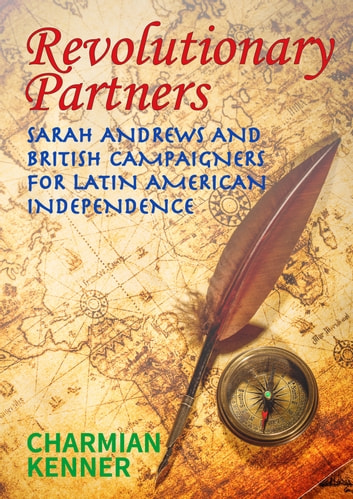
I have just published my book Revolutionary Partners: Sarah Andrews and British Campaigners for Latin American Independence, and as an independent researcher I have found the Women’s Studies Group to be a vital source of support.
I discovered Sarah Andrews, the main subject of my research, in a painting at the Venezuelan Cultural Centre in London. The picture is a contemporary re-imagining of a scene taking place in the early 1800s. Simón Bolívar, the future Liberator of Venezuela, Bolivia, Colombia, Ecuador, Peru, and Panama from the Spanish, is being received by fellow revolutionary Francisco de Miranda at the latter’s London home. My attention was caught by the depiction of a young woman in the corner of the painting, reading a book with two young children next to her.
This young woman turned out to be Sarah Andrews, the British partner of Francisco de Miranda. Intrigued, I began to investigate her story and found that Sarah ran the household, which served as a London headquarters for supporters of Latin American independence. My starting point was a treasure trove of Sarah’s letters to Miranda while he was away fighting in Venezuela from 1805-1807 while she held the fort back home.
I had been a feminist historian 35 years earlier and many other things in between. Now retired, with no institutional affiliation, I needed a way to exchange ideas with like-minded people. The ideal would be a group centered on women’s history, so I searched online and was excited to find the WSG close to me in London, with seminars accessible to all.
Attending my first seminar, I was welcomed and immediately treated as an equal. Everyone I spoke to was interested in my topic and eager to help, suggesting references and recommending lines of enquiry. I was relieved to find that many in the group were independent researchers and had been able to publish their work.
The seminars were a constant source of wonder, revealing so much about centuries of women’s history. Ideas about my own research were stimulated as contributors interacted with the audience and drew out threads of commonality between the presentations. Questions and comments were always infused with a spirit of positivity.
Some topics were of direct relevance to my research. A paper by Valentina Aparicio drew attention to Maria Graham’s journal of her stay in newly-independent Chile in 1822, which became an important source for my study. Together with documentation I had already gathered on Mary English and Kitty Cochrane, who accompanied British partners fighting alongside Simón Bolívar, this widened my focus beyond Sarah Andrews’ story. My book now includes the experiences of other British women supporters of Latin American independence.
Like everyone in the WSG, I was invited to submit a paper for the seminars. This was an opportunity to focus my thinking and develop my analysis. The response from the audience was heartening. They were keen to discover more about Sarah Andrews and her social and political context, encouraging me to continue with the research and to publish.
Feedback at the seminar provided me with key ideas from wide-ranging scholarly knowledge amongst the WSG. For example, several group members highlighted the significance of Sarah Andrews’ father being a shoemaker. This could explain how Sarah encountered revolutionary ideas in the Yorkshire market town where she was born since shoemakers’ shops were a well-documented centre for radical discussion.
Further help was forthcoming after the seminar. Louise Duckling sent suggestions for publishers, whilst Gillian Williamson shared information she found in Old Bailey records concerning a burglary at Sarah Andrews’ home in 1840. The court evidence revealed Sarah’s living arrangements and those sharing her house at this point, a period for which little other data was available.
This support validated my topic and spurred me on. I soon began to write, and at a recent WSG seminar I was happy to say that I was about to publish my book with free access online. WSG members received this announcement with the same pleasure and interest they had shown throughout my research journey. It felt like coming full circle.
The final hurdle was to convert my Word document into the format required for an e-book. Images and captions kept repositioning themselves, and I couldn’t find anyone who knew how to solve the problem. Once again, WSG came to the rescue. I put out a call for help on the email list, and Louise Duckling quickly responded with suggestions for people experienced in formatting. The first person I contacted sent an immediate reply and not only sorted out my pictures but also improved the book’s overall design. I was ready to publish! Revolutionary Partners: Sarah Andrews and British Campaigners for Latin American Independence can be accessed free here.
Thank you, WSG!
Charmian Kenner
Charmian Kenner started life as a feminist historian in the 1970s. After many other incarnations she returned to her original occupation, having discovered the existence of Sarah Andrews, the partner of Venezuelan revolutionary Francisco de Miranda in London in the early 1800s. Sarah’s intriguing story was waiting to be told, and the result is the recently published book Revolutionary Partners: Sarah Andrews and British Campaigners for Latin American Independence, available free on Kobo.
 Women's Studies Group 1558 - 1837
Sorry, I cannot access your Comment box, so let me say: Hooray to Charmian Kenner! She’s given us an inspiring story — and example. This is a brave woman, dedicated to her subject & secure in her identity as a scholar and publishing author. We wish her continuing success, Maureen E. Mulvihill (PhD) Princeton Research Forum, NJ (a respected community of Independent Scholars). ____
LikeLike