Call for papers from the Women’s Studies Group: 1558-1837 (London)

CFP Deadline: 6 August 2024

The Women’s Studies Group 1558-1837 is a small, informal, multidisciplinary group formed to promote women’s studies in the early modern period and the long eighteenth century. Established in the 1980s, the group has enabled those interested in women’s and gender studies to keep in touch, hear about one another’s research, meetings and publications, and meet regularly to discuss relevant topics. We organize regular meetings and an annual workshop (see membership application form) where members can meet and discuss women’s studies topics. This season we shall also be hosting two book launches for publications by our members. We can offer advice and opportunities to engage in activities that increase opportunities for publication, or enhance professional profiles in other ways. The WSG is open to men, women, and non-binary people, students, faculty, and independent scholars, all of whom are invited to join the group and give papers.

The group now has two kinds of meeting for seminars.

In-person seminar meetings. These will take place at the Foundling Museum, 40 Brunswick Square, WC1N 1AZ, UK, on Saturday afternoons. We will be allowed into the room at 1.00 pm., to give us time to sort out paperwork and technology, but sessions will run from 1.30 – 4.30 pm. So please arrive a little early if you can.

ZOOM seminar meetings. These will take place on Thursday evenings and will be hosted by a member of the wsg committee. They will run from 7-8.30 pm, with the waiting room opening at 18.45 pm.

Topics can be related to any aspect of women’s studies: not only women writers, but any activity of a woman or women in the period of our concern, or anything that affects or is affected by women in this period, such as the law, religion, etc. Male writers writing about women or male historical figures relevant to the condition of women in this period are also a potential topic. Papers tackling aspects of women’s studies within or alongside the wider histories of gender and sexuality are particularly welcome; so are topics from the early part of our period. We would also welcome how-to presentations for discussion: examples of suitable topics would include, but are not limited to, grant applications, setting up research networks, becoming a curator, co-authorship, using specialised data, and writing about images. Papers should be 20-25 minutes.

Last year’s titles and abstracts are available on the website seminars page to provide examples of papers accepted in the past. 

Dates of seminar meetings:

Saturday 19 October 2024       In-person 

Saturday 9 November 2024      In-person

Thursday 16 January   2025      ZOOM. 7-8.30 pm, Greenwich Mean Time

Thursday 6 February   2025      ZOOM. 7-8.30 pm, Greenwich Mean Time.

Saturday 15 March     2025       In-person

Thursday 10 April       2025       ZOOM. 7-8.30 pm, British Summer Time

Find out more about us on https://womensstudiesgroup.org

Please reply to Carolyn D. Williams on cdwilliamslyle@aol.com

Lodgers, Landlords, and Landladies in Georgian London by Gillian Williamson. Review by Sarah Murden

London: Bloomsbury Academic. 2021. Pp 256. £85.00 Hardback; £28.99 Paperback; £76.50 Ebook. ISBN: 978-1350212633.

How often, when we walk past surviving Georgian houses, do we wonder what life would have been like for the people who lived behind those closed doors back in the eighteenth and nineteenth centuries? Probably not very often, if at all, if truth be known. We admire the classical architecture which has stood the test of time and is iconic of that period, but what about the lives of those who lived there?

Gillian Williamson’s book Lodgers, Landlords, and Landladies in Georgian London investigates what life would have been like behind those closed doors, both for the landlord/lady and for a lodger. The majority of homeowners weren’t rich and famous, they were more your average working people, living lives we may well be familiar with today – going to work to provide for their family, staying at home to raise the family, socialising with friends, but also taking in lodgers to make ends meet – so what was life really like behind those iconic Georgian doors?

I have to begin this review with a confession. As someone who spends most of their time in the eighteenth century, I had never given lodgers, landlords or landladies a second thought, but this book has definitely shone a very bright light into this world, and how much social history was hidden behind those doors. This book is quite probably unique in its investigation, which makes it utterly fascinating and extremely thought-provoking.

Lodging in the eighteenth century could be compared to a certain extent with multi-occupancy student accommodation today, but with the landlord/lady and possibly their family also living ‘on site’. A lodger rarely had their own door key, and did you even know that there was a ‘code’ to ringing a doorbell or knocking on one of those Georgian front doors waiting to be let in? Each knock or ring defined who you were and your status within Georgian society.

How did one approach the task of finding somewhere to lodge in Georgian London? In some ways part of the actual process of finding lodgings hasn’t really changed that much since the eighteenth century, instead, it has just become quicker. As with today, where you are going to live in London determined the price you would pay for lodgings. Some people only took lodgings for ‘The Season’, others only when Parliament was sitting, but for most, it was taken more as a long-term residence, assuming you weren’t ejected for a misdemeanour, or simply because the owner had a change in their situation, and you would perhaps stay there for about a year or so.

Williamson investigates this process thoroughly, in a step by step way, from the landlord/lady placing an advert in say a newspaper, to potential candidates applying, often via a third party, to how lodgings were advertised, how much it would cost to rent a room(s), the size of your accommodation and then of course, there were the extras to be carefully considered – did you want to do your own cooking in your room or pay for meals with your landlord/lady or dine out? How about laundry? – would you do you own or pay the household servant to do it for you? What about heating? – after all, it was cheaper to sit in the parlour with the owner rather than spend money on your own coals, but then maybe you would have to mix with other lodgers who you may or may not rub along with, who were also trying to save money on heating. Cost was of paramount importance, as were ways to save money on what was an expensive art of simply living. One amusing quote Williamson includes is a reference to the poet William Wordsworth who visited the Lambs at their lodgings, who were then charged extra for sugar as Wordsworth took more sugar in his tea than most – everything had its price!

Lodgers agreed an inventory so there could be no argument when they moved out, along with recompense at the end of the agreement for any damage caused, which it appears was not uncommon, be it spilled ink or fire damage, the list goes on. It was always worth considering when taking unfurnished accommodation that the lodger should check out the status of their landlord so that, should the bailiffs be called in, your possessions weren’t also seized to fund their debt.

Moving lodgings, now this was another performance in itself, such as packing your chest(s) then unpacking at your new location. Williamson investigates methods for arranging your chest to be transported for you, as of course it contained all your worldly goods. Next came the settling into new, strange accommodation, often with people you would never have associated with before and who you may not get along with.

Williamson cites several people who disliked this process intensely and for whom a record remains of their experiences. Then of course, there was the issue of having to live in a room with furniture and accessories which might not have been to one’s taste, but not being able to afford one’s own dwelling with a front door meant there was no choice. Funds determined the potential size of the accommodation, so it may have been just a tiny garret or several rooms with use of the household servants.  Stereotypical gender roles were often assumed, with female lodgers having to fend for themselves, whereas it was commonplace for female landladies to do extra things for their male lodgers, such as repairing clothing and caring for them if unwell.

Some landlord/ladies allowed their lodgers to have their name on the front door to help callers know that you lived there, but it’s perfectly feasible you might be charged extra for this service.

Trying to ‘rub along’ together with strangers is never easy and that hasn’t changed despite the passage of two hundred years. We all have our own idiosyncrasies, as people did back then, but for most people today, we can close our doors and be ourselves – not so for many in Georgian London, as you had to consider the other lodgers.

The book comprises of seven chapters, plus an extensive notes section at the end and is without doubt a book which will appeal to anyone with an interest in social history, day to day life in the Georgian Era and social housing in general. The book is filled with fascinating anecdotes, and I have learnt so much from it, including much I had never even thought about, and as such I would highly recommend it. I’m sure it’s one I will return to again and again in future research.

Sarah Murden

All Things Georgian

Sarah Murden, FRHistS, is an eighteenth-century historian, genealogist and independent researcher, who has also co-authored five books, published by Pen & Sword books. Sarah is most well known for her website, All Things Georgian, which includes around 700 articles, covering all aspects of Georgian life.
Review: WSG Seminar, 26th March 2022 at The Foundling Museum

Sophie Johnson: History’s ‘Other’ Sculptors: The Underrepresentation of Historic women sculptors (1558-1837) in the history of art

Charlotte Goodge: ‘Sedentary occupations ought chiefly to be followed by women’: The ‘Fat’ Woman and ‘Masculine’ Exercise in the Literary Culture of the long eighteenth century

Moira Goff: Evered Laguerre: A Female Professional Dancer on the London Stage

We returned to the Foundling Museum for our March seminar, after an absence of two years, to hear three outstanding papers and to enjoy an afternoon of lively and informative discussion. As so often happens, unexpected connections between the subjects emerged and we could certainly have continued our explorations for much longer. Sophie Johnson began by extemporizing on her research into women sculptors throughout the period covered by the Women’s Studies Group and beyond, to examine how the few who have found a place in art history have been represented and under what circumstances they forged a career in this overwhelmingly male-dominated art form. She discussed the amateur/professional binaries, the problems and risks surrounding the perceived transgressive nature of the art and emphasised curatorial practice and questions of mistaken attribution as crucial factors in the invisibility of women sculptors.

Charlotte Goodge tackled debates about corpulent women in the eighteenth century in the light of society’s expectations about women’s delicate nature and what kind of exercise was considered appropriate. She focussed on participation in the hunt and on mountaineering and walking, citing literary examples from Charlotte Lennox The Female Quixote (1752) and Thomas Love Peacock Crotchet Castle (1831). Through these literary examples, Goodge argued that the ‘fatness’ of their female protagonists was pointedly used to flag an immoderate excess in terms of over rather than under exercising. Contemporary anxieties about women’s over-enthusiastic exercise centred less on health risks and benefits and more on the fact that robust physical strength was perceived as characteristic of labouring people (especially labouring men), an undesirable outcome for women from the genteel classes. Women’s transgression in different forms was important in both these papers.

Moira Goff offered her findings on the life of the early eighteenth-century dancer, Evered Laguerre, whose remarkable career on the London stage lasted more than twenty years, from her debut at thirteen in 1716 to her final performances in leading dance roles for John Rich’s company in 1737 when she was only thirty-five. We had glimpses of her in a print depicting her dancing with Francis Nivelon in the pantomime Perseus and Andromeda (1731),and in a possible second representation as the ‘Lady dancing’ in Nivelon’s The Rudiments of Genteel Behavior (1737). During our discussion, Goff gave us further fascinating insights into the stage careers of young dancers and into the published dance notation for a Harlequin dance, perhaps related to The Necromancer; or, Harlequin Doctor Faustus (1723) in which Laguerre danced the part of ‘Harlequin Woman’.

The papers demonstrated the difficulties of finding women in the archives, but the importance of pursuing the research if we are to recognise their contributions, a perennial problem faced by those working on women’s history. They also highlighted the delicate line between compliance and error, recognition and notoriety and the inescapable judgements of a patriarchal system. Our thanks to all three presenters, and to those who joined us at the seminar.

Miriam Al jamil

Review: WSG Seminar (25 September 2021) by Miriam Al Jamil

This is a review of the WSG seminar that took place on 25 September 2021. The speakers were:

  1. Valerie Schutte: Anachronistic representations of Edward Underhill
  2. Helen Leighton Rose: Women’s subversion of the Scottish Church Courts 1707-1757
  3. Matthew Reznicek: Healing the Nation; Women, Medicine and the Romantic National Tale
  4. Norena Shopland: Women Dressed as Men

Abstracts of the speakers’ papers are available to read here.

Our 2021-2022 Seminar season began with an excellent selection of papers from four speakers, ostensibly on a variety of unrelated topics and yet subtle connections emerged through the discussion.

Valerie Schutte’s paper examined the afterlives of Gentleman Pensioner Edward Underhill’s 1561 memoir which traced his life as a Protestant under Mary I’s reign, beginning with his arrest for publishing a now lost ballad at her accession in 1553. Elements of the memoir later appeared in John Strype’s 1721 Ecclesiastical Memorials which was used by Agnes and Elizabeth Strickland in their Lives of the Queens of England, From the Norman Conquest, With Anecdotes of Their Courts (London: Henry Colburn, 1845) and by the prolific writer W.H. Ainsworth in his popular The Tower of London (London: Bentley, 1840). Schutte offered Underhill’s devotion to the queen in spite of his anti-Catholicism as a more nuanced alternative to the standard view of hostile Protestant reaction to Mary. The nineteenth-century writers she examined were sympathetic to Mary, citing her marriage to Philip II of Spain as the source of Protestant oppression throughout her reign, although Charles Dickens’ unequivocal characterisation of ‘bloody Queen Mary’ still prevails as part of the national historical narrative.

In the discussion Schutte expanded on archival evidence of ballads against Mary I, citing twenty surviving examples, handwritten on cheap paper, most in single copies at the Society of Antiquaries. The writers were persecuted, though some of their ballads no longer exist. Underhill’s Catholic friends gave him the nickname ‘the Hot Gospeller’, a term picked up on by Ainsworth. Schutte also noted that the Strickland sisters’ romantic study of the Queens of England focused on them as women rather than simply as wives, which makes the book unusual.

Helen Leighton Rose’s paper presented her ongoing work on cases brought before the Scottish Kirk in two localities. She discussed the different recorded cases brought before the sessions, the types of moral offences and forms of punishment. The crimes included adultery, for which the punishment was six appearances wearing sackcloth in a public place of repentance, and fornication which involved three appearances. The ultimate sanction, meted out to a woman who repeatedly refused to appear was ‘lesser excommunication’, which meant she was shunned by her community, denied marriage, baptism or a funeral and banished from her place of birth. Rose pointed out that this had serious implications for accessing poor relief. The case studies revealed intriguing facts about women who were unafraid of accusing and naming the men implicated in their crimes, and who defied the punishments meted out to them. They also highlighted the fact that wealthy men could often avoid embarrassing personal repercussions by helping their pregnant victims circumvent the kirk disciplinary system and give birth in arranged lodgings in Edinburgh, while they themselves could evade punishment by paying fines. The case studies brought the individual women uncovered from the archives vividly to life.

Discussion points included the role of the well organised private lodging houses in Edinburgh, which require more research. A question was asked about cross-dressing as a recorded crime, and Rose has not found this or homosexuality mentioned in the records yet. The rich subject of her research clearly offers many different rewarding paths for future work.

Our third paper centred on Sydney Owenson’s The Wild Irish Girl (1806) Vol. I, II and Vol. III,   

and Maria Edgeworth’s Ennui, or Memoirs of the Earl of Glenthorn (1809).

The paper interrogated the idea of healing as a potentially feminist intervention. Reznicek gave a close reading of these novels, in the light of the social and economic conditions of Ireland which contributed to high mortality in nineteenth-century cholera outbreaks, and the concept of a healthy social body composed of healthy individuals to which the woman as healer made a crucial contribution. Owenson’s novel is usually cited as the first ‘national tale’, but is not usually interpreted as a story of sickness and healing (See for example, discussions in:

https://www.cambridge.org/core/books/cambridge-companion-to-the-irish-novel/national-tale-and-allied-genres-1770s1840s/7195FADCF1F85A2DB7E05A43EE49A15E [accessed 28 September 2021]).

Reznicek suggested that Owenson’s use of the word ‘physicianer’ to describe her character Glorvina was a deliberate subversive one to challenge contemporary male-dominated medical practice. The plot of the novel reveals that the threat of disease and religious fervour in the Prince of Inismore character makes his integration into the new social body impossible. Edgeworth used fever as a potent metaphor with multiple meanings. Her novel Ennui poses literature as the remedy of ennui as a disease. Once again, the woman is healer within the plot and in the broader context of the national social body.

Discussion ranged from the disabled body in Romantic fiction such as the Waverley novels, to Swift’s The Story of the Injured Lady in which ‘Ireland’ is the wronged virgin and ‘Scotland’ is the sickly rival for marriage to ‘England’, in Swift’s critique of marriage.

Our final paper was an overview of Norena Shopland’s writing projects, specialising in LGBT history, highlighting pertinent issues for many researchers into womens’ history. The instability of terminology and changes of definitions over time means that it can be difficult to find people from the past, particularly in the case of women living their lives as men, dressing, and working as men, unrecorded and marginalised. Shopland mentioned such celebrated cases as Hannah Snell, the soldier; Mary Anne Talbot or John Taylor, a sailor; and the pirates Anne Bonny and Mary Read. Other unidentified women later worked as navvies on the railways or as bricklayers, etc. The pay was better for men’s work, and it could be a short-term solution to hardship.

During a lively question session, the point was made that the literary cross-dressing heroine usually returns to heteronormativity after her escape to follow her lover is resolved in the plot. The detective work necessary to uncover archival sources for the anonymous women and the confusion over national traditions of dress which might be interpreted as more male than female; the infantilisation of women as a subtext in the ‘breeching’ of boys who progressed to adulthood and left their sisters behind; breeches parts for women in the theatre; and the hazards of labouring as a man with the vulnerabilities of the female body were all topics addressed. The interesting textual alteration made to the 16th century Geneva Bible which described Adam and Eve using fig leaves to make themselves breeches showed the sensitivity to gender-appropriate terms, when it was illegal for a woman to take men’s clothing.

As usual, the discussion could have continued well beyond time. We found all the papers stimulating and thought provoking. Our thanks to all the participants, and we look forward to more insights into WSG speakers’ research in the months to come.

-Miriam Al Jamil

Great explorations: a fictional midwife and fictions of ideal women by Louise Duckling

Following on from the arrival of WSG’s anniversary volume in paperback format, Louise Duckling introduces new books launched by two of its contributors: Sara Read and Tabitha Kenlon.

_________________________________________________________ 

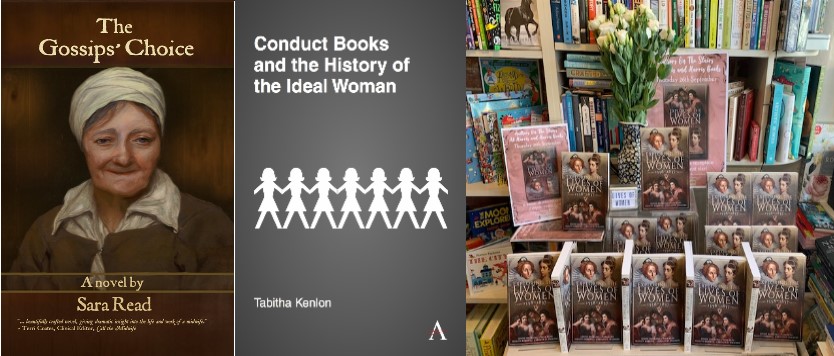
On an autumnal evening last September, a small crowd gathered at Harris & Harris Books in Clare, Suffolk, for one of its popular Author on the Stairs events. Gillian Williamson and I had been invited to talk about WSG’s anniversary book, Exploring the Lives of Women, 1558–1837, which had recently been released in paperback format.

As one of the book’s editors, I wanted to convey the scope and originality of our authors’ contributions in my talk. Therefore, I chose to address the question: why had so many of the women featured in the book been left out of the historical record? I considered how women’s history was constructed (and gendered) in Victorian biographical dictionaries, using our ‘bookend’ queens Elizabeth I and Victoria as opening case studies, before introducing some of the women whose lives are explored in our anniversary volume.

This approach led neatly into Gillian’s talk about her chapter on the Gentleman’s Magazine. Gillian eloquently described how the magazine constructed ideas of gender in the eighteenth century, specifically referencing the emergence of obituaries in its pages. The obituaries were used by Gillian (with some brilliant flashes of humour) to show how femininity was framed in the Gentleman’s Magazine, while also providing glimpses of a less-neatly gendered society.

There was an opportunity for the audience to ask questions and handle some of our original source material – an 1866 edition of a female biographical dictionary and an early volume of the Gentleman’s Magazine­. We enjoyed lively discussion and hospitality, in the perfect setting of an independent bookshop. Reflecting on this evening, in such an intimate and sociable environment, it is clear we were very fortunate. For anyone releasing a book right now, any ‘in-person’ events or celebrations will have to wait. This is exactly the case for two of our book’s contributors, whose latest work has been published during the lockdown.

The first of these new books is by Dr Sara Read, who specialises in cultural and literary representations of women, reproduction and medicine in the early modern period. Sara played a pivotal role in the WSG book, serving as both co-editor and contributor, with her chapter focusing on The Countesse of Lincolnes Nurserie (1622) by Elizabeth Clinton and highlighting views around childcare and breastfeeding. In her latest work, Sara continues to draw upon this rich subject knowledge, while venturing into new territory: the genre of historical fiction.

In her excellent debut novel, The Gossips’ Choice, Sara has created an atmospheric world for her protagonist, the midwife Lucie Smith. The book has been described as a seventeenth-century version of ‘Call the Midwife’, as we follow Lucie’s cases during the plague year of 1665. It is a beautifully crafted and impeccably researched novel, drawing upon a wide range of historical sources. For example, some of the events in the book are inspired by A Complete Practice of Midwifery (1737), the memoir of midwife Sarah Stone. This approach provides authentic detail to a vividly imagined and compelling story.

The second new book release is by Dr Tabitha Kenlon. Tabitha’s research concentrates on eighteenth-century British novels, theatre, and conduct manuals. In Exploring the Lives of Women, Tabitha’s chapter provides a close reading of a single text, exposing the confused rhetoric in the cautionary pamphlet Advice to Unmarried Women (1791) written by an anonymous clergyman. Tabitha also contributed one of the two poems in our book, ‘Gretchen’s Answer’, which follows similar themes by exploring the consequences of “when society tells women how to think, how to act, how to feel” (Exploring, p. 98).

Tabitha’s first monograph continues this investigation. In Conduct Books and the History of the Ideal Woman, Tabitha shows how the longest-running war is the battle over how women should behave. This is an exceptional study, being the first of its kind to provide a trans-historical approach: expanding upon previous period-specific studies, Tabitha considers the persistence (or alteration) of the female ideal over six centuries. Tabitha’s brilliant close readings of a wide range of texts are superbly executed and entertaining, making the book highly accessible to the specialist or general reader. It is a powerful book, written with compassion and flashes of anger, in an elegant and witty prose.

Until we can all meet to celebrate, congratulations to Sara and Tabitha for producing two great books. Full reviews of both publications will appear on this website in the coming months: watch this space!

____________________________________________

The Gossips’ Choice by Sara Read is published by Wild Pressed Books for £12.

Conduct Books and the History of the Ideal Woman by Tabitha Kenlon is published by Anthem Press for £80 (hardback) and £25 (ebook). Please ask your institutional library to buy a copy. A 20% discount is available to WSG members.

Exploring the Lives of Women, 1558–1837, the anniversary book by WSG, is published by Pen & Sword Books for £19.99 (hardback), £12.99 (paperback) and £5.20 (ebook).

Please support your local independent booksellers if you can. Harris & Harris Books is currently offering a delivery service.