
Venanzio Rauzzini and the Birth of a New Style in English Singing: Scandalous Lessons. By Brianna E. Robertson-Kirkland. New York and Abingdon: Routledge, 2022. Pp 244. 11 B/W Illustrations. £130.00 (hardback) £29.24 (ebook), ISBN 9780367443375.
The Italian castrato Venanzio Rauzzini (1746–1810) spent some 36 years in Britain, where he made a significant contribution to the musical and cultural life of the nation. His multi-faceted career was chronicled in Paul F. Rice’s monograph Venanzio Rauzzini in Britain: Castrato, Composer, and Cultural Leader (2015), which concluded that Rauzzini’s most enduring legacy was ‘his teaching of a generation of leading soloists and his development of the Bath concerts’ (p. 285). While his activities as a concert director account for a generous proportion of the book, however, little attention is given to Rauzzini’s achievements as an educator. Robertson-Kirkland’s study fills this gap in the literature by examining the singer’s influence through the lens of his teaching, probing the pedagogical methods and socio-historic contexts that contributed to his producing some of the finest singers of the period. It unpacks the loyal network of relationships that Rauzzini built with his students, revealing how he cultivated a respectable public image in order to navigate the culture of suspicion that surrounded music masters generally, and castrati in particular.
After an opening ‘Prelude’ that sets out the book’s novel agenda, chapter one provides an overview of British music education in the eighteenth century, pointing up the distinction between the rigorous training that Rauzzini received in Italy and the unregulated system of apprenticeships and private tuition that prevailed in Britain. Arriving in London in 1774 to take up the role of primo uomo at the King’s Theatre, Rauzzini brought with him a wealth of knowledge of Italian music pedagogy at a time when Italian opera and vocal methods were highly respected. Having already established himself as an operatic star and singing master on the continent, the timing was opportune for Rauzzini to hone his skills in Britain. He was also well placed to use his celebrity status to promote his own students on the London stage, and chapter two explores the mixed reception given to two such individuals. Caterina Schindlerin failed to make a lasting impression and prompted Charles Burney to grumble about ‘the number of Italian singers who insisted their inferior students perform with them in the opera’ (p. 43). Anna Selina (Nancy) Storace was only ten when Rauzzini assigned her a minor role in his opera Le ali d’Amore in 1776 (Storace’s performances 1773–1778 are listed in Appendix 1). After completing her training in Italy, she went on to enjoy considerable success, not least as Mozart’s first Susanna in Le nozze de Figaro.
Rauzzini’s activity as a teacher was closely linked to the musical and cultural life of Bath, where from 1780 his own prestigious concert series provided a public platform for his growing network of associates. Chapter three compares the vocal techniques and careers of Gertrud Mara and Elizabeth Billington, both leading sopranos who regularly sang at these concerts. Claims that they were formally trained by Rauzzini are shown to be unlikely, however, although both women were certainly part of the musical circle that promoted his reputation. The next chapter unpacks why Rauzzini was dubbed ‘the father of a new style in English singing’, contrasting English and Italian vocal techniques and explaining how the two melded to create a ‘new style’. Although unable to father children of his own, Rauzzini spawned a generation of celebrity British-born singers through his teaching of Italian vocal technique. Chapter five explores this method through a detailed account of Rauzzini’s Twelve Solfeggi (1808), a treatise aimed at the advanced student and which sealed his pedagogical legacy. The concepts and history of the solfeggi tradition are lucidly explained and shown to be a versatile training tool that was fundamental to musical literacy and vocal flexibility. Rauzzini’s exemplary musicianship can be attributed to his own study of solfeggi, which was the standard method taught in the Italian conservatories and continues to inform vocal pedagogy today.
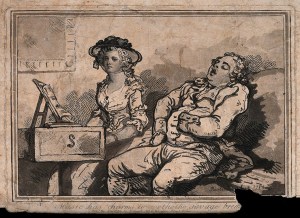
Chapters six and seven engage with the ‘scandalous lessons’ of the book’s subtitle, amusingly reflected in the caricature by Thomas Rowlandson chosen for its cover. During his early years in Bath, Rauzzini’s pupils included wealthy young women for whom musical skill was an expected accomplishment, and in which context his renowned good looks and geniality made him susceptible to slander. In 1779 he was publicly accused by William Gooch of a romantic involvement with his wife Elizabeth while she was Rauzzini’s pupil. The assumptions underlying this incident provide a platform for exploring fictional narratives that played into contemporary attitudes concerning music masters, particularly foreign ones. George Colman the elder’s comic afterpiece The Musical Lady (1762) satirised the British infatuation with Italian music and musicians through its portrayal of Sophy, a young woman whose moral judgement was swayed by ‘an unhealthy attachment to music and Italians’ (p. 132).
Although Rauzzini emerged from the Gooch incident relatively unscathed, other singers in his circle were less fortunate, and those whose careers were harmed by their involvement in scandal are discussed in chapter seven. Gertrud Mara’s liaison with Charles Florio prompted Joseph Haydn to declare her behaviour to be ‘despicable to the whole nation’ (p. 155), while Nancy Storace’s affair with John Braham, another of Rauzzini’s students, elicited considerable opprobrium in the press. Framing these case studies is an anecdote concerning a romantic entanglement immediately prior to Rauzzini’s arrival in England, recounted years later by the tenor Michael Kelly in his Reminiscences (1826, I, p.10). The story was unsubstantiated and received scant notice at the time, but it has recently been appropriated by a media keen to exploit public curiosity around castrati, particularly their perceived gender and sexual function. Thus an article in The Guardian in 2010 headlined Rauzzini as ‘the bedhopping singing star of the 1700s’, describing him as ‘a ladies’ man, a kind of castrato Casanova, sleeping his way round Europe’.
Intriguingly entitled ‘The Eighteenth Century in the Twenty-First Century’, the Postlude opens with an admission that we know very little about what Rauzzini’s singing lessons actually entailed, because of the intrinsically private nature of the teaching space. The one-to-one lesson is still the primary model for vocal and instrumental instruction today, and Robertson-Kirkland does not shy away from drawing parallels between potential hazards of the teacher-pupil relationship 350 years ago and those in the present. Reference to recent abusive behaviour and sexual grooming at a specialist music school in the UK makes uncomfortable reading but is effective in highlighting the timeliness and relevance of this study.
Overall, this is a fascinating investigation of teaching in relation to the education of professional and amateur singers in Georgian Britain, set in its wider cultural and social context. The writing is clear and engaging, and the scholarship lightly worn while underpinned by meticulous archival work of an interdisciplinary nature. There is a useful appendix containing short biographies of 47 singers advertised as Rauzzini’s pupils, the majority of whom are women. Comprehensive end notes for each chapter are supplemented by a detailed bibliography of manuscripts and published sources, and the excellent index will ensure the book’s usefulness as a reference tool. As a study that places teaching at the centre of the socio-historical narrative, it is a welcome addition to Routledge’s Studies in Eighteenth-Century Cultures and Societies series and deserves a wide readership.
Cheryll Duncan
Cheryll Duncan is Emeritus Professor of Musicology at the Royal Northern College of Music in Manchester, UK. She publishes on professional music culture in Britain during the late seventeenth and eighteenth centuries, with a particular focus on records of the equity and common-law courts.
 Women's Studies Group 1558 - 1837