The Tudors: Art and Majesty in Renaissance England

An exhibition review by Valerie Schutte

The Tudors: Art and Majesty in Renaissance England is a dynamic exhibition of Tudor artifacts currently touring the United States. On 14 May 2023, it wrapped up the second leg of its tour at the Cleveland Museum of Art, which was preceded by three months at the Metropolitan Museum of Art, New York, from 10 October 2022 to 8 January 2023, to be followed by three months at the Legion of Honor, San Francisco, from 24 June to 24 September 2023.

The accompanying exhibition catalogue is filled with full-page color images of every item, though not all are on display at all three museums. It also includes entries for items not on display at any of the exhibition stops because some of the loans were cut by the time the exhibition opened in October 2022, being delayed from its original autumn 2020 opening date.

As I saw the exhibition twice in Cleveland, I was unable to see many of the items related to Queen Mary I that were not displayed at this venue. These items included Hans Eworth’s 1554 portrait of her, as well as the cartoons for the panels donated by Philip and Mary for the Last Supper “King’s Window” at Sint-Janskerk, Gouda, though they are both beautifully represented in the catalogue. As a scholar of Mary I, I also have minor objections to the descriptions of some of the entries. For example, item number 27 is a 1557 copy of Juan Luis Vives’ Instruction of a Christen Woman on loan from the British Library. The catalogue description was written by Sarah Bochicchio, a PhD Candidate in art history at Yale University. While Bochicchio points out that Vives was a spiritual advisor to Catherine of Aragon and a director of Mary’s studies, she also writes that the text informed Mary and Elizabeth as inheritors of a gendered hierarchy of leadership. Furthermore, on the object label at the exhibition, Catherine of Aragon is not even mentioned, while the description highlights how both Mary and Elizabeth navigated a gendered duality during their queenships. While this is accurate, I am frustrated that such a powerful monument to Catherine and Mary must be discussed in terms of its importance to Elizabeth, thus fortifying the public perception of Elizabeth being a more important or worthy Tudor queen.

However, the more than 80 items on display in Cleveland showcased visual art as a formidable tool of monarchical power, from paintings and drawings to cups and bowls, and suits of armor to giant hanging tapestries. Various museums and private collections across Europe and the United States contributed displayed items. The Devonshire Collection at Hardwick Hall lent the “Sea Dog” table, a drawing table so called because of the sea dogs carved into its walnut legs, the Victoria and Albert Museum lent the Heneage Jewel, and the Kunsthistorisches Museum of Vienna lent Hans Holbein’s painting of Jane Seymour, while the newly-crowned King Charles III lent a miniature of Henry VIII and drawings by Holbein from the Royal Collection. These are only a few of the museums and collectors who participated in fielding these artifacts.

While some of the displayed items are well known, such as the painting of Henry VIII from the workshop of Hans Holbein and both the Sieve and Rainbow portraits of Elizabeth, many are lessor known artifacts that still portrayed the magnificence of the Tudor court. These include the ewer and basin engraved with portrait medallions of the monarchs on loan by the Boston Museum of Fine Arts and the embroidered portrait of Elizabeth I in a garden loaned from a private collection. 

Altogether the exhibition overwhelms its viewers with images of majesty, power, and Renaissance ideas of humanism and antique glory. The Tudors: Art and Majesty in Renaissance England is not to be missed, as this variety of Tudor objects and artifacts is not likely to be showcased in the United States again anytime soon.

Valerie Schutte is a historian who specialises in books dedicated to Tudor queens. She has published two monographs and her seventh edited collection will be published later this year – Mid-Tudor Queenship and Memory: The Making and Re-Making of Lady Jane Grey and Mary I. She is editing a special issue of the Royal Studies Journal to be published in December 2023 on Tudor royal sexualities. Schutte is currently writing a cultural biography of Anne of Cleves and is working on several essays on Queen Mary I.
WSG visit, Portraying Pregnancy: from Holbein to Social Media

WSG visit to the Foundling Museum exhibition, 15th February 2020

Tour and talk by curator Karen Hearn

Report by Miriam Al Jamil

Curator Karen Hearn treated a group of WSG members to a tour of her stunning exhibition at the Foundling Museum. Her interest in the subject of ‘pregnancy portraits’ began twenty years ago when she curated a small display at Tate Britain on the painter Marcus Gheeraerts II which included his Portrait of an Unknown Lady c.1595, a recent acquisition by the Tate depicting a woman who was clearly pregnant. But it is now, Karen suggested, that the subject has really ‘found its moment’ and the current exhibition is generating a huge amount of interest. Though Karen’s area of research centres on the Early Modern, the exhibition explores portraits from the Tudor period through to current social media images. Led by the availability of material and the strict parameters she set herself, Karen has assembled a range of portraits which can reasonably be read as showing an expectant woman, whether coinciding with a portrait commission, the reason for the commission itself or a fact cleverly concealed from the viewer. We saw examples of all these; stories told through paintings, drawings, prints, books and photographs as well as through fascinating objects, dress, needlework and sculpture. The sheer range of media on show and the interaction between objects, each with an important narrative to contribute albeit within the modest space available is a triumph of skill and professional expertise.

We began our tour on the ground floor of the museum, with William Hogarth’s 1750 painting The March of the Guards to Finchley, in which a ballad-seller clings to her soldier lover, her hand on her ‘bump’, the prominent ‘rising of her apron’ as evidence of her condition. Fear and dismay often attended the unwanted pregnancies which prompted the Foundling’s original mission, but Portraying Pregnancy is concerned with depictions of the inevitable and frequently dangerous condition which defined usually married women’s lives until relatively recently and the genuine fear of death which haunted the anticipated birth. So-called ‘Mother’s Legacy’ texts were poignant letters to an unborn child in case of such an outcome, and the slim manuscript and subsequently published version written by Elizabeth Jocscelin (1622) is on show. Sadly, she did not survive, as was the case for several other women who Karen introduced to us.

Beginning with representations of The Visitation from New Testament sources, we notice again the hand on the bump, a gesture which becomes a sign in many of the oil paintings, for example in the magnificent Unknown Lady in Red (Marcus Gheeraeets II, 1620) and Lady Verney (Anthony van Dyck, late 1630’s). The delicate drawing of Cecily Heron, daughter of Sir Thomas More, by Hans Holbein II (c.1527) details the knotted ties which join her expanded stays. Cecily appears again in a reproduction of the sketch used by Holbein for a large family portrait which shows her delicate hand on her bump.

Self-portraits by women artists are an important feature of the exhibition. WSG members may remember seeing and discussing Mary Beale’s Self-portrait with Husband and Eldest Son (1659-60) at our visit to the Geffrye Museum a few years ago. The artist sits on the left, traditionally associated with the male side of a husband and wife portrait, and holds a mantle up to her chest. This may conceal her pregnancy, since her second son was born in 1660. Karen has included the pregnancy stays and matching stomacher, probably made for the daughter-in-law of lady Verney and displayed close to her portrait. We noticed it was well worn. How many of her pregnancies had happy outcomes? Plate one of William Hunter’s grim and familiar print, The anatomy of the human gravid uterus exhibited in figures (1774) is nearby to remind us of one sadly anonymous woman’s fate – anatomised along with her unborn child. Among the final exhibits is the front cover of Vanity Fair (August 2017) featuring a heavily pregnant Serena Williams. Karen pointed out that the complications Serena suffered after the birth of her daughter would probably have led to her death in a previous century and this highlights the ever-present hazards of pregnancy and serves to connect the variety of images in the exhibition which this brief report has only touched upon.

A beautiful catalogue accompanies the exhibition. It includes extra examples and discussion, Karen’s work on the subject which has been twenty years in the making!

The Portraying Pregnancy: from Holbein to Social Media will run until 26th April 2020.

———————————————

Karen is involved in other events associated with the exhibition which members might find of interest:

She is giving a lecture on Elizabethan-period pregnancy portraits, especially that of Mildred Cecil, c.1563, at the National Portrait Gallery at lunchtime on 16 April: https://www.npg.org.uk/whatson/event-root/april/lunchtime-lecture-16042020

She is also speaking about portraits of Mildred Cecil at the conference on 21 April, to be held at The Garden Museum in London, to mark the 500th anniversary of the birth of her husband William Cecil, Lord Burghley: https://gardenmuseum.org.uk/events/burghley-500-symposium/

Finally, on 22 April, The Foundling Museum is holding a study day relating to the Portraying Pregnancy show. The speakers will predominantly be covering Early Modern subject matter: https://foundlingmuseum.org.uk/events/study-day-pp/

Featured images:

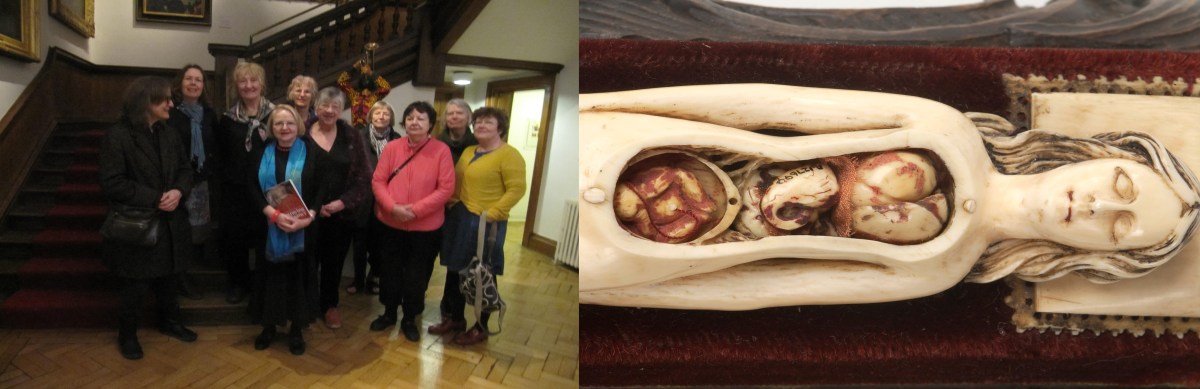
WSG visit to Portraying Pregnancy: From Holbein to Social Media (15th February 2020).
Alongside it is an Ivory anatomical model of a pregnant female with removable internal organs, on a cloth-covered wooden couch with ivory pillow, available from: https://wellcomecollection.org/works/ehms3mj9