
Danish-British Consort Portraiture, c.1600–1900. By Sara Ayres. London: Lund Humphries. 2023. pp. 176. £60.00 (hardback), ISBN 9781848225183. Review by Miriam al Jamil.

The title of this superbly illustrated book ostensibly indicates an overview of a specific group of royal portraits, produced over the course of three hundred years. An unusual focus on consorts who united the Danish and British royal families through marriage reveals the deep bonds between European dynasties, but also presents exemplary models for the author’s argument across otherwise broad and unmanageable periods of time. The book remains disciplined and centred, while at the same time offering a variety of evidence and new readings to make it a compelling and authoritative contribution to art history and visual culture. The chosen cover image, if unfamiliar to the reader, is assumed to represent one of these royal individuals in eighteenth-century military costume and with all the expected accoutrements of assertive might and power. However, it is soon revealed to encapsulate the far more complex narrative of the book. It subverts our expectations and challenges us to reassess what a portrait can tell us.

The 1770 portrait by Peder Als shows Caroline Matilda of Great Britain (1751–1775), the daughter of Frederick, Prince of Wales and Princess Augusta of Saxe-Gotha, who was married to King Christian VII of Denmark. She wears the uniform of the Life Guards, with red coat, sash and spurs, and sword at her side, about to take her tricorn hat from the table and to stride out through an arched doorway to inspect a line of soldiers drawn to attention in the courtyard. Her story forms chapter four of the book. By then, the reader has followed the writer’s close readings of three other consort portraits and traced the postures, settings and iconography which connect them to tell a history of transformation in the art of embodying the royal image (p. 10). The portrayal of rank shifted into one based exclusively on gender, a shift which affects our ability to understand and interpret a portrait even today. The argument is original and intriguing, underscored by research references drawn from a broad range of visual culture and historical sources, in particular Walter Benjamin’s writings on the work of art in an age of technological reproducibility. The argument relies on detailed observation to find new connections. Of the five Danish royal consort subjects of this study, only one, Prince George of Denmark (1653–1708), is male, but the book aims to explore how the royal image “rhetorically incorporated the most functional, symbolic qualities of maleness and femaleness” (p.22). It centres on uncovering the “complex palimpsest” of royal portraiture as embodiment, centring on the 1617 Paul van Somer portrait of Anne of Denmark (Royal Collection Trust) as its starting point.

Anne’s full-length portrait incorporates elements of the traditional male hunting portrait, the horse, dogs and distant view of a royal palace and park, as part of her self-fashioning. It was importantly designed to “instruct and nurture” (p.44) her son Charles in the noble and princely arts necessary for kingship. Charles I’s dismounted equestrian portrait by Anthony van Dyck, dated to c.1635, can be construed as a pendant. The crooked elbow which features in these and later royal portraits is an important sign derived from emblem book symbols of female perfection. When added to examples of extended elbows in male portraits suggesting greater male heat and virility, a feature of the ancient four humours medical theory, it is clear that there was more gender fluidity and layered meaning in the royal portrait than we might have realised.

The book explores the construction of royal embodiment and its image through the physical nature of the medium. The discussion on Prince George of Denmark centres on his youthful Grand Tour which included England on its itinerary, and the shaping of a cultured and refined royal figure. The wax medium used for the clothed and wigged waxwork of the young prince by Antoine Benoist (undated), now in Rosenborg Palace, Copenhagen, indicates the pliable mind of the prince as he was prepared for a role of power. The advances in scientific and Cartesian methodology, while essential elements of a modern royal education, changed the nature of royal embodiment. Louisa (1724–1751), daughter of George II, married Crown Prince Frederick V of Denmark-Norway. Her death during a late stage in pregnancy was followed by an autopsy which her doctors described in detail, changing the sacral body into a pathological case study. As the author notes,“The artisanal epistemology that had been the province of the consort and the artist as they together crafted the contours of the royal body as a work of art now became the property of the man of medical sciences” (p.80). The work of the anatomist reinforced the changing balance of power and the female body was laid open to a newly authorised male gaze.

The final two chapters consolidate the narrative of change. The author offers a new interpretation of a scurrilous woodcut lampoon of Caroline Matilda, printed in 1772, which “heralds the hygienic exclusion of the influence of women from political, public life, regardless of their rank, and their exile en masse to the seclusion of the domestic sphere” (p.88). The crude woodcut shows the queen on horseback, alongside a nurse holding her baby, and a male figure looking out of a window. The queen is construed as an “unnatural, sexually incontinent woman” (p.87) in the tradition of world turned upside down satire. The author suggests that the nurse represents the king, “left holding the baby” (p.89), the offspring of the queen’s affair with Johann Friedrich Struensee, the king’s doctor and prime minister. The threat to the royal bloodline at the centre of the print and the failure of masculine authority is embodied in the subversive and unruly woman. However, the king approved of Caroline’s wearing male attire, so contrary to a simple reading of the satire, the author suggests “the queen’s transvestism [is] a performative fall into masculinity responding to the king’s desire”, and a form of “sympathetic magic of mimesis” which constitutes the “body of the absolute king for him” (p.100–101). This reading questions and complicates the satire, based on traditional forms of unruly female representation and possible interpretations. However, the final example of consort portraiture is taken from an age of reproduction by means of photography. The narrative was reinvented for a new audience with irreconcilable binary gendered expectations determining its reception.

Alexandra of Denmark (1844–1925) married Albert Edward, Prince of Wales, later Edward VII, in 1863. Her elaborate reception in the capital “created a topological phantasmagoria within which ancient ceremony and industrial modernity comingled” (p.113). The rise of the carte de visite form popularised the image of the consort but also enabled comparisons and imitations in its mass availability and reproducibility. Following this, “fashion and the photographic image” defined the image of the consort and made her “a visual commodity”, a development that has ultimately made the represented female body “simultaneously object and abject” (p.128). Though beyond the scope of the book, clear contemporary examples can be found in the consorts of the current British royal family. The book does not falter in its structured and thorough exploration. Each chapter contributes new material and builds on its central premise of change over several centuries. However, while the title is precise, the breadth of the subject may not be anticipated by the browser in a library or book shop. But the book is a rewarding study as part of the Northern Lights book series, and the portraits examined cannot be seen in isolation again.

Miriam Al Jamil is on the WSG committee, chairs the Burney Society UK, and is Fine Arts editor for BSECS Criticks online reviews. She has published on women travel writers, Horace Mann and his circle in Florence and Rome, on Frances Burney, and on Eleanor Coade. There will be a chapter on Coade in the forthcoming WSG book.

Elisabetta Sirani. By Adelina Modesti. London: Lund Humphries. 2023. Pp. 144 + 65 colour and 12 black and white illustrations. £35.00 (hardcover), ISBN 9781848224971. By Anna Pratley

This is the first of three reviews we will be publishing on the Illuminating Women Artists series, edited by Andrea Pearson and Marilyn Dunn, and published by Lund Humphries. The beautifully illustrated volumes in this series explore the lives and works of women artists, many of whom have been previously overlooked in the history of art. To begin, Anna Pratley discusses the volume on Elisabetta Sirani.

 *******

Built upon decades of dedicated research and an informed analysis of recent developments in scholarly thought, Adelina Modesti’s contribution to the Illuminating Women Artists series is essential reading for any student or enthusiast seeking an overview of the remarkable life and work of Elisabetta Sirani (1638–1665). By seamlessly weaving into the text faithful English translations of seventeenth-century Italian sources and non-judgemental explanations of art historical terminology, Modesti has forged a highly accessible narrative which is gripping, informative, and truly illuminating.

Modesti begins by providing an impressively concise overview of the contemporary issues which shaped Sirani as an artist, including those relating to her family, education, and influential sociopolitical debates associated with the Counter-Reformation. Alongside addressing topics familiar to the scholar of early modern women, such as the Querelle des Femmes (‘Woman Question’), it also considers those factors unique to Bologna which allowed women artists to flourish. The most significant of these is the “matrilineal pedagogic model”, a term coined by Modesti to acknowledge Bologna’s encouragement of women teaching other women (p.19). Readers who wish to delve further into recent archival discoveries relating to the success of Bolognese women artists are appropriately signposted to Babette Bohn’s Women Artists, their Patrons, and their Publics in Early Modern Bologna (Penn State University Press, 2021).

Chapter 2 evaluates Sirani’s training, artistic influences, technique, and style. In accordance with Linda Nochlin’s 1971 argument – that the disadvantages faced by women artists should not be employed as an intellectual position – Modesti emphasises the wealth of resources available to Sirani: plaster casts, sculptures, paintings, drawings, palace collections, churches, books, and religious festivities to name a few. Relevant archival materials support investigations into Sirani’s colleagues and apprentices, particularly Lorenzo Tinti (1626–1672), whose artistic relationship with the maestra has not yet received its due focus and would be worth further investigation. A short paragraph on Sirani’s little-known caricatures (p.50) presents a similarly tantalising opportunity for further research.

However, it is Modesti’s ability to paint a picture of Sirani’s genuine passion for her profession which remains the most illuminating aspect of this chapter, and indeed of the whole monograph. Of note are personal anecdotes from Sirani’s biographer and friend, Carlo Cesare Malvasia (1616–1693); one of these (p.41) recalls the artist’s repeated visits to a jewellery shop to view a much-loved painting, and her subsequent avoidance of returning out of embarrassment for spending so much time admiring it. Descriptions of Sirani’s technique are just as evocative, for instance, how her experiments with wet-on-wet paint application created a “shimmering quality to the surface of her paintings” (p.32).  Modesti’s writing brings Sirani to life in this chapter, allowing her youth, character, and talent to radiate from the glossy printed reproductions of her works. It is a must-read example of how to introduce a non-specialist audience to the world of art history.

A natural progression from the previous chapter, Chapter 3 covers the themes, subjects, and iconography of Sirani’s works. An examination of Sirani’s religious paintings considers their propensity for use in spiritual reflection, a significant role for artworks in the Counter-Reformation. The suggestion that Sirani’s depictions of Saint Anne gained popularity as exemplars of the aforementioned matrilineal pedagogic model is insightful and well-supported. Perhaps the most successful use of images appears in this section (pp.64–65). The rich red, white, and blue drapery of Sirani’s Virgin and Child (1663) is complemented by that of the adjacent Salvator Mundi (c.1655–8), while a self-portrait sketch apparently used as the basis of the latter work is displayed alongside it, allowing direct comparison.

However, Modesti’s examination of Sirani’s historical heroines is tenuous in places. Her argument that the formal composition of Timoclea may have been inspired by Artemisia Gentileschi’s Judith Beheading Holofernes (c.1620) (p.78) is a refreshing addition to the discourse; yet one cannot help feeling that this was an attempt to shoehorn in a connection between two women artists where there is no extant evidence that they had any knowledge of each other’s works. More perplexing is the lack of any reference to Amy Golhany’s 2011 article – which recognises the irrefutable similarity between Sirani’s Timoclea and an earlier eponymous print by Matthaüs Merian (1593–1650) – despite its inclusion in Modesti’s select bibliography.

It is also worth noting that the section on anti-heroines assumes the authenticity of an Iole (1662), a Cleopatra (c.1664), and a Circe (c.1664), all of which have contested authorship. Modesti is known for taking an enthusiastic approach to attributions, sparking much debate with the other primary scholar on Sirani, Babette Bohn. The reader should remain conscious of this and take a critical approach to new attributions in this work. Chapter 1, for instance, attributes a painting traditionally thought to be by Sirani to her sister Barbara. The curious reader will discover that the ‘reference’ supporting this claim is a link to a Facebook image of the work with no caption, posted to the page of the Galleria Umbria Perugia in 2022. There are, I am sure, reasons behind this assertion, but without knowing them it is difficult to judge its validity.

Chapter 4 offers an extensive evidence-based analysis of the artist’s patronage networks and modes of self-representation. Of note are some previously unrecognised connections with the Medici, including commissions from a Medici courtier, the chief administrative officer of the Medici military company, and a Bolognese statesman in the service of a Medici cardinal (p.99). Modesti’s chronological analysis of Sirani’s notebook is a particularly helpful guide to the evolution of the artist’s popularity over time. Towards the end of this chapter, the inclusion of visual reproductions of contemporary laude (figs. 69 and 70, p.110) adds valuable weight to the running emphasis on the artist’s impressive reputation.

Modesti’s concluding chapter is fittingly dedicated to documenting the posthumous memory of Sirani. This section provides a stark reminder of the tragedy of Sirani’s untimely death, supported by detailed descriptions of her funeral proceedings and three moving contemporary letters mourning her loss. A brief but comprehensive analysis of Sirani’s critical reception through time follows. This section subtly emphasises the important role played by women in preserving Sirani’s memory across the centuries, from Carolina Bonafede’s 1856 biographic play to the use of the Timoclea in the #MeToo movement. The commemorative plaque now adorning Sirani’s home could potentially have provided further support for Modesti’s comments on the early twentieth-century dismissal of Sirani’s works as imitations of her predecessor, Guido Reni (1575–1642). However, this omission does not detract from the success of this chapter.

Just as Sirani produced an astonishing 200+ paintings in just over a decade of work, Modesti’s book encompasses a vast amount of research in just 144 pages. This need for concision results in a few minor lapses in academic rigour, mostly in the justifications for attributions. Nonetheless, this book provides a much-needed point of entry into the world of Elisabetta Sirani, reminding us that many historical women artists are still awaiting equal representation outside of the boundaries of academia.

Anna Pratley recently graduated from the Warburg Institute with an MA (Dist.) in Art History, Curatorship and Renaissance Culture. Her research interests include amateur women miniaturists working in seventeenth-century England, the domestic lives of the “middle class” in the long eighteenth century, and the application of feminist surveillance theory to women’s self-portraiture.

The Art of the Actress: Fashioning Identities. By Laura Engel. Review by Victoria Joule

The Art of the Actress: Fashioning Identities. By Laura Engel. Cambridge: Cambridge University Press. 2024. Pp 78. £17.00 paperback), ISBN 9781108977906.

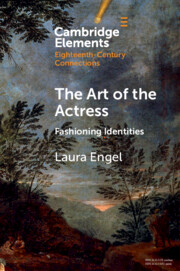
The cover image of Laura Engel’s The Art of the Actress is not of an eighteenth-century actress, but instead features the moody tones of Donato Creti’s Astronomical Observations: Comet (1711). Although not discussed within the book – indeed, Engel may not have chosen the image – the significance is clear. Set against darkening skies, the glowing comet shines out much like the actresses discussed in the text; their dazzling images and performances are moments in history that artists and actress-artists alike attempted to capture in solid form for posterity. In this book, Engel offers the reader a visually and intellectually stimulating insight into the literary, cultural and material legacy of the actress. The Art of the Actress is part of Cambridge Elements: an extensive collection of shorter academic works covering a wide range of disciplines. Engel’s work is published within the Eighteenth-Century Connections series that explores ‘connections between verbal and visual texts and the people, networks, cultures and places’ with attention to ‘oral, written and visual media’. Cambridge Elements can be purchased as affordable print or electronic editions, and some are also open access.

The paperback version of Engel’s book is about the size of a journal but lighter and softer to handle, and the cover image is beautifully reproduced. The text is divided into four parts: part one concentrates on the use of pearls in portraiture; part two is on the relationship between artist and actress; part three focuses on another material object – a muff; and part four cleverly reads the style of ‘unfinished’ art against the in/ability to capture the actress’s image. Engel effectively selects specific material objects and specific actresses to provide ‘a visual exhibition highlighting the representations, creative works, collaborations, and experiences of both well-established and lesser-known performers’ (3) in the eighteenth century. In Engel’s terms, ‘The “art” of the actress thus refers to the actress represented in art, as well as the actress’s labor and skill in making art ephemerally through performance and tangibly through objects’ (2). Throughout the study, Engel highlights the fascinating web of theatrical connections between artists and actresses, demonstrating how ‘women fashioned their identities on- and offstage, as well as how audiences perceived women in the public sphere through theatrical lenses’ (3–4).

Part one immediately establishes Engel’s aims using a piece of jewellery to observe the complex history it brings to different visual portrayals. A string of pearls can tell a story about the actress and her infiltration into the higher echelons of society, but it also conveys the pearls’ murky history in terms of slavery; furthermore, ideas about beauty and competing metaphors of virginity and sexuality show the actress’s ‘[occupation of a] precarious and significant place in the early modern world’ (18). The section concludes with a concise but fascinating examination of pearls as stage accessory in portraits of actresses, providing links between the parts they and others played.

Part two develops the concept of the actress as artist/artist as actress. With a focus on Anne Damer (amateur actress and sculptor) and Angelica Kauffman (artist), Engel demonstrates how involvement in acting had an impact on their representations of women. Engel provides an expansive backstory to a selection of portraits showing how Damer and Kauffman’s private and public lives, as well as public theatre and private theatricals – and even specific performances, costumes and contemporary fashions – fed into their artistic creations. Damer, present in the public eye as an actress, sculptor, and quite a character with her ‘dazzling, over-the-top costumes’ (38), was inevitably subject to satiric attacks. Engel provides an empowering reading of the ongoing presence of these women’s work in museums and galleries as testimony to their valuable contributions to the arts.

The penultimate section focusses on one figure and an emblematic object: Mary Anne Clarke and her strategically held muff. Clarke appeared with a huge white muff at the scandalous court case concerning her selling of army commissions to fund decoration of the house given to her by her lover, the Duke of York. Taking theory and knowledge of actresses’ self-fashioning and their contemporary reception and portrayal, Engel reads the subsequent images of Clarke in comparable ways: ‘Although Clarke was not an actress on the stage, her theatrical maneuvering and publicity stunts established her as a performer to be reckoned with’ (48). The validity of this approach is reinforced by the section on Thomas Rowlandson’s collection of prints featuring Clarke and actress Dorothy Jordan, in which Engel persuasively highlights connections between the satirical portrayals of the two women. Engel concludes with a more uplifting comment on Clarke’s later attempt to control her image through neo-classical sculpture.

To conclude, Engel effectively examines the transitory nature of performance by turning to ‘unfinished’ artwork. Engel uses a selection of Sir Thomas Lawrence’s unfinished portraits to show how they ‘are inextricably tied to the theater, an art form that is by definition fleeting, ephemeral, and open-ended’ (63). Again, Engel reveals the intricate web of theatrical connections behind and feeding into artistic works. The unfinished portraits are of the actress and playwright Elizabeth Inchbald, and of Lady Cahir who performed with Lawrence in one of Inchbald’s plays at a private theatrical. Engel extends the reading of theatrical influences on portraiture to a brief analysis of other portraits. One is ‘almost too finished’ (68) compared to the others: ‘these portraits are alive because they are not done yet’ (65).

One lasting impression this condensed book gives is just how theatrically infused culture was in the eighteenth century. Because of the impressive scope of Engel’s work in exploring the connections and conversations between artists and actresses, visual art, performances and more, there is less space at times to delve into detailed analysis and deepening of concepts, such as how the eighteenth-century actress ‘is central to understanding unfolding anxieties about nation, race, gender and heteronormativity’ (4). For example, the ‘unexpected analogy’ between an enslaved (female) child and duchess (in Duchess of Portsmouth with an Unknown Female Attendant) could be developed further using broader post-colonial studies, particularly in relation to the subsequent portrait of Nell Gwyn (with black male slave) which Engel presents as an echo (17). Sometimes the cruder, more explicit aspects of the material are left unsaid: for example, we can consider exactly how Gwyn is (erotically) ‘making’ (or stuffing or washing?) sausages and how Clarke’s muff (like Sophia Western’s in Tom Jones)is representative of female genitalia. These kinds of questions, however, also point to the effectiveness of Engel’s style, which encourages an interactive engagement. Engel often poses questions or makes references to online reproductions of portraits for readers to follow up in addition to the extensive range she discusses. I found myself setting up another device to look at these images while reading this book. I can imagine students and scholars alike being inspired to pursue new research projects. As a kind of condensed monograph, in an age when time seems to be as short as ever and new research is published rapidly, this easy-to-read book serves as a model and inspiration for future study.

Victoria Joule is an independent scholar based in Wales. Victoria has published on women’s writing of the long eighteenth century with particular attention to self-representation and literary forms. She co-edited and contributed to the essay collection with Emrys D. Jones, Intimacy and Celebrity in Eighteenth-Century Literary Culture: Public Interiors (Palgrave Macmillan, 2018).

The Tudors: Art and Majesty in Renaissance England

An exhibition review by Valerie Schutte

The Tudors: Art and Majesty in Renaissance England is a dynamic exhibition of Tudor artifacts currently touring the United States. On 14 May 2023, it wrapped up the second leg of its tour at the Cleveland Museum of Art, which was preceded by three months at the Metropolitan Museum of Art, New York, from 10 October 2022 to 8 January 2023, to be followed by three months at the Legion of Honor, San Francisco, from 24 June to 24 September 2023.

The accompanying exhibition catalogue is filled with full-page color images of every item, though not all are on display at all three museums. It also includes entries for items not on display at any of the exhibition stops because some of the loans were cut by the time the exhibition opened in October 2022, being delayed from its original autumn 2020 opening date.

As I saw the exhibition twice in Cleveland, I was unable to see many of the items related to Queen Mary I that were not displayed at this venue. These items included Hans Eworth’s 1554 portrait of her, as well as the cartoons for the panels donated by Philip and Mary for the Last Supper “King’s Window” at Sint-Janskerk, Gouda, though they are both beautifully represented in the catalogue. As a scholar of Mary I, I also have minor objections to the descriptions of some of the entries. For example, item number 27 is a 1557 copy of Juan Luis Vives’ Instruction of a Christen Woman on loan from the British Library. The catalogue description was written by Sarah Bochicchio, a PhD Candidate in art history at Yale University. While Bochicchio points out that Vives was a spiritual advisor to Catherine of Aragon and a director of Mary’s studies, she also writes that the text informed Mary and Elizabeth as inheritors of a gendered hierarchy of leadership. Furthermore, on the object label at the exhibition, Catherine of Aragon is not even mentioned, while the description highlights how both Mary and Elizabeth navigated a gendered duality during their queenships. While this is accurate, I am frustrated that such a powerful monument to Catherine and Mary must be discussed in terms of its importance to Elizabeth, thus fortifying the public perception of Elizabeth being a more important or worthy Tudor queen.

However, the more than 80 items on display in Cleveland showcased visual art as a formidable tool of monarchical power, from paintings and drawings to cups and bowls, and suits of armor to giant hanging tapestries. Various museums and private collections across Europe and the United States contributed displayed items. The Devonshire Collection at Hardwick Hall lent the “Sea Dog” table, a drawing table so called because of the sea dogs carved into its walnut legs, the Victoria and Albert Museum lent the Heneage Jewel, and the Kunsthistorisches Museum of Vienna lent Hans Holbein’s painting of Jane Seymour, while the newly-crowned King Charles III lent a miniature of Henry VIII and drawings by Holbein from the Royal Collection. These are only a few of the museums and collectors who participated in fielding these artifacts.

While some of the displayed items are well known, such as the painting of Henry VIII from the workshop of Hans Holbein and both the Sieve and Rainbow portraits of Elizabeth, many are lessor known artifacts that still portrayed the magnificence of the Tudor court. These include the ewer and basin engraved with portrait medallions of the monarchs on loan by the Boston Museum of Fine Arts and the embroidered portrait of Elizabeth I in a garden loaned from a private collection. 

Altogether the exhibition overwhelms its viewers with images of majesty, power, and Renaissance ideas of humanism and antique glory. The Tudors: Art and Majesty in Renaissance England is not to be missed, as this variety of Tudor objects and artifacts is not likely to be showcased in the United States again anytime soon.

Valerie Schutte is a historian who specialises in books dedicated to Tudor queens. She has published two monographs and her seventh edited collection will be published later this year – Mid-Tudor Queenship and Memory: The Making and Re-Making of Lady Jane Grey and Mary I. She is editing a special issue of the Royal Studies Journal to be published in December 2023 on Tudor royal sexualities. Schutte is currently writing a cultural biography of Anne of Cleves and is working on several essays on Queen Mary I.

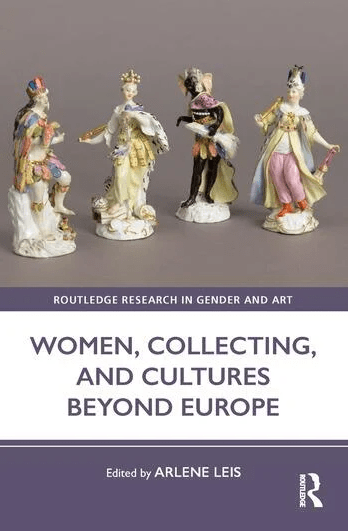
Women, Collecting, and Cultures beyond Europe. Arlene Leis. Review by Valeria Viola

Women, Collecting, and Cultures beyond Europe. Arlene Leis. New York and London, Routledge. 2023. 282 pages, 21 Colour & 33 B/W Illustrations. £120.00, ISBN 978-1-032-13546-5

Arlene Leis makes the aim of this essay collection explicit in the book title. The 17 chapters intersect and consolidate two fields of research: Women and Collecting. The topic itself is not new, but research in this field is still very much alive. In 1985, in response to the provocative question ‘Did Women Have a Renaissance?’ raised by Joan Kelly-Gadol (1977), David Herlihy pinpointed that, even when pushed to marginal positions, women could find other routes to social influence in a world of men. Since then, scholars have demonstrated that one of these routes was collecting. An increasingly extensive approach has brought to light many women who commissioned buildings or collected artworks, so that the assumption of uniquely male-gendered patronage has become no longer sustainable (Reiss 2013). This extensive approach has at times risked dismissing the female social performance as inevitable (Hills 2003). Yet, research has been energized again by the exploration of the dynamics between the two sexes, who used art to negotiate their own spaces (e.g., Maurer 2019). This exploration has generated new questions about the influence of gender on the motivations and practices of collecting, and on the opportunity to use the same methodology to explore women’s and men’s collections. Arlene Leis herself addressed these issues in Women and the Art and Science of Collecting in Eighteenth-Century Europe (2021), co-edited with Kacie L. Wills, and they also appear, here and there, in this new book, proving that her research interest fits well into this burgeoning trajectory.

The key aspect of Leis’ new publication, however, lies in the last words of its title, Cultures beyond Europe, which signal how the work is sensitive to the increasingly pressing question of decolonizing research. The view of Europe from China, with which the book opens, is significant in this sense. While most of the essays are by English-speaking authors, their perspectives and approaches vary and extend to less-investigated areas and peoples around the globe, and to a greater extent than other recent publications on similar topics (e.g., Bellion and Smentek 2023). The broad chronological framework of the book, from the end of the seventeenth century to almost the present day, could be daunting, but it allows the reader to engage with case studies spanning long periods and to gain a glimpse into secular changes in collecting practices. 

Understandably, this wide perspective is not meant to be all-encompassing. A global methodology can deal with temporary connections and fragmented narratives without aiming for comprehensive knowledge of a phenomenon (Adamson, Riello, and Teasly 2011). The tempting effort to “fill the gap” is quickly set aside by Leis, who – more wisely – nudges us towards a comparative reading of the different narratives, by suggesting that we either follow the structure of the five themed sections or make our own connections. Since documentation is often poor in relation to women’s collections, these narratives stem from the collectables themselves, which bear their own information and knowledge. The problematic paucity of sources on women’s possessions, compared to their male counterparts, emerges as a transversal issue, from the poor goods of the women from San Fernando de Béxar, which have been traced through their wills by Amy M. Porter, to the Chinese imperial collections investigated by Chih-En Chen. In this regard, Chen has circumvented the problem by using a cross-source methodology that has proved useful for capturing the interactions between everyday practices, objects, and spaces. 

Albeit to varying degrees, the individual chapters show us that collected items are neither neutral nor passive but can implement change. In this sense, the book can be framed within the scholarship on materiality, where the term ‘materiality’ refers to the capacity of things to actively affect people’s attitudes and behaviours. Through a rigorous exploration of the eighteenth-century collections in the Chinese Imperial harem, Chih-En Chen argues that trompe l’oeil porcelain satisfied Qing women’s curiosity about European art, giving them a fictive freedom from their golden cage. Focusing on the Ottoman Empire, Gwendolyn Collaço argues that a dowry, prepared by a woman for another woman, could affect both the receiver’s and the donor’s social status. In Laura Garcia-Vedrenne and Martha Sandoval-Villegas’s case study, four court dresses demonstrate the wealth of an unidentified woman living in late eighteenth-century Mexico City. In Lisa Hellman’s study, the complexity of an entire collection is viewed through the lens of a single dress that bears witness to the travels and encounters of a Swedish woman. For its part, this dress caused her misfortunes and successes, according to the different perceptions of the stories it related. Perception, acceptance, and reciprocity can serve as the reading keys to the essay by Maria Antonietta Spadaro dealing with the Japanese artist, O’Tama Kiyohara, who moved to Italy at the end of the nineteenth century. While O’Tama assimilated the European way of painting, her oriental culture was met with mixed acclaim.

In a period of voyages, long-distance trade, and transcultural encounters, materiality intersects with questions of power and domination. Knowledge as intellectual appropriation is central to the naturalistic classifications that Europeans carried out in their colonies. As the contribution of women has often been thwarted and long gone unrecognized, many questions remain about their role in the colonization process. The botanist Jeanne Baret, discussed by Glynis Ridley, was forced to disguise herself as a man to travel with the French expedition to circumnavigate the world. Unsurprisingly, her work has remained somewhat overshadowed by that of the men she worked with. In this regard, however, the question that emerges as more urgent is not whether women indexed samples differently from men, but to what extent their scientific interest determined their political complicity. Thoroughly delving into the multi-faceted relationship between British colonialism and the scientific illustrations of Indian flora and fauna, Apurba Chatterjee argues that an aristocratic woman, Lady Mary Impey, participated in the colonial enterprise by collecting images of birds drawn by Indian artists. If the inclusion of specimens in the Linnaean taxonomy already implied their extraction from their native environments, a further degree of appropriation was their transfer to European soil. Additionally, the crossing of borders provided these samples with new values and potential. For instance, the pineapple plant successfully replanted in Amsterdam gave fame to Agnes Block, the amateur botanist investigated by Catherine Powell-Warren. Not much differently, the display of dwarves from the Portuguese colonies emphasized the colonial power of the Lisbon court. This case study by Agnieszka Anna Ficek underscores the extent to which curiosity for the exotic intersected with discourses of race, exploitation, and slavery.

While gaining knowledge of others was both the cause and the result of transcultural encounters, the documentation and exhibitions of objects became a further step to perpetuate, promote, and spread this acquired knowledge. The crucial point was and remains the degree of cultural interference that an external (mostly Western) perspective can impose on the heritage of others. This point holds true even when these actions are implemented with the best intentions. Cynthia Sugars explores the case of a British botanist, Catharine Parr Traill, who, while laying the foundations for Canada’s natural history, misunderstood and bypassed Indigenous knowledge of nature because of her moralistic and imperialist view. In their laudable efforts to preserve and promote artists from Santa Fe, the five Pennsylvania women investigated by Nancy Owen Lewis could not avoid imposing their idea of art on indigenous works. As Martha Sandoval-Villegas argues in her study of Mesoamerican huipils, the objects may come from communities that gave collecting practices different purposes. 

When exhibited, objects push people to take a stand with respect to the stories, knowledge, and meanings that the same objects bring with them. For Angela Fey and Maureen Matthews, for example, the collection of Métis embroidered clothing enabled women from Manitoba to face and acknowledge their indigenous heritage. Yet, when collectors themselves are unaware of what lies behind their collections, they prevent any other observer from reaching a critical awareness. Brandt Zipp suggests this reflection to us when he tells us about a group of white women who, between the 1920s and 1930s, recovered forgotten examples of eighteenth-century American pottery, but not the Afro-American identity of their ceramicist. Working against this attitude, Toby Upson proposes an adjacency approach which aims for the viewers to understand the object without alienating it from themselves. According to this approach, institutional and non-institutional collectors should not only display or explain otherness but also help observers to find a critically aware position with respect to the same otherness. Louise Hamby seems to suggest a very personal approach, but one that is equally open to the cultural implications of the object. As an artist, she has collected Aboriginal fibre objects from Arnhem Land in Australia with the aim of learning and collaborating with local artists. 

To conclude, the global perspective of this book allows the reader to perceive differences and similarities between very varied contexts, thus responding to the expectations created by its title. However, it also opens questions that are useful for the development of its lively field of research. For this reason, scholars dealing with the fields of women, materiality, and collecting will find it very useful. Furthermore, the book makes a very rich contribution to the niche field of the relationship between art, science, and gender. However, the text could also be of interest to all those who aspire to a decolonizing vision of history. Amongst these, I would certainly include the teachers who try to provide their students with this vision every day.

Valeria Viola

Valeria Viola (Ph.D. in History of Art and Architecture in 2020) is an Art teacher with experience in both architectural practice and research. At the moment, she is engaged in integrating gender and decolonial perspectives into teaching. You can find her publications here: https://york.academia.edu/ValeriaViola

Cited works.

Adamson, Glenn, Giorgio Riello, and Sara Teasly (eds.). “Introduction”. In Global Design History, 1–10. Abingdon: Routledge, 2011.

Bellion, Wendy and Kristel Smentek (eds.). Material Cultures of the Global Eighteenth Century. Art, Mobility, and Change. London and New York: Bloomsbury Visual Arts, 2023.

Herlihy, David. “Did Women have a Renaissance? A Reconsideration.” Medievalia et Humanistica 13 (1985): 1-22.

Hills, Helen (ed.). “Theorizing the Relationship between Architecture and Gender in Early Modern Europe.” In Architecture and the Politics of Gender in Early Modern Europe, 3–36. Aldershot and Burlington: Ashgate, 2003.

Maurer, Maria F. Gender, Space and Experience at the Renaissance Court. Performance and Practice at the Palazzo Te. Amsterdam: Amsterdam University Press, 2019.Reiss, Sheryl E. “Beyond Isabella and Beyond: Secular Women Patrons of Art in Early Modern Europe.” In The Ashgate Research Companion to Women and Gender in Early Modern Europe, edited by Allyson M. Poska, Jane Couchman, and Katherine A. McIver, 445–467. London and New York: Routledge, 2013.