Upcoming in-person seminar, Foundling Museum, Saturday 6th December, 2025

We have an upcoming in-person seminar taking place Saturday 6th December, 2025.  In-Person: Foundling Museum, 40 Brunswick Square, London, WC1N 1AZ, Saturday 13.00 for 13:30 – 16:30(GMT).

The papers to be presented are:

Breeze Barrington: ‘Versifying Maid[s] of Honour’: Mary of Modena’s artistic legacy.

Diane Clements: ‘A very anxious and affectionate mother’: dealing with personal indebtedness in Georgian England.

Rhian Jones: ‘For what signifies an absent friend?’ Epistolary friendship between women and men in England, c. 1650-1750.

All members are invited to attend.

WSG Member Organizes Hybrid Conference: “Collective Biographies Across Disciplines and Ages”

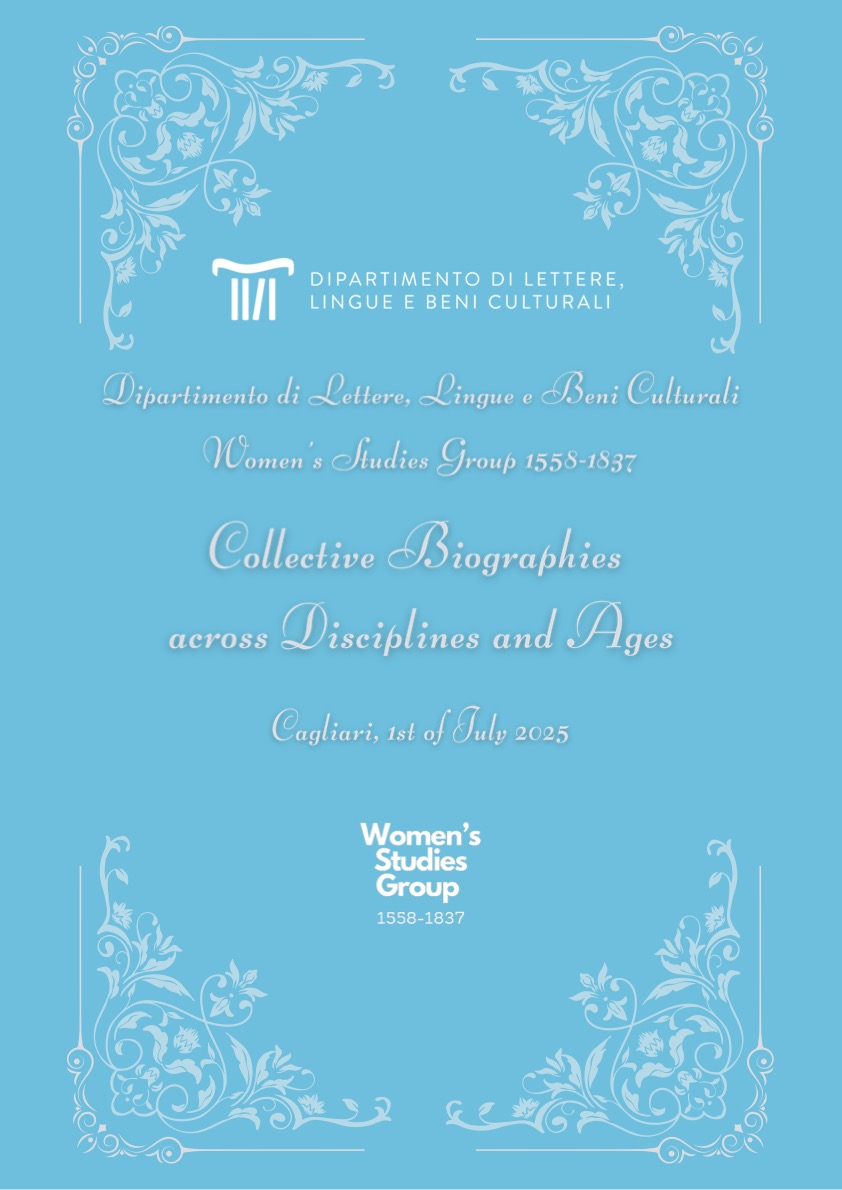
WSG Member Organizes July 1st, 2025 Hybrid Conference: “Collective Biographies Across Disciplines and Ages”

The Women’s Studies Group 1558–1837 is pleased to announce an upcoming one-day hybrid conference, “Collective Biographies Across Disciplines and Ages,” taking place on 1 July 2025, in person at the Università degli Studi di Cagliari (Faculty of Humanities, Via San Giorgio 12, Aula 6 and Aula Magna) and online via Microsoft Teams. This international event is organized by WSG member Dr. Maria Grazia Dongu, and it brings together an international group of scholars across disciplines.

About the Conference

This conference explores the literary, historical, and artistic dimensions of collective biography, narratives that center shared experience, social connection, and cultural memory. Presenters will consider how collective biographies function as both historical sources and narrative strategies, across genres as varied as Shakespearean drama, Quaker life writing, detective fiction, and eighteenth-century art. Drawing on approaches from literary studies, historiography, and biography theory, the conference reflects on how individual and group identities are shaped through storytelling.

The Women’s Studies Group 1558–1837 is proud to support this event, which features presentations by a number of our members and provides the opportunity to strengthen scholarly networks internationally and across disciplines.

Conference Schedule – 1 July 2025

9:30 am – Brief Introduction: On Collective Biographies by Maria Grazia Dongu (Università di Cagliari)

10:00 am – Competing to Tell Lives in Shakespeare’s Richard III by Maria Grazia Dongu (Università di Cagliari)

10:30 am – A Case Study of Early Quaker Biographies by Judith Roads (Independent Scholar)

11:00 am – Indizi tra le righe: l’Irlanda che cambia nelle detective story (Clues Between the Lines: Ireland’s Changing Face in Detective Stories) Luciano Cau (Università di Cagliari)

11:30 amBreak

12:00 pm – Anne of Cleves in Collective Biographies by Valerie Schutte (Independent Scholar)

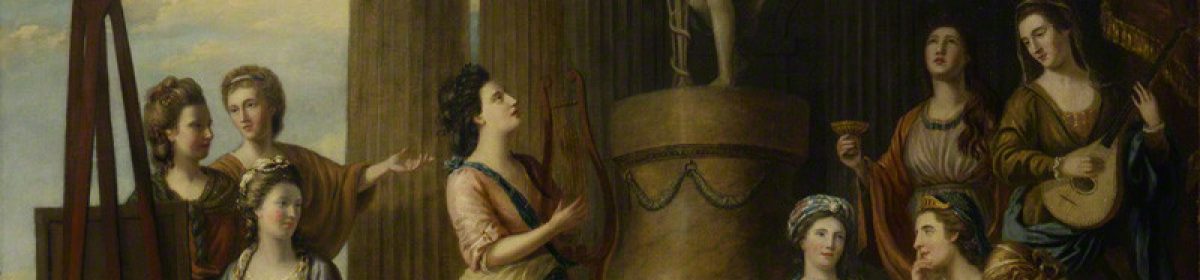
12:30 pm – The Collective Biographies of 18th-Century Art: Harnessing the Power of Storytelling to Re-Read Martin’s “Lady Elizabeth Murray and Dido Belle” (1779) by Karen Lipsedge (Kingston University)

1:00 pm – Vita collettiva e autorialità: La famiglia Manzoni (Collective Life and Authorship: The Manzoni Family) by Fabio Vasarri (University of Florence)

13:30 pm – Catherine of Aragon, Cardinal Wolsey and Henry VIII through Chronicles and Shakespeare’s plays by Valeria Steri, Alessandra Carta, and Elena Melis (Università di Cagliari)

The day will conclude with a roundtable discussion among speakers and attendees.

Hybrid Attendance – All Are Welcome

This is a hybrid event, and attendees are warmly invited to join either in person or virtually.
To receive the Microsoft Teams link for online attendance, please contact Dr. Maria Grazia Dongu at dongu@unica.it.

The Women’s Studies Group 1558–1837 is proud to support Dr. Maria Grazia Dongu in organizing this exciting interdisciplinary event. We celebrate her leadership and the vibrant international scholarly exchange this conference promises to foster across disciplinary boundaries.

Laboring Mothers. Reproducing Women and Work in the Eighteenth Century. By Ellen Malenas Ledoux. Charlottesville: University of Virginia Press. 2023. Pp. 274. $29.50 (paperback), ISBN 9780813950280. By Jasmin Bieber

Ellen Ledoux’s Laboring Mothers is dedicated to women as nurturers and caretakers and their multifarious professions. The monograph consists of six chapters – organised into three parts – featuring mothers who worked as actors, midwives, soldiers, slaves, street hawkers and prostitutes. This selection already points to Ledoux’s central ambition to seek out intersections of gender and class in a diverse array of case studies. The female elite of eighteenth-century Britain is accordingly not her main focus; instead, she concentrates primarily on the lower and working classes, the mothers without a ‘voice’ or those whose ambitions cast them into obscurity. Working mothers, Ledoux determines, existed and continue to exist on societal and spatial thresholds in which the principles and expectations of the public and private spheres merge and/or clash.

Ledoux not only productively renders visible those mothers at the margins, but she also argues that they enabled and were enabled by two cultural and social circumstances of the eighteenth century: the emergence of the public sphere and the cult of motherhood. These conditions, she observes, “created an Enlightenment concept of maternity that galvanized privileged women’s ability to earn income and, in some cases, to professionalize” (p. 3). As this statement demonstrates, her study draws attention to the strategies that allowed women to deliberately profit from their status as mothers and also highlights rhetorical representations or visual reflections of motherhood. Laboring Mothers employs an intersectional feminist reading that applies a broad understanding of ‘text’ as anything pertaining to a signifier, which results in a vast and impressively researched corpus of paintings, poems, letters, advertisements, plays, contracts, newspaper articles and further materials that facilitate Ledoux’s reading of “literal and symbolic forms of motherhood” (p. 9). Her acknowledgement of women’s resilience is paired with sober reflections on the tolls of maternal caretaking and, at times, working conditions that render mothering impractical or even impossible.

Part 1 of the book (‘Speaking for Herself’) is dedicated to women utilising the public sphere to their economic advantage, a pursuit which is impaired by their social, financial, and educational status. Ledoux presents, in her first chapter, the cases of actresses Sarah Siddons and Mary Robinson. For both, maternity and motherhood were not damaging circumstances. They deliberately staged their swollen pregnant bodies and mother–child relations to curate their virtuous public images, which were paradoxically based on a display of the private. While they garnered societal criticism for their practices – especially once their bodies showed their advanced age and illnesses – their longstanding professional successes speak to the eighteenth century’s fascination with maternity on display. Their stagings were only acceptable if their motherly duties were not superseded by their desire for fame and fortune. Chapter 2 offers a different perspective on such public self-fashioning by turning to midwifery and its shifting trends throughout the eighteenth century, notably from female to male practitioners. In response to these developments, manuals by female midwives argued for their expertise, pointing to their first-hand experience as mothers as topping male medical education. The chapter effectively demonstrates the paradoxical rhetoric governing debates that appear to hinge on existential gendered distinctions and the scrutiny of gender.

While Part 1 presents professionalism and motherhood as being far from exclusive states, Part 2 (‘Spoken For’) opens with another apparent contradiction. In Chapter 3, Ledoux introduces two mothers who served in the military, Christian Davis and Hannah Snell. Their autobiographies are testimonies of women’s patriotism and a desire for a lifestyle detached from normative societal female obligations. The absence of motherly affection and care for their children is considered a rejection of any aspirations to adhere to ‘good’ motherhood. Ledoux refrains from speculating on the lack of remarks on their time as mothers or their disinterest in their children’s future. Instead, these gaps in their narratives are used to highlight the stark limitations of female virtues in a militant and thus masculine-coded field of work. Chapter 4 likewise deals with a narrative’s failings in addressing maternity and its affective dimension, in light of physically taxing work. While reciprocal caretaking had been possible in all previous cases, The History of Mary Prince (1831) emphasises the insurmountably different expectations towards empathic caretaking and the labouring and living conditions of female slaves. Ledoux observes what she terms as ‘slow violence’ (pp. 116ff) in early instances of Prince’s narrative. Her reading results in bleak imageries of motherhood that either end in spiritual defeat or the death of mother and child. The chapter adds to its primary case an array of caricatures that showcase how the supposed ‘natural’ nurturing abilities of black women have been used and reproduced in public debates surrounding childcare at English-owned plantations.

Opening Part III (‘Spoken About’), Chapter 5 consists of six representations of female street hawkers, all artistic renditions by (male) painters such as William Hogarth and Thomas Rowlandson. As caricatures, parts of larger ensembles or allegorical representations, women are depicted carrying their children as well as tools of their professions. This balancing act already runs counter to idealised practices of the ‘cult of motherhood’ that sees women solely focused on nurturing, as expertly demonstrated by Ledoux with the example of Caroline Watson’s Maternal Tuition (1793). In such street hawker prints, lower-class mothers – literally and metaphorically – buckle the expectations of mindful mothering while pursuing honest or socially degrading occupations. Failing at one task entails failing at the other; a gin seller, for instance, is bound to bring forth the next generation of drunkards. The influence of the mother’s profession on their offspring is, however, shrouded in silence in Ledoux’s final chapter on prostitutes. Demonstrating the eighteenth century’s shifting attitude towards prostitutes as victims rather than active perpetrators by exploring manuscripts relating to the Magdalen House. The case study highlights sentimental rhetoric as an effective tool to stage a woman’s resort to prostitution as a parental obligation, allowing for her potential readmission into society.

Ledoux expresses throughout her work an awareness of the complex etymology of terms central to her cultural research. Her collection of cases highlights the effects and processes of the dissemination of stereotypes surrounding the feminine and female, as well as the enduring issues related to womanhood and motherhood. Her conclusive remarks reflect her findings on prevailing contemporary formations and cement the importance of Ledoux’s work in addressing mothering as a profession, one whose compatibility with women’s working aspirations can greatly vary. Laboring Mothers is an excellent read for students and researchers of British eighteenth-century society and presents its readership with a productive intersectional feminist perspective with far-reaching applicability.

***

Jasmin Bieber is a doctoral student at the University of Konstanz, Germany, where she is working on her PhD project dedicated to eighteenth-century British women travellers. Her research reflects her interests in gendered geography and literary spatiality, and she enjoys teaching undergraduate courses in early modern to contemporary literature.
Call for Papers: Adapting the Tudors: From Novels to Film to Public History

WSG member and historian Valerie Schutte is co-editing an exciting new two-volume collection with Jessica S. Hower and William B. Robison that explores how the Tudor period has been adapted across various media and forms. This timely collection comes as Tudor-themed adaptations continue to captivate audiences, from the National Portrait Gallery’s recent Six Lives exhibition to new screen productions like Firebrand and Shardlake.

The editors welcome submissions examining any aspect of Tudor adaptation, from historical novels and screen adaptations to museum exhibits and heritage sites. The collection aims to investigate how history is adapted for public audiences and what these adaptations reveal about both the Tudor period and the times in which they were created.

Potential topics include, but are not limited to:

  • Historical novelists and their works, focused on the Tudor period
  • Screen adaptations of Tudor-themed novels
  • Theatrical adaptations
  • Historians who have ventured into historical fiction
  • Museum exhibitions and heritage sites
  • Digital adaptations, including virtual exhibitions and video games

Submission Guidelines:

  • Abstract length: 250-300 words
  • Chapter length: approximately 7,500 words
  • Deadline: Friday, 31 January 2025
  • Full contributions due: early 2026
  • Please include a brief academic CV (max 3 pages)

Submit abstracts to all three co-editors:

This collection promises to be an essential resource for academics, students, and enthusiasts of Tudor history and its contemporary interpretations.

For the complete CFP and further details, please see the full CFP: Adapting the Tudors

Do not miss this opportunity to contribute to this significant collection—remember to submit your abstract by Friday, 31 January 2025.

They Run with Surprising Swiftness: The Women Athletes of Early Modern Britain. By Peter Radford. Review by Carolyn D. Williams

They Run with Surprising Swiftness: The Women Athletes of Early Modern Britain. By Peter Radford. Charlottesville and London: University of Virginia Press. 2023. Pp 296. £31.79 (paperback), ISBN 9780813947938.

Readers of Peter Radford’s previous work, including his chapter entitled ‘Better than the Men’ in Exploring the Lives of Women (2018), a collection of essays by members of the Women’s Studies Group 1558–1887, will expect great things from his latest publication. They will not be disappointed.

This fascinating and wide-ranging study of women’s past achievements in sports and athletics, as well as other forms of physical activity demanding various combinations of strength, skill, courage and endurance, incorporates a forceful defence of their ability and right to participate in these activities today. We are currently emerging from a period when women’s participation in sport was restricted on the grounds that strenuous exertion would threaten their capacity for motherhood or even their physical survival. Radford has unearthed evidence of ‘a kind of cultural amnesia’ (208) that seems to have been fostered by nineteenth-century masculine anxieties, obliterating awareness of traditional female sports. The chapter headed ‘Moral Meddling, Cant, and Sheer Humbug: 1825 Onward’ gives a painfully eloquent account of this turning point. As he shows elsewhere in his book, the participants were often subjected to various forms of misogynistic prejudice, but at least the existence of these events was acknowledged.

As in previous work, Radford counters this great forgetting. After producing evidence for women’s robustness in the Neolithic period, and their versatile athleticism in Ancient Greece, he provides detailed studies of events involving female runners, and occasionally walkers, concentrating on the period 1638–1850. A theme that should inspire interest in other feminist historians is the rise and fall of the smock race, and its connections with skimmington rides. He then discusses women’s involvement in football, cricket, prize-fighting (with swords and fists), equestrianism and tennis: women in the last two categories beat the best male professionals.

Some of the book’s findings cast new light on established disciplines. Analyses of the pictures of sporting activities included in the illustrations use information about eighteenth-century practices to distinguish the works of eye-witnesses from copies and products of the artists’ imagination. For example, familiarity with the structure and placement of wickets, knowledge of the rules of best-of-three races, and awareness of what running women actually look like provide tools for art historians seeking to establish the authenticity of sporting pictures. John Collett emerges as a reliable and well-informed creator of original images of female runners and cricketers, which were copied inaccurately by Thomas Rowlandson.

Frances Burney scholars should brace themselves for an outright denial that anything like the twenty-yard race between two enfeebled octagenarian women in Evelina (1778) was ever reported in the eighteenth century: Radford sees it as ‘a product of her fertile imagination’ (31), possibly sparked by a reference in Tobias Smollett’s The Adventures of Ferdinand, Count Fathom (1753) to two aristocratic gamblers running their grandmothers together, i.e. seeing which would live longer. In actuality, age presented fewer barriers to demonstrations of physical prowess: ninety-year-old Mary Wilkinson walked the 290 miles from York to London ‘in five days and three hours with “a keg of gin, and a quantity of provisions on her back”’ (125), while an eighteen-month-old girl ‘walked the length of the Mall (half a mile) in twenty-three minutes’ (90).

Precisely because this work is the result of carefully planned and scrupulously detailed research, it abounds in unexpected discoveries, sometimes appearing initially random: they are the rewards for the author’s determination to follow the evidence. Three examples must suffice. Firstly, everybody acquainted with early modern childbirth customs must have come across references to a ‘groaning cheese’, but how many know exactly what it was? Radford has unearthed a reference to a specimen weighing a hundred pounds that was the first prize for a race between ‘six heavily pregnant brewers’ wives’ who were to run a mile ‘to the top of Arthur’s Seat in Edinburgh’; he then cites ‘an old English tradition in which the father of a newborn baby brought a very large, flat, round cheese for the baby’s christening’: slices would be cut from the centre, and the baby passed through the resulting hole ‘for luck’ (56). Secondly, the importance of accurate time-keeping, especially when wagers were involved, have led the author, after thorough investigation, to conclude that ‘watches were high-status, finely-crafted objects in the eighteenth century, and they recorded time very accurately; cheap and unreliable watches were still sometime in the future’ (118). More directly relevant to the book’s subject, but even more startling, is the discovery that ‘the first example of a football match played on grass, with teams of a fixed number, and played for the benefit and amusement of a crowd’ (179) was a six-a-side women’s event that took place on a bowling green in Bath, probably arranged by Beau Nash, in 1726.

There are a few minor errors in expression and presentation. In the transcription of the motto of the Amateur Athletic Assocation, taken from lines 95 and 96 of Pindar’s 9th Olympian Ode, ποδῶν and ἀκμαί have been run together when they should have space between them, and ideally […] to indicate the omission of an intervening word (115). In the useful appendix, explaining the technicalities of distance measurement, currency and gambling in early modern Britain, the author apparently makes a slip when describing the kind of wager known as a match against time: ‘In the example above, a timekeeper would stand at the finishing line and call “Time” precisely one hour after the start’ (245). Unfortunately, the hypothetical example requires the contestants to run ‘one mile (e.g. from the tavern door to the church door)’ (245) which seems far too short a distance for the time allowed, especially when we reflect that ‘a fifteen-year-old girl from Wrotham ran it in 5 minutes 28 seconds on Saturday July 11, 1795, a record unbeaten in Britain until 20 August 1932’ (119). Perhaps the chosen course should be taken into consideration: how long would the contestants stay in the tavern before they reached its door?

As well as applying extensive and meticulous scholarship to his study of human physical activity in general and sport in particular, the author deploys the practical experience acquired during an athletic career that earned him a world record, two Commonwealth gold medals and two Olympic bronze medals. He can flesh out the briefest account of an event with considerations of how it would have been organized and publicised, how the expenses would be covered, how many heats were involved, or the conditions in which it took place: for example, in 1822, when girls ran races ‘on a wet Wednesday in August’ on Gander Down, to the east of Winchester, ‘it must have been difficult for them on the wet grass, though these were chalk downs and would have drained quickly’ (205).

Professor Radford has yet more to say about the history of women’s physical achievements: on Saturday, October 7, 2023, at the opening seminar of the Women’s Studies Group 2023–24 season, at London’s Foundling Museum, he will present a paper entitled ‘Strong Women in Early Modern Europe: A Counter Narrative’. To readers of this book, this is very good news.

Carolyn D. Williams