Upcoming in-person seminar, Foundling Museum, Saturday 6th December, 2025

We have an upcoming in-person seminar taking place Saturday 6th December, 2025.  In-Person: Foundling Museum, 40 Brunswick Square, London, WC1N 1AZ, Saturday 13.00 for 13:30 – 16:30(GMT).

The papers to be presented are:

Breeze Barrington: ‘Versifying Maid[s] of Honour’: Mary of Modena’s artistic legacy.

Diane Clements: ‘A very anxious and affectionate mother’: dealing with personal indebtedness in Georgian England.

Rhian Jones: ‘For what signifies an absent friend?’ Epistolary friendship between women and men in England, c. 1650-1750.

All members are invited to attend.

WSG ‘Her Stories’ Reading Group: Upcoming session

Reading for WSG reading group session on 28th October, 7–8pm 2025 (GMT)

Frances Brooke’s The History of Emily Montague (Jasmin Bieber’s suggestion).

Please see the WSG October Newsletter for the Zoom link.

All WSG members are welcome to join this session, co-ordinated and facilitated by Karen Lipsedge.

About the reading:

Jasmin Bieber has kindly prepared a PDF of Brooke’s novel, which will be available to participants. If you cannot manage to read the entire novel, Jasmin recommends prioritising the first half, which takes place in Quebec and introduces intriguing, sensible romance plots. Alternatively, you might read from letter 57 to letter 177, which covers the troubled relationship between the main characters.

How the session will be organised:

Jasmin will begin by sharing why she chose Brooke’s novel and discussing the core themes. As with previous sessions, each participant will then share one thing they found noteworthy about the text.

At this meeting, we will also discuss and plan reading group sessions for December 2025 to October 2026, so please bring your suggestions and diaries.

To participate in ‘Her Stories’:

Contact Karen Lipsedge directly: K.Lipsedge@Kingston.ac.uk

WSG Member Organizes Hybrid Conference: “Collective Biographies Across Disciplines and Ages”

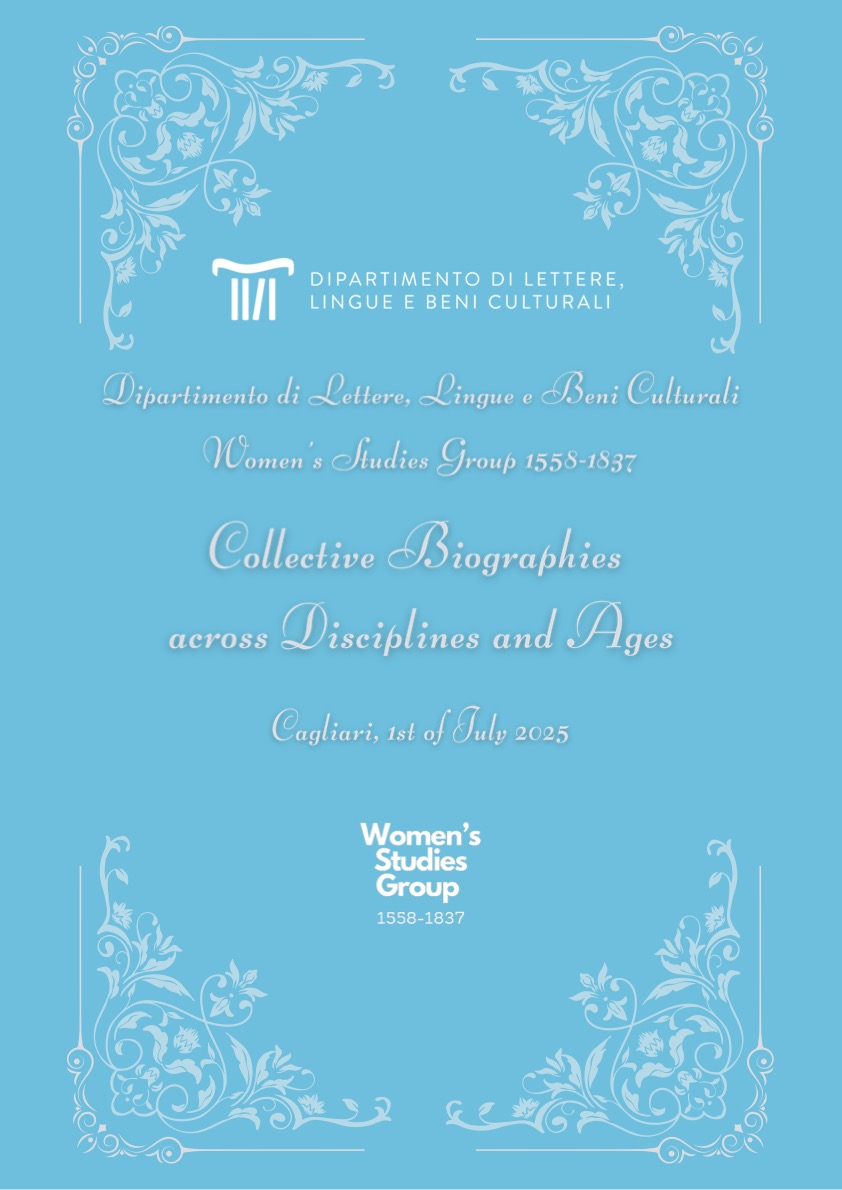
WSG Member Organizes July 1st, 2025 Hybrid Conference: “Collective Biographies Across Disciplines and Ages”

The Women’s Studies Group 1558–1837 is pleased to announce an upcoming one-day hybrid conference, “Collective Biographies Across Disciplines and Ages,” taking place on 1 July 2025, in person at the Università degli Studi di Cagliari (Faculty of Humanities, Via San Giorgio 12, Aula 6 and Aula Magna) and online via Microsoft Teams. This international event is organized by WSG member Dr. Maria Grazia Dongu, and it brings together an international group of scholars across disciplines.

About the Conference

This conference explores the literary, historical, and artistic dimensions of collective biography, narratives that center shared experience, social connection, and cultural memory. Presenters will consider how collective biographies function as both historical sources and narrative strategies, across genres as varied as Shakespearean drama, Quaker life writing, detective fiction, and eighteenth-century art. Drawing on approaches from literary studies, historiography, and biography theory, the conference reflects on how individual and group identities are shaped through storytelling.

The Women’s Studies Group 1558–1837 is proud to support this event, which features presentations by a number of our members and provides the opportunity to strengthen scholarly networks internationally and across disciplines.

Conference Schedule – 1 July 2025

9:30 am – Brief Introduction: On Collective Biographies by Maria Grazia Dongu (Università di Cagliari)

10:00 am – Competing to Tell Lives in Shakespeare’s Richard III by Maria Grazia Dongu (Università di Cagliari)

10:30 am – A Case Study of Early Quaker Biographies by Judith Roads (Independent Scholar)

11:00 am – Indizi tra le righe: l’Irlanda che cambia nelle detective story (Clues Between the Lines: Ireland’s Changing Face in Detective Stories) Luciano Cau (Università di Cagliari)

11:30 amBreak

12:00 pm – Anne of Cleves in Collective Biographies by Valerie Schutte (Independent Scholar)

12:30 pm – The Collective Biographies of 18th-Century Art: Harnessing the Power of Storytelling to Re-Read Martin’s “Lady Elizabeth Murray and Dido Belle” (1779) by Karen Lipsedge (Kingston University)

1:00 pm – Vita collettiva e autorialità: La famiglia Manzoni (Collective Life and Authorship: The Manzoni Family) by Fabio Vasarri (University of Florence)

13:30 pm – Catherine of Aragon, Cardinal Wolsey and Henry VIII through Chronicles and Shakespeare’s plays by Valeria Steri, Alessandra Carta, and Elena Melis (Università di Cagliari)

The day will conclude with a roundtable discussion among speakers and attendees.

Hybrid Attendance – All Are Welcome

This is a hybrid event, and attendees are warmly invited to join either in person or virtually.
To receive the Microsoft Teams link for online attendance, please contact Dr. Maria Grazia Dongu at dongu@unica.it.

The Women’s Studies Group 1558–1837 is proud to support Dr. Maria Grazia Dongu in organizing this exciting interdisciplinary event. We celebrate her leadership and the vibrant international scholarly exchange this conference promises to foster across disciplinary boundaries.

Reminder: WSG Reading Group, Her Stories, March 10, 2025, 7–8pm (GMT) via Zoom

The next WSG Reading Group, Her Stories, is on 10th March, 7-8pm 2025 (GMT) 

The Women’s Studies Group (WSG) will host its next “Her Stories” Reading Group meeting on March 10th, 2025, from 7-8pm GMT. All members are welcome to participate in this upcoming session, organized and hosted by Karen Lipsedge.

The group will discuss Louise’s selected text: Jennie Batchelor’s The Lady’s Magazine (1770–1832) and the Making of Literary History (2022, Edinburgh University Press). For those unable to read the entire book, Louise recommends either the Conclusion or Chapter 6, “Achievements and Legacies: The Lady’s Magazine in Literary History.”

Members can access a virtual copy of the book through a provided link, though they should note it’s a large file and check their connection in advance. Thanks go to Louise for providing this link.

Each reading group follows a consistent format: the member who selected the text gives a brief introduction explaining their choice, followed by participants sharing one aspect of the text they wish to discuss—whether it relates to characters, style, readership, or even a single word or phrase.

Anyone interested in joining “Her Stories” can contact Karen Lipsedge directly.

Review: WSG Seminar, 26th March 2022 at The Foundling Museum

Sophie Johnson: History’s ‘Other’ Sculptors: The Underrepresentation of Historic women sculptors (1558-1837) in the history of art

Charlotte Goodge: ‘Sedentary occupations ought chiefly to be followed by women’: The ‘Fat’ Woman and ‘Masculine’ Exercise in the Literary Culture of the long eighteenth century

Moira Goff: Evered Laguerre: A Female Professional Dancer on the London Stage

We returned to the Foundling Museum for our March seminar, after an absence of two years, to hear three outstanding papers and to enjoy an afternoon of lively and informative discussion. As so often happens, unexpected connections between the subjects emerged and we could certainly have continued our explorations for much longer. Sophie Johnson began by extemporizing on her research into women sculptors throughout the period covered by the Women’s Studies Group and beyond, to examine how the few who have found a place in art history have been represented and under what circumstances they forged a career in this overwhelmingly male-dominated art form. She discussed the amateur/professional binaries, the problems and risks surrounding the perceived transgressive nature of the art and emphasised curatorial practice and questions of mistaken attribution as crucial factors in the invisibility of women sculptors.

Charlotte Goodge tackled debates about corpulent women in the eighteenth century in the light of society’s expectations about women’s delicate nature and what kind of exercise was considered appropriate. She focussed on participation in the hunt and on mountaineering and walking, citing literary examples from Charlotte Lennox The Female Quixote (1752) and Thomas Love Peacock Crotchet Castle (1831). Through these literary examples, Goodge argued that the ‘fatness’ of their female protagonists was pointedly used to flag an immoderate excess in terms of over rather than under exercising. Contemporary anxieties about women’s over-enthusiastic exercise centred less on health risks and benefits and more on the fact that robust physical strength was perceived as characteristic of labouring people (especially labouring men), an undesirable outcome for women from the genteel classes. Women’s transgression in different forms was important in both these papers.

Moira Goff offered her findings on the life of the early eighteenth-century dancer, Evered Laguerre, whose remarkable career on the London stage lasted more than twenty years, from her debut at thirteen in 1716 to her final performances in leading dance roles for John Rich’s company in 1737 when she was only thirty-five. We had glimpses of her in a print depicting her dancing with Francis Nivelon in the pantomime Perseus and Andromeda (1731),and in a possible second representation as the ‘Lady dancing’ in Nivelon’s The Rudiments of Genteel Behavior (1737). During our discussion, Goff gave us further fascinating insights into the stage careers of young dancers and into the published dance notation for a Harlequin dance, perhaps related to The Necromancer; or, Harlequin Doctor Faustus (1723) in which Laguerre danced the part of ‘Harlequin Woman’.

The papers demonstrated the difficulties of finding women in the archives, but the importance of pursuing the research if we are to recognise their contributions, a perennial problem faced by those working on women’s history. They also highlighted the delicate line between compliance and error, recognition and notoriety and the inescapable judgements of a patriarchal system. Our thanks to all three presenters, and to those who joined us at the seminar.

Miriam Al jamil