WSG is offering a bursary of £750 to an early career researcher*, independent scholar or PhD student who is a member of the WSG. The bursary is intended to support research in any aspect of women’s studies in the period 1558-1837 for new or continuing interdisciplinary or single-discipline projects.
The deadline for bursary applications is 15 December 2025, and the successful applicant will be announced in January 2026. For further information, and to apply, please download the application form.
Applications are considered by the WSG committee. The money will normally be paid on presentation of receipts. The successful applicant will be expected to give a paper at a future WSG meeting in person or via Zoom in the 2026-2027 seminar season. The contribution of the WSG bursary should be acknowledged in any resulting publications.
*Early career researcher is ‘an individual who is within eight years of the award of their PhD or within 6 years of their first academic appointment’ (AHRC).
***********
Recent Bursary Winners (for a full list of winners, visit our bursary page)
2025: Valentina Aparicio, researching Maria Graham’s correspondence for her forthcoming monograph, Challenging Friendships: Scottish Women Travellers in Latin America, 1820–60 (Main Award); and Charlotte Vallis, ‘French diplomatic archives relating to Russian Empresses Elizabeth Petrovna and Catherine II’ (Travel Award), Patricia Ahern, ‘Enlightenment memories of Mary Queen of Scots’ (Travel Award), and Rachel Bynoth, ‘Anxiety in family letters’ (Travel Award).
2024: Amy Solomons, ‘Eighteenth-century female reading experiences in historic house spaces’.
2023: Eleanor Bird, ‘Margaret Davy, sister-in-law of Humphrey Davy and collector of his works’ (Main Award); and Brianna Robertson-Kirkland, ‘Examining three Georgian opera singers: Elizabeth Billington, Anna Selina Storace and Gertrude Mara’ (Travel Award).
WSG is offering a bursary of £750 to an early career researcher*, independent scholar or PhD student who is a member of the WSG. The bursary is intended to support research in any aspect of women’s studies in the period 1558-1837 for new or continuing interdisciplinary or single-discipline projects.
The deadline for bursary applications is 15 December 2024, and the successful applicant will be announced in January 2025. For further information, and to apply, please download the PDF application form here.
Applications are considered by the WSG committee. The money will normally be paid on presentation of receipts. The successful applicant will be expected to give a paper at a future WSG meeting in person or via Zoom in the 2025-2026 seminar season. The contribution of the WSG bursary should be acknowledged in any resulting publications.
*Early career researcher is ‘an individual who is within eight years of the award of their PhD or within 6 years of their first academic appointment’ (AHRC).
***********
Previous Bursary Winners
2024: Amy Solomons, ‘Eighteenth-century female reading experiences in historic house spaces’
2023: Eleanor Bird, ‘Margaret Davy, sister-in-law of Humphrey Davy and collector of his works’ (Main Award); and Brianna Robertson-Kirkland, ‘Examining three Georgian opera singers: Elizabeth Billington, Anna Selina Storace and Gertrude Mara’ (Travel Award)
2020: Anna Jamieson, ‘Spending and Shopping: Women’s Experience in the Eighteenth-Century Madhouse’ and Alexis Wolf, ‘Women Nurses and Inspectors of the Foundling Hospital, 1750-1830’ (Joint award with Foundling Museum)
We are delighted to announce that the 2024 WSG Bursary has been awarded to Amy Solomons. Amy is a trained archivist and librarian and is currently a PhD researcher at the University of Liverpool and the National Trust. Her research focusses on eighteenth-century female reading experiences in historic house spaces. She will use the bursary to fund two research trips: to Mount Stuart, Isle of Bute, and Sandon Hall, Staffordshire, each of which contains bibliographic and archival sources documenting Lady Mary Wortley Montagu, her daughter, Lady Mary Countess of Bute, and her granddaughter Lady Louisa Stuart.
***********
Previous Bursary Winners
2023: Eleanor Bird, ‘Margaret Davy, sister-in-law of Humphrey Davy and collector of his works’ (Main Award); & Brianna Robertson-Kirkland , ‘Examining three Georgian opera singers: Elizabeth Billington, Anna Selina Storace and Gertrude Mara’ (Travel Award)
2020: Anna Jamieson, ‘Spending and Shopping: Women’s Experience in the Eighteenth-Century Madhouse’ and Alexis Wolf, ‘Women Nurses and Inspectors of the Foundling Hospital, 1750-1830’ (Joint award with Foundling Museum)
2019: Charlotte Young, ‘Women’s involvement in Canterbury sequestrations, 1643-50’; Hannah Jeans, ‘Women’s Reading Habits and Gendered Genres, c.1600-1700’
2018: Madeleine Pelling, ‘The friendship of Horace Walpole and Mary Hamilton’; Rebecca Simpson, ‘Narratives of pregnancy’
2017: Charmian Mansell, ‘A new history of female service in early modern England, 1550-1650
Louise Ducklingreflects on the collegial traditions of WSG and, in particular, its history of collaborative publication, which cumulated in the launch of the group’s latest book last year.
My first encounter with the Women’s Studies Group was in 1996. I had just begun (rather ambitiously) a part-time PhD at the University of Essex while working full-time as a media analyst. My PhD supervisor was Elaine Jordan, a passionate proponent of feminism and gender studies in literature. She was also a great believer in the importance of creativity, scholarly networks and the simple pleasure of loving what you do. Unsurprisingly—given their common values—Elaine introduced me to WSG by sharing the 1996–97 seminar programme (featuring Marilyn Butler and Jacqueline Labbe as speakers) and subsequently keeping me up to date with group events. I was finally able to become an active WSG member, following a career change, in January 2001.
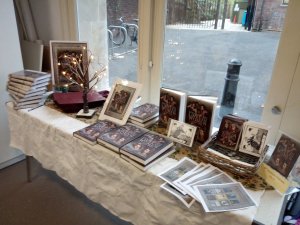
Exploring the Lives of Women on display at the book launch in Dec 2018
One of the earliest seminars that I attended was in June 2001 and the speaker was WSG committee member Mary Waldron. The paper was auspiciously entitled “A Very Different Kind of Patronage: Ann Yearsley’s New Friends”; within a year, Mary had become a new friend and a special kind of patron to me. As a Visiting Fellow at the University of Essex, Mary wanted to be of practical use in the department and so, in 2002, I acquired an additional informal supervisor. I gained enormously—as did so many of us at WSG—from her incisive comments and breadth of knowledge.
Mary’s support encapsulated the generosity of the group and its community spirit. By May 2003, when I was invited to join the organising committee, I naturally welcomed the opportunity to give back something in return. During my time on the committee (2003–2017) there were some exciting changes within the group. In 2003, WSG hosted the first of its popular workshops (with keynote speaker Helen King talking on “The Reproductive Cycle: Menstruation, Pregnancy, Childbirth and Lactation”) and the seminar programme was relaunched (with fewer sessions featuring multiple speakers). For my own part, I really enjoyed sharing some of the skills gleaned from my professional life in marketing, working on publicity for the group and establishing an online presence.
Over its thirty year history, the WSG has continually evolved; however, its core commitment has always been to support and promote the work of its members and this fact is evident in the group’s history of collaborative publication. Our edited essay collections, in book and journal form, provide a permanent record of the group’s activities and showcase our members’ research. In each volume, the majority of articles were first given as papers at WSG events, augmented with contributions by other group members responding to our internal calls for papers.
The first publication was a special issue of Women’s Writing (Volume 8, 2001 – Issue 2, introduced by Carol Banks and Anne Kelley). This project evolved from WSG’s 1998 Day School on “The Body and Women” and featured a wide range of topics, ranging from Elaine Hobby on midwifery to Myra Cottingham on Felicia Hemans’s “dead and dying bodies”. When Mary Waldron died, in 2006, Carolyn D. Williams was the energetic catalyst for two further publications that were inspired by and dedicated to Mary. The first of these emerged from the 2008 workshop and was another special issue of Women’s Writing, this time celebrating “edgy” women (Volume 17, 2010 – Issue 1: Women Out Loud, with managing editors Vicki Joule, Daniel Grey and Sarah Oliver). It included some fabulous characters, including two articles (by Kerri Andrews and Claire Knowles) on the subject of Mary’s research, the labouring-class ‘milkmaid poet’ Ann Yearsley. The second festschrift for Mary was Woman to Woman: Female Negotiations During the Long Eighteenth Century (University of Delaware Press, 2010), which I had the great pleasure of co-editing with Carolyn D. Williams and Angela Escott. Fittingly, for a work by WSG dedicated to Mary Waldron, the book’s theme was female collaboration. The essays were grouped into three core themes—family alliances, friends and companions, adventurous women—and included contributions from Jennie Batchelor and Judith Hawley.
We enjoyed two memorable launch events for our 2010 publications, with Ron Waldron (Mary’s husband) attending as guest of honour. The Women’s Writing special issue was launched at a champagne reception in June 2010 at Lucy Cavendish College in Cambridge, hosted by the journal’s co-founders Janet Todd and Marie Mulvey Roberts to coincide with their “Celebrating Women’s Writing” conference. It was wonderful that so many WSG members were able to attend, given the long association between the group and the journal. In October 2010 Lois Chaber hosted another splendid gathering for WSG members at her London home to mark the publication of Woman to Woman.
By a fortunate stroke of serendipity, the ideas for these publishing ventures were conceived around the time of WSG’s tenth and twentieth birthdays. However, in 2016—with our thirtieth anniversary approaching—Sara Read proposed a deliberate strategy: to officially celebrate this important milestone in print. The result was our latest book, Exploring the Lives of Women, 1558–1837 (Pen & Sword History, 2018), a rich collection of essays sourced from WSG members and edited by myself, Sara Read, Felicity Roberts and Carolyn D. Williams.
As Carolyn notes, ‘the thirtieth year has a particularly organic appeal, because it measures a generation’ (Introduction, Exploring, p.xix). As a celebration of the group’s ability to survive and thrive over its thirty-year existence, the editorial objective of the book was to reflect the essential qualities of WSG and the many and varied interests of our members. Unlike our previous publications, which focused on a single theme, it therefore provides an expansive, wide-ranging view of women from all walks of life—featuring opera singers and mine workers, queens and prostitutes—within an accessible and affordable volume.
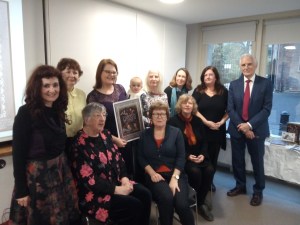
On December 8, 2018, Exploring the Lives of Womenwas formally launched at WSG’s thirtieth anniversary seminar at The Foundling Museum, London. This was a convivial and inclusive occasion, with attendees aged from 8 months to 80 years old and guests travelling from as far afield as the US. The one great sadness was that one of our authors, long-term member Marion Durnin, died very shortly before the event. The seminar was a timely opportunity to remember and celebrate Marion’s significant contribution to WSG and to the book (which includes her last published work) in the company of her husband Kevin and son Owen.
While the launch provided an opportunity to reflect upon and commemorate the group’s history and achievements over a generation, the key theme of the event was “Women’s and Gender Studies in 2018 and Beyond”. This focus reflects WSG’s forward-thinking philosophy, equally evident in the decision to use all proceeds from sales of the book to fund the group’s popular bursary scheme, thereby supporting future research in the field.
I was privileged to open the event with anillustrated talk,describing how the editorial team sourced the public domain images included in the book’s generous plate section, before using these images to describe and celebrate each author’s contribution. The next paper was delivered by our guest speaker Professor Bernadette Andrea(University of California, SantaBarbara). An expert on English women and Islam in early modern English literature, Bernadette introduced us to a unique narrative: Elizabeth Marsh’s The Female Captive(1769), the first full-length account of Maghrebian captivity written by an Englishwoman. Bernadette provided close readings from the text to illustrate Marsh’s “sartorial negotiations” which delicately balance her abjection as a female English captive with her apparent assimilation to Moroccan gender norms. The final speaker, Felicity Roberts, provided a stimulating and thought-provoking talk on the issue of precarity in academia, considering issues relating to gender and marginalisation, alongside a personal and polemical view on the practical ways in which WSG could provide enhanced support to its members in the future.
One of the emerging trends within the group has been its desire to embrace the creativity of our members, demonstrated perfectly by WSG’s very first creative seminar scheduled for August 2019. This tendency is also reflected in Exploring the Lives of Women, which features two poems: ‘Gretchen’s Answer’ by Tabitha Kenlon and ‘Stilts’ by author and performer Jacqueline Mulhallen. At our thirtieth anniversary event, Jacqueline entertained us all with a recital of ‘Stilts’: this was recorded by William Alderson and we are delighted to be able to share a video of the performance.
To conclude the event, it was fitting that the final words should be reserved for the personal reminiscences of long-term supporter Lois Chaber, who gave an honest and entertaining account of her life within the group and its evolution, and WSG founder member Yvonne Noble. Yvonne Noble wonderfully described how and why the WSG was founded as a support network, and urged us all to continue to work together to support the group and reach out to those who may benefit from its collegial spirit.
When I was urged to join WSG, almost twenty years ago, I expected to find friendship and community. Yet professionally and intellectually it has exceeded my expectations. As an independent scholar, WSG has given me an unrivalled opportunity to publish my own work, collaborate with others and benefit from the significant skills, knowledge and experience of my co-editors. WSG will continue to flourish in the coming decade and I am certain there will be plenty to celebrate in its fortieth year–and perhaps there will even be another book?
Every scholar has had that moment when they’ve wondered if they’re ever going to get their project done, or get their enthusiasm for their subject back, whether it’s because of administrative overload, physical or mental ill health, or precarity. Groups like WSG can form a supportive network to researchers, particularly those who find themselves outside traditional academic structures. In the fourth of our series reflecting on the history of WSG and in honour of our new book Exploring the Lives of Women (Pen & Sword, 2018), Marilyn L. Brooks recounts how WSG has been a resource for her through the years.
I’ve found it extremely interesting and very enjoyable to be given the opportunity to look back over the history of the WSG and its influence on my life and well-being.
I came to academia late as a mature student in my 30s. I must have joined WSG in the mid to late 80s after being encouraged to make contact by Marie Mulvey-Roberts at a BSECS conference. This was my first opportunity to immerse myself in women’s studies. At the time, the period coverage was narrower, starting at 1600, but it firmly included my own specialism of eighteenth-century women’s literature and Mary Hays in particular. Right from the start I found a welcoming and encouraging atmosphere nurtured by the warm support and enthusiasm of Yvonne Noble, Lois Chaber, Mary Waldron and Linda Bree. I was struck by their belief in sharing our interests with others. During my MA studies at Queen Mary College, London, Chris Reid and Isobel Grundy also urged me to become involved in the meetings. I wasn’t able to attend regularly because my work for the Open University took place on Saturdays but those I could get to I found inspiring, not least the chats during the breaks. I was pleased to see that one of my MA students, Marion Durnin, went on to be a committee member.
I gave a paper ‘Mary Hays and “My Struggles to Free Myself”’ in April 1988, which led to a regional Day School in Cambridge two years later called ‘Appropriations of Power’ (with the encouragement and administrative help of Yvonne). Another paper ‘Mary Hays: Reluctant Radical’ was given in 1996. This was followed by a joint (with Nora Crook) centenary conference on Shelley/Wollstonecraft in 1997 in Cambridge which was advertised through our group, with several members attending and offering papers.
In 2000 I had to retire from work through ill health (I had been diagnosed with Bipolar 1 disorder over 40 years ago and my condition was worsening) and, on medical advice, moved to southern France (for the light) so I was unable to come to meetings and I soon started to feel geographically and psychologically isolated (one of the reasons why Yvonne wanted to form the group in the first place). As well as cancelling my subscription to BSECS, Women’s Writing, and Enlightenment and Dissent, I decided that WSG also had no further interest for me so I didn’t renew to that either and dropped off its mailing list. How many times did I say to myself ‘Do I need to know that so-and-so had published such-and-such or that, for example, a BARS conference ‘Women, Money and Markets (1750-1850)’ will take place at Kings College London in May 2017’? Well, yes I did and yes I do. I remember feeling that my isolation (geographical and psychological) was increasing by knowing what I was being excluded from so I thought STOP. I don’t know when I decided how much I missed knowing what was going on in my subject area but after some years I decided to renew my subscription. I was glad to know for instance, that Janet Todd had published Death and the Maidens and Anne Stott had a book out on Hannah More, both of which I later read and enjoyed. I probably wouldn’t have heard of these elsewhere. I’ve noticed a very impressive progression from quite basic/rudimentary information to a sophisticated notice board giving dates on events and access to essential databases such as the Orlando projectled by WSG member Isobel Grundy.
Would I go up to the Foundling Museum if I could? Well yes I would. Workshops to which participants are asked to bring a 5-minute contribution shows the Group’s commitment to inclusion and participation especially relevant to newcomers. I saw that one recent workshop was advertised as offering discussion and conviviality, both of which are always guaranteed.
At times I’ve thought I can’t attend meetings therefore I’m not a real member. But of course I am. After rejoining I’ve felt that badly-needed intellectual support through the mailing list, sometimes two or more items arriving in a day.
The publications I thought I’d lost interest in after early retirement actually became central to my life here – a way of connecting. A major resource has been the members’ interests list. Scrolling down it I found Susan Purdie and Sarah Oliver shared my interest in William Frend and their article on his relationship with Mary Hays gave me a badly needed boost and being in touch has been a great boost to me. We’ve been lucky to have this extensive resource of members’ interests eg 4 Sep 2016 Judith Hawley asked for help with her work on Joanna Baillie and I am sure she got it. I was also asked for advice regarding a forthcoming viva on Mary Hays and was glad to offer some.
I have to admit that the frequent receipt of notices of events sometimes seemed to reinforce my feelings of isolation from the academic world but latterly I came to see this as a badly needed lifeline. I’ve found myself carefully reading the extensive synopses before each group meeting as if I could almost feel that I was going to attend. I like to know what’s going on and thus feel included. Do I need to know that our workshop on seventeenth-century portraits of women will take place on 6 May 2017 at the Foundling Museum? Well, yes I do! And maybe I’ll be able to come.
The format has become more and more sophisticated over the years and we must applaud the contribution made voluntarily by members. The coverage is impressive and a respected outlet for other sources e.g. BARS, academic blogs, outings, cfps, etc.
I should say that suffering from my worsening bipolar illness has fed this isolation even more by removing any input I would have liked to make. This is where the notifications have given me hope that my interests can resurface. In fact, due largely to the circle I find myself in I am silently encouraged to pursue my research on William Frend even though it looks very unlikely that it will come to completion. I’ve had to accept that some things are no longer possible but that I can still get enjoyment out of them. I’ve felt nurtured by interest in my work outside a competitive forum. The Group has unknowingly given me the courage to carry on.
I think this is due to the nurturing support of the WSG. Thank you Yvonne for the vision and thank you all for fulfilling it.
 On December 8, 2018, Exploring the Lives of Womenwas formally launched at WSG’s thirtieth anniversary seminar at
  Women's Studies Group 1558 - 1837