WSG Member Organizes Hybrid Conference: “Collective Biographies Across Disciplines and Ages”

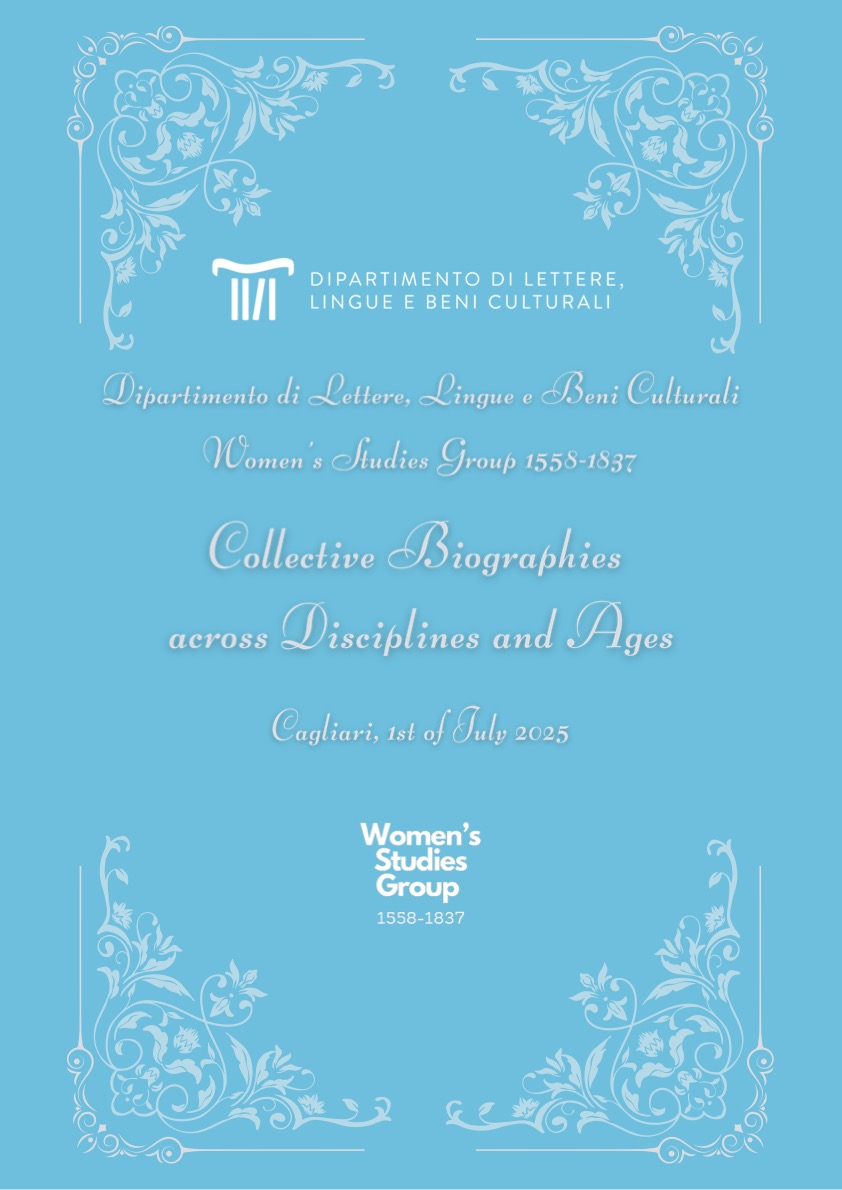
WSG Member Organizes July 1st, 2025 Hybrid Conference: “Collective Biographies Across Disciplines and Ages”

The Women’s Studies Group 1558–1837 is pleased to announce an upcoming one-day hybrid conference, “Collective Biographies Across Disciplines and Ages,” taking place on 1 July 2025, in person at the Università degli Studi di Cagliari (Faculty of Humanities, Via San Giorgio 12, Aula 6 and Aula Magna) and online via Microsoft Teams. This international event is organized by WSG member Dr. Maria Grazia Dongu, and it brings together an international group of scholars across disciplines.

About the Conference

This conference explores the literary, historical, and artistic dimensions of collective biography, narratives that center shared experience, social connection, and cultural memory. Presenters will consider how collective biographies function as both historical sources and narrative strategies, across genres as varied as Shakespearean drama, Quaker life writing, detective fiction, and eighteenth-century art. Drawing on approaches from literary studies, historiography, and biography theory, the conference reflects on how individual and group identities are shaped through storytelling.

The Women’s Studies Group 1558–1837 is proud to support this event, which features presentations by a number of our members and provides the opportunity to strengthen scholarly networks internationally and across disciplines.

Conference Schedule – 1 July 2025

9:30 am – Brief Introduction: On Collective Biographies by Maria Grazia Dongu (Università di Cagliari)

10:00 am – Competing to Tell Lives in Shakespeare’s Richard III by Maria Grazia Dongu (Università di Cagliari)

10:30 am – A Case Study of Early Quaker Biographies by Judith Roads (Independent Scholar)

11:00 am – Indizi tra le righe: l’Irlanda che cambia nelle detective story (Clues Between the Lines: Ireland’s Changing Face in Detective Stories) Luciano Cau (Università di Cagliari)

11:30 amBreak

12:00 pm – Anne of Cleves in Collective Biographies by Valerie Schutte (Independent Scholar)

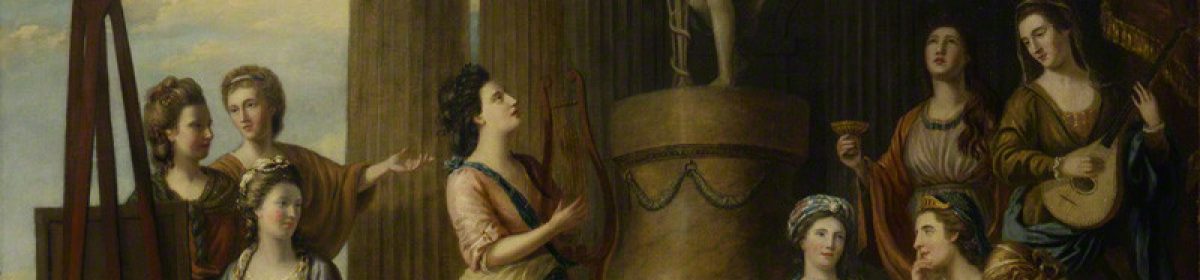
12:30 pm – The Collective Biographies of 18th-Century Art: Harnessing the Power of Storytelling to Re-Read Martin’s “Lady Elizabeth Murray and Dido Belle” (1779) by Karen Lipsedge (Kingston University)

1:00 pm – Vita collettiva e autorialità: La famiglia Manzoni (Collective Life and Authorship: The Manzoni Family) by Fabio Vasarri (University of Florence)

13:30 pm – Catherine of Aragon, Cardinal Wolsey and Henry VIII through Chronicles and Shakespeare’s plays by Valeria Steri, Alessandra Carta, and Elena Melis (Università di Cagliari)

The day will conclude with a roundtable discussion among speakers and attendees.

Hybrid Attendance – All Are Welcome

This is a hybrid event, and attendees are warmly invited to join either in person or virtually.
To receive the Microsoft Teams link for online attendance, please contact Dr. Maria Grazia Dongu at dongu@unica.it.

The Women’s Studies Group 1558–1837 is proud to support Dr. Maria Grazia Dongu in organizing this exciting interdisciplinary event. We celebrate her leadership and the vibrant international scholarly exchange this conference promises to foster across disciplinary boundaries.
Review: Special seminar with Merry Wiesner-Hanks, February 13, 2025, Review by Louise Duckling

We were delighted to welcome distinguished Professor Emerita Merry Wiesner-Hanks as a special guest to discuss her new book Women and the Reformations: A Global History.

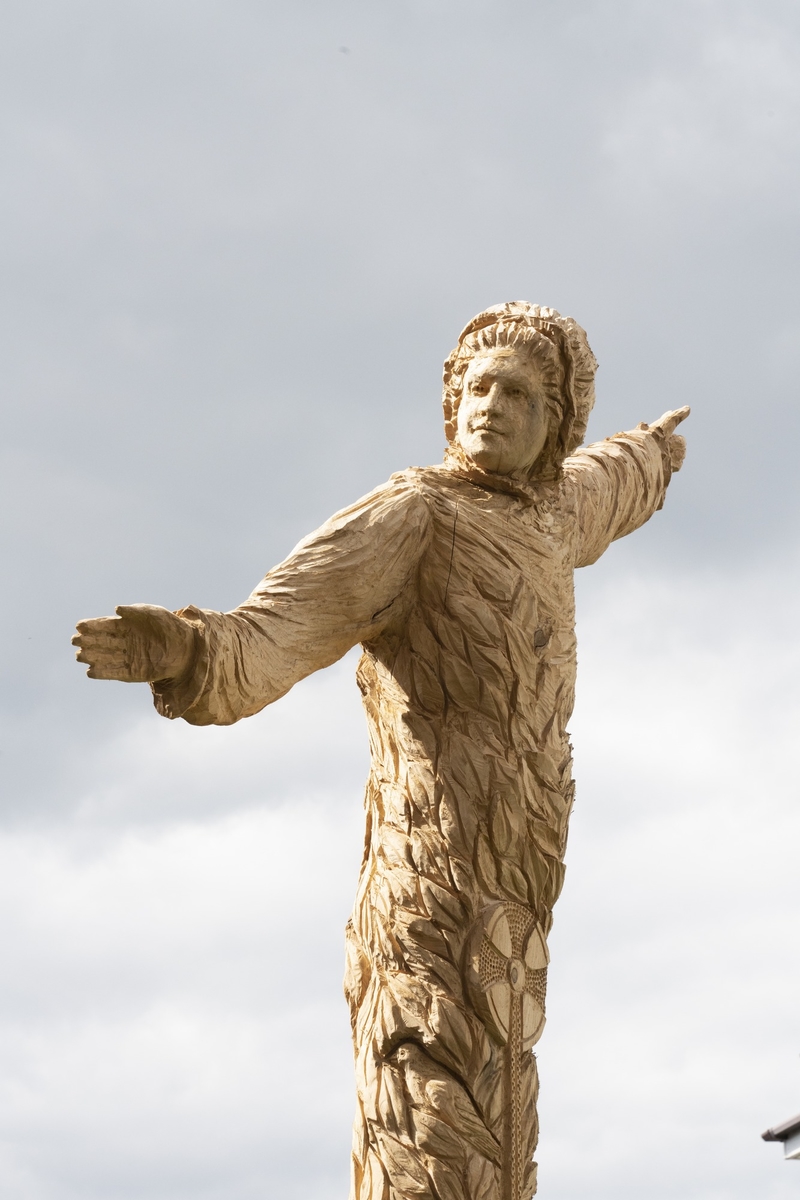
O’Rourke, Simon; Susanna Wesley (1669-1742), Mother of Methodism; ; http://www.artuk.org/artworks/susanna-wesley-16691742-mother-of-methodism-323273

The seminar began with a 30-minute presentation outlining the book’s structure and introducing us to some of the incredible women within its pages. Professor Wiesner-Hanks explained how the idea for the book emerged in response to the Luther 500 celebrations in 2017. These celebrations did not truly reflect the new scholarship on women that had emerged in Reformation Studies in the previous decades. Women and the Reformations aims tofill that gap for a general audience.

Our attention was drawn to the plural in the title: this is a work about Reformations, Catholic and Protestant, with women from both sides appearing in every chapter. The motivation is to draw parallels and comparisons, rather than organise the material in a ‘predictable’ way. The text is therefore structured by the type of women that are featured: monarchs, mothers, migrants, martyrs, mystics, and missionaries.

The historical, geographical, and thematic scope of the book is impressive. The content will not be covered in detail here, as a full book review is planned for a later post. In the meantime, we will share some fascinating insights from the seminar.

Most strikingly, it is worth noting there are 258 named individuals in the book. Some of them are very young – and they were taken very seriously in their time – and some are very old. Some are well-known, such as Teresa of Avila, and others are recently discovered.

Professor Wiesner-Hanks’ presentation gave a very clear sense of how ordinary people might encounter these women today, through memorials, statues, and material culture. A striking example is the sculpture of Susanna Wesley (1669–1742) by Simon O’Rourke, carved from the remains of a Cypress tree in East Finchley Methodist Churchyard.  

Another significant feature of the book is the fact it is a global history. A woman from outside Europe is featured in each chapter. For example, among others, we heard about the African visionary, Kimpa Vita; the Ethiopian abbess and saint, Walatta Petros; the Peruvian mystic, Rose of Lima; and Japanese and Korean martyrs.

In the questions, we enjoyed a lively discussion on women’s agency, early modern patriarchy, and Allyson M. Poska’s case for “agentic gender norms”. Women were right at the centre of every different exchange at this time, actively breaking these gender norms. There were so many female networks in this period, and a surprising number of women rulers who exercised power: this is essentially a book about women’s agency.

Another important strand to the conversation was around writing craft: how can we communicate ideas in an accessible way for a wider audience? Professor Wiesner-Hanks shared some tips, ideas, and her enthusiasm for writing a trade book, covering elements from writing style to selection of material. This was a practical and inspirational way to close the session. We hope to hold similar events in the future.

Our thanks to Merry Wiesner-Hanks and the team at Yale University Press, as well as our chair Valerie Schutte, for making this seminar possible.

Captions:

Susanna Wesley (1669–1742), Mother of Methodism. By Simon O’Rourke.

© the artist. Image credit: Nick Bowman / Art UK.

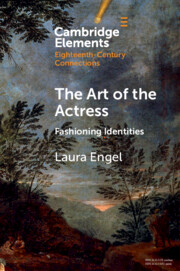
The Art of the Actress: Fashioning Identities. By Laura Engel. Review by Victoria Joule

The Art of the Actress: Fashioning Identities. By Laura Engel. Cambridge: Cambridge University Press. 2024. Pp 78. £17.00 paperback), ISBN 9781108977906.

The cover image of Laura Engel’s The Art of the Actress is not of an eighteenth-century actress, but instead features the moody tones of Donato Creti’s Astronomical Observations: Comet (1711). Although not discussed within the book – indeed, Engel may not have chosen the image – the significance is clear. Set against darkening skies, the glowing comet shines out much like the actresses discussed in the text; their dazzling images and performances are moments in history that artists and actress-artists alike attempted to capture in solid form for posterity. In this book, Engel offers the reader a visually and intellectually stimulating insight into the literary, cultural and material legacy of the actress. The Art of the Actress is part of Cambridge Elements: an extensive collection of shorter academic works covering a wide range of disciplines. Engel’s work is published within the Eighteenth-Century Connections series that explores ‘connections between verbal and visual texts and the people, networks, cultures and places’ with attention to ‘oral, written and visual media’. Cambridge Elements can be purchased as affordable print or electronic editions, and some are also open access.

The paperback version of Engel’s book is about the size of a journal but lighter and softer to handle, and the cover image is beautifully reproduced. The text is divided into four parts: part one concentrates on the use of pearls in portraiture; part two is on the relationship between artist and actress; part three focuses on another material object – a muff; and part four cleverly reads the style of ‘unfinished’ art against the in/ability to capture the actress’s image. Engel effectively selects specific material objects and specific actresses to provide ‘a visual exhibition highlighting the representations, creative works, collaborations, and experiences of both well-established and lesser-known performers’ (3) in the eighteenth century. In Engel’s terms, ‘The “art” of the actress thus refers to the actress represented in art, as well as the actress’s labor and skill in making art ephemerally through performance and tangibly through objects’ (2). Throughout the study, Engel highlights the fascinating web of theatrical connections between artists and actresses, demonstrating how ‘women fashioned their identities on- and offstage, as well as how audiences perceived women in the public sphere through theatrical lenses’ (3–4).

Part one immediately establishes Engel’s aims using a piece of jewellery to observe the complex history it brings to different visual portrayals. A string of pearls can tell a story about the actress and her infiltration into the higher echelons of society, but it also conveys the pearls’ murky history in terms of slavery; furthermore, ideas about beauty and competing metaphors of virginity and sexuality show the actress’s ‘[occupation of a] precarious and significant place in the early modern world’ (18). The section concludes with a concise but fascinating examination of pearls as stage accessory in portraits of actresses, providing links between the parts they and others played.

Part two develops the concept of the actress as artist/artist as actress. With a focus on Anne Damer (amateur actress and sculptor) and Angelica Kauffman (artist), Engel demonstrates how involvement in acting had an impact on their representations of women. Engel provides an expansive backstory to a selection of portraits showing how Damer and Kauffman’s private and public lives, as well as public theatre and private theatricals – and even specific performances, costumes and contemporary fashions – fed into their artistic creations. Damer, present in the public eye as an actress, sculptor, and quite a character with her ‘dazzling, over-the-top costumes’ (38), was inevitably subject to satiric attacks. Engel provides an empowering reading of the ongoing presence of these women’s work in museums and galleries as testimony to their valuable contributions to the arts.

The penultimate section focusses on one figure and an emblematic object: Mary Anne Clarke and her strategically held muff. Clarke appeared with a huge white muff at the scandalous court case concerning her selling of army commissions to fund decoration of the house given to her by her lover, the Duke of York. Taking theory and knowledge of actresses’ self-fashioning and their contemporary reception and portrayal, Engel reads the subsequent images of Clarke in comparable ways: ‘Although Clarke was not an actress on the stage, her theatrical maneuvering and publicity stunts established her as a performer to be reckoned with’ (48). The validity of this approach is reinforced by the section on Thomas Rowlandson’s collection of prints featuring Clarke and actress Dorothy Jordan, in which Engel persuasively highlights connections between the satirical portrayals of the two women. Engel concludes with a more uplifting comment on Clarke’s later attempt to control her image through neo-classical sculpture.

To conclude, Engel effectively examines the transitory nature of performance by turning to ‘unfinished’ artwork. Engel uses a selection of Sir Thomas Lawrence’s unfinished portraits to show how they ‘are inextricably tied to the theater, an art form that is by definition fleeting, ephemeral, and open-ended’ (63). Again, Engel reveals the intricate web of theatrical connections behind and feeding into artistic works. The unfinished portraits are of the actress and playwright Elizabeth Inchbald, and of Lady Cahir who performed with Lawrence in one of Inchbald’s plays at a private theatrical. Engel extends the reading of theatrical influences on portraiture to a brief analysis of other portraits. One is ‘almost too finished’ (68) compared to the others: ‘these portraits are alive because they are not done yet’ (65).

One lasting impression this condensed book gives is just how theatrically infused culture was in the eighteenth century. Because of the impressive scope of Engel’s work in exploring the connections and conversations between artists and actresses, visual art, performances and more, there is less space at times to delve into detailed analysis and deepening of concepts, such as how the eighteenth-century actress ‘is central to understanding unfolding anxieties about nation, race, gender and heteronormativity’ (4). For example, the ‘unexpected analogy’ between an enslaved (female) child and duchess (in Duchess of Portsmouth with an Unknown Female Attendant) could be developed further using broader post-colonial studies, particularly in relation to the subsequent portrait of Nell Gwyn (with black male slave) which Engel presents as an echo (17). Sometimes the cruder, more explicit aspects of the material are left unsaid: for example, we can consider exactly how Gwyn is (erotically) ‘making’ (or stuffing or washing?) sausages and how Clarke’s muff (like Sophia Western’s in Tom Jones)is representative of female genitalia. These kinds of questions, however, also point to the effectiveness of Engel’s style, which encourages an interactive engagement. Engel often poses questions or makes references to online reproductions of portraits for readers to follow up in addition to the extensive range she discusses. I found myself setting up another device to look at these images while reading this book. I can imagine students and scholars alike being inspired to pursue new research projects. As a kind of condensed monograph, in an age when time seems to be as short as ever and new research is published rapidly, this easy-to-read book serves as a model and inspiration for future study.

Victoria Joule is an independent scholar based in Wales. Victoria has published on women’s writing of the long eighteenth century with particular attention to self-representation and literary forms. She co-edited and contributed to the essay collection with Emrys D. Jones, Intimacy and Celebrity in Eighteenth-Century Literary Culture: Public Interiors (Palgrave Macmillan, 2018).

How the WSG supported my research

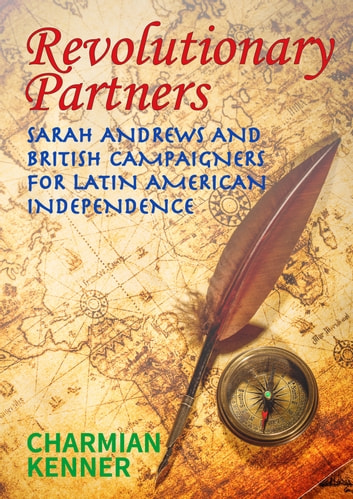
A reflection by Charmian Kenner

I have just published my book Revolutionary Partners: Sarah Andrews and British Campaigners for Latin American Independence, and as an independent researcher I have found the Women’s Studies Group to be a vital source of support.

I discovered Sarah Andrews, the main subject of my research, in a painting at the Venezuelan Cultural Centre in London. The picture is a contemporary re-imagining of a scene taking place in the early 1800s. Simón Bolívar, the future Liberator of Venezuela, Bolivia, Colombia, Ecuador, Peru, and Panama from the Spanish, is being received by fellow revolutionary Francisco de Miranda at the latter’s London home. My attention was caught by the depiction of a young woman in the corner of the painting, reading a book with two young children next to her.

This young woman turned out to be Sarah Andrews, the British partner of Francisco de Miranda. Intrigued, I began to investigate her story and found that Sarah ran the household, which served as a London headquarters for supporters of Latin American independence. My starting point was a treasure trove of Sarah’s letters to Miranda while he was away fighting in Venezuela from 1805-1807 while she held the fort back home.

I had been a feminist historian 35 years earlier and many other things in between. Now retired, with no institutional affiliation, I needed a way to exchange ideas with like-minded people. The ideal would be a group centered on women’s history, so I searched online and was excited to find the WSG close to me in London, with seminars accessible to all.

Attending my first seminar, I was welcomed and immediately treated as an equal. Everyone I spoke to was interested in my topic and eager to help, suggesting references and recommending lines of enquiry. I was relieved to find that many in the group were independent researchers and had been able to publish their work.

The seminars were a constant source of wonder, revealing so much about centuries of women’s history. Ideas about my own research were stimulated as contributors interacted with the audience and drew out threads of commonality between the presentations. Questions and comments were always infused with a spirit of positivity. 

Some topics were of direct relevance to my research. A paper by Valentina Aparicio drew attention to Maria Graham’s journal of her stay in newly-independent Chile in 1822, which became an important source for my study. Together with documentation I had already gathered on Mary English and Kitty Cochrane, who accompanied British partners fighting alongside Simón Bolívar, this widened my focus beyond Sarah Andrews’ story. My book now includes the experiences of other British women supporters of Latin American independence.

Like everyone in the WSG, I was invited to submit a paper for the seminars. This was an opportunity to focus my thinking and develop my analysis. The response from the audience was heartening. They were keen to discover more about Sarah Andrews and her social and political context, encouraging me to continue with the research and to publish.

Feedback at the seminar provided me with key ideas from wide-ranging scholarly knowledge amongst the WSG. For example, several group members highlighted the significance of Sarah Andrews’ father being a shoemaker. This could explain how Sarah encountered revolutionary ideas in the Yorkshire market town where she was born since shoemakers’ shops were a well-documented centre for radical discussion.

Further help was forthcoming after the seminar. Louise Duckling sent suggestions for publishers, whilst Gillian Williamson shared information she found in Old Bailey records concerning a burglary at Sarah Andrews’ home in 1840. The court evidence revealed Sarah’s living arrangements and those sharing her house at this point, a period for which little other data was available.

This support validated my topic and spurred me on. I soon began to write, and at a recent WSG seminar I was happy to say that I was about to publish my book with free access online. WSG members received this announcement with the same pleasure and interest they had shown throughout my research journey. It felt like coming full circle. 

The final hurdle was to convert my Word document into the format required for an e-book. Images and captions kept repositioning themselves, and I couldn’t find anyone who knew how to solve the problem. Once again, WSG came to the rescue. I put out a call for help on the email list, and Louise Duckling quickly responded with suggestions for people experienced in formatting. The first person I contacted sent an immediate reply and not only sorted out my pictures but also improved the book’s overall design. I was ready to publish! Revolutionary Partners: Sarah Andrews and British Campaigners for Latin American Independence can be accessed free here.

Thank you, WSG!

Charmian Kenner

Charmian Kenner started life as a feminist historian in the 1970s. After many other incarnations she returned to her original occupation, having discovered the existence of Sarah Andrews, the partner of Venezuelan revolutionary Francisco de Miranda in London in the early 1800s. Sarah’s intriguing story was waiting to be told, and the result is the recently published book Revolutionary Partners: Sarah Andrews and British Campaigners for Latin American Independence, available free on Kobo.