WSG member and historian Valerie Schutte is co-editing an exciting new two-volume collection with Jessica S. Hower and William B. Robison that explores how the Tudor period has been adapted across various media and forms. This timely collection comes as Tudor-themed adaptations continue to captivate audiences, from the National Portrait Gallery’s recent Six Lives exhibition to new screen productions like Firebrand and Shardlake.
The editors welcome submissions examining any aspect of Tudor adaptation, from historical novels and screen adaptations to museum exhibits and heritage sites. The collection aims to investigate how history is adapted for public audiences and what these adaptations reveal about both the Tudor period and the times in which they were created.
Potential topics include, but are not limited to:
Historical novelists and their works, focused on the Tudor period
Screen adaptations of Tudor-themed novels
Theatrical adaptations
Historians who have ventured into historical fiction
Museum exhibitions and heritage sites
Digital adaptations, including virtual exhibitions and video games
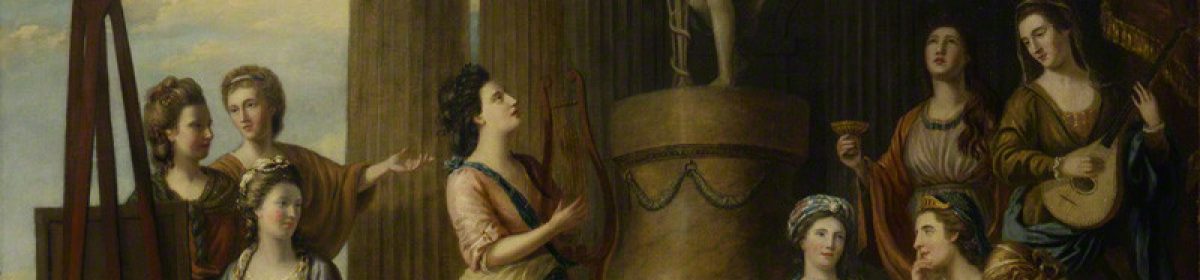
A reminder that the special Women’s Studies Group 1558-1837 seminar takes place 8 December, when WSG launches its 30th anniversary collection, Exploring the Lives of Women 1558-1837 (Pen & Sword Books, 2018) at the Foundling Museum, London. Reserve your place now to hear a special set of papers, ‘Women’s and Gender Studies in 2018 and Beyond’, drink a glass of wine (or soft drink), and get a copy of the book.
Speakers are:
Louise Duckling: Exploring the Lives of Women, 1558-1837: A Journey in Images Bernadette Andrea: ‘English Daughters’ in Eighteenth-Century Morocco: Abjection and Assimilation in the Narratives of Thomas Pellow and Elizabeth Marsh Felicity Roberts: The Academic Precariat: Writing Women’s History Now
Seminars take place at the Foundling Museum, 40 Brunswick Square, WC1N 1AZ, starting promptly at 1pm (doors open 12.30pm) and finishing at 4pm. The Foundling is a wheelchair accessible venue, and directions for getting to the Museum can be found here, including for those who are partially sighted. This seminar will be a parent and baby-friendly event.
Come and help the Women’s Studies Group 1558-1837 celebrate the launch of their 30th anniversary book, Exploring the Lives of Women! On 8 December at the Clore room in the Foundling Museum, London, WSG will be holding a one-off edition of one of their winter seminars, featuring a special set of 3 papers, ‘Women’s and Gender Studies in 2018 and Beyond’, followed by the book launch. Booking for this seminar is now open on eventbrite. Reserve your place to join us for three stimulating papers, a glass of bubbly or a soft drink and an opportunity to peruse the new book.* Hardback copies will be available for purchase on the day at the special pre-order price of £15.99 and editors and contributors will be there to sign or dedicate your copy. It would make an ideal Christmas present…
Speakers are:
Louise Duckling on ‘Exploring the Lives of Women, 1558-1837: A Journey in Images’
Bernadette Andrea on ‘‘English Daughters’ in Eighteenth-Century Morocco: Abjection and Assimilation in the Narratives of Thomas Pellow and Elizabeth Marsh’
Felicity Roberts on ‘The Academic Precariat: Writing Women’s History Now’
The Foundling Museum, 40 Brunswick Square, WC1N 1AZ, is a wheelchair accessible venue, and directions for getting to the Museum can be found here, including for those who are partially sighted. Seminars are free and open to the public, start promptly at 1pm and finish at 4, doors open at 12.30pm, and those attending the seminars are welcome to look round the museum before or after. This seminar is a parent and baby-friendly event.
*Once you have booked, no printed ticket is necessary to attend this event. Just turn up and give your name. If you are experiencing trouble booking, please email the WSG organisers on wsgpostbox@gmail.com.
*If you are intending to purchase a book, please also indicate to the organisers by emailing wsgpostbox@gmail.com. Please bring cash.
To order a copy online, see our publisher Pen & Sword’s page.
This year our summer trip was organised by WSG member Miriam al Jamil and we went to the National Portrait Gallery’s Heinz Archive and Library, where staff had organised a sumptuous display of prints and other material all related to gender and women’s studies in the early modern period and long eighteenth century. WSG member Susan Schonfield went along and here reports on the day:
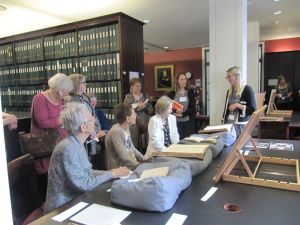
Twelve WSG members and friends visited the Archive and Library where the Curator of the Gallery’s Reference Collection, Paul Cox, had put out material for us to view. As an example, he had been asked by Miriam al Jamil, who had organised the visit, to show what the archive and Gallery held on the Chevalier d’Eon (1728-1810). Several prints and a copy of the one oil portrait (on loan to a Berlin museum) gave an indication of the wealth of material available to researchers and students.
Images of the Chevalier D’Eon at the NPG
Paul gave a short talk on the life of the Chevalier. He included explanations of the different print techniques used, e.g. stipple and intaglio, and mentioned the various sources of the prints, including contemporary scandal sheets. The Chevalier had been a soldier, diplomat and spy for Louis XV, and was famously a cross-dresser, living from 1786 as a woman. To complement D’Eon’s story, Paul had also looked out what the archive held on Hannah Snell (1723-92), a woman who had passed for a man to serve as a soldier and sailor; one print portrait of Snell was probably taken from a real-life sitting, and certainly her resourceful character was evident. After the talk, we had time to look more closely at the individual prints and ask questions.
Our second speaker was Carys Lewis, an Archivist at the collection, who spoke about the acquisition of portraits of women, as well as work by women artists. The first Annual Report of the National Portrait Gallery (NPG), founded in 1856, was in 1858 and listed 57 portraits acquired, five of which were of women. Carys also took us through some of the problems of provenance and previous incorrect attributions; some of the prints shown to us still had not had their sitter identified. We were also privileged to see the first Director of the Gallery, George Scharf’s sketchbook, with his own drawings of copies of prints and his notes on the colours of the works he’d sketched. The archive holds a collection of the 17thC artist Mary Beale, together with her husband’s diary, where he affectionately records what she was working on. Again, after the talk, we had the opportunity to look at the prints more closely, gently handle the sketchbook, and ask questions.
The Archive is open for study by members of the public Tuesdays to Thursdays, from 10.00am to 5.00pm, by appointment. The staff are most helpful and friendly. This is a real treasure trove, and several members of the group expressed the intention of returning for a visit to help them with their research.
After final questions and thanks, we went round the corner to an Italian restaurant for lunch, a pleasant social occasion.
Thanks Susan, for writing this report. And thanks too, to Paul and Carys of the NPG for organising the visit. Captivated by this post? Support the NPG’s work by becoming a member of the gallery. Want to learn more about the history of gender? Join the WSG.
As regular readers of this blog will know, the WSG is celebrating its 30th anniversary in 2017 (the date is a little bit hazy – it was so long ago! – but it is generally agreed that our panel at BSECS 1987 was our first meaningful action). As part of the celebrations, WSG has not only instituted a bursary, but is in the process of compiling and editing a volume intended to be a reflection of its members’ 30 years of research and activism. Edited by Carolyn Williams, Sara Read and Louise Duckling and with a working title of the Women’s Studies Group 1558-1837 Commonplace Book, it will comprise a mixture of short research articles, reminiscences, interviews and poems by members past and present. Those interested in the upcoming book can get a taste of it by listening to Elaine Hobby, Professor of Seventeenth-Century Studies at Loughborough University and a long-time associate of WSG, in conversation with Sara Read in a separate blog post later this month.
Commonplacing was a common knowledge-making practice during the early modern period whereby people would write short extracts or digests from their reading into books under topical headings. These could be poetry, prose, quotations, proverbs, letters and prayers, which the compiler could then reference and recombine. Books could be kept for pragmatic as well as recreational reasons. Men such as Francis Bacon and John Locke famously wrote about and kept commonplace books, but women kept them too, and in recent years much work has been done on a closely related genre, the recipe book, to which the whole household might contribute. Some thought the practice of commonplacing a cause for concern, because it would encourage superficial reading.
The commonplace book as a discursive practice arguably reached its peak during the early modern period but commonplacing is by its very nature also highly personal and has continued in various forms into the Romantic period and the present day. WSG’s Commonplace Book will be a printed rather than manuscript form, but it will reflect the collaborative, interdisciplinary, unruly, highly mobile forms of interaction and support WSG has encouraged over the years. We hope to see it published in 2018.
 A reminder that the special Women’s Studies Group 1558-1837 seminar takes place 8 December, when WSG launches its 30th anniversary collection,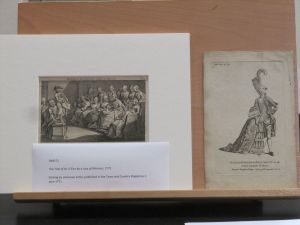
 Our second speaker was Carys Lewis, an Archivist at the collection, who spoke about the acquisition of portraits of women, as well as work by women artists. The first Annual Report of the National Portrait Gallery (NPG), founded in 1856, was in 1858 and listed 57 portraits acquired, five of which were of women. Carys also took us through some of the problems of provenance and previous incorrect attributions; some of the prints shown to us still had not had their sitter identified. We were also privileged to see the first Director of the Gallery, George Scharf’s sketchbook, with his own drawings of copies of prints and his notes on the colours of the works he’d sketched. The archive holds a collection of the 17thC artist
  Women's Studies Group 1558 - 1837