Women, Collecting, and Cultures beyond Europe. Arlene Leis. Review by Valeria Viola

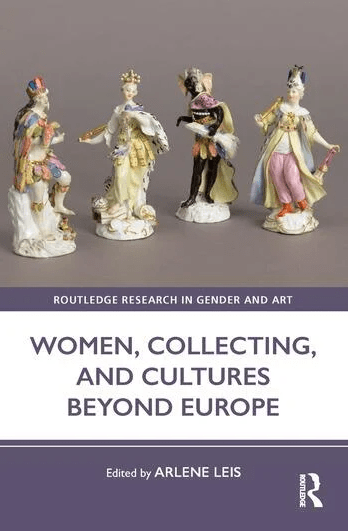
Women, Collecting, and Cultures beyond Europe. Arlene Leis. New York and London, Routledge. 2023. 282 pages, 21 Colour & 33 B/W Illustrations. £120.00, ISBN 978-1-032-13546-5

Arlene Leis makes the aim of this essay collection explicit in the book title. The 17 chapters intersect and consolidate two fields of research: Women and Collecting. The topic itself is not new, but research in this field is still very much alive. In 1985, in response to the provocative question ‘Did Women Have a Renaissance?’ raised by Joan Kelly-Gadol (1977), David Herlihy pinpointed that, even when pushed to marginal positions, women could find other routes to social influence in a world of men. Since then, scholars have demonstrated that one of these routes was collecting. An increasingly extensive approach has brought to light many women who commissioned buildings or collected artworks, so that the assumption of uniquely male-gendered patronage has become no longer sustainable (Reiss 2013). This extensive approach has at times risked dismissing the female social performance as inevitable (Hills 2003). Yet, research has been energized again by the exploration of the dynamics between the two sexes, who used art to negotiate their own spaces (e.g., Maurer 2019). This exploration has generated new questions about the influence of gender on the motivations and practices of collecting, and on the opportunity to use the same methodology to explore women’s and men’s collections. Arlene Leis herself addressed these issues in Women and the Art and Science of Collecting in Eighteenth-Century Europe (2021), co-edited with Kacie L. Wills, and they also appear, here and there, in this new book, proving that her research interest fits well into this burgeoning trajectory.

The key aspect of Leis’ new publication, however, lies in the last words of its title, Cultures beyond Europe, which signal how the work is sensitive to the increasingly pressing question of decolonizing research. The view of Europe from China, with which the book opens, is significant in this sense. While most of the essays are by English-speaking authors, their perspectives and approaches vary and extend to less-investigated areas and peoples around the globe, and to a greater extent than other recent publications on similar topics (e.g., Bellion and Smentek 2023). The broad chronological framework of the book, from the end of the seventeenth century to almost the present day, could be daunting, but it allows the reader to engage with case studies spanning long periods and to gain a glimpse into secular changes in collecting practices. 

Understandably, this wide perspective is not meant to be all-encompassing. A global methodology can deal with temporary connections and fragmented narratives without aiming for comprehensive knowledge of a phenomenon (Adamson, Riello, and Teasly 2011). The tempting effort to “fill the gap” is quickly set aside by Leis, who – more wisely – nudges us towards a comparative reading of the different narratives, by suggesting that we either follow the structure of the five themed sections or make our own connections. Since documentation is often poor in relation to women’s collections, these narratives stem from the collectables themselves, which bear their own information and knowledge. The problematic paucity of sources on women’s possessions, compared to their male counterparts, emerges as a transversal issue, from the poor goods of the women from San Fernando de Béxar, which have been traced through their wills by Amy M. Porter, to the Chinese imperial collections investigated by Chih-En Chen. In this regard, Chen has circumvented the problem by using a cross-source methodology that has proved useful for capturing the interactions between everyday practices, objects, and spaces. 

Albeit to varying degrees, the individual chapters show us that collected items are neither neutral nor passive but can implement change. In this sense, the book can be framed within the scholarship on materiality, where the term ‘materiality’ refers to the capacity of things to actively affect people’s attitudes and behaviours. Through a rigorous exploration of the eighteenth-century collections in the Chinese Imperial harem, Chih-En Chen argues that trompe l’oeil porcelain satisfied Qing women’s curiosity about European art, giving them a fictive freedom from their golden cage. Focusing on the Ottoman Empire, Gwendolyn Collaço argues that a dowry, prepared by a woman for another woman, could affect both the receiver’s and the donor’s social status. In Laura Garcia-Vedrenne and Martha Sandoval-Villegas’s case study, four court dresses demonstrate the wealth of an unidentified woman living in late eighteenth-century Mexico City. In Lisa Hellman’s study, the complexity of an entire collection is viewed through the lens of a single dress that bears witness to the travels and encounters of a Swedish woman. For its part, this dress caused her misfortunes and successes, according to the different perceptions of the stories it related. Perception, acceptance, and reciprocity can serve as the reading keys to the essay by Maria Antonietta Spadaro dealing with the Japanese artist, O’Tama Kiyohara, who moved to Italy at the end of the nineteenth century. While O’Tama assimilated the European way of painting, her oriental culture was met with mixed acclaim.

In a period of voyages, long-distance trade, and transcultural encounters, materiality intersects with questions of power and domination. Knowledge as intellectual appropriation is central to the naturalistic classifications that Europeans carried out in their colonies. As the contribution of women has often been thwarted and long gone unrecognized, many questions remain about their role in the colonization process. The botanist Jeanne Baret, discussed by Glynis Ridley, was forced to disguise herself as a man to travel with the French expedition to circumnavigate the world. Unsurprisingly, her work has remained somewhat overshadowed by that of the men she worked with. In this regard, however, the question that emerges as more urgent is not whether women indexed samples differently from men, but to what extent their scientific interest determined their political complicity. Thoroughly delving into the multi-faceted relationship between British colonialism and the scientific illustrations of Indian flora and fauna, Apurba Chatterjee argues that an aristocratic woman, Lady Mary Impey, participated in the colonial enterprise by collecting images of birds drawn by Indian artists. If the inclusion of specimens in the Linnaean taxonomy already implied their extraction from their native environments, a further degree of appropriation was their transfer to European soil. Additionally, the crossing of borders provided these samples with new values and potential. For instance, the pineapple plant successfully replanted in Amsterdam gave fame to Agnes Block, the amateur botanist investigated by Catherine Powell-Warren. Not much differently, the display of dwarves from the Portuguese colonies emphasized the colonial power of the Lisbon court. This case study by Agnieszka Anna Ficek underscores the extent to which curiosity for the exotic intersected with discourses of race, exploitation, and slavery.

While gaining knowledge of others was both the cause and the result of transcultural encounters, the documentation and exhibitions of objects became a further step to perpetuate, promote, and spread this acquired knowledge. The crucial point was and remains the degree of cultural interference that an external (mostly Western) perspective can impose on the heritage of others. This point holds true even when these actions are implemented with the best intentions. Cynthia Sugars explores the case of a British botanist, Catharine Parr Traill, who, while laying the foundations for Canada’s natural history, misunderstood and bypassed Indigenous knowledge of nature because of her moralistic and imperialist view. In their laudable efforts to preserve and promote artists from Santa Fe, the five Pennsylvania women investigated by Nancy Owen Lewis could not avoid imposing their idea of art on indigenous works. As Martha Sandoval-Villegas argues in her study of Mesoamerican huipils, the objects may come from communities that gave collecting practices different purposes. 

When exhibited, objects push people to take a stand with respect to the stories, knowledge, and meanings that the same objects bring with them. For Angela Fey and Maureen Matthews, for example, the collection of Métis embroidered clothing enabled women from Manitoba to face and acknowledge their indigenous heritage. Yet, when collectors themselves are unaware of what lies behind their collections, they prevent any other observer from reaching a critical awareness. Brandt Zipp suggests this reflection to us when he tells us about a group of white women who, between the 1920s and 1930s, recovered forgotten examples of eighteenth-century American pottery, but not the Afro-American identity of their ceramicist. Working against this attitude, Toby Upson proposes an adjacency approach which aims for the viewers to understand the object without alienating it from themselves. According to this approach, institutional and non-institutional collectors should not only display or explain otherness but also help observers to find a critically aware position with respect to the same otherness. Louise Hamby seems to suggest a very personal approach, but one that is equally open to the cultural implications of the object. As an artist, she has collected Aboriginal fibre objects from Arnhem Land in Australia with the aim of learning and collaborating with local artists. 

To conclude, the global perspective of this book allows the reader to perceive differences and similarities between very varied contexts, thus responding to the expectations created by its title. However, it also opens questions that are useful for the development of its lively field of research. For this reason, scholars dealing with the fields of women, materiality, and collecting will find it very useful. Furthermore, the book makes a very rich contribution to the niche field of the relationship between art, science, and gender. However, the text could also be of interest to all those who aspire to a decolonizing vision of history. Amongst these, I would certainly include the teachers who try to provide their students with this vision every day.

Valeria Viola

Valeria Viola (Ph.D. in History of Art and Architecture in 2020) is an Art teacher with experience in both architectural practice and research. At the moment, she is engaged in integrating gender and decolonial perspectives into teaching. You can find her publications here: https://york.academia.edu/ValeriaViola

Cited works.

Adamson, Glenn, Giorgio Riello, and Sara Teasly (eds.). “Introduction”. In Global Design History, 1–10. Abingdon: Routledge, 2011.

Bellion, Wendy and Kristel Smentek (eds.). Material Cultures of the Global Eighteenth Century. Art, Mobility, and Change. London and New York: Bloomsbury Visual Arts, 2023.

Herlihy, David. “Did Women have a Renaissance? A Reconsideration.” Medievalia et Humanistica 13 (1985): 1-22.

Hills, Helen (ed.). “Theorizing the Relationship between Architecture and Gender in Early Modern Europe.” In Architecture and the Politics of Gender in Early Modern Europe, 3–36. Aldershot and Burlington: Ashgate, 2003.

Maurer, Maria F. Gender, Space and Experience at the Renaissance Court. Performance and Practice at the Palazzo Te. Amsterdam: Amsterdam University Press, 2019.Reiss, Sheryl E. “Beyond Isabella and Beyond: Secular Women Patrons of Art in Early Modern Europe.” In The Ashgate Research Companion to Women and Gender in Early Modern Europe, edited by Allyson M. Poska, Jane Couchman, and Katherine A. McIver, 445–467. London and New York: Routledge, 2013.

Reminder: WSG March seminar 2017

WSG’s next, “works in progress” seminar takes place in a fortnight, with papers on collecting, dance and epic poetry.

Seminars take place at the Foundling Museum, 40 Brunswick Square, WC1N 1AZ, starting promptly at 1pm and finishing at 4pm.  Doors open at 12.30. Directions for getting to the Museum can be found here.  All seminars are free and open to the public, though refreshments will cost £2 to those who aren’t WSG members.  Those attending the seminars are welcome to look round the museum for free before or after.

Saturday 18th March, 2017 (works in progress). Chair: Gillian Williamson
Madeleine Pelling: “That Noble Possessor”: The Pursuit of Virtuous Knowledge and its Materials in the Collection of Margaret Cavendish Bentinck, Duchess of Portland (1715-1785).
Erica Buurman: Almack’s ballroom and the introduction of European dances.
Angela Escott: Hannah Cowley’s “dramatic talents” employed in her epic poem of the Napoleonic Wars, The Siege of Acre (1801)

Miriam Al Jamil: thoughts from the Geffrye

This year the WSG’s annual outing was to the Geffrye Museum.  WSG member Miriam Al Jamil writes about the day:

Family portrait (artist and sitter unknown), c1750, Geffrye Museum

“This year our group visit was to the Geffrye Museum, coming close on the heels of our workshop.  So from discussions centring on the public voice increasingly claimed by women we turned to the traditional private sphere of domestic spaces.  The museum occupies a modest almshouse building which opened for pensioners of the Ironmongers Company in 1714.  It was built by the wealthy merchant Sir Robert Geffrye, and rooms in a side wing of the museum have been restored to display the accommodation offered to pensioners until the early twentieth-century. The emphasis was on cleanliness, godliness (regular attendance at the small chapel was compulsory), but also on a degree of comfort and stability. As a ‘Museum of the Home’ there is an emphasis on the variety and development of material culture from the seventeenth century onwards. The personal items included in the reconstructed pensioners’ rooms are the first examples we saw of the carefully displayed objects that characterise the Geffrye’s approach to historical engagement.

The main gallery conducts us through an enfilade series of period room settings beginning with 1630 and concluding in 1998. Although our visit mirrors the experience of progressing through the rooms in stately homes the emphasis is specifically on middle class life and culture. Informative displays of materials and construction, the trades and markets supplying necessities and luxuries are well presented introductions to each room. We are encouraged to imagine that the residents have just slipped out and we are thus voyeurs encountering the possessions that defined a family’s status and interests at particular points in time.

Arrangements and contacts made by WSG members Angela Escott and Marion Durnin meant that archivists had prepared a selection of books, documents and objects from the archive as part of our visit. This was certainly a highlight and I am sure will encourage further exploration by WSG researchers. The archive focuses on domestic material, mainly from London, and with an inevitable accent on women’s history. There is a fine collection of cookery and medical recipe books, household accounts and diaries, prints and manuals. A small chest of drawers with a pencilled note indicating that it was made for a woman in 1728 has rare provenance, as does a japanned corner cupboard of around 1750 with the japanner’s stamp inscribed. The museum keeps a selection of shipwreck porcelain tea ware, complete with barnacles, to demonstrate what might have been kept in the cupboard. These pieces could be handled, and are among resources available for a variety of educational programmes.

Items from the Geffrye Museum library and archive

Our trip concluded with WSG member Helen Draper’s fascinating insight into the life and work of her research subject, the artist Mary Beale. Beale’s self-portrait with her husband and son of about 1660 is her first known painting and it was a treat to have the opportunity to examine and discuss it. The possibility that the artist had depicted herself in late pregnancy was of particular interest. Helen showed us sketches related to the work, and placed it within the context of Beale’s career. Our trip provided much food for thought as I am sure everyone who attended would agree. Many thanks are due to the organisers for such a pleasant and stimulating day!”

WSG member Helen Draper will be writing more about the artist Mary Beale in a forthcoming blog post.

Carolyn Williams: thoughts from BSECS 2016

In January the Women’s Studies Group 1558-1837 presented a panel at the British Society for Eighteenth-Century Studies annual conference at St Hugh’s College, Oxford.  Here one of the panel speakers, WSG committee member Carolyn Williams, reflects:

Anonymous, The wonderful and surprising English dwarf, etching, c1725, BM PD 1872,1012.4329 By permission of the Trustees of the British Museum
Anonymous, The wonderful and surprising English dwarf, etching, c1725, BM PD 1872,1012.4329
By permission of the Trustees of the British Museum

“The BSECS annual conference has been the site of encounters that have played a significant role in the formation of the WSG itself, so we feel we have a special relationship with it. We have always fielded speakers there, and since the organisers declared they welcome panels, these are what we have offered. Now there is an annual theme we also like to adhere to that, but we don’t let it cramp our creativity: the enlightened mood of the conference encourages broad interpretations.

The 2016 theme was ‘Growth, Expansion and Contraction’, and we called our panel ‘Minds, Bodies, and China as Sites of Female Growth, Expansion and Contraction in the Long Eighteenth Century’. This year BSECS kindly provided a chair, Dr Penny Pritchard, to look after us. We tried to be good, to stick to time limits, and to sort out our technology before the panel was due to start: particularly heroic because we were on at 9 am!

Dr Tabitha Kenlon flew in from the American University in Dubai to read a paper on ‘The Virtues of the Gothic: Lessons in Female Comportment from the Gothic Novel’. She examined the relationship between Gothic novels and conduct manuals, showing they both extended and restricted boundaries by presenting heroines who defied and embodied social conventions. Her argument took its rise from Eliza Parsons’ novel The Castle of Wolfenbach, where the heroine, on encountering a mysterious woman dwelling in secret at the castle, asks her for guidance, saying, “I shall think myself particularly fortunate if you will condescend to instruct me, for… more attention has been paid to external accomplishments than to the cultivation of my mind, or any information respecting those principles of virtue a young woman ought early to be acquainted with”.

As panel organiser, I put myself in the middle, the position which usually attracts fewest questions, and I used no technology: everybody has different skills and my speciality is distracting the audience’s attention while people behind me do clever things with computers. I took the theme literally and applied it to the human body, in a paper entitled ‘“Marry a Monster? Who would have them?”: Size and Female Sexuality’. My inspiration was the 2015 workshop, headed by Elaine Hobby, who had discussed her forthcoming edition of Aphra Behn, and particularly some episodes in The Rover Part II (1681) where men of average size pay court to a giant and a dwarf. Examining the language applied to them in this play, and also its sources, Parts I and II of Thomas Killigrew’s Thomaso, or, The Wanderer (1663), I found that the ladies’ difference from the average was often seen as a matter of quality rather than simple quantity, and that, though size did not mean everything, it could, in certain circumstances, mean anything.

Dr Emma Newport, from King’s College London, concluded the panel with ‘Interplay and Interpretation: Lady Banks’s “Dairy Book” and the collection and collation of Chinese Porcelain.’ Her paper brought to light an unpublished, hand-written account of Lady Sarah Sophia Banks’s Chinese porcelain collection, the ‘Dairy Book‘, as an example of how networks of exchange were created and complicated by the influx of Chinese goods, materials and ideas. She argued that the porcelain collection and the ‘Dairy Book’ engendered both expansion and contraction: as gateway to wider narratives, technologies and aesthetics, but also contracting as the porcelain metonymized these wider representations.

Question time was enthusiastic. As well as casting new light on Gothic fiction in general, Tabitha Kenlon attracted new readers to Eliza Parsons. Jane Austen, who included this book among the ‘horrid’ novels in Northanger Abbey, and who became notoriously ‘sick and wicked’ at the prospect of perfection in fictitious characters, must have really enjoyed it. A great deal of interest was expressed in Sarah Sophia Banks: her porcelain dairy opened up a new world for the audience. Dr Matthew McCormack, whose own paper, earlier in the conference, had expressed an interest in the relationship between humoral theory and masculine size, took my own subject in a new direction by asking whether there was any evidence of an interest in humours in depictions of giants and dwarves that I had come across. I could not provide any, but Emma Newport could: she has been conducting research into dwarves on the eighteenth-century stage, which she has generously offered for my perusal. I can’t wait!”

Do you have any further information about depictions of size on the early modern stage?  Get in touch with Carolyn here.

Valerie Schutte: women’s libraries in the age of Mary I

The independent historian Valerie Schutte recently gave a paper on ‘Pre-accession Printed Book Dedications to Mary and Elizabeth Tudor’ at the WSG’s seminar series.  Valerie’s  Mary I and the Art of Book Dedications: Royal Women, Power, and Persuasion is published by Palgrave Macmillan and is out now.  You can read a sample chapter here.  Valerie has another title, The Birth of a Queen, marking the 500th anniversary of Mary I’s birth, also in Palgrave’s Queenship and Power series, coming out in the spring.

After the seminar the WSG blog had a chance to catch up with Valerie about her various projects:

“I have several projects I am working on that are of interest to the WSG, and I can’t wait to come to another seminar to talk about them. Many still relate to Queen Mary I. I actually mentioned these at the WSG meeting and got lots of positive feedback. I plan on writing an article titled “Mary in Miniature.” I frequently get asked if any images are connected to the book dedications to Mary. Generally the answer is no. Mary’s books and manuscripts tend not to be illuminated or have gorgeous decoration. In “Mary in Miniature,” I am going to address this lack of images as well as address the few manuscript images of Mary that do actually exist. For my other project on Mary I am planning an essay on her relationship with Hampton Court Palace. This is a palace that she chose to use and visit for the most important personal occasions in her reign, such as her honeymoon and her first childbirth. I am going to address why she chose this palace and how she used it as Queen.

My next major project is one that I mentioned at the WSG meeting and was highly encouraged to pursue. In my first monograph, I spent a chapter recreating the personal library of Queen Mary I. It was some of my most rewarding and enjoyable research. Rather than undertaking a monograph on only one woman’s library and books dedicated to her, I have decided to write one where each chapter is about one woman related to or connected with Queen Mary I, such as Jane Dormer. Each chapter will cover a different woman and her books. Once I have around five or seven women and have recovered their literary history, I will put them together in a monograph along with an introduction and conclusion that tie the patterns of their libraries, book collections, and dedications together. This will allow me to draw conclusions about Mary’s literary influence at court.”

We’re looking forward to hearing further details of Valerie’s work as these projects progress.  You can see Valerie’s webpage for further details and relevant cfps.  Along with her Unexpected Heirs in Modern Europe and Shakespeare’s Queens (co-edited with Kavita Mudan Finn) collections, it looks like Valerie is going to be extremely busy in 2016.