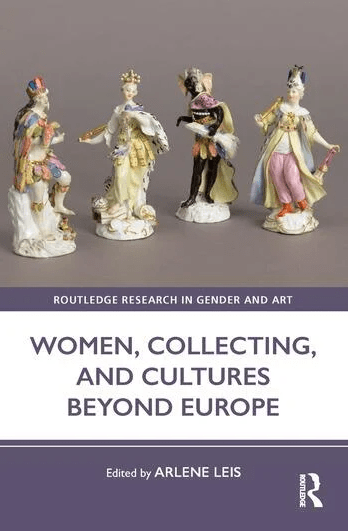
Women, Collecting, and Cultures beyond Europe. Arlene Leis. New York and London, Routledge. 2023. 282 pages, 21 Colour & 33 B/W Illustrations. £120.00, ISBN 978-1-032-13546-5
Arlene Leis makes the aim of this essay collection explicit in the book title. The 17 chapters intersect and consolidate two fields of research: Women and Collecting. The topic itself is not new, but research in this field is still very much alive. In 1985, in response to the provocative question ‘Did Women Have a Renaissance?’ raised by Joan Kelly-Gadol (1977), David Herlihy pinpointed that, even when pushed to marginal positions, women could find other routes to social influence in a world of men. Since then, scholars have demonstrated that one of these routes was collecting. An increasingly extensive approach has brought to light many women who commissioned buildings or collected artworks, so that the assumption of uniquely male-gendered patronage has become no longer sustainable (Reiss 2013). This extensive approach has at times risked dismissing the female social performance as inevitable (Hills 2003). Yet, research has been energized again by the exploration of the dynamics between the two sexes, who used art to negotiate their own spaces (e.g., Maurer 2019). This exploration has generated new questions about the influence of gender on the motivations and practices of collecting, and on the opportunity to use the same methodology to explore women’s and men’s collections. Arlene Leis herself addressed these issues in Women and the Art and Science of Collecting in Eighteenth-Century Europe (2021), co-edited with Kacie L. Wills, and they also appear, here and there, in this new book, proving that her research interest fits well into this burgeoning trajectory.
The key aspect of Leis’ new publication, however, lies in the last words of its title, Cultures beyond Europe, which signal how the work is sensitive to the increasingly pressing question of decolonizing research. The view of Europe from China, with which the book opens, is significant in this sense. While most of the essays are by English-speaking authors, their perspectives and approaches vary and extend to less-investigated areas and peoples around the globe, and to a greater extent than other recent publications on similar topics (e.g., Bellion and Smentek 2023). The broad chronological framework of the book, from the end of the seventeenth century to almost the present day, could be daunting, but it allows the reader to engage with case studies spanning long periods and to gain a glimpse into secular changes in collecting practices.
Understandably, this wide perspective is not meant to be all-encompassing. A global methodology can deal with temporary connections and fragmented narratives without aiming for comprehensive knowledge of a phenomenon (Adamson, Riello, and Teasly 2011). The tempting effort to “fill the gap” is quickly set aside by Leis, who – more wisely – nudges us towards a comparative reading of the different narratives, by suggesting that we either follow the structure of the five themed sections or make our own connections. Since documentation is often poor in relation to women’s collections, these narratives stem from the collectables themselves, which bear their own information and knowledge. The problematic paucity of sources on women’s possessions, compared to their male counterparts, emerges as a transversal issue, from the poor goods of the women from San Fernando de Béxar, which have been traced through their wills by Amy M. Porter, to the Chinese imperial collections investigated by Chih-En Chen. In this regard, Chen has circumvented the problem by using a cross-source methodology that has proved useful for capturing the interactions between everyday practices, objects, and spaces.
Albeit to varying degrees, the individual chapters show us that collected items are neither neutral nor passive but can implement change. In this sense, the book can be framed within the scholarship on materiality, where the term ‘materiality’ refers to the capacity of things to actively affect people’s attitudes and behaviours. Through a rigorous exploration of the eighteenth-century collections in the Chinese Imperial harem, Chih-En Chen argues that trompe l’oeil porcelain satisfied Qing women’s curiosity about European art, giving them a fictive freedom from their golden cage. Focusing on the Ottoman Empire, Gwendolyn Collaço argues that a dowry, prepared by a woman for another woman, could affect both the receiver’s and the donor’s social status. In Laura Garcia-Vedrenne and Martha Sandoval-Villegas’s case study, four court dresses demonstrate the wealth of an unidentified woman living in late eighteenth-century Mexico City. In Lisa Hellman’s study, the complexity of an entire collection is viewed through the lens of a single dress that bears witness to the travels and encounters of a Swedish woman. For its part, this dress caused her misfortunes and successes, according to the different perceptions of the stories it related. Perception, acceptance, and reciprocity can serve as the reading keys to the essay by Maria Antonietta Spadaro dealing with the Japanese artist, O’Tama Kiyohara, who moved to Italy at the end of the nineteenth century. While O’Tama assimilated the European way of painting, her oriental culture was met with mixed acclaim.
In a period of voyages, long-distance trade, and transcultural encounters, materiality intersects with questions of power and domination. Knowledge as intellectual appropriation is central to the naturalistic classifications that Europeans carried out in their colonies. As the contribution of women has often been thwarted and long gone unrecognized, many questions remain about their role in the colonization process. The botanist Jeanne Baret, discussed by Glynis Ridley, was forced to disguise herself as a man to travel with the French expedition to circumnavigate the world. Unsurprisingly, her work has remained somewhat overshadowed by that of the men she worked with. In this regard, however, the question that emerges as more urgent is not whether women indexed samples differently from men, but to what extent their scientific interest determined their political complicity. Thoroughly delving into the multi-faceted relationship between British colonialism and the scientific illustrations of Indian flora and fauna, Apurba Chatterjee argues that an aristocratic woman, Lady Mary Impey, participated in the colonial enterprise by collecting images of birds drawn by Indian artists. If the inclusion of specimens in the Linnaean taxonomy already implied their extraction from their native environments, a further degree of appropriation was their transfer to European soil. Additionally, the crossing of borders provided these samples with new values and potential. For instance, the pineapple plant successfully replanted in Amsterdam gave fame to Agnes Block, the amateur botanist investigated by Catherine Powell-Warren. Not much differently, the display of dwarves from the Portuguese colonies emphasized the colonial power of the Lisbon court. This case study by Agnieszka Anna Ficek underscores the extent to which curiosity for the exotic intersected with discourses of race, exploitation, and slavery.
While gaining knowledge of others was both the cause and the result of transcultural encounters, the documentation and exhibitions of objects became a further step to perpetuate, promote, and spread this acquired knowledge. The crucial point was and remains the degree of cultural interference that an external (mostly Western) perspective can impose on the heritage of others. This point holds true even when these actions are implemented with the best intentions. Cynthia Sugars explores the case of a British botanist, Catharine Parr Traill, who, while laying the foundations for Canada’s natural history, misunderstood and bypassed Indigenous knowledge of nature because of her moralistic and imperialist view. In their laudable efforts to preserve and promote artists from Santa Fe, the five Pennsylvania women investigated by Nancy Owen Lewis could not avoid imposing their idea of art on indigenous works. As Martha Sandoval-Villegas argues in her study of Mesoamerican huipils, the objects may come from communities that gave collecting practices different purposes.
When exhibited, objects push people to take a stand with respect to the stories, knowledge, and meanings that the same objects bring with them. For Angela Fey and Maureen Matthews, for example, the collection of Métis embroidered clothing enabled women from Manitoba to face and acknowledge their indigenous heritage. Yet, when collectors themselves are unaware of what lies behind their collections, they prevent any other observer from reaching a critical awareness. Brandt Zipp suggests this reflection to us when he tells us about a group of white women who, between the 1920s and 1930s, recovered forgotten examples of eighteenth-century American pottery, but not the Afro-American identity of their ceramicist. Working against this attitude, Toby Upson proposes an adjacency approach which aims for the viewers to understand the object without alienating it from themselves. According to this approach, institutional and non-institutional collectors should not only display or explain otherness but also help observers to find a critically aware position with respect to the same otherness. Louise Hamby seems to suggest a very personal approach, but one that is equally open to the cultural implications of the object. As an artist, she has collected Aboriginal fibre objects from Arnhem Land in Australia with the aim of learning and collaborating with local artists.
To conclude, the global perspective of this book allows the reader to perceive differences and similarities between very varied contexts, thus responding to the expectations created by its title. However, it also opens questions that are useful for the development of its lively field of research. For this reason, scholars dealing with the fields of women, materiality, and collecting will find it very useful. Furthermore, the book makes a very rich contribution to the niche field of the relationship between art, science, and gender. However, the text could also be of interest to all those who aspire to a decolonizing vision of history. Amongst these, I would certainly include the teachers who try to provide their students with this vision every day.
Valeria Viola
Valeria Viola (Ph.D. in History of Art and Architecture in 2020) is an Art teacher with experience in both architectural practice and research. At the moment, she is engaged in integrating gender and decolonial perspectives into teaching. You can find her publications here: https://york.academia.edu/ValeriaViola
Cited works.
Adamson, Glenn, Giorgio Riello, and Sara Teasly (eds.). “Introduction”. In Global Design History, 1–10. Abingdon: Routledge, 2011.
Bellion, Wendy and Kristel Smentek (eds.). Material Cultures of the Global Eighteenth Century. Art, Mobility, and Change. London and New York: Bloomsbury Visual Arts, 2023.
Herlihy, David. “Did Women have a Renaissance? A Reconsideration.” Medievalia et Humanistica 13 (1985): 1-22.
Hills, Helen (ed.). “Theorizing the Relationship between Architecture and Gender in Early Modern Europe.” In Architecture and the Politics of Gender in Early Modern Europe, 3–36. Aldershot and Burlington: Ashgate, 2003.
Maurer, Maria F. Gender, Space and Experience at the Renaissance Court. Performance and Practice at the Palazzo Te. Amsterdam: Amsterdam University Press, 2019.Reiss, Sheryl E. “Beyond Isabella and Beyond: Secular Women Patrons of Art in Early Modern Europe.” In The Ashgate Research Companion to Women and Gender in Early Modern Europe, edited by Allyson M. Poska, Jane Couchman, and Katherine A. McIver, 445–467. London and New York: Routledge, 2013.

 Women's Studies Group 1558 - 1837