Danish-British Consort Portraiture, c.1600–1900. By Sara Ayres. London: Lund Humphries. 2023. pp. 176. £60.00 (hardback), ISBN 9781848225183. Review by Miriam al Jamil.

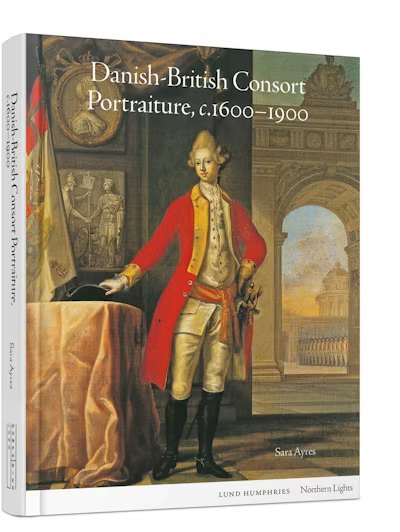
The title of this superbly illustrated book ostensibly indicates an overview of a specific group of royal portraits, produced over the course of three hundred years. An unusual focus on consorts who united the Danish and British royal families through marriage reveals the deep bonds between European dynasties, but also presents exemplary models for the author’s argument across otherwise broad and unmanageable periods of time. The book remains disciplined and centred, while at the same time offering a variety of evidence and new readings to make it a compelling and authoritative contribution to art history and visual culture. The chosen cover image, if unfamiliar to the reader, is assumed to represent one of these royal individuals in eighteenth-century military costume and with all the expected accoutrements of assertive might and power. However, it is soon revealed to encapsulate the far more complex narrative of the book. It subverts our expectations and challenges us to reassess what a portrait can tell us.

The 1770 portrait by Peder Als shows Caroline Matilda of Great Britain (1751–1775), the daughter of Frederick, Prince of Wales and Princess Augusta of Saxe-Gotha, who was married to King Christian VII of Denmark. She wears the uniform of the Life Guards, with red coat, sash and spurs, and sword at her side, about to take her tricorn hat from the table and to stride out through an arched doorway to inspect a line of soldiers drawn to attention in the courtyard. Her story forms chapter four of the book. By then, the reader has followed the writer’s close readings of three other consort portraits and traced the postures, settings and iconography which connect them to tell a history of transformation in the art of embodying the royal image (p. 10). The portrayal of rank shifted into one based exclusively on gender, a shift which affects our ability to understand and interpret a portrait even today. The argument is original and intriguing, underscored by research references drawn from a broad range of visual culture and historical sources, in particular Walter Benjamin’s writings on the work of art in an age of technological reproducibility. The argument relies on detailed observation to find new connections. Of the five Danish royal consort subjects of this study, only one, Prince George of Denmark (1653–1708), is male, but the book aims to explore how the royal image “rhetorically incorporated the most functional, symbolic qualities of maleness and femaleness” (p.22). It centres on uncovering the “complex palimpsest” of royal portraiture as embodiment, centring on the 1617 Paul van Somer portrait of Anne of Denmark (Royal Collection Trust) as its starting point.

Anne’s full-length portrait incorporates elements of the traditional male hunting portrait, the horse, dogs and distant view of a royal palace and park, as part of her self-fashioning. It was importantly designed to “instruct and nurture” (p.44) her son Charles in the noble and princely arts necessary for kingship. Charles I’s dismounted equestrian portrait by Anthony van Dyck, dated to c.1635, can be construed as a pendant. The crooked elbow which features in these and later royal portraits is an important sign derived from emblem book symbols of female perfection. When added to examples of extended elbows in male portraits suggesting greater male heat and virility, a feature of the ancient four humours medical theory, it is clear that there was more gender fluidity and layered meaning in the royal portrait than we might have realised.

The book explores the construction of royal embodiment and its image through the physical nature of the medium. The discussion on Prince George of Denmark centres on his youthful Grand Tour which included England on its itinerary, and the shaping of a cultured and refined royal figure. The wax medium used for the clothed and wigged waxwork of the young prince by Antoine Benoist (undated), now in Rosenborg Palace, Copenhagen, indicates the pliable mind of the prince as he was prepared for a role of power. The advances in scientific and Cartesian methodology, while essential elements of a modern royal education, changed the nature of royal embodiment. Louisa (1724–1751), daughter of George II, married Crown Prince Frederick V of Denmark-Norway. Her death during a late stage in pregnancy was followed by an autopsy which her doctors described in detail, changing the sacral body into a pathological case study. As the author notes,“The artisanal epistemology that had been the province of the consort and the artist as they together crafted the contours of the royal body as a work of art now became the property of the man of medical sciences” (p.80). The work of the anatomist reinforced the changing balance of power and the female body was laid open to a newly authorised male gaze.

The final two chapters consolidate the narrative of change. The author offers a new interpretation of a scurrilous woodcut lampoon of Caroline Matilda, printed in 1772, which “heralds the hygienic exclusion of the influence of women from political, public life, regardless of their rank, and their exile en masse to the seclusion of the domestic sphere” (p.88). The crude woodcut shows the queen on horseback, alongside a nurse holding her baby, and a male figure looking out of a window. The queen is construed as an “unnatural, sexually incontinent woman” (p.87) in the tradition of world turned upside down satire. The author suggests that the nurse represents the king, “left holding the baby” (p.89), the offspring of the queen’s affair with Johann Friedrich Struensee, the king’s doctor and prime minister. The threat to the royal bloodline at the centre of the print and the failure of masculine authority is embodied in the subversive and unruly woman. However, the king approved of Caroline’s wearing male attire, so contrary to a simple reading of the satire, the author suggests “the queen’s transvestism [is] a performative fall into masculinity responding to the king’s desire”, and a form of “sympathetic magic of mimesis” which constitutes the “body of the absolute king for him” (p.100–101). This reading questions and complicates the satire, based on traditional forms of unruly female representation and possible interpretations. However, the final example of consort portraiture is taken from an age of reproduction by means of photography. The narrative was reinvented for a new audience with irreconcilable binary gendered expectations determining its reception.

Alexandra of Denmark (1844–1925) married Albert Edward, Prince of Wales, later Edward VII, in 1863. Her elaborate reception in the capital “created a topological phantasmagoria within which ancient ceremony and industrial modernity comingled” (p.113). The rise of the carte de visite form popularised the image of the consort but also enabled comparisons and imitations in its mass availability and reproducibility. Following this, “fashion and the photographic image” defined the image of the consort and made her “a visual commodity”, a development that has ultimately made the represented female body “simultaneously object and abject” (p.128). Though beyond the scope of the book, clear contemporary examples can be found in the consorts of the current British royal family. The book does not falter in its structured and thorough exploration. Each chapter contributes new material and builds on its central premise of change over several centuries. However, while the title is precise, the breadth of the subject may not be anticipated by the browser in a library or book shop. But the book is a rewarding study as part of the Northern Lights book series, and the portraits examined cannot be seen in isolation again.

Miriam Al Jamil is on the WSG committee, chairs the Burney Society UK, and is Fine Arts editor for BSECS Criticks online reviews. She has published on women travel writers, Horace Mann and his circle in Florence and Rome, on Frances Burney, and on Eleanor Coade. There will be a chapter on Coade in the forthcoming WSG book.

WSG Seminar Reminder: Thursday, April 10, 2025 via Zoom

WSG Seminar Reminder

Thursday 10 April 2025 – ZOOM

STARTING 6.45 FOR 7 PM, FINISHING AT 8.30 PM, BRITISH SUMMER TIME

Chair: Karen Griscom

Host: Louise Duckling

Claudia Cristell Maria Berttolini: Saint Gertrude as a female role model in 18th century Puebla de los Ángeles.

Jacqui Grainger: Mary Somerville, the United Service Museum and women of science.

Francesca Saggini: Jane Austen and the Golden Age of Crime Fiction.

Valentina P. Aparicio: Boundaries and Intimacy in Transatlantic Friendships: Maria Graham and Empress Maria Leopoldina.

The seminar will take place on Zoom. Please be aware, you must be a member of the WSG to gain access to the Zoom sessions. The links are distributed through our WSG mailing list 24-hours before the event.

For further information, please see our seminars page.  To join the WSG, please see our membership page.

Reminder: WSG Reading Group, Her Stories, March 10, 2025, 7–8pm (GMT) via Zoom

The next WSG Reading Group, Her Stories, is on 10th March, 7-8pm 2025 (GMT) 

The Women’s Studies Group (WSG) will host its next “Her Stories” Reading Group meeting on March 10th, 2025, from 7-8pm GMT. All members are welcome to participate in this upcoming session, organized and hosted by Karen Lipsedge.

The group will discuss Louise’s selected text: Jennie Batchelor’s The Lady’s Magazine (1770–1832) and the Making of Literary History (2022, Edinburgh University Press). For those unable to read the entire book, Louise recommends either the Conclusion or Chapter 6, “Achievements and Legacies: The Lady’s Magazine in Literary History.”

Members can access a virtual copy of the book through a provided link, though they should note it’s a large file and check their connection in advance. Thanks go to Louise for providing this link.

Each reading group follows a consistent format: the member who selected the text gives a brief introduction explaining their choice, followed by participants sharing one aspect of the text they wish to discuss—whether it relates to characters, style, readership, or even a single word or phrase.

Anyone interested in joining “Her Stories” can contact Karen Lipsedge directly.

They Run with Surprising Swiftness: The Women Athletes of Early Modern Britain. By Peter Radford. Review by Carolyn D. Williams

They Run with Surprising Swiftness: The Women Athletes of Early Modern Britain. By Peter Radford. Charlottesville and London: University of Virginia Press. 2023. Pp 296. £31.79 (paperback), ISBN 9780813947938.

Readers of Peter Radford’s previous work, including his chapter entitled ‘Better than the Men’ in Exploring the Lives of Women (2018), a collection of essays by members of the Women’s Studies Group 1558–1887, will expect great things from his latest publication. They will not be disappointed.

This fascinating and wide-ranging study of women’s past achievements in sports and athletics, as well as other forms of physical activity demanding various combinations of strength, skill, courage and endurance, incorporates a forceful defence of their ability and right to participate in these activities today. We are currently emerging from a period when women’s participation in sport was restricted on the grounds that strenuous exertion would threaten their capacity for motherhood or even their physical survival. Radford has unearthed evidence of ‘a kind of cultural amnesia’ (208) that seems to have been fostered by nineteenth-century masculine anxieties, obliterating awareness of traditional female sports. The chapter headed ‘Moral Meddling, Cant, and Sheer Humbug: 1825 Onward’ gives a painfully eloquent account of this turning point. As he shows elsewhere in his book, the participants were often subjected to various forms of misogynistic prejudice, but at least the existence of these events was acknowledged.

As in previous work, Radford counters this great forgetting. After producing evidence for women’s robustness in the Neolithic period, and their versatile athleticism in Ancient Greece, he provides detailed studies of events involving female runners, and occasionally walkers, concentrating on the period 1638–1850. A theme that should inspire interest in other feminist historians is the rise and fall of the smock race, and its connections with skimmington rides. He then discusses women’s involvement in football, cricket, prize-fighting (with swords and fists), equestrianism and tennis: women in the last two categories beat the best male professionals.

Some of the book’s findings cast new light on established disciplines. Analyses of the pictures of sporting activities included in the illustrations use information about eighteenth-century practices to distinguish the works of eye-witnesses from copies and products of the artists’ imagination. For example, familiarity with the structure and placement of wickets, knowledge of the rules of best-of-three races, and awareness of what running women actually look like provide tools for art historians seeking to establish the authenticity of sporting pictures. John Collett emerges as a reliable and well-informed creator of original images of female runners and cricketers, which were copied inaccurately by Thomas Rowlandson.

Frances Burney scholars should brace themselves for an outright denial that anything like the twenty-yard race between two enfeebled octagenarian women in Evelina (1778) was ever reported in the eighteenth century: Radford sees it as ‘a product of her fertile imagination’ (31), possibly sparked by a reference in Tobias Smollett’s The Adventures of Ferdinand, Count Fathom (1753) to two aristocratic gamblers running their grandmothers together, i.e. seeing which would live longer. In actuality, age presented fewer barriers to demonstrations of physical prowess: ninety-year-old Mary Wilkinson walked the 290 miles from York to London ‘in five days and three hours with “a keg of gin, and a quantity of provisions on her back”’ (125), while an eighteen-month-old girl ‘walked the length of the Mall (half a mile) in twenty-three minutes’ (90).

Precisely because this work is the result of carefully planned and scrupulously detailed research, it abounds in unexpected discoveries, sometimes appearing initially random: they are the rewards for the author’s determination to follow the evidence. Three examples must suffice. Firstly, everybody acquainted with early modern childbirth customs must have come across references to a ‘groaning cheese’, but how many know exactly what it was? Radford has unearthed a reference to a specimen weighing a hundred pounds that was the first prize for a race between ‘six heavily pregnant brewers’ wives’ who were to run a mile ‘to the top of Arthur’s Seat in Edinburgh’; he then cites ‘an old English tradition in which the father of a newborn baby brought a very large, flat, round cheese for the baby’s christening’: slices would be cut from the centre, and the baby passed through the resulting hole ‘for luck’ (56). Secondly, the importance of accurate time-keeping, especially when wagers were involved, have led the author, after thorough investigation, to conclude that ‘watches were high-status, finely-crafted objects in the eighteenth century, and they recorded time very accurately; cheap and unreliable watches were still sometime in the future’ (118). More directly relevant to the book’s subject, but even more startling, is the discovery that ‘the first example of a football match played on grass, with teams of a fixed number, and played for the benefit and amusement of a crowd’ (179) was a six-a-side women’s event that took place on a bowling green in Bath, probably arranged by Beau Nash, in 1726.

There are a few minor errors in expression and presentation. In the transcription of the motto of the Amateur Athletic Assocation, taken from lines 95 and 96 of Pindar’s 9th Olympian Ode, ποδῶν and ἀκμαί have been run together when they should have space between them, and ideally […] to indicate the omission of an intervening word (115). In the useful appendix, explaining the technicalities of distance measurement, currency and gambling in early modern Britain, the author apparently makes a slip when describing the kind of wager known as a match against time: ‘In the example above, a timekeeper would stand at the finishing line and call “Time” precisely one hour after the start’ (245). Unfortunately, the hypothetical example requires the contestants to run ‘one mile (e.g. from the tavern door to the church door)’ (245) which seems far too short a distance for the time allowed, especially when we reflect that ‘a fifteen-year-old girl from Wrotham ran it in 5 minutes 28 seconds on Saturday July 11, 1795, a record unbeaten in Britain until 20 August 1932’ (119). Perhaps the chosen course should be taken into consideration: how long would the contestants stay in the tavern before they reached its door?

As well as applying extensive and meticulous scholarship to his study of human physical activity in general and sport in particular, the author deploys the practical experience acquired during an athletic career that earned him a world record, two Commonwealth gold medals and two Olympic bronze medals. He can flesh out the briefest account of an event with considerations of how it would have been organized and publicised, how the expenses would be covered, how many heats were involved, or the conditions in which it took place: for example, in 1822, when girls ran races ‘on a wet Wednesday in August’ on Gander Down, to the east of Winchester, ‘it must have been difficult for them on the wet grass, though these were chalk downs and would have drained quickly’ (205).

Professor Radford has yet more to say about the history of women’s physical achievements: on Saturday, October 7, 2023, at the opening seminar of the Women’s Studies Group 2023–24 season, at London’s Foundling Museum, he will present a paper entitled ‘Strong Women in Early Modern Europe: A Counter Narrative’. To readers of this book, this is very good news.

Carolyn D. Williams

How the WSG supported my research

A reflection by Charmian Kenner

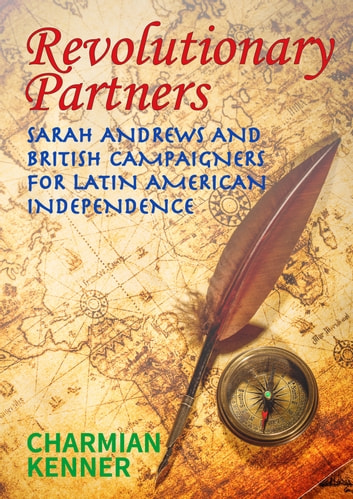
I have just published my book Revolutionary Partners: Sarah Andrews and British Campaigners for Latin American Independence, and as an independent researcher I have found the Women’s Studies Group to be a vital source of support.

I discovered Sarah Andrews, the main subject of my research, in a painting at the Venezuelan Cultural Centre in London. The picture is a contemporary re-imagining of a scene taking place in the early 1800s. Simón Bolívar, the future Liberator of Venezuela, Bolivia, Colombia, Ecuador, Peru, and Panama from the Spanish, is being received by fellow revolutionary Francisco de Miranda at the latter’s London home. My attention was caught by the depiction of a young woman in the corner of the painting, reading a book with two young children next to her.

This young woman turned out to be Sarah Andrews, the British partner of Francisco de Miranda. Intrigued, I began to investigate her story and found that Sarah ran the household, which served as a London headquarters for supporters of Latin American independence. My starting point was a treasure trove of Sarah’s letters to Miranda while he was away fighting in Venezuela from 1805-1807 while she held the fort back home.

I had been a feminist historian 35 years earlier and many other things in between. Now retired, with no institutional affiliation, I needed a way to exchange ideas with like-minded people. The ideal would be a group centered on women’s history, so I searched online and was excited to find the WSG close to me in London, with seminars accessible to all.

Attending my first seminar, I was welcomed and immediately treated as an equal. Everyone I spoke to was interested in my topic and eager to help, suggesting references and recommending lines of enquiry. I was relieved to find that many in the group were independent researchers and had been able to publish their work.

The seminars were a constant source of wonder, revealing so much about centuries of women’s history. Ideas about my own research were stimulated as contributors interacted with the audience and drew out threads of commonality between the presentations. Questions and comments were always infused with a spirit of positivity. 

Some topics were of direct relevance to my research. A paper by Valentina Aparicio drew attention to Maria Graham’s journal of her stay in newly-independent Chile in 1822, which became an important source for my study. Together with documentation I had already gathered on Mary English and Kitty Cochrane, who accompanied British partners fighting alongside Simón Bolívar, this widened my focus beyond Sarah Andrews’ story. My book now includes the experiences of other British women supporters of Latin American independence.

Like everyone in the WSG, I was invited to submit a paper for the seminars. This was an opportunity to focus my thinking and develop my analysis. The response from the audience was heartening. They were keen to discover more about Sarah Andrews and her social and political context, encouraging me to continue with the research and to publish.

Feedback at the seminar provided me with key ideas from wide-ranging scholarly knowledge amongst the WSG. For example, several group members highlighted the significance of Sarah Andrews’ father being a shoemaker. This could explain how Sarah encountered revolutionary ideas in the Yorkshire market town where she was born since shoemakers’ shops were a well-documented centre for radical discussion.

Further help was forthcoming after the seminar. Louise Duckling sent suggestions for publishers, whilst Gillian Williamson shared information she found in Old Bailey records concerning a burglary at Sarah Andrews’ home in 1840. The court evidence revealed Sarah’s living arrangements and those sharing her house at this point, a period for which little other data was available.

This support validated my topic and spurred me on. I soon began to write, and at a recent WSG seminar I was happy to say that I was about to publish my book with free access online. WSG members received this announcement with the same pleasure and interest they had shown throughout my research journey. It felt like coming full circle. 

The final hurdle was to convert my Word document into the format required for an e-book. Images and captions kept repositioning themselves, and I couldn’t find anyone who knew how to solve the problem. Once again, WSG came to the rescue. I put out a call for help on the email list, and Louise Duckling quickly responded with suggestions for people experienced in formatting. The first person I contacted sent an immediate reply and not only sorted out my pictures but also improved the book’s overall design. I was ready to publish! Revolutionary Partners: Sarah Andrews and British Campaigners for Latin American Independence can be accessed free here.

Thank you, WSG!

Charmian Kenner

Charmian Kenner started life as a feminist historian in the 1970s. After many other incarnations she returned to her original occupation, having discovered the existence of Sarah Andrews, the partner of Venezuelan revolutionary Francisco de Miranda in London in the early 1800s. Sarah’s intriguing story was waiting to be told, and the result is the recently published book Revolutionary Partners: Sarah Andrews and British Campaigners for Latin American Independence, available free on Kobo.