Reminder: WSG seminar November 2020

The second seminar of the year takes place on Saturday, 1pm (GMT), 21 November 2020.

This meeting will be delivered on Zoom. All meetings will start promptly at 1pm GMT (with arrivals from 12.30 onward to allow for necessary preparations and administration). We aim to finish by 3.30pm. If you would like to attend, please make sure your membership is up-to-date to receive the Zoom link.

November 21, 2020
Rocio Martinez: To defend a princess’s rights to her father’s throne: Maria Theresia of Austria and the protestations against her renunciation of the inheritance of the Spanish Monarchy.

When infanta Maria Theresia of Austria was married by proxy to her cousin, king Louis XIV of France, in 1659, she was forced by her father to sign a renunciation to all her rights to the Spanish Throne for herself and her descendants. The Spanish Monarchy’s succession law established that women could inherit the throne if they didn’t have any surviving brothers or if they died without any descendants, so Maria Theresia, as the eldest daughter of king Philip IV of Spain, was the first woman called to her father’s succession if he was to die without any surviving sons. Philip IV only had, at the time of Maria Theresa’s marriage, one son that could separate the soon-to-be queen of France from the Spanish Throne, so this renunciation was designed to avoid the possibility that Louis XIV and the recently wed infanta could become one day the legal heirs of the Spanish Monarchy. Despite the fact that the document itself tried to protect Maria Theresia’s rights, saying that, if she became a widow without having any children and came back to Spain, her rights as the eldest daughter of the monarch would be totally restored, the point of it was to prevent the union of France and the Spanish Monarchy under one crown if the scarce male descendants of king Philip IV of Spain were to die without any legitimate descendants. This renunciation was negotiated with the French court, was included in the famous Treaty of the Pyrenees, was considered as a law and treated as such by the Spanish government, and Louis XIV promised his uncle that he would ratify it after the marriage was finished, although he didn’t honour this last promise. In fact, Louis XIV began to protest against the renunciation as soon as the marriage was finished and the new queen was in France. There were numerous legal treaties, diplomatic dispatches and formal documents where the king argued that his wife and, later, his son and grandson, were the rightful heirs to the Spanish Monarchy and that her renunciation was totally invalid from a legal, diplomatic and dynastic point of view. But in this proposal, I want to present a document in which the French king presented more that seventy five reasons why the rights of his wife couldn’t be erased and she was the rightful heiress of the Spanish Monarchy, with the intention of going beyond this specific case and analyse how the royal women’s rights of succession were defended, protected and, ultimately, viewed in the complex scenario of the Early Modern Europe.

Avleen Grewal: Vathek: Gaze, Disorientations and Policing Identity.

This paper examines the brief interactions between Vathek, the protagonist of William Beckford’s Vathek, and the Giaour, a racialized other who travels to Vathek’s kingdom of Samarah. Vathek is depicted as a monstrous masculine figure with a humongous appetite and an ‘evil eye’ that can shock people into a state of unconsciousness. The failure of Vathek’s ‘evil eye’ to police the Giaour’s identity, and orient the Giaour in relation to himself, to make him apprehensible within the particular space of his kingdom, disrupts Vathek’s monstrous power and the disorienting affect of his “terrible,” Medusa-like gaze (Beckford 3)1. This paper juxtaposes Max Fincher’s analysis of Vathek’s fixation on regulation of bodies and his disorienting, and thus queering (Ahmed) gaze with Homi Bhabha’s theorization of the evil eye as it functions to other racial bodies.

Following this, I will then introduce Sara Ahmed’s concept of disorientation and suggest that averting gaze of the subject gives subjective agency to the object and, consequently, disorients the subject. This paper defines the queer under gaze as refusing to be objectified and instead asserting their own subjectivity by rejecting that gaze and its disorienting affects. This paper investigates Vathek’s failure to interpret the Giaour, the Giaour returning Vathek’s gaze by staring back at him, and its relation to Vathek’s inability to translate the inscriptions on the sabres he bought from the Giaour.

This double-failure to translate the sabres puts Vathek in a disoriented state, resulting in his loss of appetite, a metaphoric and literal indicator of his monstrous masculinity. Without translation, there is no degree of intervention by the subject. In that moment of disjointedness, the Giaour’s unreadability threatens the impact of Vathek’s gaze and power. When Vathek stares at the Giaour, and the Giaour gazes back at him, Vathek loses his appetite and fears his wives being seduced by the Giaour’s appetite. Vathek’s identity and orientation become vulnerable to be affected and shifted without his consent.

1 Beckford, William. Vathek, edited by Thomas Keymer. Oxford University Press, 2013.

Eva Lippold: Marriage and Magic Swords: Mariana Starke’s Factual Fairytale.

Mariana Starke’s The Sword of Peace (1788) is a play which unites two very different worlds. It is a romantic comedy full of fairytale elements, set in exotic India. At the same time, it deals extensively with facts of eighteenth-century life, even those which reflect an uncompromising and often brutal reality – including the marriage market and the slave trade. The play often shifts rapidly between two different tones: the light, entertaining witticisms of eighteenth-century comedy, and incisive political commentary reminiscent of Mary Wollstonecraft’s works.

In this paper, I will show how Starke strikes a delicate balance between romance and reality, using the popular conventions of the London stage to comment on life in the British colonies. The outwardly fictional nature of stage comedy enabled Starke and other playwrights to use it as a vehicle for serious discussions about the real world. The Sword of Peace shows particularly clearly that although entertainment and politics were supposedly two separate spheres, eighteenth-century playwrights and theatre audiences were happy to combine both.

By demonstrating the play’s extensive engagement with contemporary and social issues, I will argue that eighteenth-century female playwrights were especially interested in putting politics on the stage – even though contemporary gender roles and theatre regulations officially prevented this.

For further information including abstracts, see our seminars page.  To join the WSG, see our membership page.
Reminder: WSG seminar 19 September 2020

The first seminar of the year takes place on Saturday, 1pm (BST), 19 September 2020.

This meeting will be delivered on Zoom. All meetings will start promptly at 1pm BST/GMT* (with arrivals from 12.30 onward to allow for necessary preparations and administration). We aim to finish by 3.30pm. If you would like to attend, please make sure your membership is up-to-date to receive the Zoom link.

September 19, 2020
Stephen Spiess: Reading Strumpets: Thomas Heywood, Sexual Epistemology, and the Making of English Whoredom

In a decidedly offhand tone, as if sharing an insight so obvious as to barely merit acknowledgement, Thomas Heywood asserts in Gynaikeion (1624), his encyclopaedic catalogue of women historical and mythological, that “almost every boy of fifteen or sixteen years old knows what a strumpet is, better by his own practice than I can illustrate to him by all my reading.” How, we might ask, can he be so sure? Upon what terms, standards, and practices does such sexual knowledge depend? In this paper, I leverage Heywood’s provocation as an invitation to think early modern “whoredom” not simply as an historical practice or literary trope, but a knowledge-relation whose contours and problematics open onto broader questions of sexual epistemology, both in the early modern period and our own. My reading thus unfolds on two levels. First, I situate Heywood’s claim in relation to the broader project in which it appears: a 466-page treatise which aims to distinguish between chaste and illicit women, and whose manifold anecdotes and exempla consistently unsettle the sexual knowability it promises to secure. In this, Gynaikeion exemplifies in strong form what I call the “making of English whoredom”—that is, the immense social, textual, and discursive labor necessary to produce and sustain the fiction of the early modern “whore” as a fixed, transparent object of knowledge. Second, and by detailing this claim, I discuss how my epistemological approach fits within the broader scholarship of early modern sex, as well as how it offers new traction on old problems (archival, hermeneutic, historiographic, etc.) faced by historians and literary critics interested in the structures and meanings of English whoredom.

Sonia Villegas Lopez: Female Libertinism in Gabriel de Brémond’s Transnational Oriental Fictions.

French oriental narratives were both translated and published profusely in England in the 1670s and 1680s. The action of many of these novellas was situated in the exotic territories of Morocco and the Ottoman Empire, though often telling stories about the French and the English nobility under cover. They illustrated sexual scandals, in which women, though primarily the objects of love and gallantry, were also prone to give free rein to their desires. Gabriel de Brémond’s Hattige, or the Amours of the King of Tamaran (1680) and Homais, Queen of Tunis (1681), reproduce Charles II’s sexual affairs, and construe both Hattige, the king of Tamaran’s favourite, and Homais, wife of the King of Tunis, as emblems of female libertinism within the safe boundaries of the seraglio. Tamaran (or England) and Tunis were described as places of gallantry, the perfect environment for stories of intrigue, love and passion. These female rakes followed their ambition and used their sexual authority over kings and nobles, making fools of them to earn political power in return. They behaved as apt manipulators but their downfall was precipitated by their own romantic weaknesses for other men whom they loved, in spite of not being rich or powerful. I argue that, far from being read as models of female exoticism and otherness, as in later Enlightenment oriental novels, these strong women and the love intrigues they spin could be interpreted as examples of what Srinivas Aravamudan has fitly called “transcultural allegories” (2012: 202). I subscribe to Aravamudan’s interpretation of the late seventeenth-century oriental novel as the vehicle to introduce the culturally foreign, which displaces the local and the national in favour of transculturalism. The selected novels suggest a transnational vision of the orient not in either/or exclusive categories, but in inclusive terms, according to which the east is feminised and associated to a glorious and hedonistic past.

Anthony Walker-Cook: Descending into the Underworld with Mary Leapor and Sarah Fielding.

Of women and epic poetry, this paper will explore. Following Alexander Pope’s translations of the Iliad (1715-20) and the Odyssey (1725-26), it was considered by many that Homer had been rendered into English in an edition perfect for women to use. This, alongside Dryden’s 1697 Virgil, meant the essential texts of the epic genre were now available for women to read in acceptable English translations. In the few accounts of the history of the epic genre that consider the presence of women writers of the mode, the eighteenth century is often missed. In 1716, Richard Blackmore thought that epic need not be ‘restrain’d to a Hero; since no Reason […] can be assign’d, why a Heroine may not be the principal person of an Epick.’ To go further, why might a woman not be the writer of an epic poem? This paper suggests that the works of Mary Leapor and Sarah Fielding represents the best claim for women’s work of the period to be classified within the epic genre. Both Leapor and Fielding use the underworld, the classical space par excellence, to explore the status of women in the eighteenth century, but both also register the influence of the mock-heroic, a mode popular throughout the period. Exploring Leapor’s poetry and Sarah Fielding’s The History of the Countess of Dellwyn (1759), it shall be shown how each writer uses the underworld to depict the lives of the serving class and of a woman marked by divorce respectively. This paper will thus overall suggest that the traces of the epic genre that can be detected throughout work of Leapor and Fielding warrant examination as an important part of the broadly-unwritten history that details how women writers engaged with the mode.

For further information including abstracts, see our seminars page.  To join the WSG, see our membership page.

Reminder: WSG seminar September 2020

The first seminar of the year takes place on Saturday, 1pm (BST), 19 September 2020.

This meeting will be delivered on Zoom. All meetings will start promptly at 1pm BST/GMT* (with arrivals from 12.30 onward to allow for necessary preparations and administration). We aim to finish by 3.30pm. If you would like to attend, please make sure your membership is up-to-date to receive the Zoom link.

September 19, 2020
Stephen Spiess: Reading Strumpets: Thomas Heywood, Sexual Epistemology, and the Making of English Whoredom

In a decidedly offhand tone, as if sharing an insight so obvious as to barely merit acknowledgement, Thomas Heywood asserts in Gynaikeion (1624), his encyclopaedic catalogue of women historical and mythological, that “almost every boy of fifteen or sixteen years old knows what a strumpet is, better by his own practice than I can illustrate to him by all my reading.” How, we might ask, can he be so sure? Upon what terms, standards, and practices does such sexual knowledge depend? In this paper, I leverage Heywood’s provocation as an invitation to think early modern “whoredom” not simply as an historical practice or literary trope, but a knowledge-relation whose contours and problematics open onto broader questions of sexual epistemology, both in the early modern period and our own. My reading thus unfolds on two levels. First, I situate Heywood’s claim in relation to the broader project in which it appears: a 466-page treatise which aims to distinguish between chaste and illicit women, and whose manifold anecdotes and exempla consistently unsettle the sexual knowability it promises to secure. In this, Gynaikeion exemplifies in strong form what I call the “making of English whoredom”—that is, the immense social, textual, and discursive labor necessary to produce and sustain the fiction of the early modern “whore” as a fixed, transparent object of knowledge. Second, and by detailing this claim, I discuss how my epistemological approach fits within the broader scholarship of early modern sex, as well as how it offers new traction on old problems (archival, hermeneutic, historiographic, etc.) faced by historians and literary critics interested in the structures and meanings of English whoredom.

Sonia Villegas Lopez: Female Libertinism in Gabriel de Brémond’s Transnational Oriental Fictions.

French oriental narratives were both translated and published profusely in England in the 1670s and 1680s. The action of many of these novellas was situated in the exotic territories of Morocco and the Ottoman Empire, though often telling stories about the French and the English nobility under cover. They illustrated sexual scandals, in which women, though primarily the objects of love and gallantry, were also prone to give free rein to their desires. Gabriel de Brémond’s Hattige, or the Amours of the King of Tamaran (1680) and Homais, Queen of Tunis (1681), reproduce Charles II’s sexual affairs, and construe both Hattige, the king of Tamaran’s favourite, and Homais, wife of the King of Tunis, as emblems of female libertinism within the safe boundaries of the seraglio. Tamaran (or England) and Tunis were described as places of gallantry, the perfect environment for stories of intrigue, love and passion. These female rakes followed their ambition and used their sexual authority over kings and nobles, making fools of them to earn political power in return. They behaved as apt manipulators but their downfall was precipitated by their own romantic weaknesses for other men whom they loved, in spite of not being rich or powerful. I argue that, far from being read as models of female exoticism and otherness, as in later Enlightenment oriental novels, these strong women and the love intrigues they spin could be interpreted as examples of what Srinivas Aravamudan has fitly called “transcultural allegories” (2012: 202). I subscribe to Aravamudan’s interpretation of the late seventeenth-century oriental novel as the vehicle to introduce the culturally foreign, which displaces the local and the national in favour of transculturalism. The selected novels suggest a transnational vision of the orient not in either/or exclusive categories, but in inclusive terms, according to which the east is feminised and associated to a glorious and hedonistic past.

Anthony Walker-Cook: Descending into the Underworld with Mary Leapor and Sarah Fielding.

Of women and epic poetry, this paper will explore. Following Alexander Pope’s translations of the Iliad (1715-20) and the Odyssey (1725-26), it was considered by many that Homer had been rendered into English in an edition perfect for women to use. This, alongside Dryden’s 1697 Virgil, meant the essential texts of the epic genre were now available for women to read in acceptable English translations. In the few accounts of the history of the epic genre that consider the presence of women writers of the mode, the eighteenth century is often missed. In 1716, Richard Blackmore thought that epic need not be ‘restrain’d to a Hero; since no Reason […] can be assign’d, why a Heroine may not be the principal person of an Epick.’ To go further, why might a woman not be the writer of an epic poem? This paper suggests that the works of Mary Leapor and Sarah Fielding represents the best claim for women’s work of the period to be classified within the epic genre. Both Leapor and Fielding use the underworld, the classical space par excellence, to explore the status of women in the eighteenth century, but both also register the influence of the mock-heroic, a mode popular throughout the period. Exploring Leapor’s poetry and Sarah Fielding’s The History of the Countess of Dellwyn (1759), it shall be shown how each writer uses the underworld to depict the lives of the serving class and of a woman marked by divorce respectively. This paper will thus overall suggest that the traces of the epic genre that can be detected throughout work of Leapor and Fielding warrant examination as an important part of the broadly-unwritten history that details how women writers engaged with the mode.

For further information including abstracts, see our seminars page.  To join the WSG, see our membership page.

WSG seminar series 2020-21

The Women’s Studies Group 1558-1837 is pleased to announce the speakers for their seminar series 2020-21. All meetings will start promptly at 1pm BST/GMT* (with arrivals from 12.30 onward to allow for necessary preparations and administration). We aim to finish by 3.30pm.

Please be aware, you must be a member of the WSG to gain access to the Zoom sessions. The links are distributed through our WSG mailing list 24-hours before the event. Becoming a member means you will be able to attend the Zoom and in-person seminars for the 2020-2021 season.

***

September 19, 2020*
Stephen Spiess: Reading Strumpets: Thomas Heywood, Sexual Epistemology, and the Making of English Whoredom
Sonia Villegas Lopez: Female Libertinism in Gabriel de Brémond’s Transnational Oriental Fictions.
Anthony Walker-Cook: Descending into the Underworld with Mary Leapor and Sarah Fielding.

November 21, 2020
Rocio Martinez: To defend a princess’s rights to her father’s throne: Maria Theresia of Austria and the protestations against her renunciation of the inheritance of the Spanish Monarchy.
Avleen Grewal: Vathek: Gaze, Disorientations and Policing Identity.
Eva Lippold: Marriage and Magic Swords: Mariana Starke’s Factual Fairytale.

December 5, 2020
Daniel Beaumont: Melancholy and Despair among Early Modern English Women: A case study of Hannah Allen’s Satan’s Methods and Malice Baffled (1683).
Yvonne Noble: Elizabeth Elstob, Mary Delany, and Money.
Valerie Schutte: Popular Literature at the Accession of Queen Mary.

January 23, 2021
Megan Shaw: Looking towards a cultural history of Katherine Villiers, Duchess of Buckingham (1603-1649).
Gillian Beattie-Smith: Catherine Helen Spence: a consideration of her feminist and transnational agency.
Kate Stephenson: Lawyers, Débardeuses and Pages; Women Masquerading as Men.

February 20, 2021
Sarah Ailwood: ‘In justice to myself’: Legal and Textual Subjectivities in Eighteenth-Century Women’s Memoirs.
Daisy Winter: “I who am but dust”: mortal fear in Elizabeth Delaval’s ‘Memoirs and Meditations’.
Valentina Aparicio: Maria Graham’s Journal of a residence in Chile (1824): a transnational community of women.

March 20, 2021                                                                                                                       Cheryll Duncan: ‘Much want of judgment’: new evidence concerning the singer Jane Barbier.
Maria Clara Pivate Biajoli: Understanding Current Readers’ Reception of Jane Austen through Fan Fiction.                                                                                              Miriam al Jamil: The Grand Duchess of Tuscany’s Birth Days: Weary and Waiting at the Florentine Court.

April 17, 2021*

Julie Vig: Women and martiality in the Sikh literature of early modern Punjab.
Francesca Saggini: ‘From St Martin’s Street to “Camilla Cottage.” Frances Burney’s Houses between Fact and Fantasy.’

Anna Jamieson: “Comforts in her Calamity”: Dorothea Fellowes’s Shopping and Spending in the late Eighteenth-Century Private Madhouse.

*Please note that the September and April meetings are BST, and the rest are GMT.

For further information including abstracts, see our seminars page, or contact the organiser Carolyn D. Williams.  To join the WSG, see our membership page.

Great explorations: a fictional midwife and fictions of ideal women by Louise Duckling

Following on from the arrival of WSG’s anniversary volume in paperback format, Louise Duckling introduces new books launched by two of its contributors: Sara Read and Tabitha Kenlon.

_________________________________________________________ 

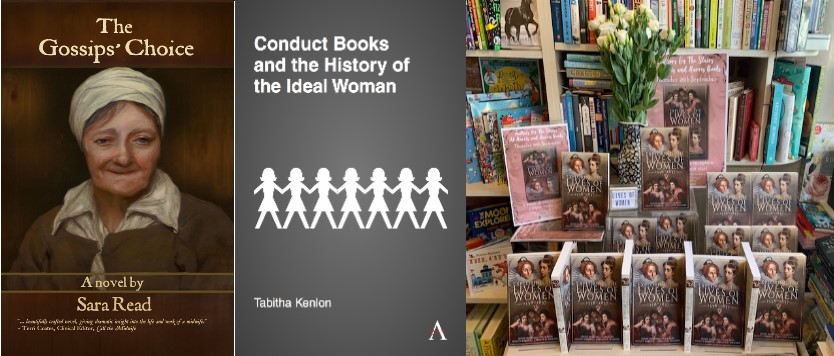
On an autumnal evening last September, a small crowd gathered at Harris & Harris Books in Clare, Suffolk, for one of its popular Author on the Stairs events. Gillian Williamson and I had been invited to talk about WSG’s anniversary book, Exploring the Lives of Women, 1558–1837, which had recently been released in paperback format.

As one of the book’s editors, I wanted to convey the scope and originality of our authors’ contributions in my talk. Therefore, I chose to address the question: why had so many of the women featured in the book been left out of the historical record? I considered how women’s history was constructed (and gendered) in Victorian biographical dictionaries, using our ‘bookend’ queens Elizabeth I and Victoria as opening case studies, before introducing some of the women whose lives are explored in our anniversary volume.

This approach led neatly into Gillian’s talk about her chapter on the Gentleman’s Magazine. Gillian eloquently described how the magazine constructed ideas of gender in the eighteenth century, specifically referencing the emergence of obituaries in its pages. The obituaries were used by Gillian (with some brilliant flashes of humour) to show how femininity was framed in the Gentleman’s Magazine, while also providing glimpses of a less-neatly gendered society.

There was an opportunity for the audience to ask questions and handle some of our original source material – an 1866 edition of a female biographical dictionary and an early volume of the Gentleman’s Magazine­. We enjoyed lively discussion and hospitality, in the perfect setting of an independent bookshop. Reflecting on this evening, in such an intimate and sociable environment, it is clear we were very fortunate. For anyone releasing a book right now, any ‘in-person’ events or celebrations will have to wait. This is exactly the case for two of our book’s contributors, whose latest work has been published during the lockdown.

The first of these new books is by Dr Sara Read, who specialises in cultural and literary representations of women, reproduction and medicine in the early modern period. Sara played a pivotal role in the WSG book, serving as both co-editor and contributor, with her chapter focusing on The Countesse of Lincolnes Nurserie (1622) by Elizabeth Clinton and highlighting views around childcare and breastfeeding. In her latest work, Sara continues to draw upon this rich subject knowledge, while venturing into new territory: the genre of historical fiction.

In her excellent debut novel, The Gossips’ Choice, Sara has created an atmospheric world for her protagonist, the midwife Lucie Smith. The book has been described as a seventeenth-century version of ‘Call the Midwife’, as we follow Lucie’s cases during the plague year of 1665. It is a beautifully crafted and impeccably researched novel, drawing upon a wide range of historical sources. For example, some of the events in the book are inspired by A Complete Practice of Midwifery (1737), the memoir of midwife Sarah Stone. This approach provides authentic detail to a vividly imagined and compelling story.

The second new book release is by Dr Tabitha Kenlon. Tabitha’s research concentrates on eighteenth-century British novels, theatre, and conduct manuals. In Exploring the Lives of Women, Tabitha’s chapter provides a close reading of a single text, exposing the confused rhetoric in the cautionary pamphlet Advice to Unmarried Women (1791) written by an anonymous clergyman. Tabitha also contributed one of the two poems in our book, ‘Gretchen’s Answer’, which follows similar themes by exploring the consequences of “when society tells women how to think, how to act, how to feel” (Exploring, p. 98).

Tabitha’s first monograph continues this investigation. In Conduct Books and the History of the Ideal Woman, Tabitha shows how the longest-running war is the battle over how women should behave. This is an exceptional study, being the first of its kind to provide a trans-historical approach: expanding upon previous period-specific studies, Tabitha considers the persistence (or alteration) of the female ideal over six centuries. Tabitha’s brilliant close readings of a wide range of texts are superbly executed and entertaining, making the book highly accessible to the specialist or general reader. It is a powerful book, written with compassion and flashes of anger, in an elegant and witty prose.

Until we can all meet to celebrate, congratulations to Sara and Tabitha for producing two great books. Full reviews of both publications will appear on this website in the coming months: watch this space!

____________________________________________

The Gossips’ Choice by Sara Read is published by Wild Pressed Books for £12.

Conduct Books and the History of the Ideal Woman by Tabitha Kenlon is published by Anthem Press for £80 (hardback) and £25 (ebook). Please ask your institutional library to buy a copy. A 20% discount is available to WSG members.

Exploring the Lives of Women, 1558–1837, the anniversary book by WSG, is published by Pen & Sword Books for £19.99 (hardback), £12.99 (paperback) and £5.20 (ebook).

Please support your local independent booksellers if you can. Harris & Harris Books is currently offering a delivery service.