Reminder: WSG seminar January 2022

The fourth seminar of the year takes place on Saturday, 29 January 2022 (GMT).

This seminar will take place on Zoom. Please be aware, you must be a member of the WSG to gain access to the Zoom sessions. The links are distributed through our WSG mailing list 24-hours before the event. Becoming a member means you will be able to attend the Zoom and in-person seminars for the 2021-2022 season.

Speakers:

Phil Winterbottom. “By cash paid herself”: Women as clients of London’s banks from the Restoration to the 1780s

 Brenda M. Hosington. Two Seventeenth-Century Women Translators of French Prose Fiction

Alannah Tomkins. “I helpt to nurse”: care work by Georgian spinsters, 1780-1820

Eliska Bujokova. Matrons, Housekeepers and Nurses: Food Provision and Power Relations in Glasgow’s Early Nineteenth c. Hospitals

For further information, see our seminars page.  To join the WSG, see our membership page.

Reminder: WSG seminar November 2021

The third seminar of the year takes place on Saturday, 27 November 2021 (GMT).

This seminar will take place on Zoom. Please be aware, you must be a member of the WSG to gain access to the Zoom sessions. The links are distributed through our WSG mailing list 24-hours before the event. Becoming a member means you will be able to attend the Zoom and in-person seminars for the 2021-2022 season.

Speakers:

Nora Crook

During the first part of the twentieth century, Mary Shelley’s editing of the work of her husband, Percy Bysshe Shelley, after his death, was widely considered to be, together with the writing of Frankenstein, one of her two major achievements (indeed, her only two achievements worth remembering). In the last fifty years her work has undergone a major reclamation. Her other works have been brought back into print, and there have been at least four major biographies. She has emerged as a major woman of letters during the years 1820–1840, while Frankenstein is the most taught novel at university level.  Her role as editor, however, has tended to recede into the background, almost as an embarrassment. While it is commendable that she is no longer esteemed above all as the piously devoted literary widow, this recession has had the regrettable consequence of obscuring the remarkable nature of her achievement, in a climate where it was uncommon for a woman to be an editor at all, let alone to be given the task of editing the work of a major British writer, and, in this case, solely by herself. Sara Coleridge, daughter of Samuel Taylor Coleridge is the only nineteenth-century British woman editor whose work is comparable to hers.

I begin with an overview of the different kinds of editing open to women during the late eighteenth- and nineteenth-centuries, including that of editing the remains of a dead author (usually father, husband, or female friend). I then turn to the difficulties under which Mary Shelley laboured, first in gathering up her husband’s scattered manuscripts, the enmity of her father in law, the libel laws that prevented her publishing an uncensored version of her husband’s poems, and attempt an assessment of her place among women editors of the nineteenth century.

Amy Solomons

‘A book is either the best treasure, or the greatest evil’: The Circulation and Readership of Conduct Literature in National Trust Libraries, 1680-1830.

Women’s reading was a highly policed, social experience in the long eighteenth century. The period, characterised by Amanda Vickery (1998) as a ‘dramatically expanding culture of female literariness’, saw a rapid rise in women’s access to and engagement with print material. Attitudes towards women’s reading were contradictory, suggesting that their reading was expansive and thought provoking, but that their reading experiences were highly controlled and regulated. Conduct literature responded to these anxieties through an emphasis on women’s reading, education, manners and behaviour.

Through an analysis of the National Trust’s library collections and the ESTC, this paper explores both the circulation and readership of thirty conduct literature titles published between 1680-1830. While scholarship on women’s education has long cited conduct literature, few studies have sought to examine the reception to prescriptive texts. Through a mixed methods approach, this paper shifts focus from a theoretical to a practical perspective. A statistical analysis of the ESTC allows this study to chart the prominence of conduct literature based on number of editions. This numerical evidence is then used alongside examples of material use of books in National Trust libraries to comment on female readership and responses to conduct texts.

Amy Prendergast

‘a means of my doing better’: Eighteenth-Century Diary Writing as a Tool for Individual Improvement

Although defined and interpreted in multiple ways, ‘improvement’ is generally understood as the opposite of revolution, as a project undertaken for ‘gradual, piecemeal, but cumulative betterment’.[1] Whether a person was striving for individual or social improvement, their method was one characterised by regularity and steadiness, eventually producing an aggregate. Such a process perfectly corresponds with the genre of the diary, with its individual entries accumulating over time to produce a final text. Built upon autonomous though interconnected entries, the diary form was an ideal one to employ in order to partake of this ethos of slow progress, and to facilitate any scheme based on gradual and cumulative development. Drawing in particular on two diaries from Ireland – that of the aristocratic Anne Jocelyn, the Countess of Roden (1797–1802) and Mary Mathew, the independent unmarried daughter of a Munster Church of Ireland landowner (1773–74) – this paper aims to explore how we might consider diaries as an unexplored aspect of the ethic of improvement, demonstrating also how these female diarists drew upon but challenged the discourse of improvement, and contribute to a larger tradition of improvement writing. Women in this period were frequently the target audience of manuals, conduct books, and literary collections with ‘improvement’ in the titles, designed to initially create and then reinforce polite ideals of femininity, rather than improve the individual person. These improvement diaries depart from such intentions, instead representing self-care interventions that see these women privileging ideas of individual betterment. Inclusion of such diaries places women at the centre of improvement projects rather than as peripheral actors, and transforms our understanding of their participation in improvement culture.

[1] Paul Slack, The Invention of Improvement: Information and Material Progress in Seventeenth-Century England. Oxford: OUP, 2015, 1.

For further information, see our seminars page.  To join the WSG, see our membership page.
Reminder: WSG seminar November 2021

The third seminar of the year takes place on Saturday, 27 November 2021 (GMT).

This seminar will take place on Zoom. Please be aware, you must be a member of the WSG to gain access to the Zoom sessions. The links are distributed through our WSG mailing list 24-hours before the event. Becoming a member means you will be able to attend the Zoom and in-person seminars for the 2021-2022 season.

Speakers:

Nora Crook. Mary Shelley as Nineteenth-century Female Editor

Amy Solomons. ‘A book is either the best treasure, or the greatest evil’: The Circulation and Readership of Conduct Literature in National Trust Libraries, 1680-1830.

Amy Prendergast. ‘a means of my doing better’: Eighteenth-Century Diary Writing as a Tool for Individual Improvement

For further information, see our seminars page.  To join the WSG, see our membership page.
Reminder: WSG seminar November 2021

The third seminar of the year takes place on Saturday, 27 November 2021 (GMT).

This seminar will take place on Zoom. Please be aware, you must be a member of the WSG to gain access to the Zoom sessions. The links are distributed through our WSG mailing list 24-hours before the event. Becoming a member means you will be able to attend the Zoom and in-person seminars for the 2021-2022 season.

Speakers:

Nora Crook. Mary Shelley as Nineteenth-century Female Editor

Amy Solomons. ‘A book is either the best treasure, or the greatest evil’: The Circulation and Readership of Conduct Literature in National Trust Libraries, 1680-1830.

Amy Prendergast. ‘a means of my doing better’: Eighteenth-Century Diary Writing as a Tool for Individual Improvement

For further information, see our seminars page.  To join the WSG, see our membership page.

Conference Report – ‘Bath 250: A Virtual Conference to Mark the 250th Anniversary of the New Assembly Rooms At Bath’ by Rachel Bynoth

On 30th September 1771, the Upper Rooms in Bath opened their doors for the first time. Two hundred and fifty years later, the Bath 250 conference welcomed scholars from across the globe to celebrate this momentous occasion.

The conference pushed against a simple retelling of Bath’s glamorous spa town façade to uncover and present many of its hidden depths. In doing so, the papers collectively nuanced understandings of the operations and experiences of Bath in the eighteenth-century and beyond. This conference beautifully demonstrated the merits of utilising one space to examine a variety of different aspects of eighteenth-century society, to understand the multiplicities of experiences and create a fuller picture of how politics, health, entertainment, and polite society played out within one location.

The first day of the conference began with an opening keynote from Dr Hannah Greig, which introduced us to the centrality of the assembly rooms, not just within Bath, but towns and cities throughout the eighteenth century. Her talk wonderfully illustrated the role of the assembly rooms in cultivating ideas of sociability and as an accepted environment for the mingling of the sexes. Later talks considered some of the discomforts of sociability within these public spaces: the mixing of those pursuing entertainment with those seeking remedies, the anxieties of the marriage market and even how the proprieties of touch meant that the use of hands could be both dangerous but exciting.

Despite the Bath season occurring outside of the London parliamentary one, several talks stressed that Bath was not an escape from politics. Indeed, they presented politics as such a central aspect of Bath’s social scene that several speakers questioned exactly how restful it was for those there to recuperate from illness or to simply relax. Politics continued to play out via notions of sociability, through female influence and celebrity politicians.

The overlooked aspects of Bath’s social scene also threaded through the papers. Explorations of sedan chairmen and their struggles, the locations of lodging and boarding houses and the undertakers of Bath revealed social, political, and hierarchical elements of Bath society which co-existed amongst the more well-trodden histories of the balls, promenades, and pump room visits.

Yet Bath can foster more conversation over its overlooked or previously marginalised histories. In the roundtable session which examined the next 250 years of Bath’s history, Professor Olivette Otele called for a joining up of Bath’s decolonising and slavery projects to push this conversation forward and coordinate a response which looks to the future as well as the past. This prompted more general discussion from the panel on the need to present Bath as a place with multiple, concurrent narratives and the challenges of heritage sites to present this.

Various papers across both days focused on the Assembly rooms themselves, from the food and drink served, to the music performed, the country dances, and the competition to elect the Masters of Ceremony for the rooms. This included a consideration of life before the upper rooms and unexecuted assembly room plans. This led very nicely into the various discussions of the international influence and historical legacy of eighteenth-century Bath which brought the online section of the conference to a close.

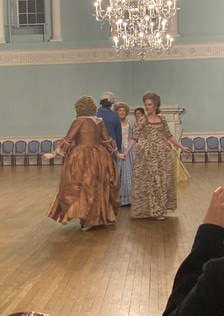
The finale to the conference was a live event, set in the upper rooms themselves. Beginning proceedings was a keynote by Dr Jonathan Foyle which explored the architectural influences of the upper rooms. It was such a pleasure to gaze upon the plans, shapes and objects while spotting the little details in the rooms around us. After a wonderful introduction to the ridotto by Hillary Burlock, the conference ended with a spectacular dance display by the Bath Minuet Company which captured the essence of the activities of the Upper Rooms on that opening day in 1771. Long sets, cotillions and, of course, the minuet, rounded off what was a compelling two days of discussion and reflection on Bath and its history.

Bath Minuet Company performance

The organisers would like to acknowledge the generous sponsorship of the British Society for Eighteenth Century Studies and the Royal Historical Society, whose grants helped to support the attendance of PGRs and ECRs in Bath. They would also like to thank the Early Dance Circle, especially Barbara Segal, Bill Tuck, Sharon Butler and Paul Cooper, for their decision to award the Janet Hauton Grant to the conference. This helped to fund a sound engineer and Bath Minuet Company’s fantastic dance display which concluded the event. The event was also supported by the University of Liverpool, the History of Parliament, TORCH from the University of Oxford, Queen Mary University, London, and the National Trust, and special thanks goes to the technical team at the University of Liverpool for their exceptional work.

***

Rachel Bynoth is a final year PhD student examining expressions of anxiety in the Canning family letters, across the lifecycle, between 1760-1830. She has an article forthcoming with the History journal in early 2022 which examines eighteenth-century female distance education through letters.