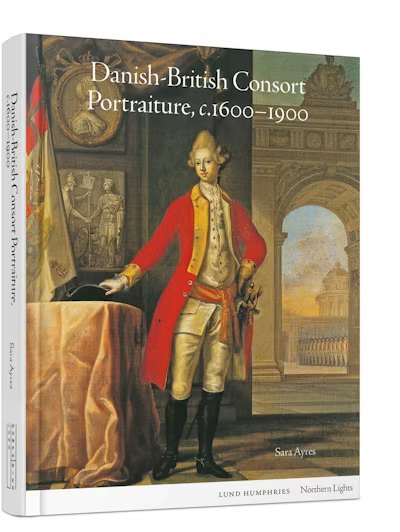
The title of this superbly illustrated book ostensibly indicates an overview of a specific group of royal portraits, produced over the course of three hundred years. An unusual focus on consorts who united the Danish and British royal families through marriage reveals the deep bonds between European dynasties, but also presents exemplary models for the author’s argument across otherwise broad and unmanageable periods of time. The book remains disciplined and centred, while at the same time offering a variety of evidence and new readings to make it a compelling and authoritative contribution to art history and visual culture. The chosen cover image, if unfamiliar to the reader, is assumed to represent one of these royal individuals in eighteenth-century military costume and with all the expected accoutrements of assertive might and power. However, it is soon revealed to encapsulate the far more complex narrative of the book. It subverts our expectations and challenges us to reassess what a portrait can tell us.
The 1770 portrait by Peder Als shows Caroline Matilda of Great Britain (1751–1775), the daughter of Frederick, Prince of Wales and Princess Augusta of Saxe-Gotha, who was married to King Christian VII of Denmark. She wears the uniform of the Life Guards, with red coat, sash and spurs, and sword at her side, about to take her tricorn hat from the table and to stride out through an arched doorway to inspect a line of soldiers drawn to attention in the courtyard. Her story forms chapter four of the book. By then, the reader has followed the writer’s close readings of three other consort portraits and traced the postures, settings and iconography which connect them to tell a history of transformation in the art of embodying the royal image (p. 10). The portrayal of rank shifted into one based exclusively on gender, a shift which affects our ability to understand and interpret a portrait even today. The argument is original and intriguing, underscored by research references drawn from a broad range of visual culture and historical sources, in particular Walter Benjamin’s writings on the work of art in an age of technological reproducibility. The argument relies on detailed observation to find new connections. Of the five Danish royal consort subjects of this study, only one, Prince George of Denmark (1653–1708), is male, but the book aims to explore how the royal image “rhetorically incorporated the most functional, symbolic qualities of maleness and femaleness” (p.22). It centres on uncovering the “complex palimpsest” of royal portraiture as embodiment, centring on the 1617 Paul van Somer portrait of Anne of Denmark (Royal Collection Trust) as its starting point.
Anne’s full-length portrait incorporates elements of the traditional male hunting portrait, the horse, dogs and distant view of a royal palace and park, as part of her self-fashioning. It was importantly designed to “instruct and nurture” (p.44) her son Charles in the noble and princely arts necessary for kingship. Charles I’s dismounted equestrian portrait by Anthony van Dyck, dated to c.1635, can be construed as a pendant. The crooked elbow which features in these and later royal portraits is an important sign derived from emblem book symbols of female perfection. When added to examples of extended elbows in male portraits suggesting greater male heat and virility, a feature of the ancient four humours medical theory, it is clear that there was more gender fluidity and layered meaning in the royal portrait than we might have realised.
The book explores the construction of royal embodiment and its image through the physical nature of the medium. The discussion on Prince George of Denmark centres on his youthful Grand Tour which included England on its itinerary, and the shaping of a cultured and refined royal figure. The wax medium used for the clothed and wigged waxwork of the young prince by Antoine Benoist (undated), now in Rosenborg Palace, Copenhagen, indicates the pliable mind of the prince as he was prepared for a role of power. The advances in scientific and Cartesian methodology, while essential elements of a modern royal education, changed the nature of royal embodiment. Louisa (1724–1751), daughter of George II, married Crown Prince Frederick V of Denmark-Norway. Her death during a late stage in pregnancy was followed by an autopsy which her doctors described in detail, changing the sacral body into a pathological case study. As the author notes,“The artisanal epistemology that had been the province of the consort and the artist as they together crafted the contours of the royal body as a work of art now became the property of the man of medical sciences” (p.80). The work of the anatomist reinforced the changing balance of power and the female body was laid open to a newly authorised male gaze.
The final two chapters consolidate the narrative of change. The author offers a new interpretation of a scurrilous woodcut lampoon of Caroline Matilda, printed in 1772, which “heralds the hygienic exclusion of the influence of women from political, public life, regardless of their rank, and their exile en masse to the seclusion of the domestic sphere” (p.88). The crude woodcut shows the queen on horseback, alongside a nurse holding her baby, and a male figure looking out of a window. The queen is construed as an “unnatural, sexually incontinent woman” (p.87) in the tradition of world turned upside down satire. The author suggests that the nurse represents the king, “left holding the baby” (p.89), the offspring of the queen’s affair with Johann Friedrich Struensee, the king’s doctor and prime minister. The threat to the royal bloodline at the centre of the print and the failure of masculine authority is embodied in the subversive and unruly woman. However, the king approved of Caroline’s wearing male attire, so contrary to a simple reading of the satire, the author suggests “the queen’s transvestism [is] a performative fall into masculinity responding to the king’s desire”, and a form of “sympathetic magic of mimesis” which constitutes the “body of the absolute king for him” (p.100–101). This reading questions and complicates the satire, based on traditional forms of unruly female representation and possible interpretations. However, the final example of consort portraiture is taken from an age of reproduction by means of photography. The narrative was reinvented for a new audience with irreconcilable binary gendered expectations determining its reception.
Alexandra of Denmark (1844–1925) married Albert Edward, Prince of Wales, later Edward VII, in 1863. Her elaborate reception in the capital “created a topological phantasmagoria within which ancient ceremony and industrial modernity comingled” (p.113). The rise of the carte de visite form popularised the image of the consort but also enabled comparisons and imitations in its mass availability and reproducibility. Following this, “fashion and the photographic image” defined the image of the consort and made her “a visual commodity”, a development that has ultimately made the represented female body “simultaneously object and abject” (p.128). Though beyond the scope of the book, clear contemporary examples can be found in the consorts of the current British royal family. The book does not falter in its structured and thorough exploration. Each chapter contributes new material and builds on its central premise of change over several centuries. However, while the title is precise, the breadth of the subject may not be anticipated by the browser in a library or book shop. But the book is a rewarding study as part of the Northern Lights book series, and the portraits examined cannot be seen in isolation again.
Miriam Al Jamil is on the WSG committee, chairs the Burney Society UK, and is Fine Arts editor for BSECS Criticks online reviews. She has published on women travel writers, Horace Mann and his circle in Florence and Rome, on Frances Burney, and on Eleanor Coade. There will be a chapter on Coade in the forthcoming WSG book.
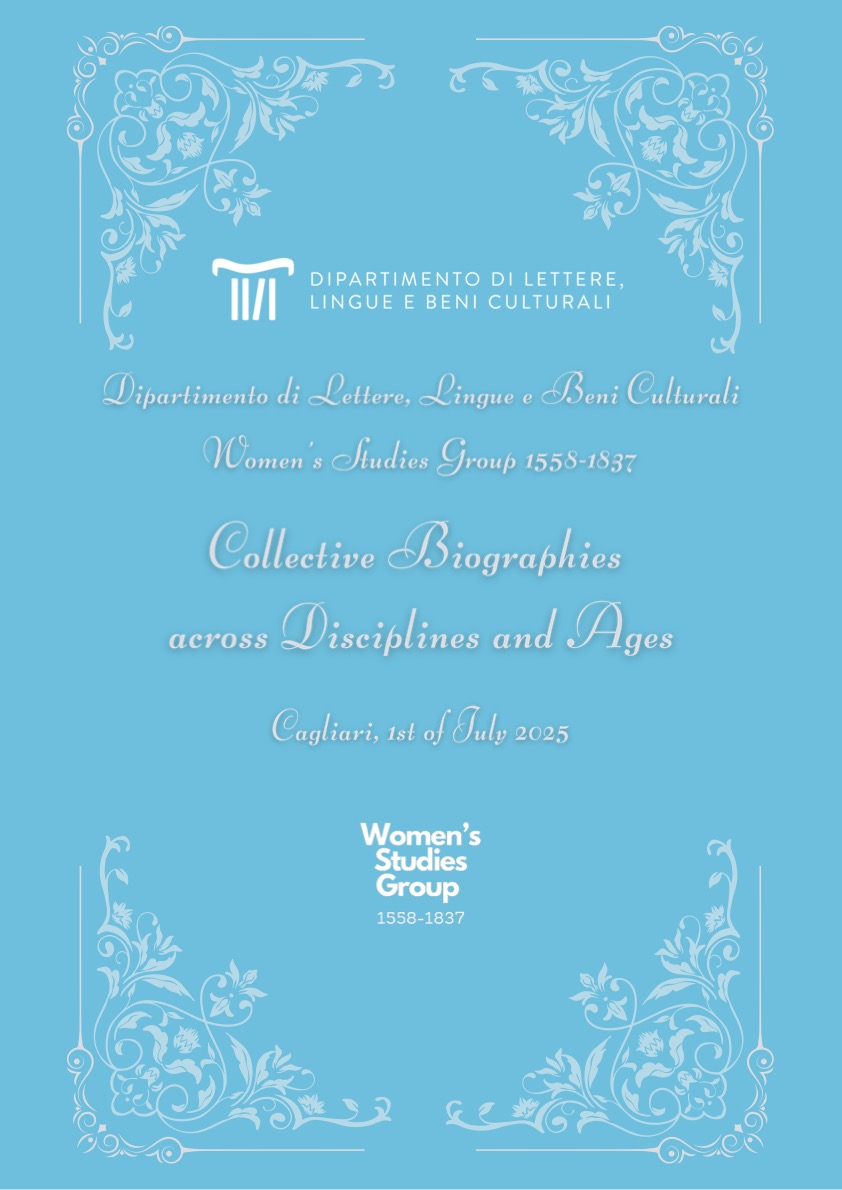
WSG Member Organizes July 1st, 2025 Hybrid Conference: “Collective Biographies Across Disciplines and Ages”
The Women’s Studies Group 1558–1837 is pleased to announce an upcoming one-day hybrid conference, “Collective Biographies Across Disciplines and Ages,” taking place on 1 July 2025, in person at the Università degli Studi di Cagliari (Faculty of Humanities, Via San Giorgio 12, Aula 6 and Aula Magna) and online via Microsoft Teams. This international event is organized by WSG member Dr. Maria Grazia Dongu, and it brings together an international group of scholars across disciplines.
About the Conference
This conference explores the literary, historical, and artistic dimensions of collective biography, narratives that center shared experience, social connection, and cultural memory. Presenters will consider how collective biographies function as both historical sources and narrative strategies, across genres as varied as Shakespearean drama, Quaker life writing, detective fiction, and eighteenth-century art. Drawing on approaches from literary studies, historiography, and biography theory, the conference reflects on how individual and group identities are shaped through storytelling.
The Women’s Studies Group 1558–1837 is proud to support this event, which features presentations by a number of our members and provides the opportunity to strengthen scholarly networks internationally and across disciplines.
Conference Schedule – 1 July 2025
9:30 am – Brief Introduction: On Collective Biographies by Maria Grazia Dongu (Università di Cagliari)
10:00 am – Competing to Tell Lives in Shakespeare’s Richard III by Maria Grazia Dongu (Università di Cagliari)
10:30 am – A Case Study of Early Quaker Biographies by Judith Roads (Independent Scholar)
11:00 am – Indizi tra le righe: l’Irlanda che cambia nelle detective story (Clues Between the Lines: Ireland’s Changing Face in Detective Stories) Luciano Cau (Università di Cagliari)
11:30 am – Break
12:00 pm – Anne of Cleves in Collective Biographies by Valerie Schutte (Independent Scholar)
12:30 pm – The Collective Biographies of 18th-Century Art: Harnessing the Power of Storytelling to Re-Read Martin’s “Lady Elizabeth Murray and Dido Belle” (1779) by Karen Lipsedge (Kingston University)
1:00 pm – Vita collettiva e autorialità: La famiglia Manzoni (Collective Life and Authorship: The Manzoni Family) by Fabio Vasarri (University of Florence)
13:30 pm – Catherine of Aragon, Cardinal Wolsey and Henry VIII through Chronicles and Shakespeare’s plays by Valeria Steri, Alessandra Carta, and Elena Melis (Università di Cagliari)
The day will conclude with a roundtable discussion among speakers and attendees.
Hybrid Attendance – All Are Welcome
This is a hybrid event, and attendees are warmly invited to join either in person or virtually. To receive the Microsoft Teams link for online attendance, please contact Dr. Maria Grazia Dongu at dongu@unica.it.
The Women’s Studies Group 1558–1837 is proud to support Dr. Maria Grazia Dongu in organizing this exciting interdisciplinary event. We celebrate her leadership and the vibrant international scholarly exchange this conference promises to foster across disciplinary boundaries.
This is the first of three reviews we will be publishing on the Illuminating Women Artists series, edited by Andrea Pearson and Marilyn Dunn, and published by Lund Humphries. The beautifully illustrated volumes in this series explore the lives and works of women artists, many of whom have been previously overlooked in the history of art. To begin, Anna Pratley discusses the volume on Elisabetta Sirani.
*******
Built upon decades of dedicated research and an informed analysis of recent developments in scholarly thought, Adelina Modesti’s contribution to the Illuminating Women Artists series is essential reading for any student or enthusiast seeking an overview of the remarkable life and work of Elisabetta Sirani (1638–1665). By seamlessly weaving into the text faithful English translations of seventeenth-century Italian sources and non-judgemental explanations of art historical terminology, Modesti has forged a highly accessible narrative which is gripping, informative, and truly illuminating.
Modesti begins by providing an impressively concise overview of the contemporary issues which shaped Sirani as an artist, including those relating to her family, education, and influential sociopolitical debates associated with the Counter-Reformation. Alongside addressing topics familiar to the scholar of early modern women, such as the Querelle des Femmes (‘Woman Question’), it also considers those factors unique to Bologna which allowed women artists to flourish. The most significant of these is the “matrilineal pedagogic model”, a term coined by Modesti to acknowledge Bologna’s encouragement of women teaching other women (p.19). Readers who wish to delve further into recent archival discoveries relating to the success of Bolognese women artists are appropriately signposted to Babette Bohn’s Women Artists, their Patrons, and their Publics in Early Modern Bologna(Penn State University Press, 2021).
Chapter 2 evaluates Sirani’s training, artistic influences, technique, and style. In accordance with Linda Nochlin’s 1971 argument – that the disadvantages faced by women artists should not be employed as an intellectual position – Modesti emphasises the wealth of resources available to Sirani: plaster casts, sculptures, paintings, drawings, palace collections, churches, books, and religious festivities to name a few. Relevant archival materials support investigations into Sirani’s colleagues and apprentices, particularly Lorenzo Tinti (1626–1672), whose artistic relationship with the maestra has not yet received its due focus and would be worth further investigation. A short paragraph on Sirani’s little-known caricatures (p.50) presents a similarly tantalising opportunity for further research.
However, it is Modesti’s ability to paint a picture of Sirani’s genuine passion for her profession which remains the most illuminating aspect of this chapter, and indeed of the whole monograph. Of note are personal anecdotes from Sirani’s biographer and friend, Carlo Cesare Malvasia (1616–1693); one of these (p.41) recalls the artist’s repeated visits to a jewellery shop to view a much-loved painting, and her subsequent avoidance of returning out of embarrassment for spending so much time admiring it. Descriptions of Sirani’s technique are just as evocative, for instance, how her experiments with wet-on-wet paint application created a “shimmering quality to the surface of her paintings” (p.32). Modesti’s writing brings Sirani to life in this chapter, allowing her youth, character, and talent to radiate from the glossy printed reproductions of her works. It is a must-read example of how to introduce a non-specialist audience to the world of art history.
A natural progression from the previous chapter, Chapter 3 covers the themes, subjects, and iconography of Sirani’s works. An examination of Sirani’s religious paintings considers their propensity for use in spiritual reflection, a significant role for artworks in the Counter-Reformation. The suggestion that Sirani’s depictions of Saint Anne gained popularity as exemplars of the aforementioned matrilineal pedagogic model is insightful and well-supported. Perhaps the most successful use of images appears in this section (pp.64–65). The rich red, white, and blue drapery of Sirani’s Virgin and Child (1663) is complemented by that of the adjacent Salvator Mundi (c.1655–8), while a self-portrait sketch apparently used as the basis of the latter work is displayed alongside it, allowing direct comparison.
However, Modesti’s examination of Sirani’s historical heroines is tenuous in places. Her argument that the formal composition of Timoclea may have been inspired by Artemisia Gentileschi’s Judith Beheading Holofernes (c.1620) (p.78) is a refreshing addition to the discourse; yet one cannot help feeling that this was an attempt to shoehorn in a connection between two women artists where there is no extant evidence that they had any knowledge of each other’s works. More perplexing is the lack of any reference to Amy Golhany’s 2011 article – which recognises the irrefutable similarity between Sirani’s Timoclea and an earlier eponymous print by Matthaüs Merian (1593–1650) – despite its inclusion in Modesti’s select bibliography.
It is also worth noting that the section on anti-heroines assumes the authenticity of an Iole (1662), a Cleopatra (c.1664), and a Circe (c.1664), all of which have contested authorship. Modesti is known for taking an enthusiastic approach to attributions, sparking much debate with the other primary scholar on Sirani, Babette Bohn. The reader should remain conscious of this and take a critical approach to new attributions in this work. Chapter 1, for instance, attributes a painting traditionally thought to be by Sirani to her sister Barbara. The curious reader will discover that the ‘reference’ supporting this claim is a link to a Facebook image of the work with no caption, posted to the page of the Galleria Umbria Perugia in 2022. There are, I am sure, reasons behind this assertion, but without knowing them it is difficult to judge its validity.
Chapter 4 offers an extensive evidence-based analysis of the artist’s patronage networks and modes of self-representation. Of note are some previously unrecognised connections with the Medici, including commissions from a Medici courtier, the chief administrative officer of the Medici military company, and a Bolognese statesman in the service of a Medici cardinal (p.99). Modesti’s chronological analysis of Sirani’s notebook is a particularly helpful guide to the evolution of the artist’s popularity over time. Towards the end of this chapter, the inclusion of visual reproductions of contemporary laude (figs. 69 and 70, p.110) adds valuable weight to the running emphasis on the artist’s impressive reputation.
Modesti’s concluding chapter is fittingly dedicated to documenting the posthumous memory of Sirani. This section provides a stark reminder of the tragedy of Sirani’s untimely death, supported by detailed descriptions of her funeral proceedings and three moving contemporary letters mourning her loss. A brief but comprehensive analysis of Sirani’s critical reception through time follows. This section subtly emphasises the important role played by women in preserving Sirani’s memory across the centuries, from Carolina Bonafede’s 1856 biographic play to the use of the Timoclea in the #MeToo movement. The commemorative plaque now adorning Sirani’s home could potentially have provided further support for Modesti’s comments on the early twentieth-century dismissal of Sirani’s works as imitations of her predecessor, Guido Reni (1575–1642). However, this omission does not detract from the success of this chapter.
Just as Sirani produced an astonishing 200+ paintings in just over a decade of work, Modesti’s book encompasses a vast amount of research in just 144 pages. This need for concision results in a few minor lapses in academic rigour, mostly in the justifications for attributions. Nonetheless, this book provides a much-needed point of entry into the world of Elisabetta Sirani, reminding us that many historical women artists are still awaiting equal representation outside of the boundaries of academia.
Anna Pratley recently graduated from the Warburg Institute with an MA (Dist.) in Art History, Curatorship and Renaissance Culture. Her research interests include amateur women miniaturists working in seventeenth-century England, the domestic lives of the “middle class” in the long eighteenth century, and the application of feminist surveillance theory to women’s self-portraiture.
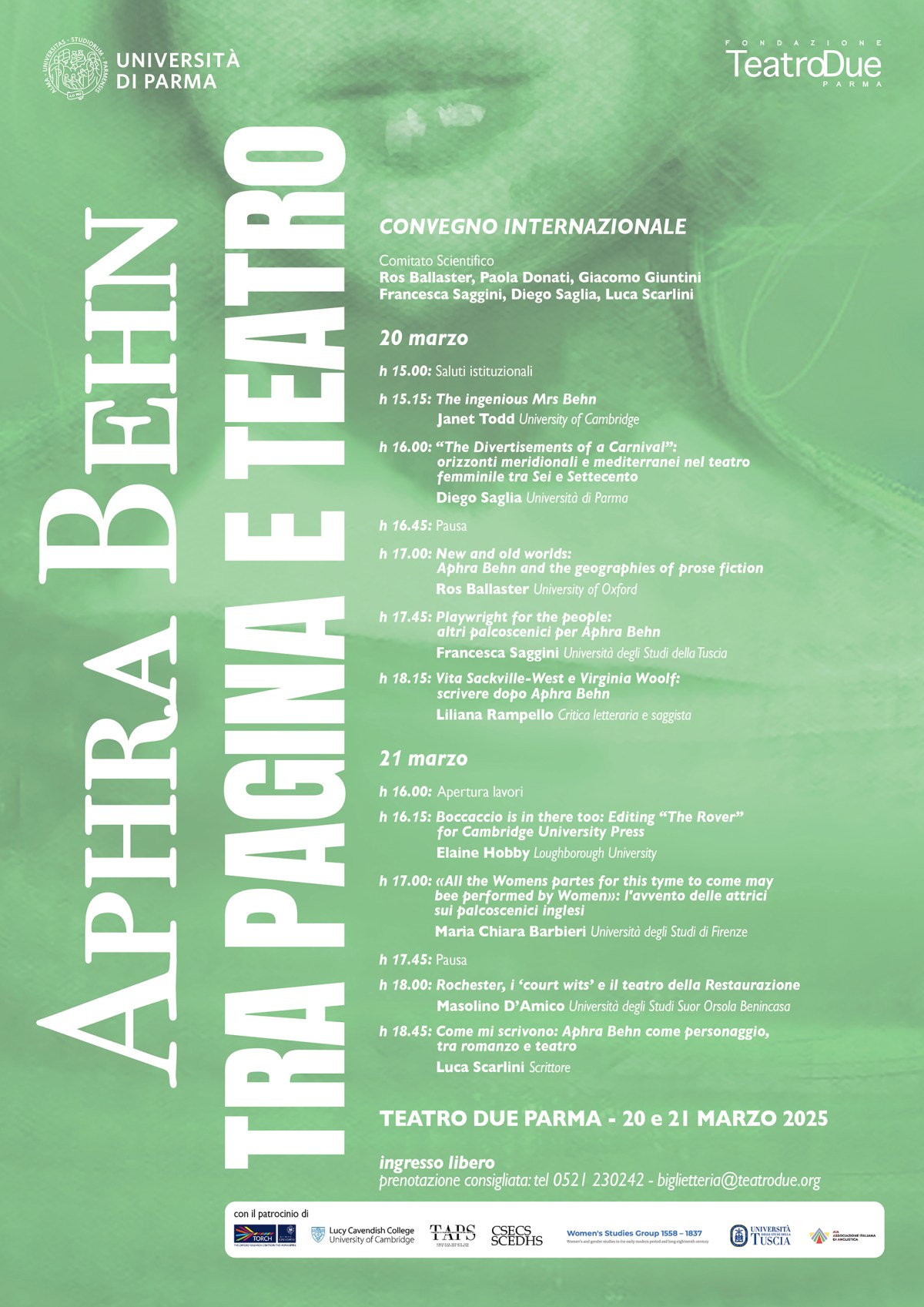
The Women’s Studies Group 1558-1837 is pleased to announce an exciting international conference, “APHRA BEHN TRA PAGINA E TEATRO” (Aphra Behn Between Page and Stage), taking place on 20-21 March 2025 at Teatro Due Parma, Italy. Our esteemed member, Francesca Saggini, is part of the organizing committee for this groundbreaking event, which represents the first event of its kind in Italy dedicated to the pioneering English author Aphra Behn.
About the Conference
This international conference, jointly organized by the Fondazione Teatro Due and the Università di Parma, will explore Behn’s remarkable contributions to literature and theatre, as well as the historical period in which she lived—a time combining “the charm of licentiousness with the violence of intrigue, marked by political and socio-cultural upheavals, scientific and artistic innovations.” The conference examines a crucial period spanning the English Civil War, the Stuart Restoration, and the Glorious Revolution through the lens of Behn’s work.
The event benefits from the support of institutions including the University of Oxford (The Oxford Research Centre in the Humanities), University of Cambridge (Lucy Cavendish College), Università degli Studi della Tuscia (Dipartimento di Studi Linguistico-Letterari, Storico-Filosofici e Giuridici), American Society for Eighteenth-Century Studies, Canadian Society for Eighteenth-Century Studies, and The Women’s Studies Group, 1558–1837.
Conference Schedule
20 March 2025
15:00 – Institutional greetings
15:15 – “The ingenious Mrs Behn” Janet Todd (University of Cambridge) The British author and scholar, a leading expert on Aphra Behn and largely responsible for her critical reappraisal in the late 20th century, will discuss her experiences of scholarship and life with this author.
16:00 – “The Divertisements of a Carnival”: orizzonti meridionali e mediterranei nel teatro femminile tra Sei e Settecento Diego Saglia (Università di Parma) An exploration, starting with The Rover, of southern and Mediterranean settings and their meanings in female comic theatre in the late 17th and early 18th centuries.
16:45 – Break
17:00 – “New and old worlds: Aphra Behn and the geographies of prose fiction” Ros Ballaster (University of Oxford) Astrea’s prose production as a starting point to explore its geographical and cultural imagery.
17:45 – “Playwright for the people: altri palcoscenici per Aphra Behn” Francesca Saggini (Università degli Studi della Tuscia) An overview of Behn’s reappearance in contemporary culture, not only on stage or in publishing, but also through commemorative events and digital remediations.
18:15 – “Vita Sackville-West e Virginia Woolf: scrivere dopo Aphra Behn” Liliana Rampello (Critica letteraria e saggista) An evocative reading of reflections on Behn developed by Vita Sackville-West and Virginia Woolf in the early decades of the 20th century.
21 March 2025
16:00 – Opening of proceedings
16:15 – “Boccaccio is in there too: Editing ‘The Rover’ for Cambridge University Press” Elaine Hobby (Loughborough University) A discussion of philological and annotation strategies based on the experience of editing The Rover for Cambridge University Press.
17:00 – “‘All the Womens partes for this tyme to come may bee performed by Women’: l’avvento delle attrici sui palcoscenici inglesi” Maria Chiara Barbieri (Università degli Studi di Firenze) A focus on Restoration theatre, particularly the revolutionary phenomenon of actresses appearing on stage following the reopening of London theatres in 1660.
17:45 – Break
18:00 – “Rochester, i ‘court wits’ e il teatro della Restaurazione” Masolino D’Amico (Università degli Studi Suor Orsola Benincasa) An in-depth analysis of the playwrights connected to the court of Charles II, including the controversial Earl of Rochester, and their innovative theatrical productions.
18:45 – “Come mi scrivono: Aphra Behn come personaggio, tra romanzo e teatro” Luca Scarlini (Scrittore) A broad overview of Behn as playwright and novelist, offering a general picture of the complexity and richness of a figure always inhabiting the space between stage and page.
A Festival of Behn
This conference is the culminating event of a two-month celebration of Aphra Behn taking place in February and March 2025. The broader initiative includes:
A new Italian translation and performance of Behn’s play The Rover at Teatro Due
Public readings of her prose works including Oroonoko and The History of the Nun
The creation of a “docudrama” about the author
The conference welcomes university students and researchers, secondary school teachers and students, and the general public. This represents a significant milestone as the first event of its kind in Italy dedicated to Aphra Behn.
Program Committee
The conference is guided by an esteemed Program Committee comprising Ros Ballaster, Paola Donati, Giacomo Giuntini, Francesca Saggini, Diego Saglia, and Luca Scarlini.
Admission and Reservations
The conference offers free entry (ingresso libero). Reservations are recommended and can be made by calling tel. 0521 230242 or emailing biglietteria@teatrodue.org.
The Women’s Studies Group 1558-1837 is proud to support our member Francesca Saggini in this important endeavor to highlight the work and legacy of one of England’s first professional women writers.


 Women's Studies Group 1558 - 1837