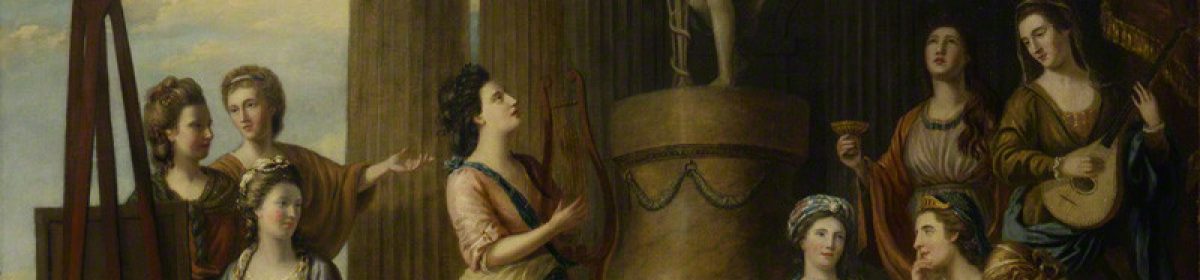
*Please note: Karen Lipsedge will now be presenting her paper at the 11 March seminar. In her stead on 14 Jan a paper from Brianna Robertson-Kirkland will be read*
Has everyone recovered from new year celebrations? Ready for more early modern women’s studies research? WSG’s January seminar takes place in just under a fortnight, with three papers on Aphra Behn, reading women, and the eighteenth-century stage.
Seminars take place at the Foundling Museum, 40 Brunswick Square, WC1N 1AZ, starting promptly at 1pm and finishing at 4pm. Doors open at 12.30. Directions for getting to the Museum can be found here. All seminars are free and open to the public, though refreshments will cost £2 to those who aren’t WSG members. Those attending the seminars are welcome to look round the museum before or after.
Sunday 14 January, 2018. Chair: TBC Maryann Feola: Aphra Behn and the shaping of an imagined Naples. Karen Lipsedge: Reading women and the eighteenth-century home. Sarah Burdett: From bloodthirsty Amazon to ‘Desp’rate Mother’: Sarah Yates’s re-invention of Queen Margaret of Anjou on the 1790s London stage.
The date for our next annual workshop has been fixed for Sunday 13th May 2018 at the Foundling Museum, London, and the theme will broadly reflect the keynote’s of music, crafts and the home. WSG & music is a good fit with the Foundling – did you know that Handel conducted benefit performances of his famous Messiah to raise funds for the Foundling Hospital, and that the museum is home to an important Handel archive and regularly holds musical events? Registrations for the workshop will open in the spring, and participants are usually expected to bring a 5-minute contribution to present in the afternoon. Places will first be advertised to the wsg members mailing list – to find out before everyone else, why not become a member?
There are just 2 weeks till the deadline for applications for this year’s Women’s Studies Group 1558-1837 anniversary bursaries. Last year, the WSG offered its first ever bursary to an early career researcher, independent scholar or PhD student who was a member of the Group to “support research in any aspect of women’s studies in the period 1558-1837”. This year we are pleased to be able to offer it again, but this time to make two awards, the first of £500 and the second of £250. The money will be paid on presentation of receipts and the winners will be expected to give a paper at a WSG seminar the following year, or, if based abroad, write a report for the WSG website.
The grant may be awarded for a new or continuing interdisciplinary or single-discipline project. For further information about the bursary, and to apply, please download the application form. The deadline for applications is November 30th 2017. Applicants will be notified of the outcome by January 2018. For further information on membership, see here.
Sampled Lives: Samplers from the Fitzwilliam Museum Fitzwilliam Museum, Trumpington Street, Cambridge CB2 1RB Free entry, until Sunday 8th April, 2018.
Accompanying catalogue: Carol Humphrey, Sampled Lives: Samplers from the Fitzwilliam Museum. Accomplishment, Identity, Education and Employment (Cambridge: The Fitzwilliam Museum, 2017). Pp 242, illustrated. £19.99 (paperback), ISBN 9781910731079.
Sophia Ellis, Band sampler with pictorial panels, 1785 (exhibition catalogue No. 62). Image courtesy of the Fitzwilliam Museum, Cambridge
Curated by the Honorary Keeper of Textiles, Carol Humphrey, this is a fascinating small exhibition of 123 samplers from the Fitzwilliam Museum’s collection which are not usually on general display. Dating from the early 17thto the 20thcentury they are attractive in their own right as material objects and a testament to the expertise and artistry of their often very young (under ten years old in some cases) female makers. Most of those makers are anonymous, destined perhaps to be known only by the initials or name they stitched into their pieces. In a few cases, especially where that name is unusual, a short life has been reconstructed from the archive, though even here the sampler is pretty much the only surviving evidence of a female life. What the exhibition does very successfully is take this evidence and use it in a fresh way: as the equivalent of a life-writing text to illuminate the under-recorded lives of girls and women. This is therefore a very helpful extension of sources not just for scholars of textiles but for all members of the Women’s Studies Group who research women’s lives.
The samplers have been arranged not only chronologically but also in groups that illustrate the themes of accomplishment, identity, education and employment which are more fully explored in the sumptuous fully-illustrated catalogue. Most of the makers are, as far as can be discovered, of gentry or middling-sort families. Their work is a testament to the embroidery skills that were a key element in a female identity, used to make and embellish clothing and household linens. Some of the later examples are interpreted, however, as portable CVs demonstrating a working woman’s employable skill with the needle. Similarities between samplers are pointed out and traced not only to printed pattern books and popular texts but also to female networks such as the pupils of teachers Judith Hayle and her daughter Rebecca Thomson of Ipswich (fl. 1691-1711), late-17th- and 18th-century Quaker circles, and the charity school of St Clement Dane’s in central London.
The technically elaborate earlier 17th-centry spot motif samplers gradually gave way to the simpler (in stitching terms) pictorial samplers with alphabet and text often intended to be framed and hung on the wall of the family home, maybe as a dutiful gift to parents. The former had included clues to a girl’s or her family’s political alignments (heraldic and royalist symbols for example), whereas the latter can be thought of as extending this to a more personal interpretation of a girl’s emerging female identity and sense of self. For example, nine-year-old Sophia Ellis’ 1785 sampler (see illustration) incorporates standard motifs (as the ‘Solomon’s Porch’ in the centre, Adam and Eve in the band below, and the urns of flowers and geometrical trees) alongside symbols of loyalty at a time of war in America (the two grenadiers and the crowned lions). She has demonstrated her ability to both read and write, now expected in gentry and middling-sort females, with her top bands of upper- and lower-case alphabets and a moral motto which is again typical in framing a female sense of piety and quiet obedience. However, in the bottom band has allowed her imagination to run riot with a charming series of more frisky pastoral images.
The next in WSG’s 2017-18 seminars takes place this month, with three papers on women authors and love, politics, and art.
Seminars take place at the Foundling Museum, 40 Brunswick Square, WC1N 1AZ, starting promptly at 1pm and finishing at 4pm. Doors open at 12.30. Directions for getting to the Museum can be found here. All seminars are free and open to the public, though refreshments will cost £2 to those who aren’t WSG members. Those attending the seminars are welcome to look round the museum before or after.
Saturday 25 November, 2017. Chair: Lois Chaber Eva-Maria Lauenstein: ‘Within these tombes enclos’d’: delineating Renaissance love in Mary Sidney Herbert’s Antonius. Mihoko Suzuki: Political writing beyond borders: Charlotte Stanley and Margaret Cavendish. Valerie G. Derbyshire: Words and pictures: Charlotte Smith (1749-1806) and the works of the artists of her day.