WSG member Miriam al Jamil reports from the recent BSECS conference.
WSG members make an increasingly strong showing at BSECS conferences, both as participants in our own panel and as speakers on others. This year’s conference took place in Oxford 4-6 Jan 2019 and the theme was ‘Islands and Isolation’, which inspired a broad and eclectic range of papers across a range of disciplines. Our panel was titled ‘Fallen Women, Missionary Wives and Castaways: Exploring Women’s Isolation in the Long Eighteenth Century’. It was organised by Carolyn Williams and chaired by Yvonne Noble.
Tabitha Kenlon’s paper was ‘Scold, Punish, Pity or Seduce? The Confused Rhetoric of Advice to Unmarried Women (1791)’. Readers of our book Exploring the Lives of Women, 1558-1837will be aware of Tabitha’s work on conduct manuals and her paper explored contradictions in an anonymous advice manual of 1791. Description of the process of seduction is combined with moralistic counselling of the young women at risk, characterised as victims who succumb to temptation. The language borders on the salacious as the reader is addressed directly as a fallen woman, her shame a ‘chronicle of male triumph’. The writer exhorts reform but is not convinced that a woman will ever be exonerated for her failure to anticipate the actions of her seducer. Tabitha interpreted ‘isolation’ as the social and moral wilderness into which the fallen woman was propelled.
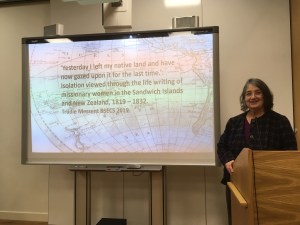
Trudie Messent presenting at BSECS 2019
Trudie Messent presented on a WSG panel for the first time. Her paper was titled ‘Yesterday I left my native land and have now gazed upon it for the last time’: Isolation viewed through the life writing of Missionary wives in the Sandwich Islands and New Zealand, 1819-1832’. Trudie examined both the harsh physical journey and the emotional one which young newly-married wives experienced as they adjusted to life on the other side of the globe. She suggested that the letters and descriptions written by her subjects had a cathartic effect in the absence of social contact that their new lives entailed. Trudie’s paper was accompanied by some beautiful slides, showing routes taken, portraits and scenes which enriched the descriptions and quotations in her paper.
Carolyn Williams’ paper ‘Ladies unus’d to such hardships: Women on Desert Islands in two Eighteenth-century Novels’ began with a witty admonition for the incompetence shown by such desert island dwellers as Ben Gunn and Robinson Crusoe who were unable to recognise the potential resources available to them on their islands, such as the fermenting grapes or sea salt which could be put to good use to supply yeast or enable cheese-making. The delicate languishing ladies in Penelope Aubin’sThe Strange Adventures of the Count de Vinevil and his Family (1721) were given short shrift in Carolyn’s discussion which highlighted the shortcomings of an upper-class life as preparation for survival on an island. Their practical working-class counterpoint was identified in Charles Dibdin’s Hannah Hewit; or, The Female Crusoe (1792) whose scientific and mechanical facility rendered her desert island sojourn a period of comfort and creative energy.
Other WSG members who gave papers at the conference included Gillian Williamson, Miriam Al Jamil, Brianna Robertson-Kirkland, our bursary winner Madeleine Pelling, and Judith Hawley who contributed her insights at a round table discussion on ‘#MeToo’. I am sure there were other members and friends at the conference. There were many familiar faces. Speakers Olivette Otele and Cynthia Wall mined their academic experience for thoughtful keynote talks, and a delightful concert of eighteenth-century songs by soprano Valeria Mignaco and guitarist Jelma van Amersfoort put us in a convivial mood for the conference dinner. Plans are already underway for next year’s conference which will be ‘Natural, Unnatural and Supernatural’ and we are sure WSG will have a strong presence again in 2020.
The biggest event in the WSG’s calendar is always the annual workshop. In the fifth in our series exploring the history of WSG and to coincide with the recent publication of Exploring the Lives of Women (Pen and Sword, 2018), members Vicki Joule and Sarah Oliver remember their roles as Committee members and workshop organisers, and some of the most memorable events WSG put on.
VJ: After several years of membership, Sarah and I were invited onto the WSG Committee and slipped into the organisational roles of co-treasurers and workshop organisers.
SO: Yes, between 2008 and 2012. There were ups and downs, but we had fun. Most of the preparatory work and head-scratching was carried out in my kitchen, but thankfully, Vicki never let the paperwork, emails and the hastily scribbled notes between us go.
VJ: Our way of managing these roles reflected the ethos of the Group: we shared, discussed and laughed. My enduring memory of our time together as co-treasurers and co-workshop organisers is firmly located in Sarah’s attic-flat, which is appropriate for scholars of eighteenth-century writers as it evokes the image of the stereotypical Grub Street hack. We spent many an hour working in the eaves albeit with warmth, good food and drink so actually far from the conditions of those attic-writer dwellers. Sarah’s open plan and richly-coloured interior, like a cross between a Moroccan and Italian roof terrace, seemed to invite relaxed and lively conversation, and our WSG work-meetings trickled into other meetings. Sarah’s tables and floors would be spread liberally with papers and Sarah would make sure the food and wine were equally if not more liberally spread.
Once the papers had been sorted and workshop folders packed, other women would arrive for book clubs, conversation and, on one occasion, baking where we exchanged our skills in pastry and scone-making. The WSG community seemed to have an impromptu base in the South West through Sarah and one that extended beyond the membership and official meetings. As our time as Committee members came to an end, we continued as members and our local book club had become well-established and the concerns and interests that WSG promoted were evident in the club. Whether we read ‘old’ or contemporary books, the question of women often emerged in our discussions.
The 2008 WSG workshop poster
Workshop 2008 – ‘The one with the journal’
SO: I remember that our first Workshop culminated in a wonderful collaborative project. The discussion that closed Marie Mulvey-Roberts’ and Joanna Goldsworthy’s ‘Mothers and Daughters’ session turned to the idea of gathering a collection of articles for a journal to commemorate one of our founder members, Mary Waldron. Marie offered to oversee the collection’s publication in the journal, Women’s Writing. As we had recently completed our PhD studies, Vicki, Daniel Grey and I were anxious to flex our muscles as Committee members and so we offered to act as guest editors. We had no idea what this would involve, and in the end, because they were invaluable in the process, we added the names of the readers to the list of editors, which must be the longest ever seen in literary history!
The project took several months, with each article read by two readers and passed on. Daniel wrote the Introduction the night before the deadline, emailing me well into the night: I think we worked until 3am, but we did it. The journal edition was entitled ‘Women Out Loud’.
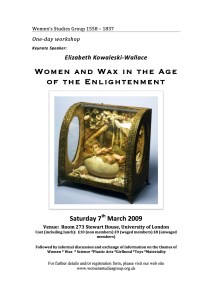
The 2009 WSG workshop poster
Workshop 2009 – ‘The Wax one’
VJ: The purpose of the WSG workshops is to learn from the expertise of the speaker on their chosen subject and then for the attendees to share their own contributions on the theme of the day in the spirit of collaboration. When Sarah and I took on the workshop organisation we kept to this successful format. As I look through my WSG folder it reminds me how productive and interesting these sessions were. In finding contributions for the workshop theme, attendees are required to think differently about their research and, if there are no connections, to look further afield for an example. The results are always surprising. For our second workshop, led by Elizabeth Kowaleski-Wallace, the title was ‘Women and Wax in the Age of the Enlightenment’ (2009). This set a challenge for attendees, and for us to find a suitable and not off-putting picture of ‘women and wax’ for our publicity material! The talk was fascinating and Elizabeth took us on a tour of the cultural significance of wax from its scientific value including anatomical models to the symbolic and literal connections with women with wax dolls. The Group rose to the challenge in finding wax in the eighteenth century and I have an eclectic mix of papers as a result.
The 2010 WSG workshop poster
Workshop 2010 – ‘The one with the animals’
VJ: For me, our 2010 Workshop had the most communal and also special feel; this is partly due to the speaker, Jane Spencer, and how we had the tables set back so that following the talk we could move into a circle. It was wonderful to be able to introduce the woman who had inspired my interest in eighteenth-century women writers with her book The Rise of the Woman Novelistand, later, with whom I had the pleasure of being supervised for my PhD. There was also something about the topic – women and animals – that inspired so many exciting contributions and there was a real energy of interest in the room.
SO: Yes, I too remember that very exciting day, Vicki! This was another of our mad catering ventures, although at this stage, we didn’t have much difficulty in organising it (more later). However, we enhanced the buffet table, as usual, with small vases of flowers and luckily, found some charming animal printed napkins – much to everyone’s amusement.
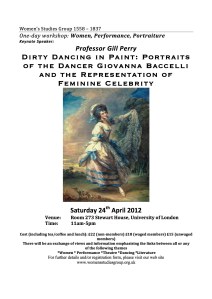
The 2012 WSG workshop poster
2012 Workshop – ‘The one with the catering’
SO: We must have foregone the pleasure of organising the 2011 workshop, but neither Vicki nor I can remember why [Teresa Barnard convened the 2011 workshop, featuring Prof Ann Shteir on ‘Myths of Flora’ – Ed.]. But, for me, the most abiding memory of this 2012 session is our anxiety over the catering at Senate House (of all things). On previous occasions, arrangement for the morning tea and coffee, buffet lunch and afternoon tea had been very easy and it had been handled by the Institute of Germanic and Romance Studies. All we had to do was to ring them, speak to Flo or Angela, order what was needed and they invoiced us.
However, somewhere between 2011 and 2012, this had changed. After many telephone calls to London from Exeter, I finally managed to find out that someone called Chris had taken over the job of dealing with the catering and I wish, on this occasion Vicki, you had offered to take it on! After a dozen attempts I heard a voice on the end of the line who assured me that there was no problem. Chris asked what was required, and in response to my request for an invoice said there was no need. We were to put the cheque under his door when we were leaving!
If that wasn’t enough, the venue had been changed to a room in the bowels of Senate House. On a recce beforehand, I remember our panic as we tried to envisage what we could do if there was no sign of coffee and therefore, of course, there would be no lunch or afternoon tea. As workshops were held on Saturdays, there would also be no one around to ask. We planned to dash to Marks and Spencer for tea, coffee, milk, napkins and armfuls of sausage rolls. We would make the refreshments ourselves by borrowing a kettle and getting water from the bathrooms.
What a relief when the morning of the workshop arrived, and the tea trolley was sitting there complete with a friendly smiling face who assured us that lunch and tea would be taken care of. During a break in the afternoon I wearily mounted the stairs, found the relevant door and gratefully pushed the envelope containing the cheque beneath it. The workshop itself was a resounding success, with an excellent talk by Professor Gill Perry on portraits and female celebrity.
Co-Treasurers
SO: At the AGM on Saturday 5th July 2008 it was announced that as the current Treasurer had been unwell for some time the role had to be re-filled. Not knowing what we were letting ourselves in for, Vicki and I offered to help and were officially appointed. Carolyn, who was safe-guarding the books, was to hand them over to me when we were next in London and a meeting was arranged. I imagined a thin folder, but I’ll never forget the moment when Carolyn D Williams and I met at a bus-stop and she handed two very large, arm-breaking bags filled with ledgers and various papers! No problem; or so I thought as I struggled to take them back to Exeter. When we arrived at our local branch, we were summarily rejected. As far as the Bank was concerned, they had never heard of us and they didn’t want us to bother them! We had chosen a time when the bank had merged with another; the bank was in chaos, and there was a very long line of irate people waiting to get attention besides us. However, we did attempt it again, and this time we were offered an appointment. The previous Treasurer’s Bank was contacted. We signed numerous forms in triplicate. Honour was served and order emerged from chaos.
VJ: We also received and sent emails from members regarding their research interests and publications which Louise Duckling needed for the website. The best part was that members often sent us lovely messages and postcards when submitting their subscriptions.
SO: But all good things come to an end, and when the Committee decided to respond to requests to have subscriptions dealt with by Paypal, we both thought it was time to call it a day. There had been highs and lows in this experience but the best part was being in constant contact with the community of full time academic women as well as independent scholars who, although busy with jobs, family and homes to look after, supported the Women’s Studies Group in all kinds of ways.
VJ: Finding Sarah at a WSG meeting when we were both working through our PhDs set in motion a friendship that would bring us and others together. We had met in the South West before, as we both attended the Symposiums and Conferences held by Exeter and Plymouth Universities, but it is in London that I really remember us securing a connection both intellectually and physically on our shared long train journeys to and from meetings. Fittingly, our first meeting was at a WSG Workshop in 2004, which was on the collaborative and creative intellectual community of the Bluestockings and their legacy, and was led by the excellent scholar Elizabeth Eger ahead of her National Portrait Gallery special exhibition. My tendency to archive means that I still have the delegate list complete with Sarah’s handwritten addition of her personal email address and telephone number.
We continue our Women’s Studies Group connection albeit in rather different places. Sarah is no longer in her flat and I am now living in a 1930s house bordered by Welsh mountains, and the Bristol Channel is now in between us. But, on a clear day you can see across the water to the South West and Sarah and I will in our various ways maintain our engagement in women’s writing as we now intend to try writing together.
SO: Yes, I very much look forward to spending some time in Wales, planning our future collaborative writing. In the meantime, the Book Group continues – sometimes in my tiny house, situated a couple of miles away from my former City Centre flat. However, since I have some Toulouse-Lautrec prints in the sitting room which leads on to a small courtyard garden, my home now suggests Montmartre rather than Morocco.
Thank goodness for WSG, the friends and contacts we made over the years, but most important of all, the memories we share.
Every scholar has had that moment when they’ve wondered if they’re ever going to get their project done, or get their enthusiasm for their subject back, whether it’s because of administrative overload, physical or mental ill health, or precarity. Groups like WSG can form a supportive network to researchers, particularly those who find themselves outside traditional academic structures. In the fourth of our series reflecting on the history of WSG and in honour of our new book Exploring the Lives of Women (Pen & Sword, 2018), Marilyn L. Brooks recounts how WSG has been a resource for her through the years.
I’ve found it extremely interesting and very enjoyable to be given the opportunity to look back over the history of the WSG and its influence on my life and well-being.
I came to academia late as a mature student in my 30s. I must have joined WSG in the mid to late 80s after being encouraged to make contact by Marie Mulvey-Roberts at a BSECS conference. This was my first opportunity to immerse myself in women’s studies. At the time, the period coverage was narrower, starting at 1600, but it firmly included my own specialism of eighteenth-century women’s literature and Mary Hays in particular. Right from the start I found a welcoming and encouraging atmosphere nurtured by the warm support and enthusiasm of Yvonne Noble, Lois Chaber, Mary Waldron and Linda Bree. I was struck by their belief in sharing our interests with others. During my MA studies at Queen Mary College, London, Chris Reid and Isobel Grundy also urged me to become involved in the meetings. I wasn’t able to attend regularly because my work for the Open University took place on Saturdays but those I could get to I found inspiring, not least the chats during the breaks. I was pleased to see that one of my MA students, Marion Durnin, went on to be a committee member.
I gave a paper ‘Mary Hays and “My Struggles to Free Myself”’ in April 1988, which led to a regional Day School in Cambridge two years later called ‘Appropriations of Power’ (with the encouragement and administrative help of Yvonne). Another paper ‘Mary Hays: Reluctant Radical’ was given in 1996. This was followed by a joint (with Nora Crook) centenary conference on Shelley/Wollstonecraft in 1997 in Cambridge which was advertised through our group, with several members attending and offering papers.
In 2000 I had to retire from work through ill health (I had been diagnosed with Bipolar 1 disorder over 40 years ago and my condition was worsening) and, on medical advice, moved to southern France (for the light) so I was unable to come to meetings and I soon started to feel geographically and psychologically isolated (one of the reasons why Yvonne wanted to form the group in the first place). As well as cancelling my subscription to BSECS, Women’s Writing, and Enlightenment and Dissent, I decided that WSG also had no further interest for me so I didn’t renew to that either and dropped off its mailing list. How many times did I say to myself ‘Do I need to know that so-and-so had published such-and-such or that, for example, a BARS conference ‘Women, Money and Markets (1750-1850)’ will take place at Kings College London in May 2017’? Well, yes I did and yes I do. I remember feeling that my isolation (geographical and psychological) was increasing by knowing what I was being excluded from so I thought STOP. I don’t know when I decided how much I missed knowing what was going on in my subject area but after some years I decided to renew my subscription. I was glad to know for instance, that Janet Todd had published Death and the Maidens and Anne Stott had a book out on Hannah More, both of which I later read and enjoyed. I probably wouldn’t have heard of these elsewhere. I’ve noticed a very impressive progression from quite basic/rudimentary information to a sophisticated notice board giving dates on events and access to essential databases such as the Orlando projectled by WSG member Isobel Grundy.
Would I go up to the Foundling Museum if I could? Well yes I would. Workshops to which participants are asked to bring a 5-minute contribution shows the Group’s commitment to inclusion and participation especially relevant to newcomers. I saw that one recent workshop was advertised as offering discussion and conviviality, both of which are always guaranteed.
At times I’ve thought I can’t attend meetings therefore I’m not a real member. But of course I am. After rejoining I’ve felt that badly-needed intellectual support through the mailing list, sometimes two or more items arriving in a day.
The publications I thought I’d lost interest in after early retirement actually became central to my life here – a way of connecting. A major resource has been the members’ interests list. Scrolling down it I found Susan Purdie and Sarah Oliver shared my interest in William Frend and their article on his relationship with Mary Hays gave me a badly needed boost and being in touch has been a great boost to me. We’ve been lucky to have this extensive resource of members’ interests eg 4 Sep 2016 Judith Hawley asked for help with her work on Joanna Baillie and I am sure she got it. I was also asked for advice regarding a forthcoming viva on Mary Hays and was glad to offer some.
I have to admit that the frequent receipt of notices of events sometimes seemed to reinforce my feelings of isolation from the academic world but latterly I came to see this as a badly needed lifeline. I’ve found myself carefully reading the extensive synopses before each group meeting as if I could almost feel that I was going to attend. I like to know what’s going on and thus feel included. Do I need to know that our workshop on seventeenth-century portraits of women will take place on 6 May 2017 at the Foundling Museum? Well, yes I do! And maybe I’ll be able to come.
The format has become more and more sophisticated over the years and we must applaud the contribution made voluntarily by members. The coverage is impressive and a respected outlet for other sources e.g. BARS, academic blogs, outings, cfps, etc.
I should say that suffering from my worsening bipolar illness has fed this isolation even more by removing any input I would have liked to make. This is where the notifications have given me hope that my interests can resurface. In fact, due largely to the circle I find myself in I am silently encouraged to pursue my research on William Frend even though it looks very unlikely that it will come to completion. I’ve had to accept that some things are no longer possible but that I can still get enjoyment out of them. I’ve felt nurtured by interest in my work outside a competitive forum. The Group has unknowingly given me the courage to carry on.
I think this is due to the nurturing support of the WSG. Thank you Yvonne for the vision and thank you all for fulfilling it.
WSG is pleased to announce an extraordinary summer seminar, exploring the relationship between history and the imagination, creativity and research.
Creative Summer Seminar, Saturday 17 August, 2019. Chair: TBC Sara Read: The Gossips’ Choice: Drawing on the Case Notes of Midwife Sarah Stone in Historical Fiction Kim Sherwood: Creative Writing Research and the Eighteenth Century Caroline Douglas: Spectre of a Woman
Seminars take place at the Foundling Museum, 40 Brunswick Square, WC1N 1AZ, starting promptly at 1pm and finishing at 4pm. Doors open at 12.30. The Foundling is a wheelchair accessible venue, and directions for getting to the Museum can be found here, including those for the visually impaired. All seminars are free and open to the public, though refreshments will cost £2 to those who aren’t WSG members. Those attending the seminars are welcome to look round the museum before or after.
Established in the 1980s, the Women’s Studies Group 1558-1837 is an informal, multidisciplinary group which promotes in the study of women and gender in the early modern period and long eighteenth century. The group enables members to keep in touch, to hear about one another’s research and publications, and to meet regularly to discuss relevant topics, including at regular weekend seminars and an annual workshop at the Foundling Museum. We can offer advice and opportunities to engage in activities that increase opportunities for publication, or enhance professional profiles in other ways.
For our 2019-20 seminars, we invite papers related to any aspect of women’s and gender studies: not only women writers, but any activity of a woman or women in the period of our concern, or anything that affects or is affected by women in this period, such as the law, religion, etc. Papers tackling aspects of women’s studies within or alongside the wider histories of gender and sexuality are particularly welcome. We would also welcome how-to presentations for discussion: examples of suitable topics would include, but are not limited to, applying for grants, setting up research networks, becoming a curator, co-authorship, using specialised data, and writing about images. Papers should be about 20-25 minutes. The closing date for applications is 20 May 2019.
The seminar dates are:
Saturday 21 September, 2019, 1-4pm
Saturday 23 November, 2019, 1-4pm
Saturday 18 January, 2020, 1-4pm
Saturday 21 March, 2020, 1-4pm
The full address for the Foundling Museum is 40 Brunswick Square, London, WC1N 1AZ. It is a wheelchair accessible venue and there are further access directions including directions for partially-sighted visitors here. We are allowed into the room at 12.30pm to give us time to sort out paperwork and technology, but sessions will run from 1-4pm. So please arrive a little early if you can.
The WSG is open to women, men and non-binary people, students, faculty, and independent scholars, all of whom are invited to join our group and to give papers.


 Women's Studies Group 1558 - 1837