Book Review: The Gossips’ Choice. By Sara Read. Wild Pressed Books. 2020. Pp 296. £12 (paperback), ISBN 978-1-916-4896-8-4. Reviewed by Rebecca Simpson

‘That’s the thing, mother. The journals got me thinking. I know you use them to help you teach. But think how many more midwives would learn from you if we made them fit for printing. I’ve published several guides to women’s health, but nothing like this, and you’d be writing from life, not other books. Think about it, mother: you’d be the first English woman to write a midwifery guide. It could make your fortune!’ (p.82)

Lucie Smith, the protagonist of Sara Read’s debut novel, chooses not to listen to the urging of her son, Simon, and retains her extensive journals for her personal private use. The journals, which comprise of detailed notes on cases from thirty years of midwifery practice, are a document of women’s secrets, and their author chooses to keep them from the eyes of the public. As Lucie herself remarks, few midwives in the seventeenth century would have either the inclination, or the literacy, to keep such detailed and valuable notes. It is unsurprising then, that many of Lucie’s remedies, and the advice she gives to her patients, are drawn from the work of Jane Sharp, who in 1671 actually became the first English woman to publish a midwifery guide, The Midwives Book: Or the Whole Art of Midwifery Discovered.

Lucie Smith’s story begins in a bedchamber at Calstone Manor, where she has just safely delivered a young woman of her first child. Privately, Lucie believes that the new mother, sixteen-year old Lady Eleanor Calstone, is too young to be having children, and disapproves that the aristocratic Calstones have hired an expensive London doctor to oversee the delivery. It is clear that the circumstances of the opening chapter are not typical of Lucie’s practice – she is more familiar with delivering the babies of the wives of farmers, weavers and local aldermen, and she is certainly unused to the presence of men in the birth chamber. However, Lucie takes seriously her oath as a midwife to not turn away a patient, and throughout the novel attends to the needs of labouring women, no matter their class, occupation, or circumstances.

The Gossips’ Choice depicts Lucie’s day-to-day existence as the most respected and in-demand midwife for the market-town of Tupingham, and surrounding area. Much of the novel is occupied with individual cases drawn from the works of Jane Sharp, and the eighteenth-century midwife Sarah Stone, who also published a midwifery guide. Should Lucie have followed her son’s urgings and published her own journals, we might have expected them to resemble Stone’s A Complete Practice of Midwifery (1737), which consists chiefly of annotated case studies, much like those Lucie uses to train her apprentice, Mary. Like Stone, Lucie Smith is married to an apothecary and is frequently called to intervene when less accomplished midwives, like the unlicensed hand-woman Mother Henshaw, risk losing their patients through malpractice. It is in the description of these many deliveries that Read’s extensive knowledge of birthing practices, and the lives of women in the seventeenth century, shine most strongly.

A number of separate storylines interweave throughout the novel, including: the fractious relationship between Lucie’s husband and their son Simon, a printer living in London; the ongoing rivalry between Lucie and Mother Henshaw; a clandestine relationship between the Smith’s maid Martha and a local widower; and finally the repercussions of a tragedy that occurs in one of Lucie’s cases. Although the events of The Gossips’ Choice are fictitious, the novel is richly informed by Read’s extensive work in the field of seventeenth-century medicine and reproduction. Here, she has skilfully blended anecdotes and cases drawn from the real work of early modern midwives, with an engaging story that explores the experiences of women across several social classes and stages of life. At times the novel feels slightly imbalanced between the narratives of Lucie’s cases, and the overarching plotlines which are concentrated largely in the second half. This does have an effect on the novel’s pacing, and its conclusion appears somewhat suddenly. However, Lucie Smith is a wonderfully rounded character whose expertise and authority shine through the text, and her charisma buoys forward the narrative.

Post-Restoration tensions in England are demonstrated through the interwoven connections between the Smith and Calstone families. The Calstones are newly elevated to the aristocracy for their support of Charles II, whereas the local townsfolk of Tupingham, and the Smith family in particular, are Parliamentary sympathisers and secretly hope for a return to the days of the Protectorate. These ideological differences are set against the friendships that develop between Lucie and Simon with various members of the wider Calstone family, and are complicated by the pervading presence of the conflict’s aftermath: in the wounded war veterans that linger on the edge of both the town and the narrative, and in Martha’s pervading spinsterhood – her fiancé having been killed fighting Prince Rupert’s army. The novel is also set against the events of the Great Plague of 1665, and the themes of quarantine, contagion, and the fear of disease are especially topical and poignant given its publication in May 2020 at the height of the COVID-19 pandemic.

The Gossips’ Choice largely avoids the debates surrounding man-midwifery that dominate eighteenth-century discussions of midwifery and women’s healthcare. Aside from the appearance of the arrogant London doctor in the first chapter, the pregnant women in Tupingham are all attended to by other women, save for the occasional appearance of a male surgeon. As readers we are invited into a world in which pregnancy and birth are the exclusive domain of women, and Lucie works hard to maintain ‘the female-only space that was proper’ (p.10). Indeed, it is the ritualistic aspects of childbirth, including the gossips (female friends invited to be present at a birth) that give the novel its title, as Lucie’s extensive knowledge and successful record in delivering babies makes her the first-choice midwife of the local gossips.

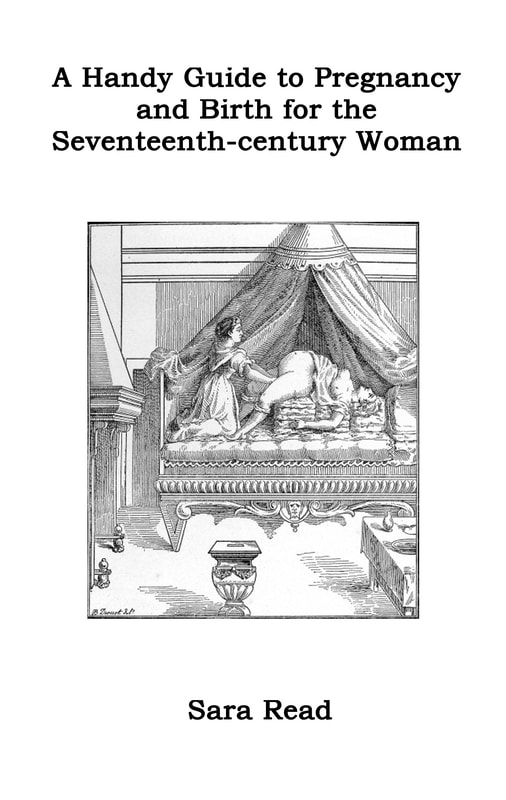
Read has also written a companion pamphlet, A Handy Guide to Pregnancy and Birth for the Seventeenth-century Woman, also by Wild Pressed Books (full details below), which serves as a primer for the medical world of The Gossips’ Choice. Also drawn largely from Jane Sharp’s work, the guide modernises much of the antiquated language of Sharp’s book, and serves as a sort of introduction to the knowledge seventeenth-century gossips might acquire from their own tenure as birth attendants and mothers.

Handy Guide to Pregnancy and Birth for the Seventeenth-century Woman by Sara Read

Framed as a tool for the unfortunate time traveller (the back cover tells us that this guide will tell you all you need to know ‘should you find yourself unexpectedly in the seventeenth century’) the guide is a light-hearted pastiche of the slew of pregnancy books available to modern readers. With sections detailing how to tell if you are pregnant, how to determine whether infertility is the fault of husband or wife, instructions for antenatal care, and an explanation of the ritual of ‘churching’, A Handy Guide to Pregnancy and Birth for the Seventeenth-century Woman unveils some of the secrets of womanhood that Lucie Smith wished so desperately to keep from the press.

The attention to detail in both A Handy Guide to Pregnancy and Birth for the Seventeenth-century Woman, and The Gossips’ Choice, will delight any readers familiar with the medical world of seventeenth-century women, whilst also offering an excellent and accessible introduction for newcomers and popular readership.

Rebecca Simpson

University of York

Rebecca is a PhD student at the University of York. Her research explores representations of pregnancy and birth in the literature and medicine of the long-eighteenth century, and she is particularly interested in the literary output of midwives and female medical practitioners.

*Disclosure: Sara Read is a member of the Women’s Studies Group 1558–1837.

The Gossips’ Choice and the Handy Guide are available from Wild Pressed Books.

A Handy Guide to Pregnancy and Birth for the Seventeenth-century Woman. By Sara Read. Wild Pressed Books. 2019. Pp 17. £4.50 (pamphlet)

Review: Early Modern Female Book Ownership. Edited by Mark Empey, Sarah Lindenbaum, Tara Lyons, Erin McCarthy, Micheline White, Georgianna Ziegler, and Martine van Elk. Reviewed by Valerie Schutte

Early Modern Female Book Ownership is a website dedicated to individual books that can be traced to female owners from 1500 to 1750. On the home page, immediately under the blog title, is the hashtag #HerBook, which the editors want site visitors to use when discussing or mentioning the blog. They often refer blog users to their Twitter page for up-to-date information about their project or to reach out with suggestions.

The main menu for the website has four tabs: Home, About this Blog, Resources, and Finding Aid. The home page is where all of the blog posts appear, one after the next, making the home page incredibly long, as the earliest blog post dates to 3 December 2018. According to this first blog post, which serves as a welcome to the website, the project is designed to showcase short posts of books owned by early modern women featuring an inscription by that woman. The blog features mostly English entries, but would like to include others. Blog posts are typically short, no more than 1,000 words, and are accompanied by pictures of the title page of the book owned by a woman and of her inscription or signature. The pictures appear to have been taken by those writing the blog post, not stock images from the internet or Creative Commons.

On the right side of the home page is both a search tool and a list of categories. In selecting a category, only the books tied to that category are shown on the home page, such as sixteenth century, seventeenth century, Dutch, and drama. There are 24 categories to choose from. However, even when you select a category, the blog posts still appear in the order in which they were posted to the blog and one right after the next on the home page. There is no way for further filtering, unless you only use the search function to look for a specific book or female book owner.

Under the About this Blog tab, the blog editors explain the purpose of the blog and welcome guest posts from scholars, collectors, and students. They hope to contribute to the study of female book ownership by offering examples of female owned books and how women showcased their ownership.

Under the Resources tab, there is a brief bibliography of books, articles, websites, and other blogs that are about women book owners and readers, which is incredibly helpful for further research on the subject. This list is far from inclusive and many of the books and articles mentioned are those by the blog editors.

Under the Finding Aid tab, they offer a list of the books and female book owners for which they have blog posts. They suggest researchers scan this list for patterns and to find specific blog posts quickly, as within the list all of the book titles are hyperlinked to the relevant blog post. This page should perhaps be the home page, in that it is much easier to scan for a specific female book owner or book, while the home page is overwhelming with information and pictures.

Overall, the blog is very useful and offers researchers and people interested in early modern books with short posts of information that they can follow up on for themselves. Most useful are the photos of the inscriptions, which are often not included in book and journal essays on the subject and allow for inscription comparison over time, and as the blog develops, across borders.

Valerie Schutte

Independent Scholar

Valerie Schutte is author or editor of several books on Tudor monarchs and their books, Shakespeare, and Queen Mary I. She is currently writing the first academic biography of Anne of Cleves.

_______________________________________________

Early Modern Female Book Ownership. Edited by Mark Empey, Sarah Lindenbaum, Tara Lyons, Erin McCarthy, Micheline White, Georgianna Ziegler, and Martine van Elk. https://earlymodernfemalebookownership.wordpress.com/. Accessed 15 July 2020.

WSG seminar series 2020-21

The Women’s Studies Group 1558-1837 is pleased to announce the speakers for their seminar series 2020-21. All meetings will start promptly at 1pm BST/GMT* (with arrivals from 12.30 onward to allow for necessary preparations and administration). We aim to finish by 3.30pm.

Please be aware, you must be a member of the WSG to gain access to the Zoom sessions. The links are distributed through our WSG mailing list 24-hours before the event. Becoming a member means you will be able to attend the Zoom and in-person seminars for the 2020-2021 season.

***

September 19, 2020*
Stephen Spiess: Reading Strumpets: Thomas Heywood, Sexual Epistemology, and the Making of English Whoredom
Sonia Villegas Lopez: Female Libertinism in Gabriel de Brémond’s Transnational Oriental Fictions.
Anthony Walker-Cook: Descending into the Underworld with Mary Leapor and Sarah Fielding.

November 21, 2020
Rocio Martinez: To defend a princess’s rights to her father’s throne: Maria Theresia of Austria and the protestations against her renunciation of the inheritance of the Spanish Monarchy.
Avleen Grewal: Vathek: Gaze, Disorientations and Policing Identity.
Eva Lippold: Marriage and Magic Swords: Mariana Starke’s Factual Fairytale.

December 5, 2020
Daniel Beaumont: Melancholy and Despair among Early Modern English Women: A case study of Hannah Allen’s Satan’s Methods and Malice Baffled (1683).
Yvonne Noble: Elizabeth Elstob, Mary Delany, and Money.
Valerie Schutte: Popular Literature at the Accession of Queen Mary.

January 23, 2021
Megan Shaw: Looking towards a cultural history of Katherine Villiers, Duchess of Buckingham (1603-1649).
Gillian Beattie-Smith: Catherine Helen Spence: a consideration of her feminist and transnational agency.
Kate Stephenson: Lawyers, Débardeuses and Pages; Women Masquerading as Men.

February 20, 2021
Sarah Ailwood: ‘In justice to myself’: Legal and Textual Subjectivities in Eighteenth-Century Women’s Memoirs.
Daisy Winter: “I who am but dust”: mortal fear in Elizabeth Delaval’s ‘Memoirs and Meditations’.
Valentina Aparicio: Maria Graham’s Journal of a residence in Chile (1824): a transnational community of women.

March 20, 2021                                                                                                                       Cheryll Duncan: ‘Much want of judgment’: new evidence concerning the singer Jane Barbier.
Maria Clara Pivate Biajoli: Understanding Current Readers’ Reception of Jane Austen through Fan Fiction.                                                                                              Miriam al Jamil: The Grand Duchess of Tuscany’s Birth Days: Weary and Waiting at the Florentine Court.

April 17, 2021*

Julie Vig: Women and martiality in the Sikh literature of early modern Punjab.
Francesca Saggini: ‘From St Martin’s Street to “Camilla Cottage.” Frances Burney’s Houses between Fact and Fantasy.’

Anna Jamieson: “Comforts in her Calamity”: Dorothea Fellowes’s Shopping and Spending in the late Eighteenth-Century Private Madhouse.

*Please note that the September and April meetings are BST, and the rest are GMT.

For further information including abstracts, see our seminars page, or contact the organiser Carolyn D. Williams.  To join the WSG, see our membership page.

The Women’s Studies Group (1558-1837) CALL FOR PAPERS 2020-2021 SEASON

The Women’s Studies Group (1558-1837) are please to announce our call for papers for the 2020-21 season is now live. Please consider presenting at one of the WSG seminars. Further details are below and on our website:

The WSG is open to men, women and non-binary people, students, faculty and independent scholars. We invite members old and new to offer papers formal and informal, as well as works-in-progress, on any topic related to early modern and long eighteenth-century women’s and gender studies, including (but not restricted to) history, literature, art, medicine, music, theatre, religion, economics, and sexuality.  Early career and independent scholars are particularly welcome. Since we usually have 3 or 4 papers in a session, papers should be restricted to a maximum of 20-25 minutes, to allow plenty of time for general discussion afterwards.

All meetings for the 2020-2021 season will start promptly at 1pm GMT (with arrivals from 12.30 onward to allow for necessary preparations and administration). We aim to finish by 3.30pm.

The dates are as follows:

Saturday 19 September 2020*

Saturday 5 December 2020

Saturday 23 January 2021

Saturday 20 March 2021

*Please note that the September meeting is British Summer Time, and the rest are GMT.

Our seminars usually take place at the Foundling Museum, 40 Brunswick Square, London, WC1N 1AZ. For the 2020-2021 season, however, the first two sessions, in September and December 2020, will be delivered on Zoom. Zoom will also be used for the last two sessions, in January and March 2021, though these may also be accompanied by meetings at the Foundling.

For more information about the society and its activities, including how to join, please see our website at https://womensstudiesgroup.org

Please reply by 17/7/2020 to Carolyn D. Williams at cdwilliamslyle@aol.com 

Great explorations: a fictional midwife and fictions of ideal women by Louise Duckling

Following on from the arrival of WSG’s anniversary volume in paperback format, Louise Duckling introduces new books launched by two of its contributors: Sara Read and Tabitha Kenlon.

_________________________________________________________ 

On an autumnal evening last September, a small crowd gathered at Harris & Harris Books in Clare, Suffolk, for one of its popular Author on the Stairs events. Gillian Williamson and I had been invited to talk about WSG’s anniversary book, Exploring the Lives of Women, 1558–1837, which had recently been released in paperback format.

As one of the book’s editors, I wanted to convey the scope and originality of our authors’ contributions in my talk. Therefore, I chose to address the question: why had so many of the women featured in the book been left out of the historical record? I considered how women’s history was constructed (and gendered) in Victorian biographical dictionaries, using our ‘bookend’ queens Elizabeth I and Victoria as opening case studies, before introducing some of the women whose lives are explored in our anniversary volume.

This approach led neatly into Gillian’s talk about her chapter on the Gentleman’s Magazine. Gillian eloquently described how the magazine constructed ideas of gender in the eighteenth century, specifically referencing the emergence of obituaries in its pages. The obituaries were used by Gillian (with some brilliant flashes of humour) to show how femininity was framed in the Gentleman’s Magazine, while also providing glimpses of a less-neatly gendered society.

There was an opportunity for the audience to ask questions and handle some of our original source material – an 1866 edition of a female biographical dictionary and an early volume of the Gentleman’s Magazine­. We enjoyed lively discussion and hospitality, in the perfect setting of an independent bookshop. Reflecting on this evening, in such an intimate and sociable environment, it is clear we were very fortunate. For anyone releasing a book right now, any ‘in-person’ events or celebrations will have to wait. This is exactly the case for two of our book’s contributors, whose latest work has been published during the lockdown.

The first of these new books is by Dr Sara Read, who specialises in cultural and literary representations of women, reproduction and medicine in the early modern period. Sara played a pivotal role in the WSG book, serving as both co-editor and contributor, with her chapter focusing on The Countesse of Lincolnes Nurserie (1622) by Elizabeth Clinton and highlighting views around childcare and breastfeeding. In her latest work, Sara continues to draw upon this rich subject knowledge, while venturing into new territory: the genre of historical fiction.

In her excellent debut novel, The Gossips’ Choice, Sara has created an atmospheric world for her protagonist, the midwife Lucie Smith. The book has been described as a seventeenth-century version of ‘Call the Midwife’, as we follow Lucie’s cases during the plague year of 1665. It is a beautifully crafted and impeccably researched novel, drawing upon a wide range of historical sources. For example, some of the events in the book are inspired by A Complete Practice of Midwifery (1737), the memoir of midwife Sarah Stone. This approach provides authentic detail to a vividly imagined and compelling story.

The second new book release is by Dr Tabitha Kenlon. Tabitha’s research concentrates on eighteenth-century British novels, theatre, and conduct manuals. In Exploring the Lives of Women, Tabitha’s chapter provides a close reading of a single text, exposing the confused rhetoric in the cautionary pamphlet Advice to Unmarried Women (1791) written by an anonymous clergyman. Tabitha also contributed one of the two poems in our book, ‘Gretchen’s Answer’, which follows similar themes by exploring the consequences of “when society tells women how to think, how to act, how to feel” (Exploring, p. 98).

Tabitha’s first monograph continues this investigation. In Conduct Books and the History of the Ideal Woman, Tabitha shows how the longest-running war is the battle over how women should behave. This is an exceptional study, being the first of its kind to provide a trans-historical approach: expanding upon previous period-specific studies, Tabitha considers the persistence (or alteration) of the female ideal over six centuries. Tabitha’s brilliant close readings of a wide range of texts are superbly executed and entertaining, making the book highly accessible to the specialist or general reader. It is a powerful book, written with compassion and flashes of anger, in an elegant and witty prose.

Until we can all meet to celebrate, congratulations to Sara and Tabitha for producing two great books. Full reviews of both publications will appear on this website in the coming months: watch this space!

____________________________________________

The Gossips’ Choice by Sara Read is published by Wild Pressed Books for £12.

Conduct Books and the History of the Ideal Woman by Tabitha Kenlon is published by Anthem Press for £80 (hardback) and £25 (ebook). Please ask your institutional library to buy a copy. A 20% discount is available to WSG members.

Exploring the Lives of Women, 1558–1837, the anniversary book by WSG, is published by Pen & Sword Books for £19.99 (hardback), £12.99 (paperback) and £5.20 (ebook).

Please support your local independent booksellers if you can. Harris & Harris Books is currently offering a delivery service.