Review: Special seminar with Merry Wiesner-Hanks, February 13, 2025, Review by Louise Duckling

We were delighted to welcome distinguished Professor Emerita Merry Wiesner-Hanks as a special guest to discuss her new book Women and the Reformations: A Global History.

O’Rourke, Simon; Susanna Wesley (1669-1742), Mother of Methodism; ; http://www.artuk.org/artworks/susanna-wesley-16691742-mother-of-methodism-323273

The seminar began with a 30-minute presentation outlining the book’s structure and introducing us to some of the incredible women within its pages. Professor Wiesner-Hanks explained how the idea for the book emerged in response to the Luther 500 celebrations in 2017. These celebrations did not truly reflect the new scholarship on women that had emerged in Reformation Studies in the previous decades. Women and the Reformations aims tofill that gap for a general audience.

Our attention was drawn to the plural in the title: this is a work about Reformations, Catholic and Protestant, with women from both sides appearing in every chapter. The motivation is to draw parallels and comparisons, rather than organise the material in a ‘predictable’ way. The text is therefore structured by the type of women that are featured: monarchs, mothers, migrants, martyrs, mystics, and missionaries.

The historical, geographical, and thematic scope of the book is impressive. The content will not be covered in detail here, as a full book review is planned for a later post. In the meantime, we will share some fascinating insights from the seminar.

Most strikingly, it is worth noting there are 258 named individuals in the book. Some of them are very young – and they were taken very seriously in their time – and some are very old. Some are well-known, such as Teresa of Avila, and others are recently discovered.

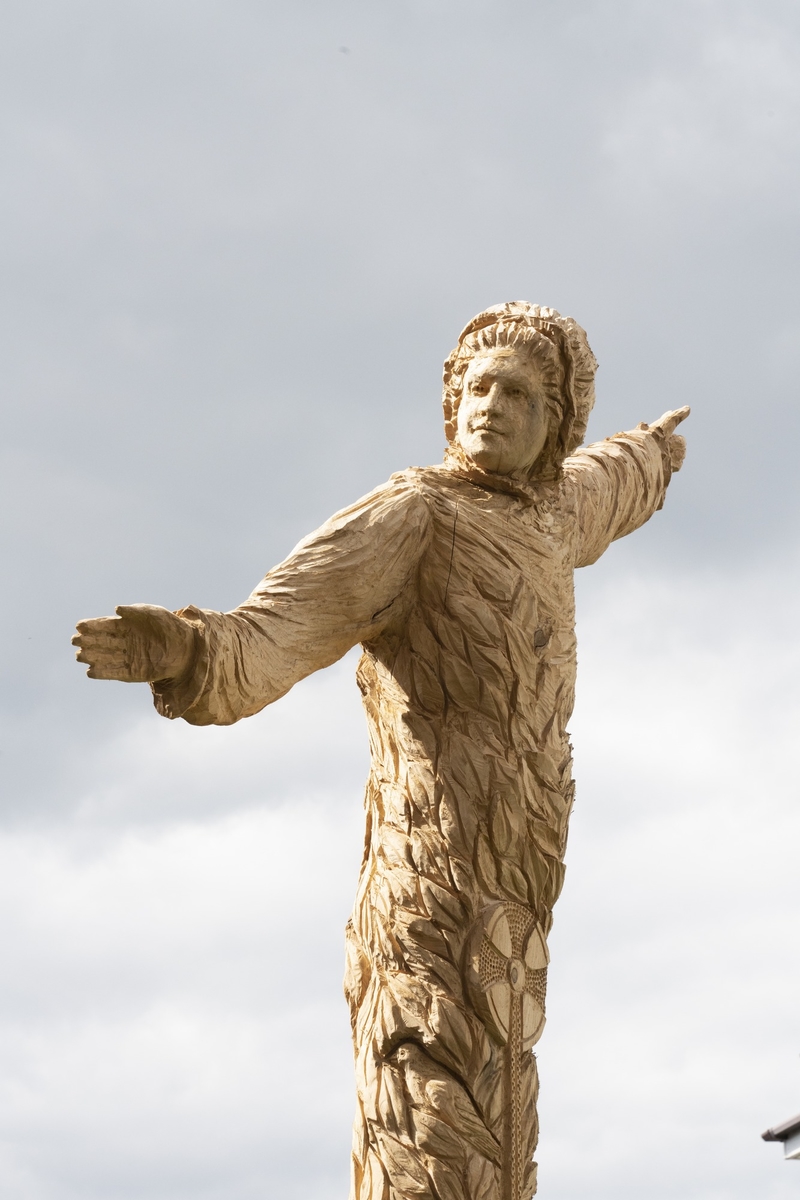
Professor Wiesner-Hanks’ presentation gave a very clear sense of how ordinary people might encounter these women today, through memorials, statues, and material culture. A striking example is the sculpture of Susanna Wesley (1669–1742) by Simon O’Rourke, carved from the remains of a Cypress tree in East Finchley Methodist Churchyard.  

Another significant feature of the book is the fact it is a global history. A woman from outside Europe is featured in each chapter. For example, among others, we heard about the African visionary, Kimpa Vita; the Ethiopian abbess and saint, Walatta Petros; the Peruvian mystic, Rose of Lima; and Japanese and Korean martyrs.

In the questions, we enjoyed a lively discussion on women’s agency, early modern patriarchy, and Allyson M. Poska’s case for “agentic gender norms”. Women were right at the centre of every different exchange at this time, actively breaking these gender norms. There were so many female networks in this period, and a surprising number of women rulers who exercised power: this is essentially a book about women’s agency.

Another important strand to the conversation was around writing craft: how can we communicate ideas in an accessible way for a wider audience? Professor Wiesner-Hanks shared some tips, ideas, and her enthusiasm for writing a trade book, covering elements from writing style to selection of material. This was a practical and inspirational way to close the session. We hope to hold similar events in the future.

Our thanks to Merry Wiesner-Hanks and the team at Yale University Press, as well as our chair Valerie Schutte, for making this seminar possible.

Captions:

Susanna Wesley (1669–1742), Mother of Methodism. By Simon O’Rourke.

© the artist. Image credit: Nick Bowman / Art UK.

WSG Seminars Reminder and Review

WSG Seminar Reminder

Thursday 6 February, 2025 – ZOOM

STARTING 6.45 FOR 7 PM, FINISHING AT 8.30 PM, GREENWICH MEAN TIME

Chair: Valerie Schutte
Host: Gillian Williamson

Dra. Pilar Botías Domínguez: ‘‘Masquerading! a lewd custom to debauch our youth’’: compliance and defiance in Aphra Behn’s The Rover (1677).

Charlotte MacKenzie: Women and knowledge making communities in Georgian Cornwall.

*NOTE – The scheduled paper by Amy Solomons and Elizabeth Ingham (on the library of Lady Mary Wortley Montagu) will now be featured in our 2025-2026 seminar season.

The seminar will take place on Zoom. Please be aware, you must be a member of the WSG to gain access to the Zoom sessions. The links are distributed through our WSG mailing list 24-hours before the event.

For further information, please see our seminars page.  To join the WSG, please see our membership page.

Review: WSG Seminar, Thursday 16 January, 2025 – ZOOM

Chair: Valerie Schutte
Host: Megumi Ohsumi

Speakers:

Jasmin Bieber: Unprecedented Paths Beyond Europe: British Women’s Travel Writing 1680-1780.

Chandni (Anjali) Rampersad: Female Genius In Memoriam: Women Writers’ Afterlife in the Gentleman’s Magazine (1731-1806).

Rosalyn Sklar: Healing women: Early modern women as healers in their own texts, practices and representations.

The 16th of January marked the first WSG seminar of 2025. The three speakers all presented portions of their PhD thesis research. Jasmin Bieber presented on eighteenth century women travelers, discussing women as authors of travel narratives meant for publication. In her project, she considers ideas such as gender, genre, mobility, and public versus private spheres. Rosalyn Sklar presented on early modern women in the medical sector. She pointed out the commonality of the presence of women in the sick chamber, even though they tended to be dismissed as non-medical personnel. In her larger research, she is interested not only in evidence of women’s participation in medical practices, but also how they wrote about it, and how it was written about by others. Chandni Rampersad presented on the visibility of female genius, especially through the lens of the Gentleman’s Magazine. She argued that understandings of female genius were riddled with eighteenth century moral ideals. Often, women were pitted against one another in the magazine.

We had time for about seventeen minutes of questions, which resulted in a lively discussion around women functioning in male spheres. As pointed out by Gillian, the three papers all considered the terms in which women were able to enter into and operate in male spaces, and the extent to which their actions were controlled by men. As each of the speakers suggested, women in the late-seventeenth and eighteenth centuries had to negotiate their roles in the public sphere, while considering practices, terms, and titles designed for male virtues or male execution. These ideas are sure to be considered further in the next WSG seminar on 6th February, where we will have three exciting papers on women writers, readers, and knowledge makers. 

~ Valerie Schutte

The Art of the Actress: Fashioning Identities. By Laura Engel. Review by Victoria Joule

The Art of the Actress: Fashioning Identities. By Laura Engel. Cambridge: Cambridge University Press. 2024. Pp 78. £17.00 paperback), ISBN 9781108977906.

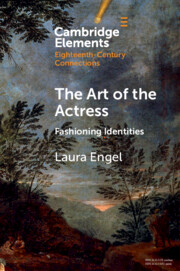
The cover image of Laura Engel’s The Art of the Actress is not of an eighteenth-century actress, but instead features the moody tones of Donato Creti’s Astronomical Observations: Comet (1711). Although not discussed within the book – indeed, Engel may not have chosen the image – the significance is clear. Set against darkening skies, the glowing comet shines out much like the actresses discussed in the text; their dazzling images and performances are moments in history that artists and actress-artists alike attempted to capture in solid form for posterity. In this book, Engel offers the reader a visually and intellectually stimulating insight into the literary, cultural and material legacy of the actress. The Art of the Actress is part of Cambridge Elements: an extensive collection of shorter academic works covering a wide range of disciplines. Engel’s work is published within the Eighteenth-Century Connections series that explores ‘connections between verbal and visual texts and the people, networks, cultures and places’ with attention to ‘oral, written and visual media’. Cambridge Elements can be purchased as affordable print or electronic editions, and some are also open access.

The paperback version of Engel’s book is about the size of a journal but lighter and softer to handle, and the cover image is beautifully reproduced. The text is divided into four parts: part one concentrates on the use of pearls in portraiture; part two is on the relationship between artist and actress; part three focuses on another material object – a muff; and part four cleverly reads the style of ‘unfinished’ art against the in/ability to capture the actress’s image. Engel effectively selects specific material objects and specific actresses to provide ‘a visual exhibition highlighting the representations, creative works, collaborations, and experiences of both well-established and lesser-known performers’ (3) in the eighteenth century. In Engel’s terms, ‘The “art” of the actress thus refers to the actress represented in art, as well as the actress’s labor and skill in making art ephemerally through performance and tangibly through objects’ (2). Throughout the study, Engel highlights the fascinating web of theatrical connections between artists and actresses, demonstrating how ‘women fashioned their identities on- and offstage, as well as how audiences perceived women in the public sphere through theatrical lenses’ (3–4).

Part one immediately establishes Engel’s aims using a piece of jewellery to observe the complex history it brings to different visual portrayals. A string of pearls can tell a story about the actress and her infiltration into the higher echelons of society, but it also conveys the pearls’ murky history in terms of slavery; furthermore, ideas about beauty and competing metaphors of virginity and sexuality show the actress’s ‘[occupation of a] precarious and significant place in the early modern world’ (18). The section concludes with a concise but fascinating examination of pearls as stage accessory in portraits of actresses, providing links between the parts they and others played.

Part two develops the concept of the actress as artist/artist as actress. With a focus on Anne Damer (amateur actress and sculptor) and Angelica Kauffman (artist), Engel demonstrates how involvement in acting had an impact on their representations of women. Engel provides an expansive backstory to a selection of portraits showing how Damer and Kauffman’s private and public lives, as well as public theatre and private theatricals – and even specific performances, costumes and contemporary fashions – fed into their artistic creations. Damer, present in the public eye as an actress, sculptor, and quite a character with her ‘dazzling, over-the-top costumes’ (38), was inevitably subject to satiric attacks. Engel provides an empowering reading of the ongoing presence of these women’s work in museums and galleries as testimony to their valuable contributions to the arts.

The penultimate section focusses on one figure and an emblematic object: Mary Anne Clarke and her strategically held muff. Clarke appeared with a huge white muff at the scandalous court case concerning her selling of army commissions to fund decoration of the house given to her by her lover, the Duke of York. Taking theory and knowledge of actresses’ self-fashioning and their contemporary reception and portrayal, Engel reads the subsequent images of Clarke in comparable ways: ‘Although Clarke was not an actress on the stage, her theatrical maneuvering and publicity stunts established her as a performer to be reckoned with’ (48). The validity of this approach is reinforced by the section on Thomas Rowlandson’s collection of prints featuring Clarke and actress Dorothy Jordan, in which Engel persuasively highlights connections between the satirical portrayals of the two women. Engel concludes with a more uplifting comment on Clarke’s later attempt to control her image through neo-classical sculpture.

To conclude, Engel effectively examines the transitory nature of performance by turning to ‘unfinished’ artwork. Engel uses a selection of Sir Thomas Lawrence’s unfinished portraits to show how they ‘are inextricably tied to the theater, an art form that is by definition fleeting, ephemeral, and open-ended’ (63). Again, Engel reveals the intricate web of theatrical connections behind and feeding into artistic works. The unfinished portraits are of the actress and playwright Elizabeth Inchbald, and of Lady Cahir who performed with Lawrence in one of Inchbald’s plays at a private theatrical. Engel extends the reading of theatrical influences on portraiture to a brief analysis of other portraits. One is ‘almost too finished’ (68) compared to the others: ‘these portraits are alive because they are not done yet’ (65).

One lasting impression this condensed book gives is just how theatrically infused culture was in the eighteenth century. Because of the impressive scope of Engel’s work in exploring the connections and conversations between artists and actresses, visual art, performances and more, there is less space at times to delve into detailed analysis and deepening of concepts, such as how the eighteenth-century actress ‘is central to understanding unfolding anxieties about nation, race, gender and heteronormativity’ (4). For example, the ‘unexpected analogy’ between an enslaved (female) child and duchess (in Duchess of Portsmouth with an Unknown Female Attendant) could be developed further using broader post-colonial studies, particularly in relation to the subsequent portrait of Nell Gwyn (with black male slave) which Engel presents as an echo (17). Sometimes the cruder, more explicit aspects of the material are left unsaid: for example, we can consider exactly how Gwyn is (erotically) ‘making’ (or stuffing or washing?) sausages and how Clarke’s muff (like Sophia Western’s in Tom Jones)is representative of female genitalia. These kinds of questions, however, also point to the effectiveness of Engel’s style, which encourages an interactive engagement. Engel often poses questions or makes references to online reproductions of portraits for readers to follow up in addition to the extensive range she discusses. I found myself setting up another device to look at these images while reading this book. I can imagine students and scholars alike being inspired to pursue new research projects. As a kind of condensed monograph, in an age when time seems to be as short as ever and new research is published rapidly, this easy-to-read book serves as a model and inspiration for future study.

Victoria Joule is an independent scholar based in Wales. Victoria has published on women’s writing of the long eighteenth century with particular attention to self-representation and literary forms. She co-edited and contributed to the essay collection with Emrys D. Jones, Intimacy and Celebrity in Eighteenth-Century Literary Culture: Public Interiors (Palgrave Macmillan, 2018).

They Run with Surprising Swiftness: The Women Athletes of Early Modern Britain. By Peter Radford. Review by Carolyn D. Williams

They Run with Surprising Swiftness: The Women Athletes of Early Modern Britain. By Peter Radford. Charlottesville and London: University of Virginia Press. 2023. Pp 296. £31.79 (paperback), ISBN 9780813947938.

Readers of Peter Radford’s previous work, including his chapter entitled ‘Better than the Men’ in Exploring the Lives of Women (2018), a collection of essays by members of the Women’s Studies Group 1558–1887, will expect great things from his latest publication. They will not be disappointed.

This fascinating and wide-ranging study of women’s past achievements in sports and athletics, as well as other forms of physical activity demanding various combinations of strength, skill, courage and endurance, incorporates a forceful defence of their ability and right to participate in these activities today. We are currently emerging from a period when women’s participation in sport was restricted on the grounds that strenuous exertion would threaten their capacity for motherhood or even their physical survival. Radford has unearthed evidence of ‘a kind of cultural amnesia’ (208) that seems to have been fostered by nineteenth-century masculine anxieties, obliterating awareness of traditional female sports. The chapter headed ‘Moral Meddling, Cant, and Sheer Humbug: 1825 Onward’ gives a painfully eloquent account of this turning point. As he shows elsewhere in his book, the participants were often subjected to various forms of misogynistic prejudice, but at least the existence of these events was acknowledged.

As in previous work, Radford counters this great forgetting. After producing evidence for women’s robustness in the Neolithic period, and their versatile athleticism in Ancient Greece, he provides detailed studies of events involving female runners, and occasionally walkers, concentrating on the period 1638–1850. A theme that should inspire interest in other feminist historians is the rise and fall of the smock race, and its connections with skimmington rides. He then discusses women’s involvement in football, cricket, prize-fighting (with swords and fists), equestrianism and tennis: women in the last two categories beat the best male professionals.

Some of the book’s findings cast new light on established disciplines. Analyses of the pictures of sporting activities included in the illustrations use information about eighteenth-century practices to distinguish the works of eye-witnesses from copies and products of the artists’ imagination. For example, familiarity with the structure and placement of wickets, knowledge of the rules of best-of-three races, and awareness of what running women actually look like provide tools for art historians seeking to establish the authenticity of sporting pictures. John Collett emerges as a reliable and well-informed creator of original images of female runners and cricketers, which were copied inaccurately by Thomas Rowlandson.

Frances Burney scholars should brace themselves for an outright denial that anything like the twenty-yard race between two enfeebled octagenarian women in Evelina (1778) was ever reported in the eighteenth century: Radford sees it as ‘a product of her fertile imagination’ (31), possibly sparked by a reference in Tobias Smollett’s The Adventures of Ferdinand, Count Fathom (1753) to two aristocratic gamblers running their grandmothers together, i.e. seeing which would live longer. In actuality, age presented fewer barriers to demonstrations of physical prowess: ninety-year-old Mary Wilkinson walked the 290 miles from York to London ‘in five days and three hours with “a keg of gin, and a quantity of provisions on her back”’ (125), while an eighteen-month-old girl ‘walked the length of the Mall (half a mile) in twenty-three minutes’ (90).

Precisely because this work is the result of carefully planned and scrupulously detailed research, it abounds in unexpected discoveries, sometimes appearing initially random: they are the rewards for the author’s determination to follow the evidence. Three examples must suffice. Firstly, everybody acquainted with early modern childbirth customs must have come across references to a ‘groaning cheese’, but how many know exactly what it was? Radford has unearthed a reference to a specimen weighing a hundred pounds that was the first prize for a race between ‘six heavily pregnant brewers’ wives’ who were to run a mile ‘to the top of Arthur’s Seat in Edinburgh’; he then cites ‘an old English tradition in which the father of a newborn baby brought a very large, flat, round cheese for the baby’s christening’: slices would be cut from the centre, and the baby passed through the resulting hole ‘for luck’ (56). Secondly, the importance of accurate time-keeping, especially when wagers were involved, have led the author, after thorough investigation, to conclude that ‘watches were high-status, finely-crafted objects in the eighteenth century, and they recorded time very accurately; cheap and unreliable watches were still sometime in the future’ (118). More directly relevant to the book’s subject, but even more startling, is the discovery that ‘the first example of a football match played on grass, with teams of a fixed number, and played for the benefit and amusement of a crowd’ (179) was a six-a-side women’s event that took place on a bowling green in Bath, probably arranged by Beau Nash, in 1726.

There are a few minor errors in expression and presentation. In the transcription of the motto of the Amateur Athletic Assocation, taken from lines 95 and 96 of Pindar’s 9th Olympian Ode, ποδῶν and ἀκμαί have been run together when they should have space between them, and ideally […] to indicate the omission of an intervening word (115). In the useful appendix, explaining the technicalities of distance measurement, currency and gambling in early modern Britain, the author apparently makes a slip when describing the kind of wager known as a match against time: ‘In the example above, a timekeeper would stand at the finishing line and call “Time” precisely one hour after the start’ (245). Unfortunately, the hypothetical example requires the contestants to run ‘one mile (e.g. from the tavern door to the church door)’ (245) which seems far too short a distance for the time allowed, especially when we reflect that ‘a fifteen-year-old girl from Wrotham ran it in 5 minutes 28 seconds on Saturday July 11, 1795, a record unbeaten in Britain until 20 August 1932’ (119). Perhaps the chosen course should be taken into consideration: how long would the contestants stay in the tavern before they reached its door?

As well as applying extensive and meticulous scholarship to his study of human physical activity in general and sport in particular, the author deploys the practical experience acquired during an athletic career that earned him a world record, two Commonwealth gold medals and two Olympic bronze medals. He can flesh out the briefest account of an event with considerations of how it would have been organized and publicised, how the expenses would be covered, how many heats were involved, or the conditions in which it took place: for example, in 1822, when girls ran races ‘on a wet Wednesday in August’ on Gander Down, to the east of Winchester, ‘it must have been difficult for them on the wet grass, though these were chalk downs and would have drained quickly’ (205).

Professor Radford has yet more to say about the history of women’s physical achievements: on Saturday, October 7, 2023, at the opening seminar of the Women’s Studies Group 2023–24 season, at London’s Foundling Museum, he will present a paper entitled ‘Strong Women in Early Modern Europe: A Counter Narrative’. To readers of this book, this is very good news.

Carolyn D. Williams
The Tudors: Art and Majesty in Renaissance England

An exhibition review by Valerie Schutte

The Tudors: Art and Majesty in Renaissance England is a dynamic exhibition of Tudor artifacts currently touring the United States. On 14 May 2023, it wrapped up the second leg of its tour at the Cleveland Museum of Art, which was preceded by three months at the Metropolitan Museum of Art, New York, from 10 October 2022 to 8 January 2023, to be followed by three months at the Legion of Honor, San Francisco, from 24 June to 24 September 2023.

The accompanying exhibition catalogue is filled with full-page color images of every item, though not all are on display at all three museums. It also includes entries for items not on display at any of the exhibition stops because some of the loans were cut by the time the exhibition opened in October 2022, being delayed from its original autumn 2020 opening date.

As I saw the exhibition twice in Cleveland, I was unable to see many of the items related to Queen Mary I that were not displayed at this venue. These items included Hans Eworth’s 1554 portrait of her, as well as the cartoons for the panels donated by Philip and Mary for the Last Supper “King’s Window” at Sint-Janskerk, Gouda, though they are both beautifully represented in the catalogue. As a scholar of Mary I, I also have minor objections to the descriptions of some of the entries. For example, item number 27 is a 1557 copy of Juan Luis Vives’ Instruction of a Christen Woman on loan from the British Library. The catalogue description was written by Sarah Bochicchio, a PhD Candidate in art history at Yale University. While Bochicchio points out that Vives was a spiritual advisor to Catherine of Aragon and a director of Mary’s studies, she also writes that the text informed Mary and Elizabeth as inheritors of a gendered hierarchy of leadership. Furthermore, on the object label at the exhibition, Catherine of Aragon is not even mentioned, while the description highlights how both Mary and Elizabeth navigated a gendered duality during their queenships. While this is accurate, I am frustrated that such a powerful monument to Catherine and Mary must be discussed in terms of its importance to Elizabeth, thus fortifying the public perception of Elizabeth being a more important or worthy Tudor queen.

However, the more than 80 items on display in Cleveland showcased visual art as a formidable tool of monarchical power, from paintings and drawings to cups and bowls, and suits of armor to giant hanging tapestries. Various museums and private collections across Europe and the United States contributed displayed items. The Devonshire Collection at Hardwick Hall lent the “Sea Dog” table, a drawing table so called because of the sea dogs carved into its walnut legs, the Victoria and Albert Museum lent the Heneage Jewel, and the Kunsthistorisches Museum of Vienna lent Hans Holbein’s painting of Jane Seymour, while the newly-crowned King Charles III lent a miniature of Henry VIII and drawings by Holbein from the Royal Collection. These are only a few of the museums and collectors who participated in fielding these artifacts.

While some of the displayed items are well known, such as the painting of Henry VIII from the workshop of Hans Holbein and both the Sieve and Rainbow portraits of Elizabeth, many are lessor known artifacts that still portrayed the magnificence of the Tudor court. These include the ewer and basin engraved with portrait medallions of the monarchs on loan by the Boston Museum of Fine Arts and the embroidered portrait of Elizabeth I in a garden loaned from a private collection. 

Altogether the exhibition overwhelms its viewers with images of majesty, power, and Renaissance ideas of humanism and antique glory. The Tudors: Art and Majesty in Renaissance England is not to be missed, as this variety of Tudor objects and artifacts is not likely to be showcased in the United States again anytime soon.

Valerie Schutte is a historian who specialises in books dedicated to Tudor queens. She has published two monographs and her seventh edited collection will be published later this year – Mid-Tudor Queenship and Memory: The Making and Re-Making of Lady Jane Grey and Mary I. She is editing a special issue of the Royal Studies Journal to be published in December 2023 on Tudor royal sexualities. Schutte is currently writing a cultural biography of Anne of Cleves and is working on several essays on Queen Mary I.