‘Demystifying the publication process’, Review by Gillian Williamson

 ‘Demystifying the publication process’ was the first of our new online support network sessions led by academic author and professional proofreader and editor Louise Duckling.  I was one of a group of twelve taken through the processes of monograph, edited volume and  journal article publication from first proposal through manuscript submission, copyediting and proofreading to the finished product. 

For me the overriding message from Louise  that ran though all these stages is the need to be clear about what you are seeking to do: why your work matters, your audience and your realistic timetable. Academic publishing is a competitive world, a marketplace with slim profit margins and commissioning editors have to be able to justify a project. It has to have a readership, be fresh and have  perennial interest. Journal articles have a limited word count so editors are looking for those that make one clear, new point and that above all fall within the journal’s scope. Many articles are rejected, the majority because they are not in scope. So do your research. Look at publishers’ lists, find gaps or alternatively series to which your work makes a contribution. Tailor your proposal to the individual publisher, fill in their forms and have an attention-grabbing,  one-sentence summary of why your book matters.   

For me, another takeaway from the session is that it pays to talk: talk to commissioning editors at conferences and find out what they have in the pipeline, what are the gaps they have in their lists; talk to your peers to learn their experience of different publishing houses and journals; and once your proposal is accepted keep talking to your editor to resolve issues quickly and painlessly.  

Then there is the important factor of accuracy. When your proposal has been accepted make sure you submit a ‘clean’ manuscript and be attentive to copy-editing and proofreading. Most publishers have no budget for language editing : it is up to you and there may be imported errors that you need to pick up. Above all follow submission guidelines and rules over length (you can be under- but not over-length) and house style. Don’t ask for big changes at the proofreading stage –  it will throw the set page format.

And a word or two about the peer review process both at proposal and submission. It can be daunting to receive criticism but try to see this as positive – helping to make your book or article better. Respond to comments in a  calm, structured way but ultimately Louise encouraged us to own our own work. Editors can read between the lines of an apparently ‘bad’ review, so this  does not necessarily mean game over.

The PDF of Louise’s PowerPoint presentation is available to all WSG members, to whom she has also generously offered 30-minute one-to-one sessions [for details, email: louise@louiseduckling.com], so armed with her advice I am sure we can look forward to seeing many books and articles from among you.   

***

The next online support network session will be on Saturday 24th January 2026 at 10am-12 noon (UK time). Sara Read, University of Loughborough, will take us through her ‘Top 10 Tips to producing quick and succinct PowerPoint presentations for conferences’ . To book one of the 20 available places, or for queries, please contact Sara on s.l.read@lboro.ac.uk.

Danish-British Consort Portraiture, c.1600–1900. By Sara Ayres. London: Lund Humphries. 2023. pp. 176. £60.00 (hardback), ISBN 9781848225183. Review by Miriam al Jamil.

The title of this superbly illustrated book ostensibly indicates an overview of a specific group of royal portraits, produced over the course of three hundred years. An unusual focus on consorts who united the Danish and British royal families through marriage reveals the deep bonds between European dynasties, but also presents exemplary models for the author’s argument across otherwise broad and unmanageable periods of time. The book remains disciplined and centred, while at the same time offering a variety of evidence and new readings to make it a compelling and authoritative contribution to art history and visual culture. The chosen cover image, if unfamiliar to the reader, is assumed to represent one of these royal individuals in eighteenth-century military costume and with all the expected accoutrements of assertive might and power. However, it is soon revealed to encapsulate the far more complex narrative of the book. It subverts our expectations and challenges us to reassess what a portrait can tell us.

The 1770 portrait by Peder Als shows Caroline Matilda of Great Britain (1751–1775), the daughter of Frederick, Prince of Wales and Princess Augusta of Saxe-Gotha, who was married to King Christian VII of Denmark. She wears the uniform of the Life Guards, with red coat, sash and spurs, and sword at her side, about to take her tricorn hat from the table and to stride out through an arched doorway to inspect a line of soldiers drawn to attention in the courtyard. Her story forms chapter four of the book. By then, the reader has followed the writer’s close readings of three other consort portraits and traced the postures, settings and iconography which connect them to tell a history of transformation in the art of embodying the royal image (p. 10). The portrayal of rank shifted into one based exclusively on gender, a shift which affects our ability to understand and interpret a portrait even today. The argument is original and intriguing, underscored by research references drawn from a broad range of visual culture and historical sources, in particular Walter Benjamin’s writings on the work of art in an age of technological reproducibility. The argument relies on detailed observation to find new connections. Of the five Danish royal consort subjects of this study, only one, Prince George of Denmark (1653–1708), is male, but the book aims to explore how the royal image “rhetorically incorporated the most functional, symbolic qualities of maleness and femaleness” (p.22). It centres on uncovering the “complex palimpsest” of royal portraiture as embodiment, centring on the 1617 Paul van Somer portrait of Anne of Denmark (Royal Collection Trust) as its starting point.

Anne’s full-length portrait incorporates elements of the traditional male hunting portrait, the horse, dogs and distant view of a royal palace and park, as part of her self-fashioning. It was importantly designed to “instruct and nurture” (p.44) her son Charles in the noble and princely arts necessary for kingship. Charles I’s dismounted equestrian portrait by Anthony van Dyck, dated to c.1635, can be construed as a pendant. The crooked elbow which features in these and later royal portraits is an important sign derived from emblem book symbols of female perfection. When added to examples of extended elbows in male portraits suggesting greater male heat and virility, a feature of the ancient four humours medical theory, it is clear that there was more gender fluidity and layered meaning in the royal portrait than we might have realised.

The book explores the construction of royal embodiment and its image through the physical nature of the medium. The discussion on Prince George of Denmark centres on his youthful Grand Tour which included England on its itinerary, and the shaping of a cultured and refined royal figure. The wax medium used for the clothed and wigged waxwork of the young prince by Antoine Benoist (undated), now in Rosenborg Palace, Copenhagen, indicates the pliable mind of the prince as he was prepared for a role of power. The advances in scientific and Cartesian methodology, while essential elements of a modern royal education, changed the nature of royal embodiment. Louisa (1724–1751), daughter of George II, married Crown Prince Frederick V of Denmark-Norway. Her death during a late stage in pregnancy was followed by an autopsy which her doctors described in detail, changing the sacral body into a pathological case study. As the author notes,“The artisanal epistemology that had been the province of the consort and the artist as they together crafted the contours of the royal body as a work of art now became the property of the man of medical sciences” (p.80). The work of the anatomist reinforced the changing balance of power and the female body was laid open to a newly authorised male gaze.

The final two chapters consolidate the narrative of change. The author offers a new interpretation of a scurrilous woodcut lampoon of Caroline Matilda, printed in 1772, which “heralds the hygienic exclusion of the influence of women from political, public life, regardless of their rank, and their exile en masse to the seclusion of the domestic sphere” (p.88). The crude woodcut shows the queen on horseback, alongside a nurse holding her baby, and a male figure looking out of a window. The queen is construed as an “unnatural, sexually incontinent woman” (p.87) in the tradition of world turned upside down satire. The author suggests that the nurse represents the king, “left holding the baby” (p.89), the offspring of the queen’s affair with Johann Friedrich Struensee, the king’s doctor and prime minister. The threat to the royal bloodline at the centre of the print and the failure of masculine authority is embodied in the subversive and unruly woman. However, the king approved of Caroline’s wearing male attire, so contrary to a simple reading of the satire, the author suggests “the queen’s transvestism [is] a performative fall into masculinity responding to the king’s desire”, and a form of “sympathetic magic of mimesis” which constitutes the “body of the absolute king for him” (p.100–101). This reading questions and complicates the satire, based on traditional forms of unruly female representation and possible interpretations. However, the final example of consort portraiture is taken from an age of reproduction by means of photography. The narrative was reinvented for a new audience with irreconcilable binary gendered expectations determining its reception.

Alexandra of Denmark (1844–1925) married Albert Edward, Prince of Wales, later Edward VII, in 1863. Her elaborate reception in the capital “created a topological phantasmagoria within which ancient ceremony and industrial modernity comingled” (p.113). The rise of the carte de visite form popularised the image of the consort but also enabled comparisons and imitations in its mass availability and reproducibility. Following this, “fashion and the photographic image” defined the image of the consort and made her “a visual commodity”, a development that has ultimately made the represented female body “simultaneously object and abject” (p.128). Though beyond the scope of the book, clear contemporary examples can be found in the consorts of the current British royal family. The book does not falter in its structured and thorough exploration. Each chapter contributes new material and builds on its central premise of change over several centuries. However, while the title is precise, the breadth of the subject may not be anticipated by the browser in a library or book shop. But the book is a rewarding study as part of the Northern Lights book series, and the portraits examined cannot be seen in isolation again.

Miriam Al Jamil is on the WSG committee, chairs the Burney Society UK, and is Fine Arts editor for BSECS Criticks online reviews. She has published on women travel writers, Horace Mann and his circle in Florence and Rome, on Frances Burney, and on Eleanor Coade. There will be a chapter on Coade in the forthcoming WSG book.

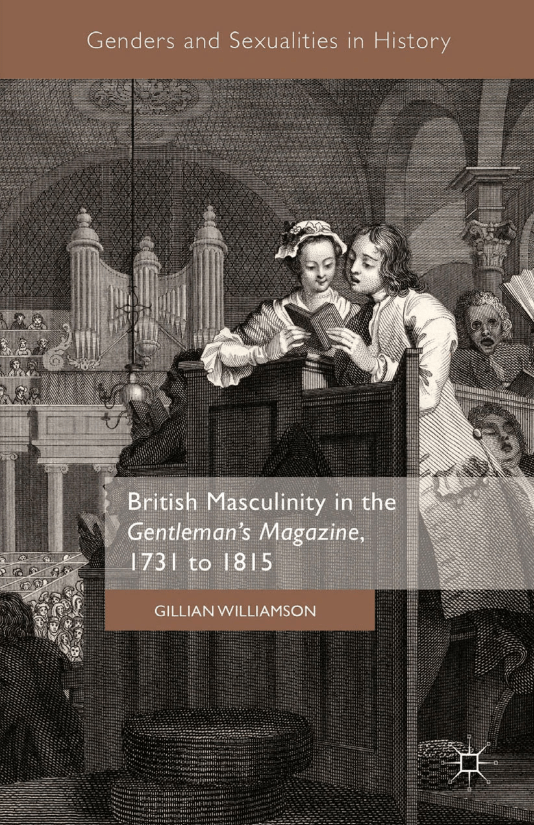
British Masculinity in the Gentleman’s Magazine 1731 to 1815. By Gillian Williamson.

Basingstoke: Palgrave Macmillan. 2016. Pp 283. £44.99 (hardback), £18.99 (eBook), ISBN 9781137542328. Review by Julie Peakman.

As part of our mission to promote women’s and gender studies, we are always happy to publish reviews of key texts in our field – especially those produced by our members. Here, Julie Peakman discusses Gillian Williamson’s important book on the Gentleman’s Magazine, an essential read for anyone interested in magazine culture and gender in the long eighteenth century.

***

The Gentleman’s Magazine ran from 1731 right up to 1907 and is one of the longest running gentleman’s magazines. In this neatly researched book, Gillian Williamson’s aim is to examine the Gentleman’s Magazine for ‘its construction of British gentlemanly masculinity’ (p. 2) between 1731 and 1815, a period which saw the emergence of a new public identity and ideology in ‘a new gentlemanly masculinity of merit achieved through industry and self-restraint’ (p. 3). In doing so, she sheds light on a particular area of literature which has not been explored before in any great depth.

Williamson sees the magazine as ‘a key medium through which middling-sort and ambitious artisan men first acquired politeness’ (p. 181) and as part of the creation of a new gentlemanly status. Readers were not simply passive participants, but took an active role in contributing in the form of letters, prose, poems and obituaries. The magazine covered all sorts of diverse topics including divinity, history, literature, geography, philosophy and scientific discovery. Debates between readers often stretched over months of the periodical.

The book is divided into four parts with six chapters. First is a general historiography providing an overview of eighteenth-century gentlemanly masculinity. Second is a history of the Gentleman’s Magazine, its owners, editors and writers. Third is an examination of the magazine’s readers and their contributions. The final three chapters provide an in-depth analysis of gentlemanly masculinity in the magazine divided into time periods: 1731–1756, 1757–1789 and 1790–1815.

In her examination of the magazine’s readers, Williamson attempts to assess the types of readers through their contributions. It is evident that those who wrote in with submissions often used pseudonyms or initials, so it is impossible to track all of them, and many contributed multiple times. Those that were traceable included the gentry and the middling sort, though as Williamson points out, these are difficult categories to define, but among them were clerics, academics, teachers and lawyers. If the content is anything to go by, there is also evidence that some contributors were ‘men of learning’ and ‘educated men’, sending in Latin poems, maths problems and debates on theological matters and domestic topics such as marriage and the education of children. At 6d an issue, the magazine was accessible to a broad span of readers.

Since self-improvement was the key to becoming a gentleman, this topic was also aimed at the lower-class artisans who would have found the publication of educational value. The reader numbers gleaned from the circulation figures were around 9,000 in 1734, rising to 12,000 by 1748, but Williamson estimates a readership of five times that much, of about 50,000 readers. One copy might go through the hands of many other readers, not just the subscribers, as they would have happened upon the Gentleman’s Magazine in inns, taverns, clubs and coffeehouses, as well as numerous people reading it at one household.

Women were both readers and contributors though the image of women was the conventional one of being subordinate to men. The Gentleman’s Magazine attacked those who behaved like men: for women, there should be no whistling, laddishness, striding around the room or making the first move in courtship. But women could be brave, as seen in the coverage of the female soldier Hannah Snell who was lauded for rescuing a girl from the unwanted attention of a sergeant. However, the magazine still managed to make a salacious story out of her, pointing to her close female friendships,

her cross-dressing, her enforced bed sharing with men and undergoing half-naked floggings as a punishment. An ideal woman was important as a wife to support her husband’s gentlemanly role, but anxieties over possible discord were voiced.

In the early Gentleman’s Magazine of the 1730s, the image of the ideal gentleman is seen as rooted firmly in the private sphere of industry and respectability. He was depicted initially as a temperate Christian Hero, a construct disrupted somewhat by the intervention of the odd unruly wife and the alternative masculinities of libertines, fiery soldiers and their like.

Masculine vices threatened this ideal of the polite gentleman which came in the form of the abusive husband or the fop, characters that were both criticised by the magazine’s authors. The drunk, the gambler, the seducer or spendthrift were gradually all overshadowed by the upstanding gentleman of family values and hard work, buttressed by his self-restraint and benevolence. Generally, in the obituary sections, the industrious man was being praised.

By 1760, benevolence to women, children, servants, the poor and dumb animals were part of the moral values necessary to fit the ideal image of the gentleman in the magazine. This was part of a refocus of gentlemanly traits within the home and family, turning inwards towards the private rather than outwards to his public persona. By now, the magazine was placing marriage above male friendship in importance and, according to its poems and obituaries, the ideal woman was designated to the positions of nurturing mother and dutiful daughter. The turning point of the Gentleman’s Magazine, argues Williamson, came in 1768, a time when it began to challenge the elite, with attacks on the ruling class calling for reforms of property law and taxation.

During the period from 1790 to 1815, the Gentleman’s Magazine was regularly covering the French Revolution and Britain’s war with France, right up to the Battle of Waterloo (1815). Another turning point was not so much the loss of America, but the monitoring of the French Revolution and fears that an uprising might erupt in Britain. Tom Paine’s Rights of Man (1791) had lit a fuse, igniting a challenge to the entire political and social system. A state of solidarity emerged between the gentleman and the elite in the face of this potential social upheaval.

Curiously the violence of masculine idols such as Captain James Cook and Horatio Nelson was blotted out, with accounts showing only the benevolent and moral aspects of their personas as middling-sort heroes. After the Battle of the Nile (1798), for example, Nelson was depicted as a man of sensibility, praised for his virtue of piety – rather a challenging view considering his long-term affair with Emma Hamilton, someone else’s wife.

During this period, the more militant readers of the magazine fell away, and circulation dropped, leaving two sorts of readers: those reminiscing about the landed squire versus those supporting self-advancement and punishment for the idle.

In the end, the overall mission of the Gentleman’s Magazine was to entertain with doses of humour, science and literature, as well as to provide information to broaden the horizons of its readers. The magazine was recognised for its educational value, and even used as a reference, as Edward Kimber compiled the first index in 1753 covering twenty volumes to 1750. Bound volumes would eventually become worth a lot of money – 50 guineas in one case. While luxury editions might appear to be targeted at the nobility and gentry, Williamson has found evidence that the magazine’s success was based on a readership from the middling sort of professionals and tradesmen, and even among men from lower down the social scale. The Gentleman’s Magazine was often read from adolescence to the grave.

Overall, Williamson’s study gives us an accessible yet scholarly overview of the development of the magazine and its depictions and image of the quintessentially British gentleman. Assessing the authors of the Gentleman’s Magazine and the contributions of its readers and their obituaries, she is able to paint a picture of what made up the Gentleman’s Magazine idea of the ideal gentleman. Her case studies provide thumbnail sketches and give added insight into her findings. In all, Williamson’s in-depth analysis of the Gentleman’s Magazine provides us with a valuable contribution to eighteenth-century magazine literature and adds another layer to our understanding of the history of masculinity.

***

Dr Julie Peakman is an historian, a Fellow of the Royal Historical Society and Honorary Fellow at the Department of History, Classics and Archaeology at Birkbeck College, University of London. She is a prolific author in the areas of eighteenth-century culture, history of sexuality and social history. Recent books include Libertine London and Licentious Worlds.
Laboring Mothers. Reproducing Women and Work in the Eighteenth Century. By Ellen Malenas Ledoux. Charlottesville: University of Virginia Press. 2023. Pp. 274. $29.50 (paperback), ISBN 9780813950280. By Jasmin Bieber

Ellen Ledoux’s Laboring Mothers is dedicated to women as nurturers and caretakers and their multifarious professions. The monograph consists of six chapters – organised into three parts – featuring mothers who worked as actors, midwives, soldiers, slaves, street hawkers and prostitutes. This selection already points to Ledoux’s central ambition to seek out intersections of gender and class in a diverse array of case studies. The female elite of eighteenth-century Britain is accordingly not her main focus; instead, she concentrates primarily on the lower and working classes, the mothers without a ‘voice’ or those whose ambitions cast them into obscurity. Working mothers, Ledoux determines, existed and continue to exist on societal and spatial thresholds in which the principles and expectations of the public and private spheres merge and/or clash.

Ledoux not only productively renders visible those mothers at the margins, but she also argues that they enabled and were enabled by two cultural and social circumstances of the eighteenth century: the emergence of the public sphere and the cult of motherhood. These conditions, she observes, “created an Enlightenment concept of maternity that galvanized privileged women’s ability to earn income and, in some cases, to professionalize” (p. 3). As this statement demonstrates, her study draws attention to the strategies that allowed women to deliberately profit from their status as mothers and also highlights rhetorical representations or visual reflections of motherhood. Laboring Mothers employs an intersectional feminist reading that applies a broad understanding of ‘text’ as anything pertaining to a signifier, which results in a vast and impressively researched corpus of paintings, poems, letters, advertisements, plays, contracts, newspaper articles and further materials that facilitate Ledoux’s reading of “literal and symbolic forms of motherhood” (p. 9). Her acknowledgement of women’s resilience is paired with sober reflections on the tolls of maternal caretaking and, at times, working conditions that render mothering impractical or even impossible.

Part 1 of the book (‘Speaking for Herself’) is dedicated to women utilising the public sphere to their economic advantage, a pursuit which is impaired by their social, financial, and educational status. Ledoux presents, in her first chapter, the cases of actresses Sarah Siddons and Mary Robinson. For both, maternity and motherhood were not damaging circumstances. They deliberately staged their swollen pregnant bodies and mother–child relations to curate their virtuous public images, which were paradoxically based on a display of the private. While they garnered societal criticism for their practices – especially once their bodies showed their advanced age and illnesses – their longstanding professional successes speak to the eighteenth century’s fascination with maternity on display. Their stagings were only acceptable if their motherly duties were not superseded by their desire for fame and fortune. Chapter 2 offers a different perspective on such public self-fashioning by turning to midwifery and its shifting trends throughout the eighteenth century, notably from female to male practitioners. In response to these developments, manuals by female midwives argued for their expertise, pointing to their first-hand experience as mothers as topping male medical education. The chapter effectively demonstrates the paradoxical rhetoric governing debates that appear to hinge on existential gendered distinctions and the scrutiny of gender.

While Part 1 presents professionalism and motherhood as being far from exclusive states, Part 2 (‘Spoken For’) opens with another apparent contradiction. In Chapter 3, Ledoux introduces two mothers who served in the military, Christian Davis and Hannah Snell. Their autobiographies are testimonies of women’s patriotism and a desire for a lifestyle detached from normative societal female obligations. The absence of motherly affection and care for their children is considered a rejection of any aspirations to adhere to ‘good’ motherhood. Ledoux refrains from speculating on the lack of remarks on their time as mothers or their disinterest in their children’s future. Instead, these gaps in their narratives are used to highlight the stark limitations of female virtues in a militant and thus masculine-coded field of work. Chapter 4 likewise deals with a narrative’s failings in addressing maternity and its affective dimension, in light of physically taxing work. While reciprocal caretaking had been possible in all previous cases, The History of Mary Prince (1831) emphasises the insurmountably different expectations towards empathic caretaking and the labouring and living conditions of female slaves. Ledoux observes what she terms as ‘slow violence’ (pp. 116ff) in early instances of Prince’s narrative. Her reading results in bleak imageries of motherhood that either end in spiritual defeat or the death of mother and child. The chapter adds to its primary case an array of caricatures that showcase how the supposed ‘natural’ nurturing abilities of black women have been used and reproduced in public debates surrounding childcare at English-owned plantations.

Opening Part III (‘Spoken About’), Chapter 5 consists of six representations of female street hawkers, all artistic renditions by (male) painters such as William Hogarth and Thomas Rowlandson. As caricatures, parts of larger ensembles or allegorical representations, women are depicted carrying their children as well as tools of their professions. This balancing act already runs counter to idealised practices of the ‘cult of motherhood’ that sees women solely focused on nurturing, as expertly demonstrated by Ledoux with the example of Caroline Watson’s Maternal Tuition (1793). In such street hawker prints, lower-class mothers – literally and metaphorically – buckle the expectations of mindful mothering while pursuing honest or socially degrading occupations. Failing at one task entails failing at the other; a gin seller, for instance, is bound to bring forth the next generation of drunkards. The influence of the mother’s profession on their offspring is, however, shrouded in silence in Ledoux’s final chapter on prostitutes. Demonstrating the eighteenth century’s shifting attitude towards prostitutes as victims rather than active perpetrators by exploring manuscripts relating to the Magdalen House. The case study highlights sentimental rhetoric as an effective tool to stage a woman’s resort to prostitution as a parental obligation, allowing for her potential readmission into society.

Ledoux expresses throughout her work an awareness of the complex etymology of terms central to her cultural research. Her collection of cases highlights the effects and processes of the dissemination of stereotypes surrounding the feminine and female, as well as the enduring issues related to womanhood and motherhood. Her conclusive remarks reflect her findings on prevailing contemporary formations and cement the importance of Ledoux’s work in addressing mothering as a profession, one whose compatibility with women’s working aspirations can greatly vary. Laboring Mothers is an excellent read for students and researchers of British eighteenth-century society and presents its readership with a productive intersectional feminist perspective with far-reaching applicability.

***

Jasmin Bieber is a doctoral student at the University of Konstanz, Germany, where she is working on her PhD project dedicated to eighteenth-century British women travellers. Her research reflects her interests in gendered geography and literary spatiality, and she enjoys teaching undergraduate courses in early modern to contemporary literature.

Elisabetta Sirani. By Adelina Modesti. London: Lund Humphries. 2023. Pp. 144 + 65 colour and 12 black and white illustrations. £35.00 (hardcover), ISBN 9781848224971. By Anna Pratley

This is the first of three reviews we will be publishing on the Illuminating Women Artists series, edited by Andrea Pearson and Marilyn Dunn, and published by Lund Humphries. The beautifully illustrated volumes in this series explore the lives and works of women artists, many of whom have been previously overlooked in the history of art. To begin, Anna Pratley discusses the volume on Elisabetta Sirani.

 *******

Built upon decades of dedicated research and an informed analysis of recent developments in scholarly thought, Adelina Modesti’s contribution to the Illuminating Women Artists series is essential reading for any student or enthusiast seeking an overview of the remarkable life and work of Elisabetta Sirani (1638–1665). By seamlessly weaving into the text faithful English translations of seventeenth-century Italian sources and non-judgemental explanations of art historical terminology, Modesti has forged a highly accessible narrative which is gripping, informative, and truly illuminating.

Modesti begins by providing an impressively concise overview of the contemporary issues which shaped Sirani as an artist, including those relating to her family, education, and influential sociopolitical debates associated with the Counter-Reformation. Alongside addressing topics familiar to the scholar of early modern women, such as the Querelle des Femmes (‘Woman Question’), it also considers those factors unique to Bologna which allowed women artists to flourish. The most significant of these is the “matrilineal pedagogic model”, a term coined by Modesti to acknowledge Bologna’s encouragement of women teaching other women (p.19). Readers who wish to delve further into recent archival discoveries relating to the success of Bolognese women artists are appropriately signposted to Babette Bohn’s Women Artists, their Patrons, and their Publics in Early Modern Bologna (Penn State University Press, 2021).

Chapter 2 evaluates Sirani’s training, artistic influences, technique, and style. In accordance with Linda Nochlin’s 1971 argument – that the disadvantages faced by women artists should not be employed as an intellectual position – Modesti emphasises the wealth of resources available to Sirani: plaster casts, sculptures, paintings, drawings, palace collections, churches, books, and religious festivities to name a few. Relevant archival materials support investigations into Sirani’s colleagues and apprentices, particularly Lorenzo Tinti (1626–1672), whose artistic relationship with the maestra has not yet received its due focus and would be worth further investigation. A short paragraph on Sirani’s little-known caricatures (p.50) presents a similarly tantalising opportunity for further research.

However, it is Modesti’s ability to paint a picture of Sirani’s genuine passion for her profession which remains the most illuminating aspect of this chapter, and indeed of the whole monograph. Of note are personal anecdotes from Sirani’s biographer and friend, Carlo Cesare Malvasia (1616–1693); one of these (p.41) recalls the artist’s repeated visits to a jewellery shop to view a much-loved painting, and her subsequent avoidance of returning out of embarrassment for spending so much time admiring it. Descriptions of Sirani’s technique are just as evocative, for instance, how her experiments with wet-on-wet paint application created a “shimmering quality to the surface of her paintings” (p.32).  Modesti’s writing brings Sirani to life in this chapter, allowing her youth, character, and talent to radiate from the glossy printed reproductions of her works. It is a must-read example of how to introduce a non-specialist audience to the world of art history.

A natural progression from the previous chapter, Chapter 3 covers the themes, subjects, and iconography of Sirani’s works. An examination of Sirani’s religious paintings considers their propensity for use in spiritual reflection, a significant role for artworks in the Counter-Reformation. The suggestion that Sirani’s depictions of Saint Anne gained popularity as exemplars of the aforementioned matrilineal pedagogic model is insightful and well-supported. Perhaps the most successful use of images appears in this section (pp.64–65). The rich red, white, and blue drapery of Sirani’s Virgin and Child (1663) is complemented by that of the adjacent Salvator Mundi (c.1655–8), while a self-portrait sketch apparently used as the basis of the latter work is displayed alongside it, allowing direct comparison.

However, Modesti’s examination of Sirani’s historical heroines is tenuous in places. Her argument that the formal composition of Timoclea may have been inspired by Artemisia Gentileschi’s Judith Beheading Holofernes (c.1620) (p.78) is a refreshing addition to the discourse; yet one cannot help feeling that this was an attempt to shoehorn in a connection between two women artists where there is no extant evidence that they had any knowledge of each other’s works. More perplexing is the lack of any reference to Amy Golhany’s 2011 article – which recognises the irrefutable similarity between Sirani’s Timoclea and an earlier eponymous print by Matthaüs Merian (1593–1650) – despite its inclusion in Modesti’s select bibliography.

It is also worth noting that the section on anti-heroines assumes the authenticity of an Iole (1662), a Cleopatra (c.1664), and a Circe (c.1664), all of which have contested authorship. Modesti is known for taking an enthusiastic approach to attributions, sparking much debate with the other primary scholar on Sirani, Babette Bohn. The reader should remain conscious of this and take a critical approach to new attributions in this work. Chapter 1, for instance, attributes a painting traditionally thought to be by Sirani to her sister Barbara. The curious reader will discover that the ‘reference’ supporting this claim is a link to a Facebook image of the work with no caption, posted to the page of the Galleria Umbria Perugia in 2022. There are, I am sure, reasons behind this assertion, but without knowing them it is difficult to judge its validity.

Chapter 4 offers an extensive evidence-based analysis of the artist’s patronage networks and modes of self-representation. Of note are some previously unrecognised connections with the Medici, including commissions from a Medici courtier, the chief administrative officer of the Medici military company, and a Bolognese statesman in the service of a Medici cardinal (p.99). Modesti’s chronological analysis of Sirani’s notebook is a particularly helpful guide to the evolution of the artist’s popularity over time. Towards the end of this chapter, the inclusion of visual reproductions of contemporary laude (figs. 69 and 70, p.110) adds valuable weight to the running emphasis on the artist’s impressive reputation.

Modesti’s concluding chapter is fittingly dedicated to documenting the posthumous memory of Sirani. This section provides a stark reminder of the tragedy of Sirani’s untimely death, supported by detailed descriptions of her funeral proceedings and three moving contemporary letters mourning her loss. A brief but comprehensive analysis of Sirani’s critical reception through time follows. This section subtly emphasises the important role played by women in preserving Sirani’s memory across the centuries, from Carolina Bonafede’s 1856 biographic play to the use of the Timoclea in the #MeToo movement. The commemorative plaque now adorning Sirani’s home could potentially have provided further support for Modesti’s comments on the early twentieth-century dismissal of Sirani’s works as imitations of her predecessor, Guido Reni (1575–1642). However, this omission does not detract from the success of this chapter.

Just as Sirani produced an astonishing 200+ paintings in just over a decade of work, Modesti’s book encompasses a vast amount of research in just 144 pages. This need for concision results in a few minor lapses in academic rigour, mostly in the justifications for attributions. Nonetheless, this book provides a much-needed point of entry into the world of Elisabetta Sirani, reminding us that many historical women artists are still awaiting equal representation outside of the boundaries of academia.

Anna Pratley recently graduated from the Warburg Institute with an MA (Dist.) in Art History, Curatorship and Renaissance Culture. Her research interests include amateur women miniaturists working in seventeenth-century England, the domestic lives of the “middle class” in the long eighteenth century, and the application of feminist surveillance theory to women’s self-portraiture.