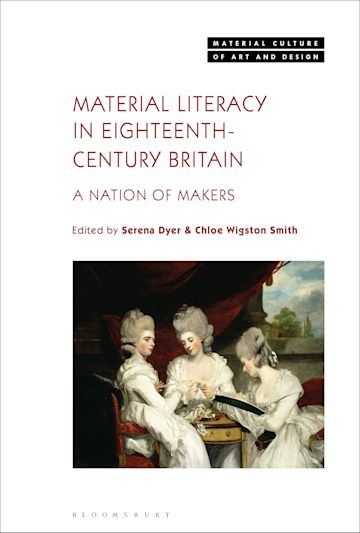
In Material Literacy in Eighteenth-Century Britain, Serena Dyer and Chloe Wigston Smith reveal how ‘this nation of shopkeepers’ was, in fact, ‘as much a nation of makers.’ (p. 13) In doing so, this important collection redresses narratives of the industrial and subsequent consumer revolutions that have previously minimized broader histories of making and material knowledge. Upsetting ‘the familiar delineation of women’s craft and men’s production,’ they argue instead ‘for a flexible and inclusive approach to material practices’ that, in the eighteenth century, were ‘fundamental to men, women and children alike.’ (p. 1)
Across its fifteen chapters, Material Literacy expands established definitions of the spaces of eighteenth-century making to incorporate diverse and sometimes surprising sites in which objects were engaged. The systems of material knowledge and the processes by which it was generated and performed – cutting, sticking, stitching, forging, melting, carving, trading, appraising and more – are traced through provincial and urban communities, ‘workshops and factories, […] drawing rooms, shops, parlours and backrooms of Britain.’ (p. 1) Three categories of maker emerge. The first of these represent active producers; those who ‘held the needle or chisel.’ The second represents those who ‘guided and advised, acting in partnership with other professional or amateur makers’ and the third, those who ‘mobilized their knowledge […] to comment upon, judge and inform their own activities as consumers and owners of material objects.’ (p. 1)
Material literacy, ‘like textual literacy, was never a zero-sum game, but instead ranged up, down and across a person’s age, class, experience and dexterity.’ (p. 4) Ariane Fennetaux notes that written instructions for the manufacture of pockets did not appear in print until 1838, meaning women and girls worked instead from private knowledge, inherited in families and swapped amongst friends. As Crystal B. Lake’s chapter attests, ‘embroidered works produced during the long eighteenth century remind us that learning to read and write frequently entailed handling not only pens, ink and paper but also needles, thread and fabric.’ (p. 35) Turning to needlework verse, Lake reveals how second wave feminists of the late twentieth century mistook the embroidery of women in previous centuries as evidence of domestic confinement and oppression; an assumption, Lake warns, that ‘threatens to erase the writing that appeared’ on samplers and other forms of embroidery.
This close relationship between text and craft runs throughout Material Literacy. In her chapter on Hannah Robertson’s 1766 The Young Ladies School of Arts, Chloe Wigston Smith reveals how such texts ‘made craft and artisan knowledge accessible, unmooring it from the traditional apprenticeship and guild systems, which had largely excluded women from formal instruction.’ (p. 51) They also offered women opportunity to monetise craftwork ‘without the help or hindrance of men.’ (p. 63) The socio-economic status of women who made, reworked and repurposed objects is the focus of Nicole Pohl’s chapter, which takes as a case study the Bluestocking Elizabeth Montagu and her younger sibling Sarah Scott. Working from largely unpublished letters written by the two women, Pohl demonstrates how textiles – whether practical, everyday fabrics or more elaborate embroidered work – ‘functioned as subtle markers of social mobility both within a social circle and a family’ and were accordingly related in detailed correspondence. (p. 68) Texts could inform how people understood and appraised objects, but also how they desired them and imagined their corporeal and emotional effects. Jon Stobart’s essay turns to pattern books, trade cards and auction catalogues to unite questions of material literacy to corporeal experience – specifically comfort – in the home. While taste, Stobart argues, had to be constantly honed and practiced, comfort (and its close relation, luxury) could be attained through the purchase of sofas, chairs, curtains and beds by anyone with the financial means to do so. Exploring the extent to which commercial advertisements infiltrated and shaped the private Georgian domestic environment, Stobart asks ‘how comfort and convenience were described’ and the rhetoric around them ‘internalized’ by consumers who appraised items before and after purchase. (p. 84)
For Serena Dyer, the material literacy of the shopper was informed by the introduction of amateur making skills to the marketplace which, as a result, ‘necessitated shopping skills beyond bargain hunting and quality assessment.’ (p. 99) Consumer knowledge, she suggests, became a commodity of its own central in ‘navigating the eighteenth-century shop.’ (p. 99) Dyer records how ‘making, acquiring, stitching and shopping’ were intertwined activities for predominantly female consumers of dress, with many working as ‘judge, facilitator, collaborator and maker during the course of garment construction.’ (p. 100) Collaboratively produced and multi-authored objects are similarly the focus of Alicia Kerfoot’s chapter on it-narratives. Kerfoot traces the ways literary productions took up such items to reveal (and satirise) the political and economic dynamics behind them.
For Sarah Howard, Emily Taylor and Hilary Davidson, shifting tastes and trends in the eighteenth century required makers possess a broad and adaptive set of skills, particularly in the design, manufacture and sale of sartorial items. Howard’s chapter uses as its framework the surviving account book of provincial Hampshire tailors George and Benjamin Ferrey to reveal ‘the material competencies and ingenuity required to craft clothing, respond to distinct requirements from clients and also to create non-clothing items for their customers.’ (p. 134) Similarly, Taylor explores how professional mantua-makers could both ‘catalyse and contain’ evolving dress fashions. (p. 151) By ‘publishing theories of proportion and cutting practices’ as well as working in partnership with clients, these professional groups were able to create shared knowledge and ‘a foundation of understanding around materials’ that allowed garments to be reworked over time, adapted and restyled. (p. 167) For Davidson, shifting our own methodological approach to made garments holds rich opportunity to explore some of these processes. ‘Shifting our perspective from Regency fashion to its makers and materials,’ she proposes, ‘answers different questions about how this period of great stylistic change was embodied.’ As Davidson claims, ‘exploring modes and processes of making emphasizes the ways makers’ and wearers’ bodies interacted with materials, and their bodies with clothing.’ (p. 191)
The final chapters of Material Literacy focus on the narratives made objects could be used to tell. Elisabeth Gernerd’s methodologically rich chapter draws together especially compelling textual and visual sources in its account of the manufacture, wearing and eventual translation to print of decorative ostrich feathers. Gernerd tracks the ‘less-visible narrative of the ostrich feather,’ focusing on the systems of empire by which they entered Britain and underscoring how attendance to such quotidian materials might reveal broader maritime networks and imperial economies. This focus on empire and the role of objects as key tools in its storytelling continues in Robbie Richardson’s chapter on tomahawks and scalping knives. Richardson opens with a scene from a London coffee house in 1759, in which an individual billed as ‘A Famous Mohawk Indian Warrior’ and equipped with such tools entertained a curious public. But while these Native American items ‘became a trope easily deployed to evoke Indian cruelty,’ those on display in Britain were, by the mid-century, almost exclusively of European manufacture and served the imagination of those with little understanding of their ‘transcultural provenance.’ (p. 219)
Questions of how to read (in)authenticity – both in the eighteenth century and for scholars today – continue in Laura Engel’s chapter on the famous waxworks of Madame Tussaud who, in 1804, travelled to Britain from France, with an infant and the tools of her trade in tow. Tussaud’s sculptures of celebrities and notable people were ‘dressed […] in real clothes’ and presented with ‘historically accurate props’ and, although most do not survive today, ‘engendered a mode of embodied social interaction with famous faces and bodies that remains a hallmark of contemporary celebrity culture.’ (p. 239) For Engel, wax is an especially intriguing and uncanny material, one variously useful in representing human flesh and tactile, even sexual, encounters with it. It is also potentially disruptive of time and art history, with its specific material properties ‘analogous to how women artists have appeared and disappeared in the archives, as well as the ways in which women’s embodied experiences are mediated through material representations that both preserve and obscure their presence.’ (p. 243) The skills needed to fashion works like Tussaud’s, and correspondingly to read them, were not only put on display in the public spaces of eighteenth-century Britain, but actively taught. In the closing chapter of the volume, Beth Fowkes Tobin explores how shops, dealers’ warehouses and stationery stores became crucial sites of instruction to many who otherwise did not have access to formal training. At George Humphrey’s 1760s shell warehouse in London, for example, customers could attend practical sessions run by the prize-winning shellworker sisters Elizabeth and Hannah Humphrey.
Importantly, ‘material literacy’ emerges not only as crucial terminology in the scholarly articulation of eighteenth-century modes of manufacture and object reception, but also as a central tenet in modern-day methodological approaches to their study. Offering up a range of interdisciplinary frameworks, the essays gathered in Material Literacy sit alongside ongoing work by Leonie Hannan, Kate Smith, Pamela H. Smith and Paula Hohti to reflect recent turns in material culture studies ‘towards experiential research and research-as-practice.’ Among the book’s contributors, Dyer, Hilary and Pohl are all ‘experienced in the period hand-stitching that their subjects exercised.’ (p. 8) Another of the collection’s strengths lies in its inclusion of curatorial voices and expertise, reflected not only in the list of authors (Howard is a freelance conservation consultant and Taylor an Assistant Curator at National Museums Scotland), but also in the broad array of materials presented from collections at the Bata Shoe Museum in Toronto, the Lewis Walpole Library, the Museum of London, the National Museum of Australia and more. The subsequent result is a beautifully illustrated, multi-perspective volume that will be essential reading for anyone working on material culture. Moreover, Material Literacy’s methodological focus on accessing previously invisible lives and modes of making will be of special interest to Women’s Studies Group members.
____________________________________________
Madeleine Pelling
University of York
Dr Madeleine Pelling is an art historian specialising in eighteenth-century visual and material cultures. She is currently preparing her monograph, The Duchess’ Museum: Collecting, Craft and Conversation, 1730-1786, for publication and is co-editor of A Cultural History of Historiography: The Age of Enlightenment and Revolutions (under contract with Bloomsbury) and ‘Women and the Making of History, 1500–the Present’ a special issue for History: Journal of the Historical Association (forthcoming September 2021).


 Women's Studies Group 1558 - 1837