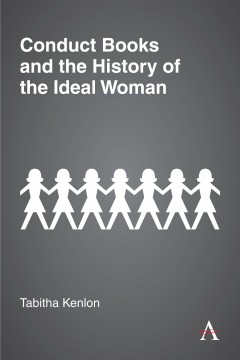
Conduct Books and the History of the Ideal Woman. By Tabitha Kenlon. London and New York: Anthem Press. 2020. pp. 218. £80 (hardback). ISBN: 9781785273148.

Tabitha Kenlon’s ambitious, witty and well-written monograph, Conduct Books and the History of the Ideal Woman, examines six centuries of conduct books and etiquette guides designed for women. A chronological exploration, each chapter homes in on the most popular conduct books published each century, though, as readers will discover, publishers repeatedly reprinted the same conduct books regardless of whether the advice was decades or even centuries old. As such, mothers, grandmothers, and even great-grandmothers could be reading (and expected to conform to) the same written advice over a fifty to one-hundred-year period. Kenlon states that while moral, religious, and social expectations adapted and changed over the centuries, advice given to women on how she should behave, how she should dress, and what was considered appropriate feminine behaviour remained disturbingly constant. Kenlon even makes parallels between advice as found in conduct books and modern tropes as seen and read in sitcoms, movies, plays, and novels as a deliberate reminder that female stereotypes have been deeply ingrained in Western European culture since the Middle Ages.

In the very first chapter, which examines two conduct manuals from the fourteenth century, Kenlon explains that women were expected to embody two opposing traits: a wife was to be submissive to her husband when he was present, but to also take over his duties in his absence, including managing a household, educating children, and giving orders. In Kenlon’s words, these texts ask that a woman be ‘both strong and submissive, intelligent and biddable, capable and helpless’ (p. 16).

By the sixteenth century, conduct manuals dwelled on a woman’s appearance, advising her to avoid ostentatious dress and gossip, less she be branded vain and outspoken. In the seventeenth century, women were encouraged to adopt self-reflection and to self-police their own behaviour. Silence and modesty were upheld as ideal feminine traits and those who failed to conform to the ideal were ‘scolded’ both legally and socially. 

Until the eighteenth century, many writers justified their advice by referring to the Bible, and biblical stories. From the eighteenth century onwards, however, Kenlon shows that writers moved away from primarily religious justifications and instead focussed more on general morality. For centuries, girls and young women were advised to fix their attention on preparing for marriage and securing an acceptable husband. Once married, keeping her husband happy and having children was expected to sustain a woman until her dying breath. Of course, happiness is somewhat of a moving target. In previous centuries, submission and silence were the acceptable behaviours women needed to adopt, but in the eighteenth century, a husband desired a wife he could have a conversation with on different topics of interest. Of course, she could not be too outspoken or too controversial, but she should be able to converse enough that the couple developed companionship. As such, girls needed to be educated so they could engage in polite conversation. Kenlon’s description of eighteenth-century female education reminded me of the fairy tale, Goldilocks and the Three Bears. If a young woman did not receive an ample education, she was too boring. If she appeared too educated, she may become too outspoken. Striking a balance was the key.

I found Kenlon’s final chapter on self-help guides and other advice writing for women in the twentieth and twenty-first centuries the most powerful but also the most disheartening. Many of these self-help guides repeat centuries-old advice: women should avoid being too loud, too brash, too outspoken, too sexy, too frigid, too put together, and too slovenly. Such advice is still very much part of present-day Western society.

Kenlon avoids discussing the LGBTQ+ perspective, even in her chapters on the twentieth and twenty-first centuries. I realise this may seem like a divergence for an already historically broad study, but it would be interesting to read Kenlon’s perspective on how advice writing speaks to the LGBTQ+ community. Indeed, a chapter that considers the LGBTQ+ perspective might make a nice addition if Kenlon were ever invited to produce a second edition of the book.

Overall, Conduct Books and the History of the Ideal Woman was a thoroughly enjoyable and thought-provoking read and a must for any student or scholar exploring gender history. This book is also available as an e-book and an audio book and, as such, is one of the first academic publications to take advantage of the audio book format. This is a much-needed development in academic book publishing, given that it makes books more accessible to a wider audience. I hope Kenlon’s determination to make the text available in multiple formats is adopted by others in future.

Dr Brianna Robertson-Kirkland

Royal Conservatoire of Scotland/University of Glasgow

Send in your news!

Have you published a new book or article that members of our Women’s Studies Group (WSG) would be interested to read? Do you have information about a new call for papers, conferences, grants, jobs, seminars, or workshops that our WSG members might be interested to hear about and contribute to?

If so, please send your news to Sara Read who writes out monthly newsletter! The newsletter is sent to all WSG members at the beginning of each month and Sara is looking for content that would benefit our membership. Please email Sara your news no later than the 30th of the month or no later than the 28th/29th if it is February!). Her email is: S.L.Read@lboro.ac.uk.

Call for papers from the Women’s Studies Group: 1558-1837

The Women’s Studies Group 1558-1837 is a small, informal, multidisciplinary group formed to promote women’s studies in the early modern period and the long eighteenth century. Established in the 1980s, the group has enabled those interested in women’s and gender studies to keep in touch, hear about one another’s research, meetings and publications, and meet regularly to discuss relevant topics. We organise regular meetings and an annual workshop (see membership application form) where members can meet and discuss women’s studies topics. We can also offer advice and opportunities to engage in activities that increase opportunities for publication, or enhance professional profiles in other ways. The WSG is open to men, women, and non-binary people, students, faculty, and independent scholars, all of whom are invited to join the group and give papers.

The group meets on Zoom at present, but it is hoped that we will be able to resume in-person meetings at the Foundling Museum, 40 Brunswick Square, WC1N 1AZ, for the last two meetings of this series (January and March 2022). We will be allowed into the room at 12.30pm., to give us time to sort out paperwork and technology, but sessions will run from 1.00–3.30pm. So please arrive a little early, whether virtually or in person, if you can. Topics can be related to any aspect of women’s studies: not only women writers, but any activity of a woman or women in the period of our concern, or anything that affects or is affected by women in this period, such as the law, religion, etc. Male writers writing about women or male historical figures relevant to the condition of women in this period are also a potential topic. Papers tackling aspects of women’s studies within or alongside the wider histories of gender and sexuality are particularly welcome; so are topics from the early part of our period. We would also welcome how-to presentations for discussion: examples of suitable topics would include, but are not limited to, grant applications, setting up research networks, becoming a curator, co-authorship, using specialised data, and writing about images. Papers should be 20-25 minutes.

Dates of meetings:

Saturday September 25, 2021 (British Summer Time) – Zoom

Saturday October 9, 2021 (Greenwich Mean Time) – Zoom

Saturday November 27, 2021 (Greenwich Mean Time) – Zoom

Saturday January 29, 2022 (Greenwich Mean Time) – Possibly in-person at The Foundling

Saturday March 26, 2022 (Greenwich Mean Time) – Possibly in-person at The Foundling

Please reply to Carolyn D. Williams on cdwilliamslyle@aol.com

Send in your news!

Have you published a new book or article that members of our Women’s Studies Group (WSG) would be interested to read? Do you have information about a new call for papers, conferences, grants, jobs, seminars, or workshops that our WSG members might be interested to hear about and contribute to?

If so, please send your news to Sara Read who writes out monthly newsletter! The newsletter is sent to all WSG members at the beginning of each month and Sara is looking for content that would benefit our membership. Please email Sara your news no later than the 30th of the month or no later than the 28th/29th if it is February!). Her email is: S.L.Read@lboro.ac.uk.

Artemisia Gentileschi and Feminism in Early Modern Europe by Mary D. Garrard. London: Reaktion Books. 2020. Pp. 320. £15.95 (hardback), ISBN 9781789142020.

Artemisia Gentileschi is an artist whose time has more than come. New acquisitions of her work continue to emerge with great fanfare into the gallery spaces of the world’s most august art institutions, the most recent being the Getty Museum’s acquisition of her Lucretia (1627). In 2020, London’s National Gallery built an important show around the acquisition of Gentileschi’s Self Portrait as Catherine of Alexandria (1615–17). Gentileschi’s paintings are reentering a world in which not nearly enough has changed for women since the time when she was painting her original visions. In a climate of feminist protest, in which women’s voices are rightly loud and insistent, Gentileschi’s work retains a force of resonance, a relevance, that renders it as compelling and urgent as ever it was.

Not least, the parallel between Gentileschi’s experience of taking a rape complaint to trial and the experiences of women today who enter a courtroom in the hope of obtaining justice is painfully obvious. It is by now impossible to approach Gentileschi’s oeuvre without knowledge of this crime against her, and of the horror of her trial. The MeToo movement has highlighted how common it is for women to experience the crime of sexual assault and how rarely such crimes are punished. Society continues to accommodate systemic violence against women and girls. The crime of rape, then, is apposite to women’s reception of her work at this contemporary moment. It cannot be evacuated from Gentileschi’s history as an artist without enacting a distortion.

Yet too often, Gentileschi’s works of art have been framed as materially indexical to her rape, as symptoms arising from a private trauma. At their worst, such framings figure Gentileschi’s artistic agency as secondary to that of her abusers, whose actions not only “author” her works but provide their natural interpretive framework. Clearly, there is a balance to be struck between telling the whole of the important story of this female artist and allowing the undoubted quality and originality of her work to stand on its own terms. This can only take place outside of the tired psychobiographical framework that serves only to suppress Gentileschi’s painterly originality within a reductive teleological narrative of victimhood.

Eminent scholar, founding member of the field of feminist art history and pioneer of Artemisia Gentileschi studies, Mary D. Garrard is perhaps uniquely equipped to plot a course through these rocky waters. If, as Garrard argues, the repetition and magnification of artists and their work is a central strategy for canon formation, then Garrard is rightly feted for having been responsible for some of the most effective and transformative repetition and magnification of women’s art in the discipline of art history. Her new book represents a new and full account of Artemisia Gentileschi’s life and work. There are seven chapters, organised around recurring and important themes in Gentileschi’s work. This structure facilitates an interrogation of the contemporary visual and literary context illuminating these pictures and their subjects – their Judiths, Susannas, Lucretias, musicians, saints and allegorical figurations.

Garrard’s strategy of situating Gentileschi’s paintings within the contemporary writing and patronage of women avoids the shallows, contextualising the paintings within a broad and lively field of female authorship, creativity and crucially, feminism avant-la-lettre. This does not render the emotion in Gentileschi’s paintings insubstantial, but rather rebalances it against a feminist intellectual ballast, recuperating this extraordinary artist’s richness and range. It reframes Gentileschi’s work as a deliberate intervention in public debate.

Garrard’s book establishes Gentileschi very firmly as a player within the artistic and intellectual networks spanning Europe’s great courts and cities. This is really fascinating stuff, which, moreover, serves to situate Gentileschi’s art within a transterritorial conversation, as visual currency circulating within an intellectual exchange, that both draws on and responds emphatically to contemporary discourses. Moreover, Garrard demonstrates how Gentileschi’s paintings intervened in the flourishing feminist debates then known as the querelles des femmes, resituating her oeuvre within a lively community of early modern women who thought, knew, spoke, wrote, performed and painted. Intriguingly, Garrard argues that Gentileschi’s painting visualises this community of women as one which crosses class lines. Garrard extends this idea beautifully throughout, showing how Gentileschi’s work too spans historical time, forming a rallying point for the entry of new members into this feminist community persevering into our own present day.

While acknowledging the dangers of the biographical fallacy, Garrard makes a good case for reading Gentileschi’s pictures with her biography in mind. She argues convincingly for the painter’s use of her own likeness in her paintings, a matter of some recent debate. Garrard’s love for her subject is apparent, certainly no bad thing, and her connoisseurial, but also heartfelt, engagement with her subject produces a rich intimacy in her treatment of the artist’s history. Garrard’s use of the painter’s first name throughout is indicative of this intimacy, which feels very genuine, even ethical, as the evident product of so many years of patient study (I don’t claim the same privilege for myself here, although Garrard’s point about the status of Gentileschi’s celebrity, her name brand recognition, is well made). Accordingly, Garrard works hard to centre the originality of Gentileschi’s style, of her painterly voice, and points to several areas fertile for new research, not least, early modern women’s feminist patronage of women artists.

This intimacy extends into Garrard’s formal discussions of Gentileschi’s paintings, their remarkably palpable women, livid with corporeality, their straining hands, solid forearms and locked elbows, their stolid calm in the face of blood and danger. Gentileschi’s painting of women psychologically and physically absorbed in the back-breaking work of political murder, their total commitment to assassination, retains the power to arrest the gaze. Both Gentileschi and Garrard debunk the cherished myth that women of early modern Europe were all as modest and submissive as the conduct literature of their own day and an art historiography rooted in the nineteenth century would have them be.

The book’s approach stands on it own in quite a busy field. Much is being published on Artemisia Gentileschi right now, but nothing quite like this. The book is written in an engaging and conversational style appealing to a generalist audience, but there is plenty here for specialists to value. As standard with Reaktion Books, there are lovely endpapers and a cloth cover, and many high quality colour reproductions. There is a useful bibliography. A small caveat: I would have liked more information in the image captions, where the dimensions of paintings and their locations are not usually listed; it’s important for us to know the scale at which Gentileschi worked.

Dr Sara Ayres

Affiliate Researcher

Centre for Privacy Studies at Copenhagen University