Keynote by Dr Lucy-Anne Katgely: ‘By a Lady: Branding, Collective Authorship, and the Politics of Mediocrity’.
The 2026 WSG Annual Workshop will take place at The Foundling Museum, 40 Brunswick Square, London WC1N 1AZ. Doors will open at 10:00 for Registration and we plan to finish the workshop by 16:30. A buffet lunch & refreshments will be provided.
The workshop will commence at 10:30 with the Keynote by Dr Lucy-Anne Katgely, Lecturer at St John’s College, Oxford. Her Keynote will be followed by a Q & A discussion and then lunch.
In the afternoon delegates are invited to give a 5-10 minute presentation on their current research or interests, ideally but not necessarily related to the workshop theme. You may use up to 3 PowerPoint slides to illustrate your talk, as long as these are emailed at least a day in advance to Trudie Messent via 2wsgevents@gmail.com. Please also bring the slides on your own memory stick, just in case. You can also email digital flyers or handouts to this address which will be circulated to delegates after the Workshop.
This year the workshop is FREE to WSG members, including the lunch and refreshments. However, members must reserve a place by emailing 2wsgevents@gmail.com so we can arrange catering. You are also permitted to visit the Foundling Museum for free on the day if you explain you are attending the WSG event.
Friends, colleagues and non-members are also welcome. The price for workshop registration is £20 per adult or £15 for unfunded students and people not in employment. Note that our annual UK subscription rates are £18 (waged); and £15 (unwaged or student) and our overseas rates are even lower (£15/£12). So this may be a great opportunity to join WSG instead! Find out about membership here.
Non-WSG members can pay for the Workshop by bank transfer or by cheque. Payment details will be emailed to any non-members who request to attend.
We hope you can join us to discuss this fascinating topic. Please email 2wsgevents@gmail.com if you would like to attend, no later than Saturday 11 April.
We have three events to look forward to in March, beginning with a special afternoon at the Foundling Museum on Sunday 8 March to celebrate International Women’s Day. We hope you can join us for an afternoon of talks on the theme of 18th-Century Women: Struggle, Fame or Fortune.
Covering topics such as mothers and children, women and the army, actors and writers, risk, sensation and exposure, and the law and society’s attitudes to transgression, these talks will shine a light on women’s history through the lens of the Museum’s Collection. The talks are free with Museum admission.
The talks will be taking place in the Picture Gallery between 2 – 4pm, followed by half an hour of informal discussion and refreshments in the Study Studio.
Itinerary & speakers (2pm to 4pm):
Miriam Al Jamil Introduction
Julie Peakman ‘From Streetwalkers to Courtesans: Sex in 18th-Century London’
Ellie Gregory ‘The Experiences of London Foundling Hospital Mothers, 1739-1782’
Emma Piercy-Wright ‘An Aspirational Elegy: Memory and Hope in a Mother-of-pearl Pineapple Token’
Trudie Messent ‘Oceans Apart: A Mother’s Dilemma’
Carolyn Williams ‘Abandoning Her Baby to Save Her Reputation: Tom Jones’s Real Mother’
Julia Martins ‘The Pen and the Scalpel: Fanny Burney and the Female Experience of 18th-Century Surgery’
Miriam Al Jamil ‘The Lure of a Redcoat’: Women and the Militia’
Nora Rodriguez ‘Isabella, Duchess of Manchester’
Jean G-Owen ‘Readings of Poetry: Risk, Sensation, and Exposure’
Charmian Kenner ‘Writing Our Own History: A Feminist Memoir for My Granddaughters’
***
In March we will also be hosting two online seminars in our usual Thursday evening slots. Please visit our seminars page and scroll down for full abstracts. In summary:
The Bursary Team met in January to discuss the applications received in the latest round of the WSG Bursary. Compared with previous years, there was a marked difference both in the range of research areas covered and in the overall quality of the projects for which funding was sought. It was clear that the WSG Bursary has now established itself as a form of funding that many regard as having an essential impact on their academic development, and that applicants therefore invest significantly in the quality of the projects they submit.
Due to the high quality of the applications, a decision was made to select two projects this year (each receiving an award of up to £750):
Amy Wilson, a PhD researcher, submitted a very strong proposal on Georgiana, Duchess of Devonshire. She intends to visit the Devonshire Collection Archive at Chatsworth House.
Madison Marshall, a PhD researcher, who submitted a highly detailed proposal on Isabella Leonarda, Francesca Caccini, and Barbara Strozzi—three composers representing three spheres of training and performance for women in the Seicento. She requested funding towards her research trip to Italy.
Many congratulations to Amy and Madison. We look forward to hearing further news of their projects.
We would also like to thank everyone who invested time and energy in applying for the bursary. Credit is also due to the bursary team for their diligence and care in managing this process.
The next round will take place at the end of 2026.
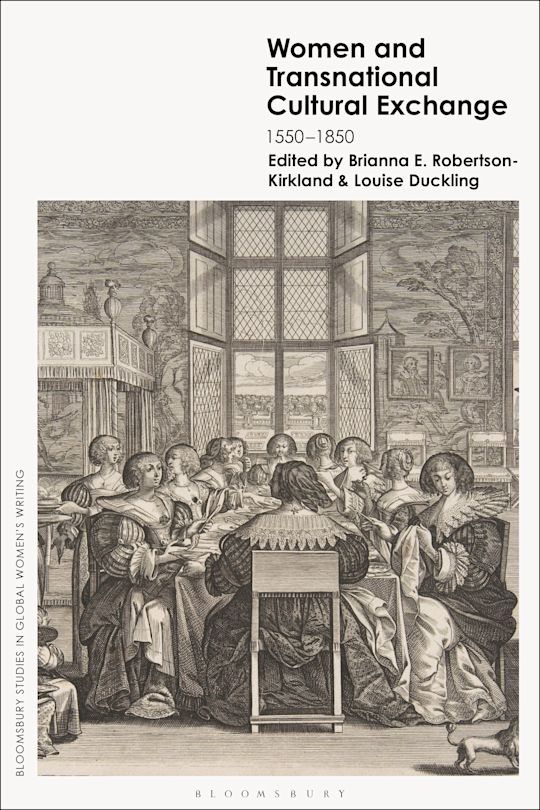
We are excited to announce the publication of a new collection of essays by WSG members, Women and Transnational Cultural Exchange, 1550–1850, edited by Brianna E. Robertson-Kirkland and Louise Duckling. Congratulations to everyone involved!
This multidisciplinary collection has been five years in the making. It was inspired by the group’s own transnational exchanges during the Covid-19 pandemic, when the move to an online space allowed deeper engagement with an international community of scholars.
Using a wide range of highly readable case studies, the authors respond to the following questions: How have women enabled the transfer of culture and ideas from one geographical region to another? What role did they play in facilitating connections and forms of exchange with and about other cultures and communities across the world?
Centuries-long biases have misrepresented women’s international influence, often by focusing on a narrow cast of women – most notably queens – and eliminating lesser-known women from the discussion entirely. The book’s prologue uses queens as case studies to explore how some of these traditional narratives of women on the international stage are being reimagined.
Individual stories are then grouped into four sections according to the category of exchange: culture, knowledge, art, and music. Each section opens with a concise essay or “postcard,” featuring an impactful image and short reflection to introduce the section’s theme. These concise and illustrated postcards provide additional insights and imaginative ways of thinking about women’s exchanges. A closing epilogue reflects on the powerful influence of women and storytelling across cultures and time. The book is published by Bloomsbury Academic and is available via all good bookstores.
***
Table of Contents
Introduction. Brianna E. Robertson-Kirkland (Royal Conservatoire of Scotland, UK) and Louise Duckling (independent scholar, UK)
Prologue. Power
Postcard 1: Queen Mary I and La Peregrina, Valerie Schutte (independent scholar, US)
1. Maria Theresa and Catherine II: Women rulers transmitting unexpected gender notions far beyond their realms, Ruth Dawson (University of Hawaii at Manoa, US)
Part 1. Culture
Postcard 2: The 188-page letter-memoir: Mary Anne Canning’s life writing as a defense of her motherhood, Rachel Bynoth (Bath Spa University, UK)
2. Imagining England: Recovering Marie-Catherine d’Aulnoy’s Memoirs of the court of England (1707), Daisy Winter (Northumbria University, UK)
3. The racial politics of the Chilean family in Maria Graham’s Journal of a Residence in Chile (1824), Valentina Aparicio (Queen Mary University of London, UK)
4. “Today, two vent’rous females spread the sail”: The presence of female travelers in the works of Mariana Starke, Eva Lippold (University of Reading, UK)
Part 2. Knowledge
Postcard 3: “A new world of ideas”: Knowledge exchange in Helen Maria Williams’s translation of Alexander von Humboldt’s Personal Narrative (1814–29), Louise Duckling (independent scholar, UK)
5. Madeleine de Scudéry, Aphra Behn, and translation: Using the “Carte de Tendre” for cross-channel communication of women’s ideas, Amelia Mills (Nottingham Trent University, UK)
6. “Suns, wich to some other Worlds give Light”: Transnational philosophies of the universe in Margaret Cavendish’s poems and letters, Masuda Qureshi independent scholar, UK)
7. Science, art, and knowledge: Nancy Anne Kingsbury Wollstonecraft and the illustration of Cuban flora, Elisa Garrido Moreno (Universidad Autónoma de Madrid, Spain)
Part 3. Art
Postcard 4: Collecting travel memories: Charlotte Bonaparte’s family album, Arlene Leis (independent scholar, UK)
8. Aletheia Talbot and the art of Italy: England’s first female collector, Breeze Barrington (independent scholar, UK)
9. Back through time and beyond Britain: Revealing polytheistic imagination and British imperial resolve in Eleanor Coade’s Artificial Stone products, 1769–1821, Miriam al Jamil (independent scholar, UK)
Part 4. Music
Postcard 5: Mrs Macglashan of Jamaica, Andrew Bull (independent scholar, UK)
10. “quite different from what it is abroad”: Elizabeth Wynne’s musical exchanges, Penelope Cave (independent scholar, UK)
11. The Murrays of Warrawang: Scots in Australia, Brianna E. Robertson-Kirkland (Royal Conservatoire of Scotland, UK)
Epilogue
Postcard 6: Felicia Hemans, the Monument of Zalongo, and the “dance” of a moment in history, Trijit Acharyya (independent scholar, India)
WSG members are also invited to our next reading group session on 5 February 2026, 7-8pm (GMT). We will be discussing Sarah Scott’s ‘A Description of Millenium Hall’ (1762) and details will be sent via our members’ mailing list.
 Women's Studies Group 1558 - 1837