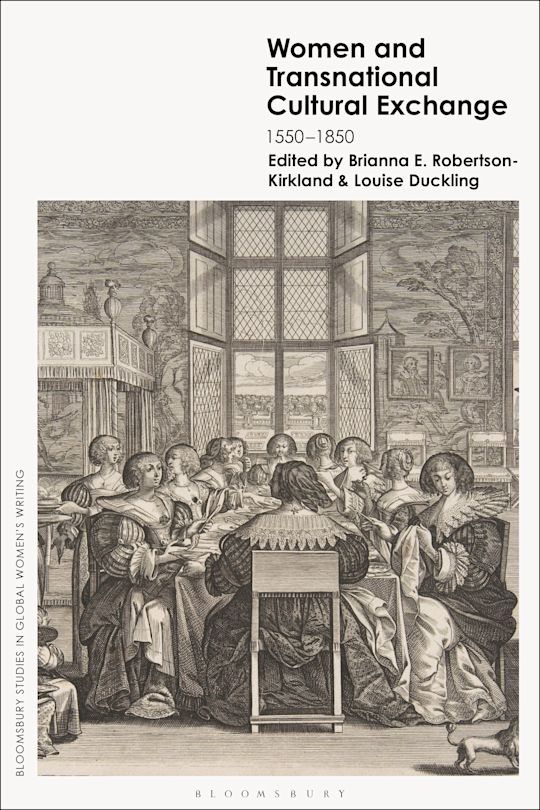
We are excited to announce the publication of a new collection of essays by WSG members, Women and Transnational Cultural Exchange, 1550–1850, edited by Brianna E. Robertson-Kirkland and Louise Duckling. Congratulations to everyone involved!
This multidisciplinary collection has been five years in the making. It was inspired by the group’s own transnational exchanges during the Covid-19 pandemic, when the move to an online space allowed deeper engagement with an international community of scholars.
Using a wide range of highly readable case studies, the authors respond to the following questions: How have women enabled the transfer of culture and ideas from one geographical region to another? What role did they play in facilitating connections and forms of exchange with and about other cultures and communities across the world?
Centuries-long biases have misrepresented women’s international influence, often by focusing on a narrow cast of women – most notably queens – and eliminating lesser-known women from the discussion entirely. The book’s prologue uses queens as case studies to explore how some of these traditional narratives of women on the international stage are being reimagined.
Individual stories are then grouped into four sections according to the category of exchange: culture, knowledge, art, and music. Each section opens with a concise essay or “postcard,” featuring an impactful image and short reflection to introduce the section’s theme. These concise and illustrated postcards provide additional insights and imaginative ways of thinking about women’s exchanges. A closing epilogue reflects on the powerful influence of women and storytelling across cultures and time. The book is published by Bloomsbury Academic and is available via all good bookstores.
***
Table of Contents
Introduction. Brianna E. Robertson-Kirkland (Royal Conservatoire of Scotland, UK) and Louise Duckling (independent scholar, UK)
Prologue. Power
Postcard 1: Queen Mary I and La Peregrina, Valerie Schutte (independent scholar, US)
1. Maria Theresa and Catherine II: Women rulers transmitting unexpected gender notions far beyond their realms, Ruth Dawson (University of Hawaii at Manoa, US)
Part 1. Culture
Postcard 2: The 188-page letter-memoir: Mary Anne Canning’s life writing as a defense of her motherhood, Rachel Bynoth (Bath Spa University, UK)
2. Imagining England: Recovering Marie-Catherine d’Aulnoy’s Memoirs of the court of England (1707), Daisy Winter (Northumbria University, UK)
3. The racial politics of the Chilean family in Maria Graham’s Journal of a Residence in Chile (1824), Valentina Aparicio (Queen Mary University of London, UK)
4. “Today, two vent’rous females spread the sail”: The presence of female travelers in the works of Mariana Starke, Eva Lippold (University of Reading, UK)
Part 2. Knowledge
Postcard 3: “A new world of ideas”: Knowledge exchange in Helen Maria Williams’s translation of Alexander von Humboldt’s Personal Narrative (1814–29), Louise Duckling (independent scholar, UK)
5. Madeleine de Scudéry, Aphra Behn, and translation: Using the “Carte de Tendre” for cross-channel communication of women’s ideas, Amelia Mills (Nottingham Trent University, UK)
6. “Suns, wich to some other Worlds give Light”: Transnational philosophies of the universe in Margaret Cavendish’s poems and letters, Masuda Qureshi independent scholar, UK)
7. Science, art, and knowledge: Nancy Anne Kingsbury Wollstonecraft and the illustration of Cuban flora, Elisa Garrido Moreno (Universidad Autónoma de Madrid, Spain)
Part 3. Art
Postcard 4: Collecting travel memories: Charlotte Bonaparte’s family album, Arlene Leis (independent scholar, UK)
8. Aletheia Talbot and the art of Italy: England’s first female collector, Breeze Barrington (independent scholar, UK)
9. Back through time and beyond Britain: Revealing polytheistic imagination and British imperial resolve in Eleanor Coade’s Artificial Stone products, 1769–1821, Miriam al Jamil (independent scholar, UK)
Part 4. Music
Postcard 5: Mrs Macglashan of Jamaica, Andrew Bull (independent scholar, UK)
10. “quite different from what it is abroad”: Elizabeth Wynne’s musical exchanges, Penelope Cave (independent scholar, UK)
11. The Murrays of Warrawang: Scots in Australia, Brianna E. Robertson-Kirkland (Royal Conservatoire of Scotland, UK)
Epilogue
Postcard 6: Felicia Hemans, the Monument of Zalongo, and the “dance” of a moment in history, Trijit Acharyya (independent scholar, India)
 Women's Studies Group 1558 - 1837